
Lecture
Pentagon dodecahedron (from Ancient Greek πενταγον — «pentagon» + δωδεκάεδρον — «twelve-faced») — a solid figure with twelve faces in the shape of irregular pentagons.
| Pentagon dodecahedron | |
|---|---|
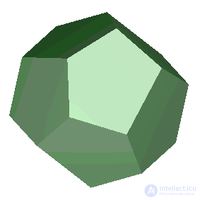 Face indices {2 1 0} |
|
| Type | Irregular polyhedron |
| Face | Irregular pentagon |
| Faces | 12 |
| Edges | 30 (6+24) |
| Vertices | 20 (8+12) |
| Faces at a vertex | 3 |
| Symmetry group | Tetrahedral (Th) |
| Dual polyhedron | — |
Belongs to the dodecahedra.
Visually it resembles the Platonic dodecahedron, but has tetrahedral rather than icosahedral symmetry.
The faces of the pentagon dodecahedron are irregular pentagons, symmetric with respect to a plane passing through the center of the figure.
Belongs to the point group Th or 
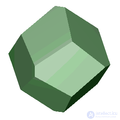
face indices {10 9 0}
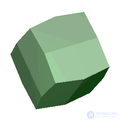
face indices {7 1 0}
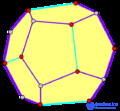
12 faces
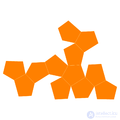
unfolded 12 faces
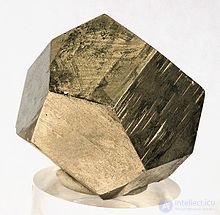
Pentagon dodecahedron (pentagon dodecahedron or dodecahedron — twelve-faced solid) — a closed twelve-faced solid with faces in the shape of pentagons with 4 equal sides and 1 unequal side .
One of the simple forms of crystals of the cubic system. It is a closed form consisting of 12 equal faces shaped like irregular pentagons . It is often found in pyrite crystals.

Comments