
Lecture
In ancient times the word "symmetry" was used in the sense of "harmony", "beauty". Indeed, translated from Greek, symmetry means "commensurability, proportionality, sameness in the arrangement of parts".
Since ancient times man has used symmetry in architecture. It lends harmony and completeness to ancient temples, the towers of medieval castles, and modern buildings.
Symmetry (Ancient Greek συμμετρία = «commensurability»; from συμ- «together» + μετρέω «I measure»), in a broad sense — correspondence, invariance, manifested under some changes or transformations (for example: of position, energy, information, or something else). Thus, for example, spherical symmetry of a body means that the appearance of the body will not change if it is rotated in space through arbitrary angles (keeping the center in place and provided the surface of the body is homogeneous). Two-sided symmetry means that the right and left sides relative to some plane look identical.
Symmetry is a fundamental principle of the self-organization of material forms in nature and of form-generation in art. The absence or violation of symmetry is called asymmetry or dissymmetry.
General symmetry properties are described by means of group theory.
Symmetries can be exact or approximate.
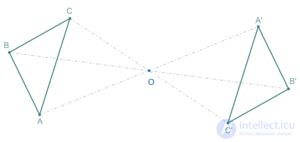
Two triangles with point symmetry of reflection in a plane. Triangle A’B’C can be obtained from triangle ABC by a rotation of 180 ° about point O.
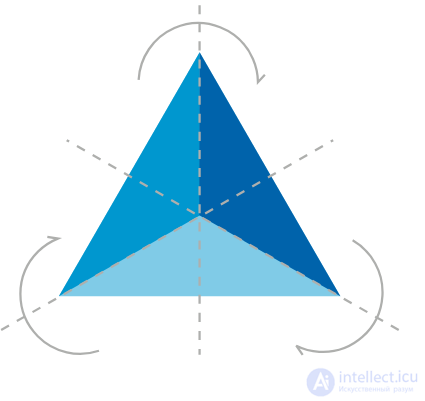
Geometric symmetry — this is the best-known type of symmetry for most people. A geometric object is called symmetric if, after it has been transformed geometrically, it retains some of its original properties. For example, a circle rotated about its center will have the same shape and size as the original circle. That is why the circle is called symmetric with respect to rotation (it has axial symmetry). The kinds of symmetry possible for a geometric object depend on the set of available geometric transformations and on which properties of the object must remain unchanged after the transformation.
Kinds of geometric symmetries:
Mirror symmetry or reflection— a motion of Euclidean space, the set of whose fixed points is a hyperplane (in the case of three-dimensional space — simply a plane). The term mirror symmetry is also used to describe the corresponding type of symmetry of an object, that is, when the object maps into itself under the operation of reflection. This mathematical concept in optics describes the relationship between objects and their (virtual) images upon reflection in a flat mirror. It manifests itself in many laws of nature (in crystallography, chemistry, physics, biology, etc., as well as in art and art history).
A figure is called symmetric with respect to line A if, for every point of the figure, the point symmetric to it with respect to line A also belongs to this figure.
Rotational symmetry — a term denoting the symmetry of an object with respect to all or some of the proper rotations of m-dimensional Euclidean space. Proper rotations are the kinds of isometries that preserve orientation. Thus, the symmetry group corresponding to rotations is a subgroup of the group E+(m) (see Euclidean group).
Translational symmetry can be regarded as a special case of rotational symmetry — rotation about a point at infinity. Under such a generalization, the rotational symmetry group coincides with the full E+(m). This kind of symmetry is not applicable to finite objects, since it makes the whole space homogeneous, but it is used in the formulation of physical laws.
The set of proper rotations about a fixed point of space forms the special orthogonal group SO(m) — the group of orthogonal m×m matrices with determinant equal to 1. For the particular case m = 3 the group bears a special name — the rotation group.
In physics, invariance with respect to the rotation group is called isotropy of space (all directions in space are equivalent) and is expressed in the invariance of physical laws, in particular the equations of motion, with respect to rotations. Noether's theorem relates this invariance to the existence of a conserved quantity (an integral of motion) — angular momentum.
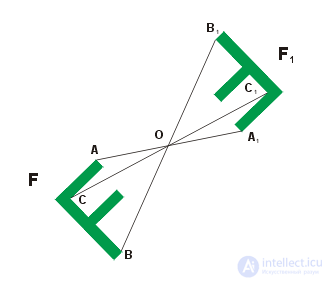
Central symmetry
Central symmetry (sometimes called central inversion) with respect to a point A is the transformation of space that carries a point X to a point X′ such that A is the midpoint of segment XX′. Central symmetry with center at point A is usually denoted by  , while the notation
  can be confused with axial symmetry. A figure is called symmetric with respect to point A if, for every point of the figure, the point symmetric to it with respect to point A also belongs to this figure. Point A is called the center of symmetry of the figure. It is also said that the figure possesses central symmetry. Other names for this transformation are symmetry with center A. Central symmetry in planimetry is a special case of rotation, more precisely, it is a rotation by 180 degrees.
Glide symmetry — an isometry of the Euclidean plane. Glide symmetry is the composition of symmetry with respect to some line  and a translation by a vector parallel to (this vector may also be zero). A glide symmetry can be represented as a composition of 3 axial symmetries (Chasles' theorem).
Types of symmetry encountered in mathematics and the natural sciences:
 (that is, bijections
  ) with respect to the operation of composition.

Comments