
Lecture
Measuring creative abilities using special tests. Guilford's tests became especially well known; he
saw the basis of creative intelligence in so-called divergent
thinking, i.e., the ability to give unexpected responses to a standard
test. Some of these tests include:
1. The ability to generate ideas. Task – write down as
many ideas as possible related to a given topic (for example –
work on the railway, in a hospital, in an orchestra). Another task – list uses for an ordinary brick and an ordinary wooden pencil. This same test can also assess spontaneous flexibility based on shifting an object from one class to another. For instance, a brick can be used in construction, but it can also be crushed into red powder for sprinkling on garden paths.
2. Associative fluency. Task – write synonyms for
each of the given words. For example, for the word «hard», possible
answers would be: heartless, inflexible, harsh, cold, firm,
strong, tough, strict, merciless, sharp.
3. Expressional fluency. Comparing some objects with others.
For example, women's clothing is like spring (a possible variant – it contains all the variety of spring colors).
4. Adaptive flexibility. The «Match Problem» test. Task – in
a set of adjoining squares made of matches,
one must remove several matches so that a specific number of squares results.
5. Originality. The «Plot Titles» test. Task – write titles for a short story. Only original
titles are counted, i.e., ones involving a shift or transfer of concepts that lead to unusual and new ideas.
6. Symbolic production. Task – devise simple symbols for objects or actions. Topics: «A person walking», «An airplane
taking off», «Anger», «Pride». The content of the topic must be expressed symbolically.
A literal depiction – for example, drawing a walking person – is not accepted.
7. Semantic elaboration. Task – for a given
symbol, propose several different professions or jobs such that
the symbol represents them. For example, a glowing light bulb might symbolize the profession of an electrical engineer, a night-shift
worker, or a missionary.
67
Torrance Tests
1. «Incomplete Figures». Six figures are given. The task is to complete
them so as to produce various objects or drawings,
preferably unusual ones. The subject must give their drawing a title.
2. «Imaginative Stories» – composing a story about the behavior
of an animal or a person with some kind of deviation (a dog that doesn't bark, a person who cries, a lion that doesn't roar, a flying monkey).
THE EPQ QUESTIONNAIRE (H. EYSENCK'S METHOD)
Scales: extraversion – introversion, neuroticism – stability,
psychoticism
PURPOSE OF THE TEST
The questionnaire is intended for studying individual
psychological personality traits in order to diagnose the degree to which properties considered essential components of personality are expressed: neuroticism, extraversion, introversion, and psychoticism.
The EPQ questionnaire includes 101 questions and contains the following four scales:
• extraversion – introversion;
• neuroticism – stability;
• psychoticism;
• a lie (sincerity) scale.
There is no time limit for answering, although it is not recommended to drag out the testing procedure.
Test instructions
You are asked to answer questions concerning your usual way of behaving. Try to picture typical situations and
give the first «natural» answer that comes to mind. If you
agree with a statement, put a «+» (yes) next to its number; if
not – put a «-» (no). Answer quickly and accurately. Remember that there are no «good» or «bad» answers.
68
TEST
1. Do you have many different hobbies?
2. Do you think things over before doing them?
3. Does your mood often go up and down?
4. Have you ever taken credit for something that someone else
actually did?
5. Are you a talkative person?
6. Would it worry you if you were in debt?
7. Have you ever felt
unhappy without any real reason?
8. Have you ever been greedy, wanting to get more than
you deserved?
9. Do you lock your door carefully at night?
10. Do you consider yourself a cheerful person?
11. Would it upset you greatly to see a child or an animal suffer?
12. Do you often worry about
things you should not have done or said?
13. Do you always keep your promises, even if it is
very inconvenient for you personally?
14. Would you enjoy
parachute jumping?
15. Can you let yourself go and enjoy yourself thoroughly at a lively
party?
16. Are you an irritable person?
17. Have you ever blamed someone for something that was really
your own fault?
18. Do you like meeting new people?
19. Do you believe in the value of insurance?
20. Are your feelings easily hurt?
21. Are all your habits good and desirable ones?
22. Do you tend to keep in the background on social occasions?
23. Would you take drugs which may have strange or dangerous effects (alcohol, narcotics)?
24. Do you often feel fed up?
25. Have you ever taken anything (even a pin or a button) that belonged to
someone else?
26. Do you like going out a lot and being in company often?
27. Does it please you to hurt those you love?
28. Are you often troubled by feelings of guilt?
29. Have you ever talked about things you know nothing about?
30. Do you generally prefer reading to meeting people?
31. Do you have any enemies who clearly wish you harm?
32. Would you call yourself a nervous person?
69
33. Do you always apologize when you have been rude to someone?
34. Do you have many friends?
35. Do you enjoy practical jokes and pranks that could sometimes
really hurt people?
36. Are you a worrier?
37. As a child, did you always do as you were told
immediately and without grumbling?
38. Would you call yourself a carefree person?
39. Do good manners and cleanliness matter a lot to you?
40. Do you worry about awful things that
might happen but never do?
41. Have you ever broken or lost something belonging to someone else?
42. Are you usually the one to make the first move when
getting to know people?
43. Can you easily understand another person's feelings if they share their troubles with you?
44. Are your nerves often stretched to their limit?
45. Would you leave litter lying around if there were no bin at hand?
46. Are you rather quiet when among other people?
47. Do you think marriage is old-fashioned and should be abolished?
48. Do you sometimes feel sorry for yourself?
49. Do you sometimes boast a lot?
50. Can you easily liven up a rather dull party?
51. Do careful drivers annoy you?
52. Do you worry about your health?
53. Have you ever said anything bad about another person?
54. Do you like telling jokes and funny stories to your friends?
55. Do most foods taste the same to you?
56. Do you sometimes get into a bad mood?
57. Were you ever cheeky to your parents as a child?
58. Do you like mixing with people?
59. Does it worry you if you find out you have made mistakes in your work?
60. Do you suffer from insomnia?
61. Do you always wash your hands before eating?
62. Are you the kind of person who is never at a loss for words?
63. Do you prefer to arrive at appointments a little
early?
64. Do you feel apathetic or tired for no particular reason?
65. Do you love talking so much that you never miss a chance
to speak with a new person?
66. Have you ever cheated at a game?
67. Is (or was) your mother a good person?
68. Does life often seem terribly dull to you?
70
69. Have you ever taken advantage of another person's mistake for
your own benefit?
70. Do you often take on more than there is time for?
71. Are there people who try to avoid you?
72. Are you very concerned about your appearance?
73. Are you always polite, even to unpleasant people?
74. Do you think people spend too much time
securing their future by saving money, taking out insurance, and so on?
75. Have you ever wished you were dead?
76. Would you try to avoid paying tax on extra income if you were certain that you would never be found out?
77. Can you liven up a party?
78. Do you try not to be rude to people?
79. Do you dwell for a long time on an embarrassing experience?
80. Have you ever insisted on having your own way?
81. Do you often arrive at the station at the last minute before the train leaves?
82. Have you ever deliberately said something
unpleasant or hurtful to someone?
83. Have your nerves ever bothered you?
84. Are you uncomfortable being around people who tease their friends?
85. Do you easily lose friends through your own fault?
86. Do you often feel lonely?
87. Do your words always match your deeds?
88. Do you sometimes enjoy teasing animals?
89. Are you easily hurt by remarks about you personally or your
work?
90. Would you find life without any danger too dull for you?
91. Have you ever been late for an appointment or work?
92. Do you like a lot of bustle and excitement around you?
93. Do you want people to be afraid of you?
94. Is it true that you are sometimes full of energy, with everything
going full speed, and sometimes quite sluggish?
95. Do you sometimes put off until tomorrow what you should do today?
96. Do people think of you as lively and cheerful?
97. Are you often told untrue things?
98. Are you very sensitive to certain events, phenomena, or things?
99. Are you always willing to admit your mistakes?
100. Have you ever felt sorry for an animal caught in a trap?
101. Did you find it hard to fill out this questionnaire?
71
PROCESSING AND INTERPRETING TEST RESULTS
Answer key
1. Extraversion–introversion scale:
• «no» (-) answers: 22, 30, 46, 84;
• «yes» (+) answers: 1, 5, 10, 15, 18, 26, 34, 38, 42, 50, 54, 58, 62, 65, 70, 74, 77,
81, 90, 92, 96.
2. Neuroticism scale:
• «yes» (+) answers: 3, 7, 12, 16, 20, 24, 28, 32, 36, 40, 44, 48, 52, 56, 60, 64, 68,
72, 75, 79, 83, 86, 89, 94, 98.
3. Psychoticism scale:
• «no» (-) answers: 2, 6, 9, 11, 19, 39, 43, 59, 63, 67, 78, 100;
• «yes» (+) answers: 14, 23, 27, 31, 35, 47, 51, 55, 71, 85, 88, 93, 97.
4. Lie (sincerity) scale:
• «no» (-) answers: 4, 8, 17, 25, 29, 41, 45, 49, 53, 57, 66, 69, 76, 80, 82, 91, 95;
• «yes» (+) answers: 13, 21, 33, 37, 61, 73, 87, 99.
The obtained answers are compared against the «key». For an answer
matching the key, 1 point is awarded; for one not matching
the key – 0 points. The points obtained are then summed.
Average scores on the extraversion–introversion scale: 7–15 points.
High scores on the extraversion–introversion scale correspond to the extraverted type, low scores – to the introverted type.
Average scores on the neuroticism scale: 8–16.
A result below 8 points indicates the person's emotional
stability, while above 16 indicates emotional instability (neuroticism).
Average values on the psychoticism scale: 5–12.
People scoring above 10 points are not recommended to work in "person-to-person" occupations (see below). H. Eysenck viewed the structure of
personality as consisting of three factors.
72
I. Extraversion – introversion.
Characterizing the typical extravert, the author notes their sociability and
outward orientation, wide circle of acquaintances, and need for
contacts. The typical extravert acts on the impulse of the moment, is impulsive and quick-tempered. They are carefree, optimistic, good-natured, and cheerful.
They prefer movement and action, and tend toward aggressiveness.
Feelings and emotions are not strictly controlled, and they are inclined toward risky
actions. They cannot always be relied upon.
The typical introvert is a calm, shy person, inclined toward
introspection. They are reserved and distant from everyone except close friends. They plan
and think their actions through in advance, distrust sudden impulses, take decision-making seriously, and like order in everything. They control their feelings and are not easily provoked. They tend toward pessimism and highly value moral standards.
II. Neuroticism (emotional stability).
Characterizes emotional stability or instability. According to some
data, neuroticism is linked to indicators of the lability of the nervous system.
Emotional stability – a trait expressing the maintenance of organized behavior and situational purposefulness in both ordinary and stressful situations. An emotionally stable person is characterized by maturity, excellent adaptation, the absence of significant tension or anxiety, as well as a tendency toward leadership and sociability.
Emotional instability, or neuroticism, is expressed in extreme
nervousness, instability, poor adaptation, a tendency toward rapid
mood swings (lability), feelings of guilt and anxiety, worry, depressive reactions, scattered attention, and instability in stressful situations.
Neuroticism is associated with emotionality, impulsiveness; unevenness
in contacts with people, changeable interests, self-doubt, pronounced sensitivity, impressionability, and a tendency toward irritability. A neurotic personality is characterized by inadequately strong reactions to the stimuli that provoke them. In people with high scores on the neuroticism scale, unfavorable stressful
situations can lead to the development of a neurosis.
73
III. Psychoticism.
This scale reflects a tendency toward antisocial behavior, eccentricity,
inadequacy of emotional reactions, high conflict-proneness, unsociability, egocentrism, selfishness, and indifference.
According to H. Eysenck, high scores on extraversion and neuroticism
correspond to a psychiatric diagnosis of hysteria, while high scores
on introversion and neuroticism correspond to a state of anxiety or reactive depression.
When pronounced, neuroticism and psychoticism are understood as a «predisposition» to the corresponding types of pathology.
Drawing on data from the physiology of higher nervous activity, H. Eysenck
hypothesizes that the strong and weak types described by I.P. Pavlov
are very close to the extraverted and introverted personality types. The nature of introversion and extraversion is seen as rooted in the innate
properties of the central nervous system that ensure the balance of the processes of excitation and inhibition. In H. Eysenck's view,
personality traits such as extraversion–introversion and neuroticism–stability are orthogonal, i.e., statistically independent of one another.
Accordingly, H. Eysenck divides people into four types, each of which represents a particular combination of a high or low score in the
range of one trait together with a high or low score in the range of the other. Thus, using data from testing on the
extraversion–introversion and neuroticism–stability scales, one can derive indicators of personality temperament according to I.P. Pavlov's classification, who
described four classic types:
• sanguine (characterized, in terms of the basic properties of the central nervous system, as strong, balanced, and mobile);
• choleric (strong, unbalanced, mobile);
• phlegmatic (strong, balanced, inert);
• melancholic (weak, unbalanced, inert).
A "pure" sanguine person adapts quickly to new conditions, quickly gets along with people, and is sociable. Feelings arise easily and change readily,
and emotional experiences are, as a rule, not deep. Facial expressions are rich,
mobile, and expressive. They are somewhat restless, need new
impressions, do not sufficiently regulate their impulses, and are unable to strictly
adhere to an established daily routine or a system in their work. As a
74
result, they cannot successfully carry out tasks that require an even expenditure
of effort, prolonged and methodical exertion, perseverance, sustained
attention, or patience. In the absence of serious goals, deep thoughts,
or creative activity, superficiality and inconstancy develop.
The choleric person is distinguished by heightened excitability, and their actions are jerky.
They are characterized by abruptness and swiftness of movement, strength, impulsiveness, and vivid emotional experiences. Because of their lack of balance, once absorbed in a task, they tend to act with all their strength,
exhausting themselves more than they should. Given social interests, their temperament shows itself in initiative, energy, and adherence to principle. In the
absence of a rich inner life, the choleric temperament often shows itself
in irritability, emotional excess, lack of restraint, quick temper,
and an inability at self-control under emotional circumstances.
The phlegmatic person is characterized by a comparatively low level of behavioral
activity; new forms of behavior develop slowly in them, but are then stable. They are marked by slowness and calm in actions, facial expressions, and speech, and by evenness, constancy, and depth of feelings and moods.
A persistent and diligent "worker of life," they rarely lose their temper, are not
prone to emotional outbursts, and, having weighed their strength, see things through to the end; they are even in their
relationships, moderately sociable, and dislike idle chatter. They conserve their strength and do not waste it needlessly. Depending on conditions, in some cases a
phlegmatic person may display "positive" traits: composure, depth of thought, constancy, thoroughness, and so on; in others –
sluggishness, indifference to their surroundings, laziness and lack of willpower, poverty and weakness of emotion, and a tendency to perform only habitual actions.
In the melancholic person, the reaction often does not match the strength of the stimulus; there is depth and stability of feeling combined with weak outward expression of it. They
find it hard to concentrate on something for long. Strong influences often produce in the melancholic a prolonged inhibitory reaction ("their hands drop"). They are characterized by restraint and subdued movement and
speech, shyness, timidity, and indecisiveness. Under normal conditions,
the melancholic is a deep, substantial person who can be a good
worker and successfully cope with life's tasks. Under unfavorable conditions, they may turn into a withdrawn, fearful, anxious, and vulnerable person, prone to severe inner suffering
over life circumstances that do not really deserve it.
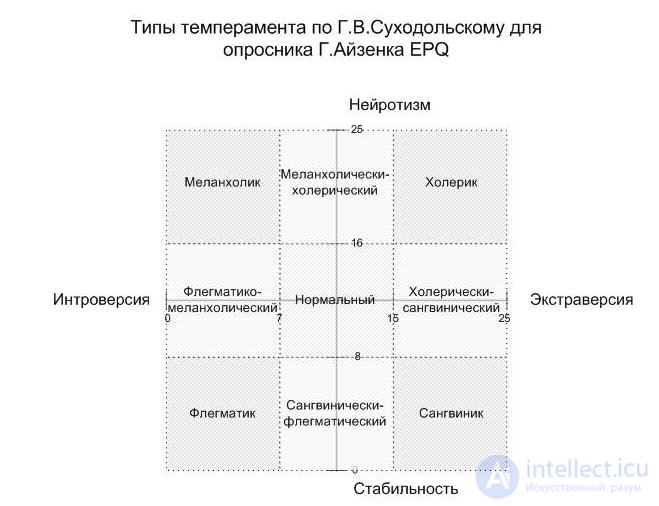
As a rule, one should speak of a predominance of certain
temperament traits, since they are rarely found in pure form in real life.
This is precisely why G.V. Sukhodolsky believes it is necessary to distinguish not
four ("pure" types are an abstraction), but nine personality types: the norm
and eight accentuations. In addition to the four "pure" types,
G.V. Sukhodolsky proposed four "intermediate" ones:
1. choleric-sanguine,
2. sanguine-phlegmatic,
3. phlegmatic-melancholic,
4. melancholic-choleric,
5. the normal type.
According to G.V. Sukhodolsky, H. Eysenck's typology can be represented
as a matrix, whose rows characterize orientation (introversion; average values; extraversion), whose columns correspond to levels
of emotional stability (neuroticism; average values; stability), and whose elements are the statistically normal type and types deviating
from it.

Comments