
Lecture
Methodological guidelines. In covering the energetic aspects of communication, it is necessary to consider it as a process of energetic exchange of conscious and unconscious, verbal and nonverbal messages. «Not my kind of» artistic work, a «difficult person,» a «difficult hall» from an energetic point of view. Provide examples and counter-examples of communication between musicians of various eras with their colleagues
The consciousness of «homo creantem,» the creating human being, is a special form of human consciousness directed toward creation, the transformation of the surrounding world, and self-realization through creativity. Unlike ordinary or reproductive consciousness, the consciousness of the creating person is characterized by the active generation of new ideas, forms, and meanings, the ability to overcome habitual patterns of thought, and the capacity to create qualitatively new products — whether in the sphere of art, science, technology, or interpersonal relations. This type of consciousness manifests itself not only in individual acts of creation but also in a constant state of intellectual and emotional activity, a striving for self-development, and the expansion of the boundaries of one's own experience.
The activity of the creating person is multidimensional and includes various forms of interaction with the world, with other people, and with oneself. The main types of this activity can conventionally be divided into creative, transformative, and reflective. Creative activity is aimed at forming new objects, structures, or meanings, the result of which is an explicit or tangible work. Transformative activity is expressed in the ability to modify what already exists, to adapt it to new conditions, or to combine elements of prior experience in new combinations. Reflective activity presupposes the inner work of consciousness — the analysis of one's own thoughts, the evaluation of actions, the search for new perspectives, and ways of self-realization.
A special place in understanding the consciousness of homo creantem is occupied by the levels of dialogical relations. Human creativity cannot be regarded as a fully isolated process, since it always develops in interaction with the external environment and other subjects. The first level of dialogical relation is the inner dialogue that occurs between different aspects of one's own «self»: the rational and the emotional, the conscious and the subconscious, current experience and imagination. It is precisely the inner dialogue that ensures the synthesis of new ideas, allows hidden possibilities to be discovered, and determines the optimal courses of action.
The second level of dialogical relation is interpersonal dialogue. Human creativity is closely tied to the exchange of ideas, joint work, discussion, and criticism. At this level, interaction with other people stimulates the broadening of horizons, allows different points of view to be taken into account, and enables the creation of more complex, multilayered works. The social environment and cultural context act as a kind of mirror in which individual creative impulses are reflected, allowing them to be transformed and developed.
The third level of dialogical relation can be called transcendent or cultural. It is manifested in a person's relation to universal human values, traditions, universal meanings, and ideals. At this level, the consciousness of the creating person enters into dialogue with historical and cultural heritage, reinterprets it, and contributes to its development. Through this dialogue, creativity becomes not only individual but also collective, a part of the cultural and intellectual evolution of society.
In the context of the consciousness of «homo creantem,» the types of dialogical relations can be classified as follows:
Inner dialogue
This is a dialogue within the person themselves, between different aspects of their consciousness: the rational and the emotional, current experience and imagination, the conscious and the subconscious.
Functions: stimulates the generation of new ideas, ensures self-reflection, helps resolve inner contradictions.
Example: a writer discusses with themselves which plot to choose or how best to express an idea.
Interpersonal dialogue
This is interaction with other people: discussions, criticism, joint work, exchange of experience.
Functions: broadens the horizons of perception, allows different points of view to be taken into account, stimulates collective creativity.
Example: a scholarly discussion among colleagues, the joint work of a visual artist and a musician on a project.
Dialogue with cultural and historical heritage (transcendent dialogue)
This is a person's interaction with the culture, traditions, values, and ideals of society.
Functions: reinterpreting and developing cultural heritage, creating meanings that go beyond personal experience.
Example: a composer uses motifs of folk music, reworking them into a contemporary composition; a philosopher carries on a dialogue with the ideas of past thinkers.
Dialogue with the natural environment
Interaction with the surrounding natural and material environment, through which a person perceives, transforms, and comprehends reality.
Functions: inspiration for creativity, the formation of new ideas through the experience of contact with the world.
Example: an architect studies the terrain and climate of a location in order to create a unique building that fits organically into its surroundings.
Dialogue with the work itself (object dialogue)
This is a special kind of dialogue in which a person «converses» with an already created product or idea, evaluating, correcting, and developing it.
Functions: improving the result, deepening understanding of what has been created, identifying new possibilities.
Example: a painter returns to a picture already painted, makes changes, and discovers new meanings.
These types of dialogical relations often intersect and mutually reinforce one another, forming the dynamic consciousness of the creating person.
Thus, the consciousness of homo creantem is a dynamic system in which types of activity and levels of dialogical relations mutually enrich one another. Creative activity stimulates inner and outer dialogues, and dialogical interactions, in turn, generate new ideas and forms of activity. Understanding this structure allows for a deeper awareness of the nature of human creativity, its role in personal self-realization, and in the development of society. The consciousness of the creating person is not limited to simply creating something new; it expresses a special philosophical stance — a person's striving for harmony, meaning, and the transformation of the world through their own active participation.
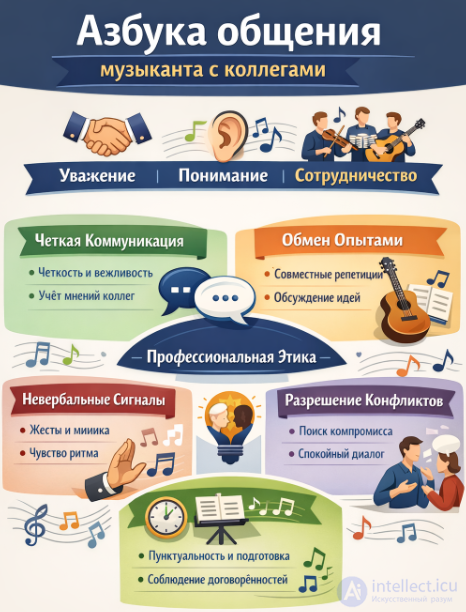
The «ABCs of a musician's communication with colleagues» is a set of principles and rules that help musicians interact effectively in creative and professional processes.
A musician's communication with colleagues rests on three fundamental foundations: respect, understanding, and cooperation. First and foremost, respect presupposes an attentive attitude toward the personality of each participant, toward their experience, performance style, and creative ideas. Even when disagreements arise, the musician must remain courteous, avoid imposing their position, and be ready to compromise.
Understanding means the ability to listen and to hear others: not only to take in words but also to sense musical intonations, emotional shades, and nonverbal signals. It is extremely important for a musician to develop empathy and the capacity for a shared sense of rhythm, harmony, and dynamics. This creates an atmosphere of mutual trust and eases the process of joint creativity.
Cooperation manifests itself through active participation in shared projects, joint planning of rehearsals, and the exchange of experience and ideas. Every musician must be ready to adapt to colleagues, to adjust their own style, and to contribute to the common goal, whether that is preparing a concert, recording an album, or an improvisational session.
The ABCs of communication also include specific practical skills: expressing one's ideas clearly and respectfully, the ability to give and receive constructive criticism, readiness for dialogue and discussion, and the capacity for self-criticism. It is important to maintain professional ethics: arriving on time, being prepared, honoring agreements, and showing discipline in collective work.
Special attention is paid to nonverbal communication. A musician reads and conveys information through gestures, facial expressions, posture, breathing, and the dynamics of playing. The ability to «hear» colleagues at this level speeds up synchronization within an ensemble and raises the artistic quality of the performance.
Finally, an integral part of the ABCs of communication is the ability to resolve conflicts. Disagreements over interpretation, tempo, style, or repertoire are inevitable within a group. Effectively resolving conflicts requires patience, diplomacy, and an orientation toward the shared result rather than personal superiority.
Thus, the ABCs of a musician's communication with colleagues is a combination of ethical, communicative, and professional rules that ensure harmonious interaction, fruitful cooperation, and a high quality of musical creativity. Mastering these ABCs is an important part of every musician's professional development and the key to successful collective activity.
A musician's business communication is a special form of professional interaction aimed at organizing, coordinating, and successfully carrying out musical projects. Unlike creative communication, which is oriented toward the joint creation of music and the exchange of ideas, business communication is built on the principles of professionalism, precision, responsibility, and the honoring of agreements.
The main aspects of a musician's business communication include:
Planning and coordination
The musician takes part in organizing rehearsals, concerts, album recordings, and other events.
The exchange of information about time, place, technical requirements, repertoire, and tasks ensures effective joint interaction.
Negotiation and contracting
The musician discusses the terms of performances, payment, copyright, licenses, and participation in projects.
The ability to formulate one's requirements competently, listen to the counterparty, and reach mutually beneficial agreements is important.
Documentation and reporting
Business communication makes use of contracts, schedules, technical specifications, and reports.
This ensures legal protection and transparency of cooperation.
Professional ethics and communication
Timeliness, punctuality, correctness, honoring agreements, and respect for partners are key.
The ability to express one's thoughts clearly and correctly reduces the risk of misunderstanding and conflict.
Conflict resolution and critical feedback
Business communication includes constructive criticism, discussion of problematic situations, and the search for compromise.
It is important not to shift to personal judgments and to maintain a businesslike tone.
Networking and promotion
The musician maintains business contacts with organizers, producers, colleagues, and the media.
Business communication contributes to the expansion of professional opportunities, cooperation, and the realization of projects.
Overall, a musician's business communication is a combination of organizational, legal, communicative, and ethical skills. It ensures the successful functioning of musical activity, career development, and the stability of professional relationships.
A musician's relationship with a client is an important aspect of professional activity that directly affects the success of creative projects, the quality of performance, and the performer's reputation. In today's musical world, the role of the musician extends beyond purely artistic mastery — the ability to build constructive and trusting interaction with a client, whether an individual, an organization, or a group, becomes important. The foundation of these relationships is professionalism, encompassing both performance skills and communicative abilities.
At the first stage of communication with a client, understanding their needs and expectations plays an important role. A musician must be able to ask precise questions, identify the specifics of the event, its format, its audience, as well as the technical and organizational requirements. A clear understanding of these parameters helps avoid misunderstandings and builds trust between the parties. It is important to be attentive to detail and to demonstrate readiness for dialogue, which raises the level of professional perception of the musician.
No less significant is clarity and transparency in discussing the terms of cooperation. The musician must clearly explain the cost of services, the timeline for preparation, possible additional expenses, and the particulars of the performance. In such matters it is useful to agree in advance on all details: repertoire, format of the performance, technical equipment, and any additional wishes of the client. This minimizes conflicts and misunderstandings and creates an atmosphere of mutual respect.
The practice of a musician's communication with a client includes the ability to respond correctly to criticism and suggestions. A client often gives instructions on changing the program or the interpretation of works, based on their own ideas about the event. Here the musician's ability to adapt flexibly, without losing their professional standing and artistic individuality, is important. Effective communication requires the ability to explain one's creative decisions with reasoned arguments, to find compromises, and to maintain a constructive tone in the dialogue.
Special attention should be paid to ethics and the culture of communication. Mutual respect, attentiveness to the client's needs, and correct behavior create a positive impression of the musician and increase the likelihood of repeat cooperation. Moreover, the ability to listen and show empathy helps build long-term professional connections, which often turn out to be more important than a single fee.
In today's music business, the significance of digital communications is also growing. Many negotiations and interactions take place through email, messaging apps, and social media. Here it is important to maintain promptness and precision of messages, as well as to adhere to a businesslike style of communication. A musician must be able to formulate their thoughts clearly, competently, and persuasively, creating a professional image even in the virtual environment.
Thus, a musician's relationship with a client is a multifaceted process combining artistic mastery and professional communication skills. Successful interaction practice requires attentiveness to detail, transparency of terms, flexibility in decision-making, and the ability to build trusting relationships. Developing these competencies contributes not only to the successful realization of musical projects but also to strengthening the musician's reputation, expanding the circle of professional contacts, and increasing the satisfaction of both parties in the cooperation.
The energetic aspects of a musician's communication with others — including colleagues, listeners, and clients — play an extremely important role in the process of musical activity. Music itself is a form of energetic communication, through which the performer conveys not only sounds but also emotional states, mood, and the inner content of the work. A musician's energy is manifested in their inner state, emotional stability, concentration, and the ability to manage their emotional and physical energy during interaction with the audience.
The first important point is the musician's energetic preparation before a performance or a meeting with a client. A state of inner harmony, confidence, and focus allows the musical intent to be conveyed as effectively as possible and helps establish contact with the audience. On the practical level, this includes breathing exercises, tuning one's attention, and working with bodily and emotional relaxation. The purer and more balanced the musician's energetic flow, the easier the interaction with the client, colleagues, or listeners becomes.
Interaction with a client also has an energetic aspect. The energetics of communication are manifested through verbal and nonverbal signals: tone of voice, pace of speech, gestures, gaze, and overall emotional state. A musician with heightened energetic sensitivity is able to read the client's mood and expectations, adjust their own behavior and emotional tuning, and create an atmosphere of trust. It is important that energy not only emanate from the musician but also «resonate» with the energy of the interlocutor, which increases the effectiveness of communication.
Energetics is also manifested in the process of performing music. Every contact with an audience or a client is an exchange of energy, in which the musician transmits their emotions and the recipient reacts to them. Conscious management of this energetics allows the emotional impact of a work to be intensified, emotional contact to be established, and listeners' engagement to be maintained. In practice, this requires control over tension, the dynamics of the performance, and the ability to shift the energetic flow depending on the situation.
In addition, an important aspect is the musician's energetic protection. In professional activity, situations arise in which it is necessary to maintain inner stability in the face of criticism, a negative audience reaction, or overload. The ability to manage one's own energetic resources, to alternate periods of activity and recovery, and to maintain emotional balance contributes to preserving productivity and professional health.
Thus, the energetic aspects of a musician's communication represent an integration of inner state, emotional sensitivity, and the ability to interact with other people at the level of energy. Developing these skills ensures deeper communication, strengthens trust in relationships with clients and listeners, and contributes to the harmonious realization of the musical intent. A musician's energetic literacy becomes an inseparable part of professionalism, influencing the effectiveness of interaction, the quality of performance, and the emotional impact of works.
A musician's communication with colleagues is an inseparable part of professional musical activity and directly affects the quality of joint work, the creative atmosphere, and professional development. Interaction with other musicians can take place at various levels: from rehearsal work and joint performance of works to discussing professional matters, exchanging experience, and participating in musical projects. Effective communication in this context requires a combination of musical mastery, communicative skills, and emotional sensitivity.
At the first stage of interacting with colleagues, clarity of goals and objectives for the joint activity is important. A musician must be able to clearly express their ideas and suggestions regarding performance and interpretation of works, and also to listen to and take into account the opinions of other participants. In this process, respect and readiness for compromise are especially important, since each side brings their own skills, style, and individual perception of music to the work. Constructive dialogue helps avoid conflicts, increases the effectiveness of rehearsals, and improves the quality of joint performance.
The emotional and energetic component of communication plays a key role. Mutual trust, support, and attentiveness to colleagues' emotional state contribute to creating a harmonious creative atmosphere. A musician who knows how to work with the energetics of a group is able to strengthen the overall dynamics of the performance and sustain the motivation and inspiration of the participants, which is especially important in ensembles and orchestras. In practice, this is expressed through attentive listening, correct remarks, benevolent criticism, and readiness to help colleagues master difficult parts of the repertoire.
Joint work with colleagues also requires a high level of professionalism in communication. This includes the ability to agree on the distribution of roles, repertoire, and rehearsal schedules, and to maintain discipline and punctuality. Online platforms and messaging apps today make it possible to exchange information effectively, share sheet music materials, and coordinate organizational matters, but it is important to maintain a respectful and businesslike tone so as not to create misunderstandings.
In addition, communication with colleagues contributes to professional growth and the broadening of musical horizons. The exchange of experience, joint discussion of performance technique, methods of interpretation, and creative ideas helps develop skills, find new approaches to music, and inspires experimental projects. Such interactions form a network of professional contacts that can be useful for future projects, concerts, and cooperation with clients.
Thus, a musician's communication with colleagues is a multifaceted process uniting professional, emotional, and organizational aspects. Effective interaction contributes to raising the quality of performance, strengthening creative bonds, developing professional competence, and creating a harmonious atmosphere within the musical ensemble. The ability to build trusting, constructive, and supportive relationships with colleagues is an important element of a musician's professionalism and a key factor in successful musical activity
A musician's professional relationships with colleagues, clients, and the audience can take various forms — from constructive, supportive cooperation to conflictual and destructive interaction. Understanding the differences between healthy and unhealthy forms of communication is an important aspect of professionalism, since it directly affects the quality of work, emotional state, and career development.
Healthy forms of professional relationships are characterized by mutual respect, trust, openness to dialogue, and support. In such relationships, each side values the other's contribution, listens actively, takes into account the opinions of colleagues and clients, and is ready for constructive criticism. The musician takes responsibility for their actions, honors agreements, and maintains discipline and professional standards. These relationships contribute to effective joint work, creative growth, a strengthened professional reputation, and a positive atmosphere within the group. Examples of healthy forms of interaction include joint discussion of repertoire, mutual assistance in preparing for performances, honest and respectful discussion of financial and organizational matters, and support for colleagues in stressful situations.
Unhealthy forms of professional relationships manifest themselves in conflict, manipulation, lack of respect, distrust, and aggressive behavior. In such situations, interaction is characterized by the absence of open communication, a striving for dominance or submission, criticism that is not aimed at development, and the violation of agreements. Unhealthy relationships can arise from competition, excessive ambition, a lack of professional culture, or emotional instability. The consequences of such interactions manifest themselves in a decline in the quality of performance, growing tension within the group, emotional burnout, and a deteriorating reputation for the musician. Examples of unhealthy forms include constant criticism without a constructive purpose, ignoring colleagues' opinions, pressure on the performer from a client, and manipulation or attempts by others to control the creative process.
It is important for a musician to have the skills to recognize and manage these forms of relationship. Developing emotional intelligence, communicative skills, the capacity for self-regulation, and professional ethics makes it possible to maintain a healthy atmosphere, reduce conflicts, and minimize the negative influence of unhealthy interactions. In addition, a professional must be able to set boundaries in a timely manner, correctly express their needs, and protect their rights without infringing on the interests of colleagues and clients.
Thus, understanding the differences between healthy and unhealthy forms of professional relationships is a key element of a successful musical career. Healthy relationships create the conditions for creative development, effective cooperation, and emotional well-being, whereas unhealthy forms of interaction undermine professional and personal resources, hinder quality performance, and damage a positive reputation. The conscious building of professional connections, respect for oneself and others, and openness and constructiveness in communication become the foundation for the sustainable and successful development of a musician in the professional environment.

Comments