
Lecture
Outline
Music psychology studies how a person perceives, interprets, and emotionally reacts to music.
One of the key approaches is the use of neurocognitive models, such as Adaptive Resonance Theory (ART), developed by Stephen Grossberg and Gail Carpenter.
A dual stream of information processing:
Bottom-up stream — sensory data (sounds, rhythms, timbres).
Top-down stream — expectations and prototypes stored in memory.
Resonance: occurs when sensory data matches internal expectations.
Vigilance threshold: if the difference between expectation and perception does not exceed a certain level, the stimulus is classified as familiar.
Melody recognition:
A listener recognizes a familiar melody even if it is performed in a different key or timbre.
ART explains this through the mechanism of matching the sensory signal against prototypes in memory.
Musical memory:
Storing musical images (motifs, rhythms) as categories.
On repeated perception, resonance occurs between the new signal and the stored prototype.
Emotional response:
A match between expectations enhances the feeling of pleasure.
A violation of expectations (for example, dissonance) causes tension, but can lead to new learning.
Learning music:
ART helps explain how learners gradually recognize musical structures.
Improvisation:
The musician creates new combinations, and the listener adapts their expectations.
Music therapy:
Using familiar melodies to activate memory and emotional resonance in patients.
| Model | Basic idea | Application in music |
|---|---|---|
| ART | Matching sensory data and expectations | Recognizing melodies, forming categories |
| Associative models | Linking stimuli through repetition | Learning musical skills |
| Prediction theory | The brain forecasts the development of a musical phrase | Emotional reactions to unexpected chords |
Adaptive Resonance Theory is a universal model that explains the stability of musical perception.
It shows that music is perceived not merely as a stream of sounds, but as a structured experience based on the interaction of memory and sensory input.
In music psychology, ART helps to understand why music evokes strong emotions and how musical competence is formed.
Music psychology investigates how a person perceives, interprets, and emotionally reacts to music. One interesting concept that can be used to describe features of perception is «bright spots» — moments or elements of a musical work that stand out against the general sound and attract the listener's attention.
Visual metaphor: the term is borrowed from the psychology of perception, where «bright spots» denote areas of increased light intensity.
In music: these are sound accents, emotional flashes, or structural elements that are perceived as especially significant.
Psychological effect: such moments are fixed in memory and form the «nodes» of the musical experience.
Cognitive processes: the brain singles out unusual or contrasting elements (for example, a change of key, an unexpected chord).
Emotional reactions: a match between expectations and a striking musical event produces pleasure; a violation of expectations produces tension and interest.
Adaptive Resonance Theory (ART): «bright spots» can be regarded as points of resonance between the sensory signal and internal expectations.
The climax of a symphony: a powerful orchestral accent perceived as an emotional peak.
Improvisation in jazz: an unexpected move by the soloist that creates a flash of attention.
Pop music: a catchy chorus that is easily remembered and becomes a «hook» for the listener.
Electronic music: a sharp change of rhythm or a «drop» in a dance track.
«Bright spots» serve as memory anchors, thanks to which the listener recognizes a work.
They help form cognitive maps of music, in which key moments become reference points.
In music therapy, the use of vivid and familiar fragments helps activate emotional memories.
Learning music: teachers can emphasize «bright spots» in order to make memorization easier.
Composition: composers deliberately create such moments to hold the audience's attention.
Music therapy: vivid accents are used to stimulate emotional activity in patients.
«Bright spots» are not merely a metaphor, but an important psychological mechanism of music perception. They form the emotional richness of a work, help the listener navigate the musical flow, and create a basis for memory and re-recognition. In music psychology, this concept allows for a deeper understanding of how music affects a person and why individual moments become unforgettable.
Music psychology studies the processes of perception, memory, emotion, and the cognitive mechanisms associated with music. Two key concepts — novelty and generalization — help to understand how a person reacts to musical stimuli and how musical experience is formed.
Novelty is the perception of a musical element as new, unexpected, or different from the familiar context.
It is connected with the mechanisms of attention, emotional activation, and learning.
Emotional impact: unexpected chords, a change of rhythm or timbre evoke strong emotions.
Learning and development: new musical structures stimulate cognitive development and expand musical experience.
Creativity: composers and performers use novelty to create unique works.
Jazz improvisation, in which every new move arouses interest.
A «drop» in electronic music — a sharp change of dynamics and rhythm.
Twentieth-century modernist music, based on breaking down familiar harmonic schemes.
Generalization is the brain's ability to identify general patterns and transfer them to new musical situations.
It is connected with the formation of categories and musical memory.
Recognition: a listener recognizes a melody in a different key or performance.
Musical grammar: the formation of rules for perceiving harmony, rhythm, and structure.
Therapy and learning: generalization helps patients and students transfer skills from one context to another.
Recognizing a folk song in different arrangements.
Understanding rhythmic structures regardless of the instrument.
Transferring piano-playing skills when learning the organ.
| Concept | Function | Effect in music |
|---|---|---|
| Novelty | Attracting attention, emotional activation | Surprise, interest, excitement |
| Generalization | Stabilizing perception, forming categories | Recognition, memory, learning |
| Their interaction | Balance between the new and the familiar | Harmony of perception, enjoyment of music |
Music that combines novelty and generalization is perceived as the richest and most emotionally saturated.
Composition: a balance of novelty and generalization makes a work accessible and interesting.
Music pedagogy: teaching is built on the gradual introduction of new elements, relying on those already mastered.
Music therapy: familiar melodies evoke a feeling of safety, while new elements stimulate cognitive activity.
Novelty and generalization are two complementary mechanisms of musical perception. Novelty provides emotional power and development, while generalization provides stability and recognizability. Their interaction forms a unique musical experience that makes music both engaging and comprehensible.
Music psychology considers music not as a set of separate sounds, but as a dynamic stream perceived by a person over time. Sound streams are structured sequences of acoustic events that form a holistic musical perception.
A sound stream is a continuous sequence of sound signals organized in time.
In the psychology of music perception, it reflects how the brain groups and interprets sounds, turning them into melody, rhythm, or harmony.
Sound streams form the basis of musical experience: from a simple rhythmic pattern to complex symphonic structures.
Segmentation: the brain divides the stream into phrases, motifs, and measures.
Grouping: sounds are combined by similarity (timbre, pitch, rhythm).
Expectation: the listener predicts the development of the stream (for example, the resolution of a cadence).
Resonance: a match between perception and expectation evokes an emotional response.
| Type of stream | Characteristic | Example |
|---|---|---|
| Melodic | a sequence of pitched sounds | a soloist's singing |
| Rhythmic | an accentuated temporal structure | a drum rhythm |
| Harmonic | the simultaneous sounding of chords | piano accompaniment |
| Timbral | a stream of timbral changes | an orchestral palette |
| Dynamic | changes in loudness and intensity | a crescendo in a symphony |
Focus of attention: sound streams direct the listener's attention.
Emotions: smooth streams create a feeling of calm, abrupt ones create tension.
Memory: key moments in the stream are fixed as «nodes» of the musical experience.
Learning: understanding streams helps develop musical skills (for example, a sense of rhythm).
Music pedagogy: teaching is built on mastering individual streams (rhythm, melody).
Composition: composers create contrasting streams to hold attention.
Music therapy: the use of smooth sound streams for relaxation or the stimulation of activity.
Streams of sound are the foundation of musical perception. They form structure, direct attention, and evoke emotions. In music psychology, the study of streams helps to understand how music turns from a set of sounds into a holistic psychological and emotional experience.
A.P. Efimov's statistical theory of sound examines room acoustics through a model of the diffuse sound field, in which the reflections of waves from surfaces are analyzed statistically. It is applied to calculating reverberation, the distribution of energy, and the perception of sound in architectural and music psychology.
Efimov developed the idea that in real rooms the sound field cannot be described geometrically alone — the statistical distribution of reflections must also be taken into account.
This field became important for the design of studios, concert halls, and sound-reinforcement systems.
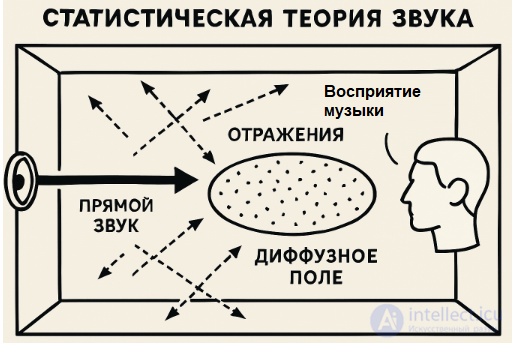
In the statistical theory, acoustic processes in a room are regarded as the gradual decay of energy of waves repeatedly reflected by the room's boundaries. This decay occurs after the sound source stops acting. Idealizing, this process is considered, to a first approximation, continuous. It can then be depicted on a linear scale as an exponential curve (Fig. 1a), and on a semi-logarithmic scale as a straight line (Fig. 1b). The premise for such a treatment is the fulfillment of two conditions: all directions of wave travel are equally probable, and the density of sound energy e = E / V is the same at every point in the room's space.
Probabilistic approach: the probability of sound waves falling on different sections of a surface is not the same, which requires statistical analysis.
Echo delay (td): the arrival time of reflected waves depends on the shape, size, and structure of the room.
Applicability: the smaller the wavelength compared to the room's dimensions, the more accurately the statistical model works.
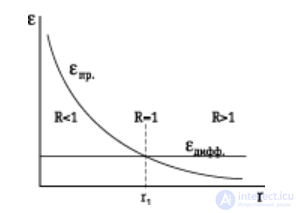
Fig. 4. Graph of the influence of diffuse and direct sound energy in the assessment of acoustic processes
Effective (equivalent) reverberation. For a more accurate assessment of acoustic processes in a room, it is necessary to take into account the energy of both diffuse and direct sound (Fig. 4). At small distances from the source, the energy of direct sound predominates; at large distances, the energy of diffuse sound predominates, since the former decreases in inverse proportion to the square of the distance, while the latter is approximately constant. The ratio of the densities of these two energies is called the acoustic ratio:
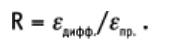
At distance r1, both components are equal (R = 1). At distances greater than r1, the predominance of diffuse energy is perceived by the ear as an increased “boominess” of the room. The numerical value of r1 is empirically related to the room's volume V and reverberation time T:
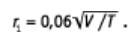
For a room volume of 150 m3 and a reverberation time of 0.7 s, we have r1 = 0.87 m, and for a volume of 8000 m3 and a reverberation time of 2.0 s, respectively, r1 = 3.8 m.
|
|
|
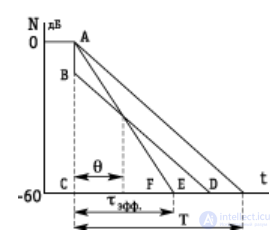
Fig. 5. The difference between the reverberation time T and the effective reverberation time Teff. |
At distances greater than r1, the character of the sound is determined mainly by the energy of diffuse sound. To determine the reverberation time in this region, the previously given formulas are used. At close distances, the level decay has a different, more complex character, shown in Fig. 5 as the “stepped” line A-B-E. The perceived effective reverberation in this case will be less than that calculated from the previously given formulas. Comparing two processes of level decay — with a “step” and without a “step” — G.A. Goldberg and S.F. Ter-Osipyants found that the determining factor for the equality of the two perceived durations of the processes is the following circumstance. Two decay processes create the same impression of duration if, after a time interval of 0.1 – 0.3 s, the graphs of both processes pass through one point corresponding to some level value. The effective reverberation time Teff. < T is determined based on the equality of the areas of two triangles, B-C-E and A-C-F. It is characterized by the time during which the level would decrease by 60 dB from the initial level of 0 dB, under the condition of level decay without a “step”, and it depends on the ratio of the energies of diffuse and direct sound, numerically expressed by the acoustic ratio R and the directivity factor W of the microphone (if a microphone serves as the sound receiver). A formula was proposed for calculating the effective reverberation time
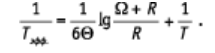
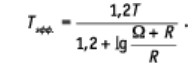
In this formula, Q is the previously mentioned time interval during which the ear sufficiently well integrates the process of level decay; its average value is 0.2 s, which is somewhat greater than the time constant of hearing t = 0.165 s. Substituting the numerical value 6Q into the formula, we obtain
As examples, let us calculate Teff. for T = 2 s, R = 1, for
W = 1 (an omnidirectional microphone) and W = 3 (a microphone with a cosine or cardioid directivity pattern):
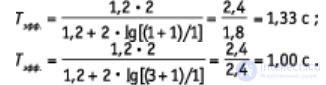
By changing the distance between the sound source and using microphones with different directivity patterns, the effective reverberation time can be adjusted within wide limits. In this way, the reverberation effect is matched to the content of the scenes being conveyed or to the genre of the musical works.
Emotional impact: the acoustic environment affects the sense of «spatiality» and the emotional coloring of music.
Musical memory: repeated reflections form stable acoustic patterns that become fixed in perception.
Therapy and learning: understanding the statistical nature of sound helps use room acoustics to optimize the perception of music.
| Theory | Basic idea | Application |
|---|---|---|
| Geometric | Analysis of the trajectories of sound rays | precise calculations for large halls |
| Statistical (Efimov) | Probabilistic distribution of reflections | acoustics of medium and small rooms |
| Psychoacoustic | Human perception of sound | music psychology, emotions |
Concert halls: creating a uniform sound field for listeners.
Music therapy: using room acoustics to enhance the emotional effect of music.
A.P. Efimov's statistical theory of sound is a fundamental approach to understanding room acoustics, one that joins engineering and psychological aspects. It shows that the perception of music depends not only on the sounds themselves, but also on the statistically distributed reflections that form a unique acoustic environment.
V.A. Sinkevich's theory of stochastic resonance develops the classical model of stochastic resonance, applying it to biological, cognitive, and musical systems. It shows how noise can enhance the perception of weak signals, especially under conditions of bistability and nonlinearity, and it is used to explain phenomena in music psychology, auditory perception, and neurophysiology.
Stochastic resonance (SR) is a phenomenon in which adding noise to a weak signal in a nonlinear system improves its detection.
V.A. Sinkevich adapted this theory to biological and cognitive systems, including the perception of music, auditory sensitivity, and neurodynamics.
Unlike classical models, his approach takes into account the multilevel organization of the brain, including bistable neural ensembles.
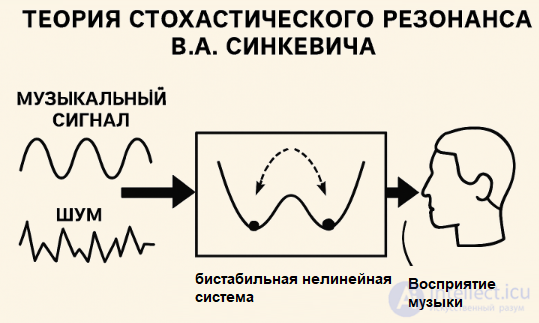
Bistability of perception: musical and auditory stimuli can switch the system between two stable states.
Noise as a useful factor: at a certain intensity, noise enhances weak signals, making them accessible to perception.
Nonlinear dynamics: the perception of music is a nonlinear process in which noise can play the role of a catalyst.
Cognitive resonance: stochastic resonance can explain moments of «insight» or the sudden recognition of a musical motif.
Auditory sensitivity: explaining why a person can hear a weak musical signal in a noisy environment.
Music therapy: using background noise to activate perception in patients with hearing or attention impairments.
Processing of rhythm and timbre: stochastic resonance helps explain how the brain extracts musical structures from a complex acoustic background.
Emotional perception: noise can enhance the emotional reaction to music, especially under conditions of uncertainty.
| Parameter | Classical SR model | Sinkevich's model |
|---|---|---|
| Field of application | Physics, climatology | Neurophysiology, psychology |
| Type of system | Simple bistable | Multilevel neural |
| Role of noise | Signal enhancement | Modulation of cognitive perception |
| Examples | Glacial cycles, the Schmitt trigger | Musical perception, auditory therapy |
Acoustic design: optimizing background noise in educational and therapeutic spaces.
Neural interfaces: using stochastic resonance to improve signal transmission to the brain.
Music education: introducing noise stimuli to activate perception in children and elderly people.
V.A. Sinkevich's theory of stochastic resonance is an extension of the classical model, applied to complex cognitive and musical systems. It shows that noise is not always an obstacle, and can be an instrument for enhancing perception, especially under conditions of weak or unstable signals. This opens new horizons in music psychology, therapy, and neuroscience.
A.P. Efimov, A. Ustinov, and V.I. Sinkevich represent three complementary approaches to music psychology: the acoustic-material approach (Efimov), the emotional-performative approach (Ustinov), and the neurodynamic approach (Sinkevich). Their concepts reveal the material (physical, acoustic, neurophysiological) and ideal (emotional, cognitive, aesthetic) aspects of the effect of music.
The material side:
Develops a statistical model of the sound field in rooms.
Sound is regarded as a physical process of reflections, diffusion, and reverberation.
The influence of architecture on the perception of music — the acoustic environment shapes the conditions for an emotional response.
The ideal side:
The acoustic structure affects the quality of the musical experience.
The spatial organization of sound becomes part of the artistic effect.
The material side:
Takes into account the movement, breathing, and motor reactions of the performer as part of musical expression.
Music is not only sound, but also bodily action.
The ideal side:
Musical performance is an experience that conveys an inner state.
Emotions in music are not merely reactions, but subjective forms of activity.
Distinguishes between life emotions and musical emotions, emphasizing the artistic specificity of the latter.
The material side:
Investigates the neurophysiological mechanisms of music perception.
Shows how noise can enhance weak musical signals in the brain.
A model of bistable neural systems that respond to acoustic stimuli.
The ideal side:
Stochastic resonance explains insight, the sudden recognition of a motif.
Music is perceived as cognitive resonance, uniting memory, attention, and emotion.
| Author | Material aspect | Ideal aspect | Field of application |
|---|---|---|---|
| A.P. Efimov | Room acoustics, diffuse field | The spatial quality of perception | Architectural acoustics, studios |
| A. Ustinov | Corporeality, motor skills, performing activity | Emotional experience, artistic expression | Musical performance, therapy |
| V.I. Sinkevich | Neurophysiology, noise, bistability | Cognitive resonance, recognition, attention | Music psychology, neuroscience |
The material: sound as a physical phenomenon, bodily activity, neural processes.
The ideal: emotions, aesthetic experience, cognitive structures.
Music acts simultaneously on the body, the brain, and consciousness, uniting physics and metaphysics.

Comments