
Lecture
Imagination — is one of the fundamental abilities of human consciousness. It allows a person to go beyond immediate experience and create new images, ideas, and concepts. Within the structure of imagination, one can distinguish general imagination, which spans all areas of human activity, and musical imagination, which manifests in the specific realm of the art of sound.
General imagination — is a universal capacity of the psyche:
Creating images: a person can mentally picture what is not currently before their eyes.
Modeling the future: imagination helps forecast events, make plans, and design new technologies.
Creative transformation: it allows one to transform reality, creating works of art, scientific hypotheses, or technical inventions.
Emotional function: imagination is closely linked to feelings, intensifies experiences, and helps one empathize with and understand others.
Thus, general imagination is the foundation for any form of creativity and innovation.
Musical imagination — is a special type of imagination associated with perceiving and creating musical images:
Auditory representations: the ability to mentally hear melodies, harmonies, and rhythms without their actual sounding.
Compositional thinking: a composer uses musical imagination to build new works, combining sounds into original structures.
Interpretation: through imagination, a performer fills music with emotional content, creating an individual sound.
Associativity: musical images are often linked to visual, emotional, or even bodily sensations.
Musical imagination is formed on the basis of general imagination but has its own unique mechanisms — auditory memory, a sense of rhythm, and the ability for inner «sounding».
| Characteristic | General Imagination | Musical Imagination |
|---|---|---|
| Scope of application | Universal, spans all areas of life | Limited to the sphere of music |
| Primary images | Visual, verbal, conceptual | Sound-based, rhythmic, harmonic |
| Functions | Planning, creativity, emotional intensification | Creating, interpreting, and perceiving music |
| Connection with feelings | Emotions intensify imagery | Emotions are expressed directly through sound |
| Role in culture | The foundation of art, science, technology | The foundation of musical art |
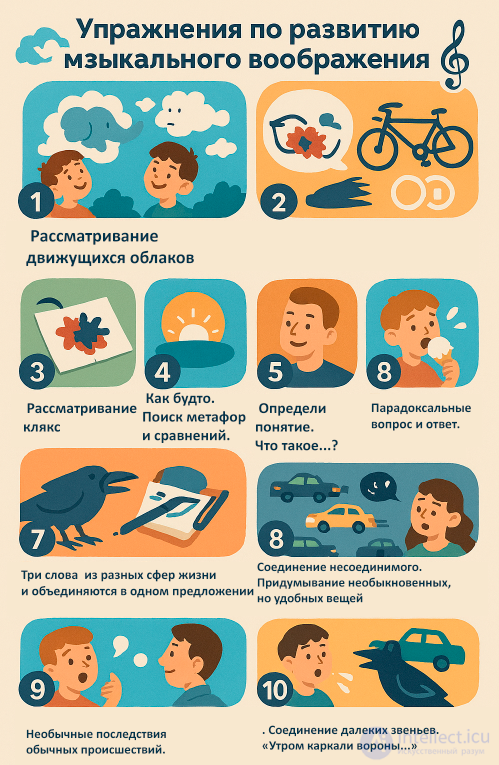
1. Watching drifting clouds. Finding in their outlines the images of animals, people, and fantastical creatures — good and evil, cheerful and sad — and inventing names and titles for them.
2. Looking at inkblots. Drop a bit of paint or ink onto a sheet of paper, fold it in half, then unfold it. Look for images in the resulting blot.
3. What does this look like. Take any object, for example, glasses. Find objects or symbols that resemble it — a bicycle, wedding rings, a toilet.
4. As if. Searching for metaphors and comparisons. «His face lit up as if... (he had become a champion, gotten into university, eaten a hundred smiles, etc.).
5. Define the concept. What is — labor, responsibility, joy, despair... It's best to answer in metaphors and aphorisms, for example, labor — is the effort to sustain life, or a means of finding the meaning of life, or — the lot of great enthusiasts, and so on.
6. Joining the unjoinable. Inventing unusual but convenient things. For example, objects that could simultaneously serve as glasses and a pen, an umbrella and a spyglass, a pen and
a flashlight.
7. Three in one. Take three words from different spheres of life and combine them in one sentence. For example, «crocodile, sausage, pump». The phrase might sound something like: «If you pump up a crocodile well with a pump, it will start to look like a sausage». The same task can also be done as a question — could a crocodile mistake a pump for a sausage? If so, under what conditions?
8. Paradoxical question and answer. «Is it true that if you eat a lot of ice cream, the northern lights will appear in your stomach?» — «That's not true, because the northern lights can only appear in the eyes of polar
bears».
9. Unusual consequences of ordinary events. I bought crayfish at the market and brought them home. And when I unwrapped the parcel they were in, I suddenly saw that (as if)...
10. Joining distant links. «The crows were cawing in the morning...» — «The dissertation defense fell through». In the morning the crows were cawing, chasing a stray cat around the yard. Frightened, the cat suddenly jumped with a crash
through the window of a first-floor apartment, where an elderly woman lived. She was so frightened that she fell ill, and her son, instead of defending his dissertation, took her to the hospital».
11. Who does he resemble. The person who is "it" steps out, and the group secretly chooses one of its members as the subject. The person who is "it" returns and asks who the chosen person resembles (which season, which dish, which piece of furniture, which flower, and so on).
12. The cause. One must find a single common cause that fits both consequences. «A great many cars have arrived in the city». — «All the young women are in a state of great excitement». The cause — a film festival, a beauty pageant is taking place in the city, or a popular rock band has arrived on tour.
Musical imagination develops through a combination of hearing, fantasy, and active creative action.
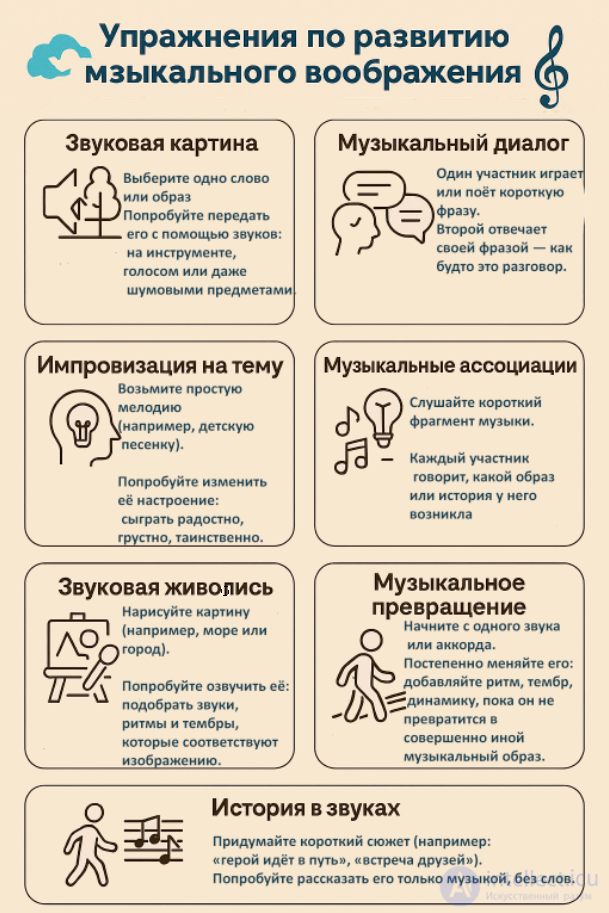
Here are a few exercises that can be used — they are suitable both for individual lessons and for group work:
Choose one word or image (for example: «forest», «storm», «sun»).
Try to convey it through sound: on an instrument, with your voice, or even with noise-making objects.
Compare the different versions and discuss which sounds come closest to the image.
One participant plays or sings a short phrase.
The second responds with their own phrase — as if it were a conversation.
The task: not to repeat, but to develop the other person's idea, creating a «storyline» in the music.
Take a simple melody (for example, a children's song).
Try changing its mood: play it joyfully, sadly, mysteriously.
This teaches one to see different emotional shades within a single musical foundation.
Listen to a short piece of music.
Each participant says what image or story came to mind.
Then try to play or sing a continuation based on these associations.
Draw a picture (for example, the sea or a city).
Try to give it sound: choose sounds, rhythms, and timbres that correspond to the image.
You can use instruments, voice, or even household objects.
Start with a single note or chord.
Gradually change it: add rhythm, timbre, dynamics, until it turns into a completely different musical image.
This exercise develops a sense of form and imagination.
Invent a short plot (for example: «the hero sets out on a journey», «a meeting of friends»).
Try to tell it using only music, without words.
After the performance, discuss whether the plot came through.
General and musical imagination — are two interconnected levels of a person's creative capacity. The first provides the universal ability to create new images and ideas; the second — reveals the unique world of sound forms and musical experiences. Musical imagination can be viewed as a specialized manifestation of general imagination, one that makes music not merely a set of sounds, but a living artistic space capable of expressing the deepest human feelings.

Comments