
Lecture
.Equal figures are figures that coincide when superimposed (their corresponding sides are equal and their corresponding angles are equal).
EQUAL-AREA FIGURES — plane figures having equal areas, or solid figures (bodies) having equal volumes. Any two simple (without self-intersections) equal-area polygons are also equidecomposable (the Bolyai — Gerwien theorem); two equal-area polyhedra, generally speaking, need not be equidecomposable (the Dehn — Kagan theorem). In other words, equal-area polygons can be recut, i.e. each of them can be cut into pieces from which the other polygon can be assembled.
Equal figures have equal areas, so equal figures are also equal-area. The converse, generally speaking, is not true.
Equal-area and equidecomposable figures. Equal-area figures are plane (solid) figures of the same area (volume); equidecomposable figures are figures that can be cut into the same number of respectively congruent (equal) parts. Usually the concept of equidecomposability is applied only to polygons and polyhedra. Equidecomposable figures are equal-area. The Hungarian mathematician J. Bolyai (1832) and the German mathematician P. Gerwien (1833) proved that equal-area polygons are equidecomposable (the Bolyai — Gerwien theorem). Therefore, by cutting into pieces and rearranging them, any polygon can be turned into a square of equal area to it. The concept of equidecomposability underlies the «dissection method», used for computing the areas of polygons: a parallelogram is reduced «by cutting and rearranging» to a rectangle, a triangle — to a parallelogram, a trapezoid — to a triangle. Equivalent to the concept of equidecomposability is the concept of equicomplementability, which underlies the «complementation method», i.e. supplementing two figures with equal parts so that the figures obtained after such supplementation are equal.
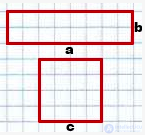
figure 1
1) The rectangle and the square shown in figure 1 are equal-area figures.
Area of the rectangle
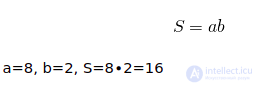
Area of the square

That is, a rectangle with sides a and b and a square with side c are equal-area if
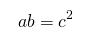
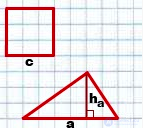
figure 2
2) The triangle and the square shown in figure 2 are equal-area figures, since they have equal areas.
Area of the square S=3²=9.
Area of the triangle
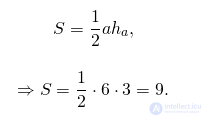
A triangle with side a and the altitude ha drawn to it, and a square with side c, are equal-area if
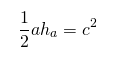
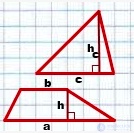
figure 3
3) The triangle and the trapezoid shown in figure 3 are equal-area, since their areas are equal.
Area of the triangle
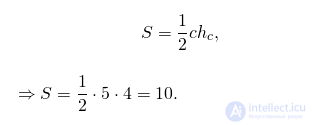
Area of the trapezoid
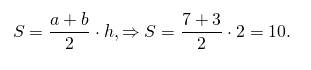
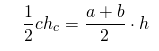
A triangle with side c and the altitude hc drawn to it, and a trapezoid with bases a and b and altitude h, are equal-area if

Comments