
Lecture
In geometry and planimetry, an antiparallelogram is a special type of self-intersecting quadrilateral. Like a parallelogram, an antiparallelogram has two opposite pairs of sides of equal length, but the sides of the longer pair intersect each other, as in a pair of scissors. Antiparallelograms are also called counterparallelograms or crossed parallelograms
An antiparallelogram is a special case of a crossed quadrilateral , whose sides are, as a rule, unequal. An antiparallelogram of a special shape is a crossed rectangle , in which two opposite edges are parallel.
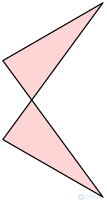
Antiparallelogram, or counterparallelogram, — a flat quadrilateral in which every two opposite sides are equal to one another but not parallel, unlike a parallelogram. The long opposite sides intersect each other at a point lying between their endpoints; the extensions of the short sides also intersect each other.
If a quadrilateral is an antiparallelogram, then its two pairs of opposite sides are antiparallel. Indeed, the vertices of an antiparallelogram are the vertices of an isosceles trapezoid, around which a circle can always be circumscribed (a sign of antiparallelism of opposite sides). That is, the lateral sides of an isosceles trapezoid are antiparallel, and the diagonals of an isosceles trapezoid are also antiparallel
Every antiparallelogram has an axis of symmetry passing through the point of intersection. Because of this symmetry, it has two pairs of equal angles, as well as two pairs of equal sides. Together with kites and isosceles trapezoids, antiparallelograms form one of the three principal classes of quadrilaterals with an axis of symmetry. The convex hull of an antiparallelogram is an isosceles trapezoid, and every antiparallelogram can be formed from the non-parallel sides and diagonals of an isosceles trapezoid. As a special case, an antiparallelogram can also be formed from the diagonals and any pair of sides of a rectangle.
Every antiparallelogram is a cyclic quadrilateral , meaning that all four of its vertices lie on a single circle .
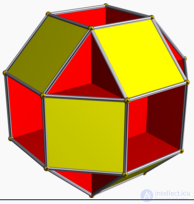
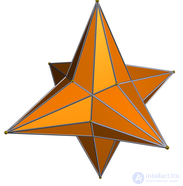
Several nonconvex uniform polyhedra , including the tetrahemihexahedron , cubohemioctahedron , octahemioctahedron , small rhombihexahedron , small icosihemidodecahedron and small dodecahemidodecahedron , have antiparallelograms as their vertex figures , cross-sections formed by cutting the polyhedron with a plane passing near a vertex, perpendicular to the axis between the vertex and the center.
For uniform polyhedra of this type, whose faces do not pass through the central point of the polyhedron, the dual polyhedron has antiparallelograms as faces; examples of dual uniform polyhedra with antiparallelogram faces include the small rhombihexacron , great rhombihexacron , small rhombidodecacron , great rhombidodecacron , small dodecicosacron and great dodecicosacron . The antiparallelograms forming the faces of these dual uniform polyhedra are the same antiparallelograms that form the vertex figure of the original uniform polyhedron.
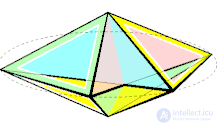
One form of a non-uniform but flexible polyhedron, the Bricard octahedron , can be constructed as a double pyramid over an antiparallelogram.
An antiparallelogram has been used as the shape of a four-bar linkage , in which four rigid bars of fixed length (the four sides of the antiparallelogram) can rotate relative to one another at joints placed at the four vertices of the antiparallelogram. In this context it is also called a «butterfly» linkage or a « butterfly» . As a linkage, it has a point of instability at which it can be converted into a parallelogram and back.
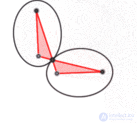
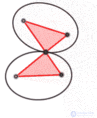
If one of the short (uncrossed) edges of the antiparallelogram linkage mechanism is fixed in place, and the remaining link moves freely, then the point of intersection of the antiparallelogram traces out an ellipse , whose foci are the endpoints of the fixed edge. The other moving short edge of the antiparallelogram has as its endpoints the foci of another moving ellipse, formed from the first by reflection across the tangent line through the point of intersection.
For both parallelogram and antiparallelogram linkage mechanisms, if one of the long (crossed) edges of the linkage mechanism is fixed as the base, the free joints move along equal circles, but in the parallelogram they move in the same direction at equal speeds, whereas in the antiparallelogram they move in opposite directions at unequal speeds. As James Watt discovered, if the long side of the antiparallelogram is fixed in this way, it forms a variant of the Watt linkage , and the midpoint of the unfixed long edge will trace out a lemniscate or a figure-eight curve. For an antiparallelogram formed from the sides and diagonals of a square, this is the lemniscate of Bernoulli .
The antiparallelogram is an important feature in the design of Hart's inversor, a linkage mechanism which (like the Peaucellier – Lipkin linkage) can convert rotational motion into straight-line motion. A linkage in the shape of an antiparallelogram can also be used to connect the two axles of a four-wheeled vehicle, reducing the vehicle's turning radius compared with a suspension that allows only one axle to turn. A pair of nested antiparallelograms was used in a linkage defined by Alfred Kempe as part of his universality theorem, stating that any algebraic curve can be traced by the joints of a suitably defined linkage. Kempe called the nested-antiparallelogram linkage a «multiplicator», since it could be used to multiply an angle by an integer.
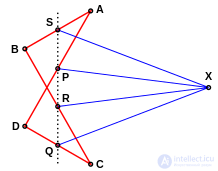
Without bracing, the antiparallelogram linkage can turn into a normal parallelogram. This can be prevented by using the construction of Abbott and Barton, 2004. This construction can be used to solve the problem in Kempe's universality theorem.
In the n-body problem , the study of the motions of point masses according to Newton's law of universal gravitation , central configurations play an important role — solutions of the n-body problem in which all the bodies rotate around some central point as if they were rigidly connected to one another. For example, for three bodies there are five solutions of this type, given by the five Lagrangian points. For four bodies with two pairs of bodies having equal masses (but with a continuously varying mass ratio between the two pairs), numerical data show that there exists a continuous family of central configurations related to one another by the motion of an antiparallelogram linkage.

Comments