
Lecture
Antiparallelism:
Antiparallel lines — lines that, when intersecting two given lines (or the sides of a given angle), form equal angles but on opposite sides (Fig.1).
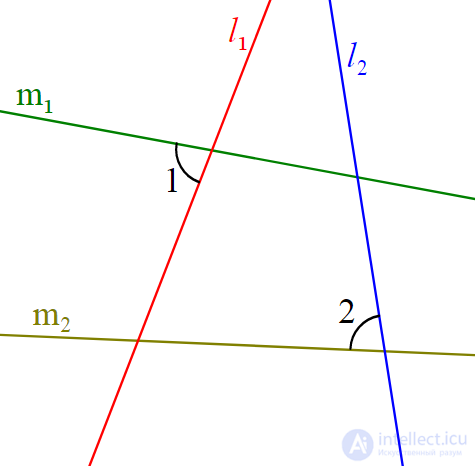
Fig.1: Let two lines be given  and
and  . The lines
  and
and  are called antiparallel with respect to and , if
  .
.
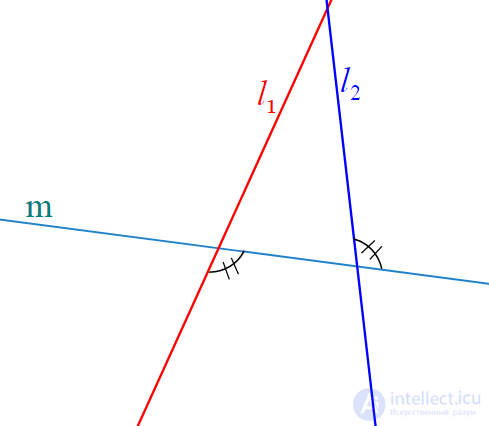
Fig.2: If two lines and coincide, then it is said that and are antiparallel with respect to the corresponding line  .
.
The lines and are called antiparallel with respect to the lines and , if in Fig.1. If the lines and intersect at some point  , then and are also called antiparallel with respect to the angle
  . If the lines and coincide, then and are called antiparallel with respect to a single line (Fig.2) .
From the definition it is clear that, unlike parallelism, the antiparallelism of two lines is a relative concept. It makes no sense to state that "lines and are antiparallel", if it is not specified with respect to which angle or which two lines they are antiparallel. However, when considering triangles, one often says that some line "is antiparallel to a side of the triangle", meaning by this that it is antiparallel to it with respect to the two other sides. Such a line is also called an antiparallel of the triangle .
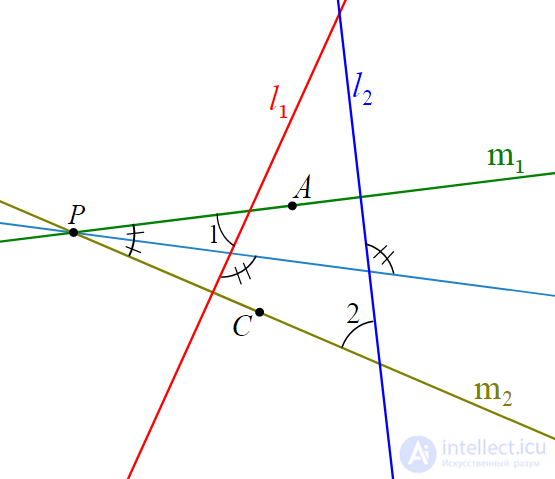
Fig.3: Two lines and are antiparallel with respect to an angle if and only if they make the same angle in opposite directions with the bisector of that angle. Note that the preceding two angles 1 and 2 are also equal.
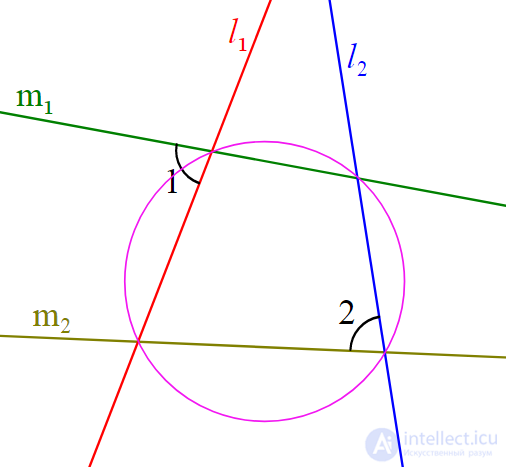
Fig.4: Any quadrilateral inscribed in a circle has opposite sides that are antiparallel with respect to the two other sides.
and are antiparallel with respect to and , then and are antiparallel with respect to and . and are antiparallel with respect to an angle if and only if they make the same angle, but in opposite directions, with the bisector of that angle (Fig.3). and
and  of triangle
  intersects the sides
  and
and  at points
  and
and  respectively, then the line
  is antiparallel to
  . If the radius of the circle is increased so that it also passes through the vertex
  , then the secant becomes the tangent at the point . Consequently,
Apparently, the term "antiparallel" was first used by Leibniz (Acta Eruditorum, 1691, p.279), but he gave it a different meaning. The definition of antiparallel lines in the modern sense is given in E. Stone's book "A New Mathematical Dictionary" (1743).

Comments