Symmedian — a cevian of a triangle whose ray is symmetric to the ray of the median with respect to the angle bisector drawn from the same vertex.
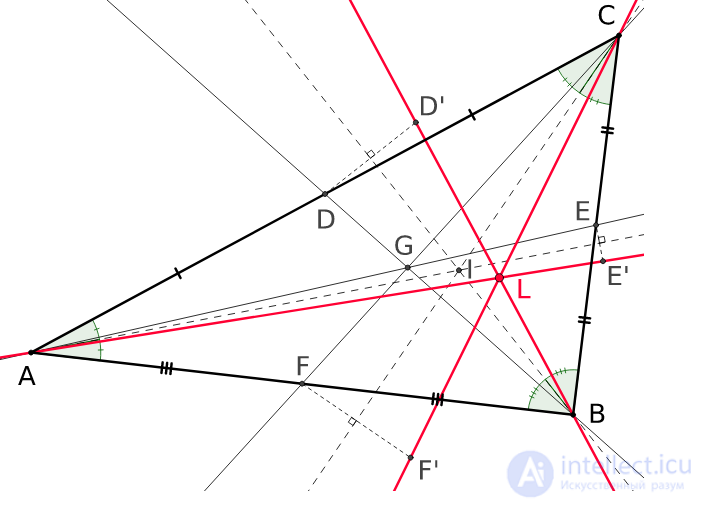
A triangle with three (gray) medians, with three (dashed) angle bisectors, and with three (red) symmedians . The symmedians intersect at the Lemoine point L, the angle bisectors — at the incenter I, and the medians — at the centroid G.
Properties
- A symmedian is the locus of points inside a triangle, issuing from one vertex, that gives two equal segments, antiparallel to the two sides meeting at that vertex, and bounded by the three sides.
- A symmedian is a special case of a cevian of a triangle.
- The segments into which a symmedian divides the opposite side are proportional to the squares of the adjacent sides.
- The symmedians of a triangle intersect at a single point, which is called the Lemoine point and is denoted K or L.
- The Lemoine point is isogonally conjugate to the centroid.
- The sum of the squares of the distances from a point in the plane to the sides of a triangle is minimal when that point is the Lemoine point.
- The distances from the Lemoine point to the sides of the triangle are proportional to the lengths of the sides.
- The Lemoine point is the only point that is the centroid of its own pedal triangle.
- The extensions of the symmedians pass through the corresponding vertices of the tangential triangle.
See also
- Notable points of a triangle
- Cevian


Comments