The Simson line is a line passing through the feet of the perpendiculars dropped to the sides of a triangle from a point on its circumscribed circle. Its existence relies on Simson's theorem.
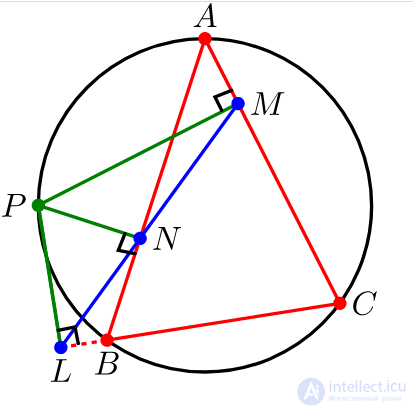
Simson line of triangle ABC
Simson's theorem
The feet of the perpendiculars dropped from an arbitrary point  on the circumscribed circle of a triangle
  onto its sides or their extensions lie on a single line. This line is called the Simson line.
The converse statement is also true: if the feet of the perpendiculars dropped from a point onto the sides of a triangle or their extensions lie on a single line, then the point lies on the circumscribed circle of the triangle.
History
The discovery of this line was long attributed to Robert Simson (1687—1768), but in fact it was only discovered in 1797 by the Scottish mathematician William Wallace. Therefore, alongside the traditional name for this line, the historically more accurate name Wallace line is often used.
Properties
- Let
 — be the orthocenter of triangle . Then the Simson line of an arbitrary point on the circumscribed circle of triangle bisects the segment
  at a point lying on the nine-point circle.
- If P and Q are points on the circumscribed circle, then the angle between the Simson lines of points P and Q equals half the angle of arc PQ.
- In particular, if 2 points on the circumscribed circle are diametrically opposite, their Simson lines are perpendicular, and in this case the intersection point of the 2 perpendicular Simson lines also lies on the nine-point circle. Moreover, the second intersection points of the 2 perpendicular Simson lines with the nine-point circle will be the endpoints of a diameter of the latter circle.
- For two given triangles with the same circumscribed circle, the angle between the Simson lines of a point P on the circle for both triangles does not depend on P.
Simson line and the Morley triangle
- On the circumscribed circle of triangle {\displaystyle ABC} there exist exactly three points such that their Simson line is tangent to the Euler circle of triangle {\displaystyle ABC}, and these points form an equilateral triangle. The sides of this triangle are parallel to the sides of the Morley triangle.
Simson line and the Steiner line
- The points symmetric to point P on the circumscribed circle with respect to the sides of the triangle lie on a single line passing through the orthocenter. This line (the Steiner line) is parallel to the Simson line and maps to it under a homothety with coefficient 1/2
Simson line and the Feuerbach point
- The Feuerbach point, that is, the point of tangency of the incircle or an excircle with the nine-point circle, is the intersection point of two Simson lines constructed for the endpoints of the diameter of the circumscribed circle passing through the corresponding center of the incircle or excircle. .
- In particular, the Feuerbach points can be constructed without using the corresponding incircle or excircle and its tangent Euler circle.
Simson line and the deltoid
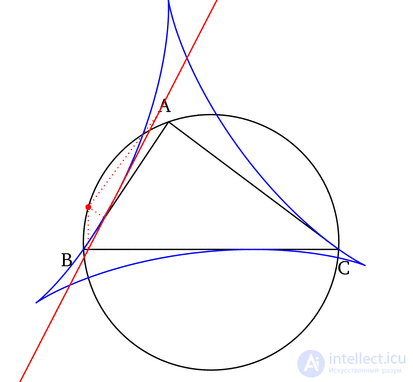
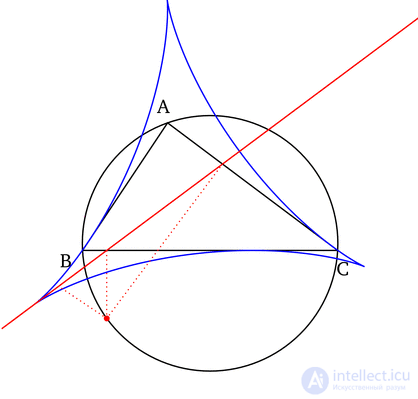
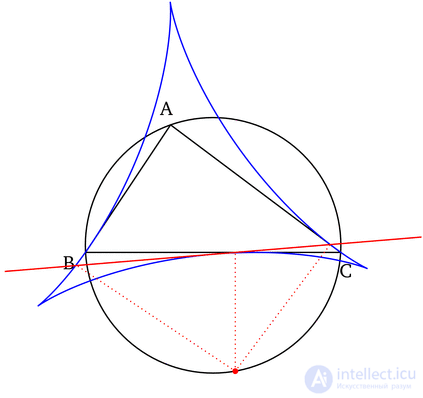
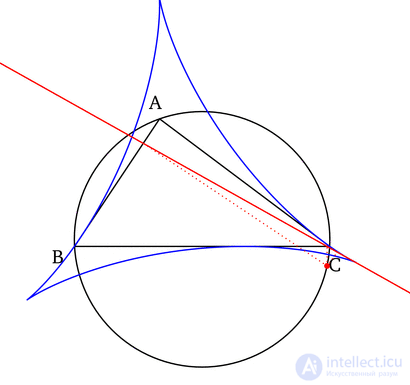
- The envelope of the family of Simson lines of a given triangle is a deltoid — the so-called Steiner deltoid.
- Jakob Steiner discovered the deltoid as a special hypocycloid, which is traced by an arbitrary fixed point of a circle rolling without slipping inside a circle of 3 times the diameter. As for the fact that the set of all possible Simson lines that can be drawn for a given triangle has an envelope in the shape of a deltoid, that was discovered about 100 years later and not by Steiner at all .
Simson line and the orthopole
- If the orthopole lies on the Simson line, then its line ℓ is perpendicular to it.
- If the line ℓ of the orthopole intersects the circumscribed circle of the triangle at two points P and Q, then the orthopole itself lies at the intersection of the two Simson lines of these last two points P and Q.
- If the line ℓ of the orthopole is the Simson line of point P, then point P is called the pole of the Simson line ℓ
Equation of the Simson line
- Placing the triangle on the complex plane, suppose that triangle ABC is inscribed in the unit circle and has vertices whose complex coordinates are a, b, c, and let P with complex coordinate p be a point on the circle. Then the Simson line is described by the following equation in z:

where the overline denotes complex conjugation.
Variations and generalizations
- No convex polygon having 5 or more sides has a Simson line.
- If from a given point on the circumscribed circle of a triangle lines are drawn at a given oriented angle to the sides, then the three resulting intersection points will lie on a single line.
- The Simson line can be defined for any inscribed
 -gon by induction as follows: the Simson line of a point with respect to a given -gon shall be called the line containing the projections of the point onto the Simson lines of all
  -gons obtained by discarding one vertex of the -gon.
- Salmon's theorem
- The pedal triangle — a triangle whose vertices are the feet of the perpendiculars dropped from a point onto the sides of a triangle; in the case when the point lies on the circumscribed circle, the pedal triangle degenerates and its vertices lie on the Simson line.
- Let ABC — be a triangle, and let the line ℓ (shown in green in the figure) pass through the center X3 of the circumscribed circle, and let the point P lie on the circle. Let AP, BP, CP intersect the line ℓ respectively at points Ap, Bp, Cp. Let A0, B0, C0 represent the projections of points Ap, Bp, Cp respectively onto the lines BC, CA, AB. Then the 3 points A0, B0, C0 are collinear points, that is, they lie on a single line. Moreover, the line passing through them also passes through the midpoint of segment PH, where H is the orthocenter of triangle ABC. If ℓ passes through P, then the line coincides with the Simson line.
Examples
- The Simson line of the Steiner point of triangle is parallel to the line
 , and the Simson line of the Tarry point is perpendicular to the line , where
  — is the center of the circumscribed circle and
  — is the intersection point of the three symmedians (the Lemoine point) of triangle .
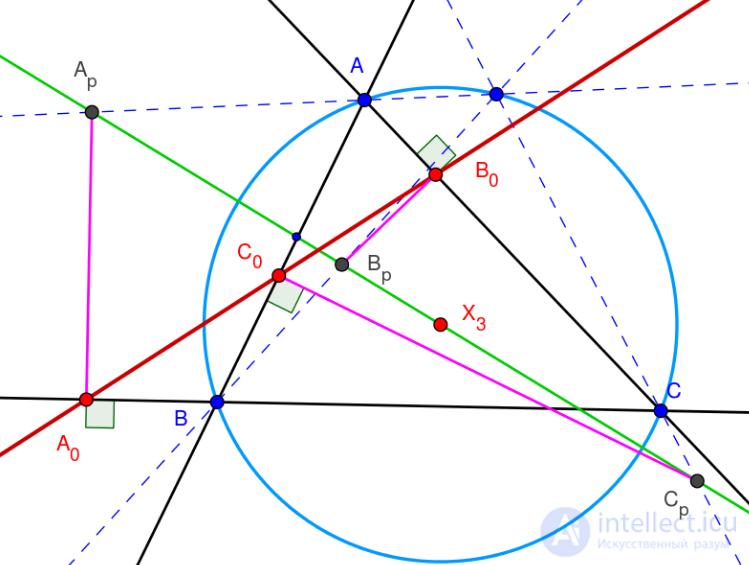
Generalization of the Simson line
See also
- Pedal triangle
- Robert Simson
- Triangle

 .
. is a cyclic quadrilateral inscribed in the circle,
  .
.  is a cyclic quadrilateral inscribed in the circle, therefore
  . Consequently,
  . Now
. Now  is a cyclic quadrilateral inscribed in the circle, therefore
  . Thus,

Comments