You get a bonus - 1 coin for daily activity. Now you have 1 coin

The Antibisector of a Triangle Angle

Lecture


Antibisector of an angle of a triangle (from Lat. anti, bi- «double» and sectio «cutting») — a specific ray originating at the vertex of the angle that divides the angle into two angles.

The antibisector of an interior angle is the locus of points inside the angle whose distances to the two sides of the angle are inversely proportional to the squares of those sides.

In a triangle, the antibisector of an angle can also mean the segment of the antibisector of that angle up to its intersection with the opposite side.

Remark

Like bisectors, antibisectors can be drawn not only to the interior angles but also to the exterior angles of a triangle. In doing so, the property of their mutual isotomy or isotomic conjugacy is preserved.

History

Antibisectors of a triangle were first introduced by Ócagne (D’Ocagne).

Properties

  • The antibisector theorem: The antibisector of an interior angle of a triangle divides the opposite side in a ratio inversely proportional to the lengths of the two adjacent sides.
  • The antibisector of an interior angle of a triangle divides the opposite side isotomically with respect to the bisector of the same angle.
  • Two cevians (lines) of a triangle, drawn from the same vertex, whose feet are equidistant from the midpoint of the side they intersect, are called isotomically conjugate, or isotomic. The bisector and the antibisector of the same interior angle of a triangle are isotomically conjugate to each other.
  • The antibisectors of the interior angles of a triangle intersect at a single point — the center of the antibisectors.
  • The segments of the sides of a triangle bounded by the lines drawn through the center of the antibisectors parallel to the sides are equal to one another.
  • The antibisector of a triangle passes through the foot of the bisector of the complementary triangle.

Several metric relations concerning the antibisector, the antisymmedian, the antialtitude, and their isogonality

We assume the definitions of an isogonal cevian and an isometric cevian to be known; we recall that the antibisector, the antisymmedian, and the antialtitude are the isometrics of the bisector, the symmedian, and the altitude of a triangle.
The following relation of Steiner (1828) for isogonal cevians is also known

The Antibisector of a Triangle Angle and The Antibisector of a Triangle Angle

The Antibisector of a Triangle Angle


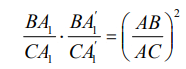
We will now prove that an analogous relation exists for isometric cevians.


Proposition
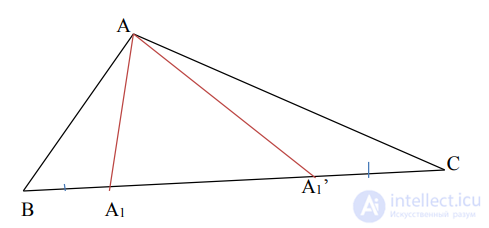
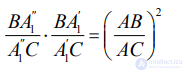
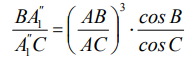
Consider triangle ABC. Let The Antibisector of a Triangle Angle and The Antibisector of a Triangle Angle be two isometric cevians, then the following relation holds:

The Antibisector of a Triangle Angle
Proof

The Antibisector of a Triangle Angle


figure 1
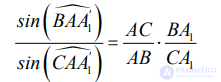
From the law of sines applied to triangles ABA1, ACA1, it follows (see the figure above)
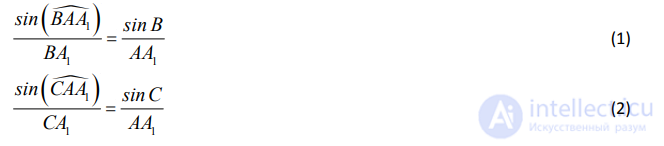
The Antibisector of a Triangle Angle
From relations (1) and (2) we keep
The Antibisector of a Triangle Angle
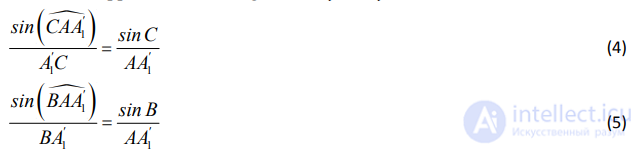
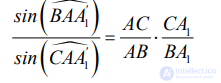
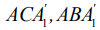
The law of sines applied in triangles The Antibisector of a Triangle Angle leads to
The Antibisector of a Triangle Angle

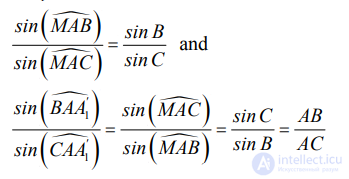
From relations (4) and (5) we obtain:

The Antibisector of a Triangle Angle
Because The Antibisector of a Triangle Angle and The Antibisector of a Triangle Angle are isometric cevians, from relations (3) and (6) we obtain relation (*) from the statement of the proposition.


Applications
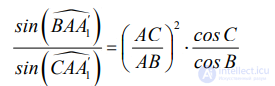
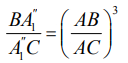
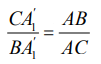
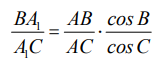
1. If AA1 is the bisector in triangle ABC and The Antibisector of a Triangle Angle is its isometric, that is, the antibisector, then from (*) we obtain

The Antibisector of a Triangle Angle
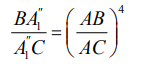
Taking into account the law of sines in triangle ABC, we obtain

The Antibisector of a Triangle Angle
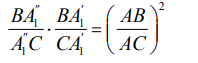
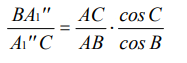
2. If The Antibisector of a Triangle Angle is the symmedian and The Antibisector of a Triangle Angle is the antisymmedian, from (*) we obtain
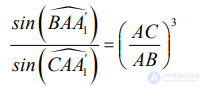
The Antibisector of a Triangle Angle
Indeed, being a symmedian, The Antibisector of a Triangle Angle is isogonal to the median AM and
The Antibisector of a Triangle Angle
3. If The Antibisector of a Triangle Angle is the altitude in triangle ABC, The Antibisector of a Triangle Angle and The Antibisector of a Triangle Angle is its isometric (antialtitude), relation (*) becomes.
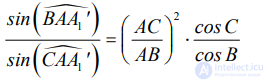
The Antibisector of a Triangle Angle
Indeed
The Antibisector of a Triangle Angle
therefore

The Antibisector of a Triangle Angle
From (*) we get

The Antibisector of a Triangle Angle
or

The Antibisector of a Triangle Angle
therefore

The Antibisector of a Triangle AngleThe Antibisector of a Triangle Angle
4. If The Antibisector of a Triangle Angle is the isogonal of the antibisector The Antibisector of a Triangle Angle then

The Antibisector of a Triangle Angle (Maurice D’Ocagne, 1883)


Proof
The Steiner relation for The Antibisector of a Triangle Angle and The Antibisector of a Triangle Angle is

The Antibisector of a Triangle Angle
But The Antibisector of a Triangle AngleThe Antibisector of a Triangle Angle is the bisector and by the bisector theorem The Antibisector of a Triangle Angle
but The Antibisector of a Triangle Angle and The Antibisector of a Triangle Angle therefore

The Antibisector of a Triangle Angle


and we obtain the D’Ocagne relation


5. If in triangle ABC the cevian The Antibisector of a Triangle Angle is isogonal to the symmedian The Antibisector of a Triangle Angle then

The Antibisector of a Triangle Angle
Proof
Since AA1 is the symmedian, from Steiner's relation we derive that
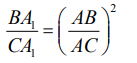
The Antibisector of a Triangle Angle
The Steiner relation for The Antibisector of a Triangle Anglegives us

The Antibisector of a Triangle Angle
Taking into account the preceding relation, we obtain
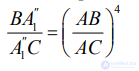
The Antibisector of a Triangle AngleThe Antibisector of a Triangle Angle
6. If The Antibisector of a Triangle Angle is the isogonal of the antialtitude The Antibisector of a Triangle Angle in triangle ABC, in which the altitude AA1 has The Antibisector of a Triangle Angle, then

The Antibisector of a Triangle Angle


Proof
If AA1 is the altitude in triangle ABC The Antibisector of a Triangle Angle, then
The Antibisector of a Triangle Angle
Because The Antibisector of a Triangle Angle is the antimedian, we have The Antibisector of a Triangle Angle and The Antibisector of a Triangle Angle then The Antibisector of a Triangle Angle

Observation
The preceding results can be generalized for anticevians of rank k and their isogonals.

See also

  • Bisector
  • Altitude (geometry)
  • Altitude of a triangle
  • antisymmedian

  • antialtitude

  • Incenter
  • Median
  • Median of a triangle
  • Symmedian
  • Angle bisector theorem
  • Axis of external bisectors, or anti-orthic axis
  • Triangle
  • Triangle of the three external bisectors
  • Axis of external bisectors, or anti-orthic axis
  • Centroid
  • Cevian
created: 2020-12-05
updated: 2026-03-09
287


Was this answer useful?
Choose a quick rating so we can improve the next answer for you.
How satisfied are you?


Comments

To leave a comment

If you have any suggestion, idea, thanks or comment, feel free to write. We really value feedback and are glad to hear your opinion.
To reply

Lectures and tutorial on "Planometry"

Terms: Planometry