Remarkable points of a triangle — points whose location is uniquely determined by the triangle and does not depend on the order in which the sides and vertices of the triangle are taken.
Usually they are located inside the triangle, but this is not necessary. In particular, the point of intersection of the altitudes may lie outside the triangle. For other remarkable points of a triangle, see the encyclopedia of triangle centers.
Examples
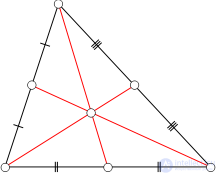
Centroid — point of intersection of the medians
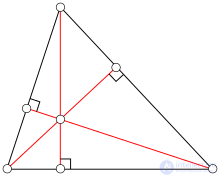
Orthocenter — point of intersection of the altitudes
The remarkable points of a triangle are
- Points of intersection of:
- medians — centroid, center of gravity (of mass);
- angle bisectors — incenter or center of the incircle;
- antibisectors — center of antibisectors;
- bisectors of exterior angles — center of the excircle;
- altitudes — orthocenter;
- perpendicular bisectors — center of the circumcircle;
- symmedians — Lemoine point;
- bisectors of the medial triangle (its incenter) — Spieker Center;
- cleavers of the triangle — also the Spieker Center;
- three (or even two) circles constructed on the segment connecting the feet of the internal and external bisectors issued from one angle, as if on a diameter, — the two Apollonius points;
- segments connecting the vertices of the triangle:
- with the points of tangency of the opposite sides and the incircle — the Gergonne point;
- with the points of tangency of the opposite sides and the excircles — the Nagel point;
- with the corresponding free vertices of equilateral triangles constructed on the sides of the triangle (outward) — the first Torricelli point;
- with the corresponding free vertices of regular triangles constructed inward on the triangle — the second Torricelli point;
- with the corresponding free vertices of triangles similar to the original triangle and constructed on its sides — the Brocard points;
Minimax points of a triangle
Minimax (extremal) points of a triangle are points at which the minimum of some function is attained, for example, the sum of powers of the distances to the sides or vertices of the triangle.
The minimax points of a triangle are:
- The point of intersection of the three medians, having the smallest sum of squares of the distances to the vertices of the triangle (Leibniz's theorem).
- The point of intersection of the three medians of a triangle is the unique point of the triangle such that the three cevians drawn through it divide the sides of the triangle, by their endpoints, into six segments. In this case, the product of the lengths of three of these six segments that have no common endpoints is maximal
- The Torricelli point (the first), having the smallest sum of distances to the vertices of a triangle with angles not exceeding
 .
.
- the Lemoine point, having the smallest sum of squares of the distances to the sides of the triangle.
- The feet of the altitudes of an acute triangle form the orthic triangle, which has the smallest perimeter among all triangles inscribed in the given triangle.
Iso-points and iso-lines of a triangle
Iso-points are points of a triangle that give some equal parameters of the three triangles formed when the iso-point is connected by segments to the three vertices of the triangle. As a result, a figure of the «dragon's eye» type is formed (see fig.)
Iso-points of a triangle forming a figure of the «dragon's eye» type
The iso-points of a triangle of this type are:
- the orthocenter (gives three triangles with three equal radii of the three circles circumscribed about them),
- the point of intersection of the medians (gives three triangles with three equal areas)
- the incenter (gives three triangles with three equal altitudes)
- the center of the circumcircle (gives three isosceles triangles with three equal pairs of sides),
- the point of equal perimeters
 or the isoperimetric point (gives three triangles with three equal perimeters),
- the Torricelli point (the first) (gives three triangles with three equal obtuse angles of ).
- The point that divides the triangle into three triangles with three equal radii of their incircles
- The Spieker Center of a triangle is the radical center of its three excircles (it has three pairs of equal tangents to all three excircles at once).
Iso-points of a triangle forming a figure of the «Trefoil (knot)» type
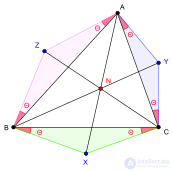
The iso-points of a triangle of this type are (see fig.):
- The Spieker Center
 is the point of intersection of the lines
  ,
,  and
and  , where
  ,
,  and
and  are similar, isosceles and identically arranged, constructed on the sides of the triangle
  outward, having the same base angle
  .
.
- The first Napoleon point
 , like the Spieker Center, is the point of intersection of the lines , and , where , and are similar, isosceles and identically arranged, constructed on the sides of the triangle outward, having the same base angle
  .
.
- Here all the points lying on the Kiepert hyperbola should be listed.
Iso-points of a triangle forming a figure of the «Tradescantia flower» type
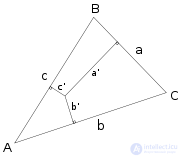
Stylized tradescantia flower
The iso-points of a triangle forming a figure of the «Tradescantia flower» type (see fig.) are as follows:
- the point of intersection of the medians forms, with three small cevian segments, three quadrilaterals with equal areas.
- the point of intersection of the angle bisectors forms, with three perpendiculars to the three sides of the triangle, three kite (deltoid) quadrilaterals with two identical adjacent sides common to all of them. The other pair of equal adjacent sides is generally different for each. All three kites have a pair of equal opposite angles of
 . They are bicentric (cyclic and tangential) quadrilaterals.
- Three circles, drawn inside the triangle through the Miquel point, intersect the sides of the triangle at three points. Three chords, drawn through the Miquel point and the three points of intersection of the three circles with the three different sides of the triangle, form equal angles with the sides.
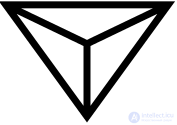
Iso-points of a triangle forming a sign of the «Model of the surface of a curvilinear triangle» type (see fig.)
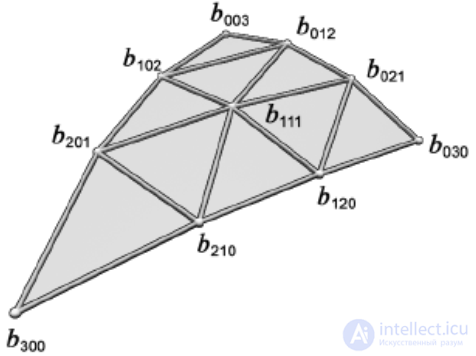
Sign of the type: Curvilinear triangle surface model
Stylized sign of the type: Curvilinear triangle surface model
Such points include:
- Points of the Euler circle
- Points in Thomsen's theorem
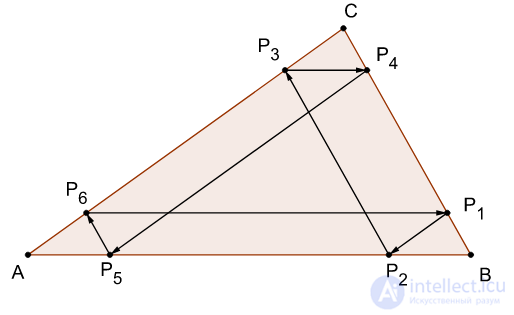
- Points in Tucker's theorem. If, in the figure for Thomsen's theorem, below and to the right, a similar 6-link broken line is drawn, alternately taking segments parallel, antiparallel, parallel, again antiparallel, again parallel to the side opposite the current one, and so on, then the last, 6th segment will return to the starting point, as in Thomsen's theorem, and the broken line will close. Tucker's theorem states that in this case the 6 points of the broken line lying on the sides of the triangle will lie on the Tucker circle
Iso-points of the triangle forming a sign of the type «Danger. Radioactive substances or ionizing radiation» (see fig.)

Sign «Danger. Radioactive substances or ionizing radiation»
Iso-points of the triangle of this type are:
- the Lemoine point (point of equal antiparallels) — a point with the property that the three antiparallels drawn through it (lines antiparallel to the three sides of the triangle) give three segments of equal length inside the triangle.
- the Equal Parallelians Point. In a certain sense it is analogous to the Lemoine point. The point has the property that the three parallels drawn through it (lines parallel to the three sides of the triangle) give three segments of equal length inside the triangle.
- The Yff Center of Congruence
- the point of intersection of the 3 antibisectors of the triangle. If 3 lines parallel to the sides of the triangle are drawn through this point, they will cut off 3 equal internal (middle) segments on the sides of the triangle.
- Another formulation of the last statement: The segments of the sides of the triangle enclosed between the lines drawn through the center of the antibisectors parallel to the three sides are equal to one another.
Other iso-points of the triangle forming cevians of general form
- the Skutin points — points of equal cevians of the triangle. Skutin's theorem states that three straight-line segments, or cevians, drawn inside the triangle through its three vertices and through any focus of the circumscribed Steiner ellipse, are equal to one another. These foci are often called the Skutin points.
Iso-lines
The iso-lines of a triangle are lines that cut the given triangle into two triangles having some equal parameters. The iso-lines of a triangle are:
- The median of a triangle bisects the opposite side and cuts the triangle into two triangles of equal area.
- The bisector (angle bisector) of a triangle bisects the angle from whose vertex it emanates.
- The altitude of a triangle intersects the opposite side (or its extension) at a right angle (that is, it forms two equal angles with the side on either side of it) and cuts the triangle into two triangles with equal (right) angles.
- The symmedian — the locus of points inside the triangle, emanating from one vertex, giving two equal segments antiparallel to the two sides meeting at that vertex, and bounded by the three sides.
- The cleaver of a triangle bisects the perimeter. A cleaver of a triangle is a segment one endpoint of which lies at the midpoint of one of the sides of the triangle, and the other endpoint lies on one of the two remaining sides. In addition, the cleaver is parallel to one of the angle bisectors. Each of the cleavers passes through the center of mass of the perimeter of triangle ABC, so that all three cleavers intersect at the Spieker center.
- The perimeter is also bisected by the segment connecting the point of tangency of a side of the triangle with the excircle to the vertex opposite that side. Three such segments of the triangle, drawn from its three vertices, intersect at the Nagel point. In other words, this segment is the cevian of the Nagel point. (In the English-language literature, the cevian of the Nagel point is sometimes called a splitter, or a perimeter bisector. They also classify the cleaver as a splitter.)
- The equalizer (equalizer) or leveler (balancer) — a straight-line segment that cuts a triangle into two figures simultaneously equal in area and perimeter[11]
- A little about the equalizer. Any line (equalizer) that passes through a triangle and bisects both the area of the triangle and its perimeter passes through the center of the incircle. There can exist three, two, or one such lines.[12]
A remark on the iso-lines of a triangle
In the English-language literature the concept of bisection is introduced as the division of something into two equal parts. For example, an isosceles triangle into two equal parts, a straight-line segment into two equal parts, a plane angle into two equal parts. The corresponding lines will be a particular case of the iso-lines of a triangle.
Lines 
An important particular case of iso-lines are the so-called lines of a triangle. A line of a triangle, emanating from its vertex, divides the opposite side in the ratio of the -th powers of the two adjacent sides[13]. Important particular cases of lines are:
- the median (
 ),
),
- the bisector (angle bisector) (
 ),
),
- the antibisector (
 ),
),
- the symmedian (
 ),
),
- the cubes line (
 ).
).
For lines of a triangle it is very easy to find some properties in general form. For example, for the line, the isogonally conjugate line is  , and the isotomically conjugate line is
  .
.
Remark
The barycentric coordinates of a center, written in terms of the sides (or trigonometric functions of the angles) of the triangle, make it possible to translate many problems about triangle centers into algebraic language. For example, to find out whether two definitions give the same center, or whether three given centers lie on a single line.
One can also use the trilinear coordinates of a center, which are very simply related to the barycentric coordinates. However, for example, isogonally conjugate points are expressed more simply in trilinear coordinates.
Variations and generalizations
- Pairs of centers are considered. For example,
- the Brocard points;
- the Apollonius points. For any nondegenerate triangle one can construct the Apollonius circle for side
 , passing through point
  . The circles constructed in this way for the three sides will intersect at two points — the inner and outer Apollonius points, respectively.
Recently discovered points (centers) of a triangle
Main source: http://faculty.evansville.edu/ck6/tcenters/index.html
- The Yff Center of Congruence
- The Gossard Perspector
- The Mittenpunkt
- The 1st and 2nd Ajima-Malfatti Points
- The Apollonius point — not to be confused with the Apollonius points
- The Bailey Points
- The Hofstadter Points
- The Congruent Isoscelizers Point
- The 1st and 2nd Morley points, associated with the Morley triangle
- The Parry Point
- The Isoperimetric Point and the Equal Detour Point
- The Equal Parallelians Point
- The Schiffler Point
- The Exeter point
- The point that divides a triangle into three triangles with three equal inradii of the three inscribed circles
See also
- Notable lines of a triangle




Comments