
Lecture
Every time you are about to communicate with any person, imagine that a soft, warm light is shining inside you. And your eyes radiate a warm glow, as if a light bulb were burning in your head.
To be able to find the keys to any person and establish contact, first of all you yourself must be ready for that contact.
Communication – a complex process of interaction between people, consisting in the exchange of information as well as in the perception and understanding of each other by the partners ; an exchange of information by means of language or gestures ; a process of establishing and developing contacts between living organisms, generated by the needs of joint activity, including the exchange of information, involving mutual perception and attempts to influence one another. The subjects of communication are living beings, people.
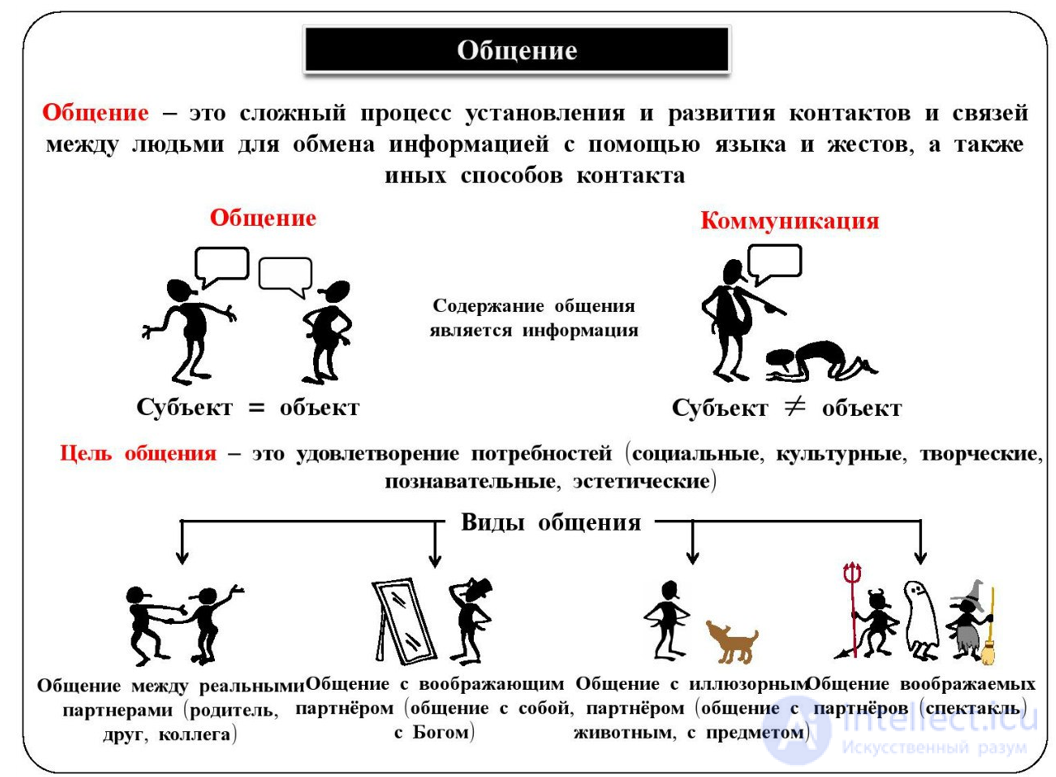
Means of communication – ways of encoding, transmitting, processing and decoding information that is conveyed in the process of communication from one being to another. Information between people can be transmitted through the sense organs, speech and other sign systems, writing, and technical means of recording and storing information.
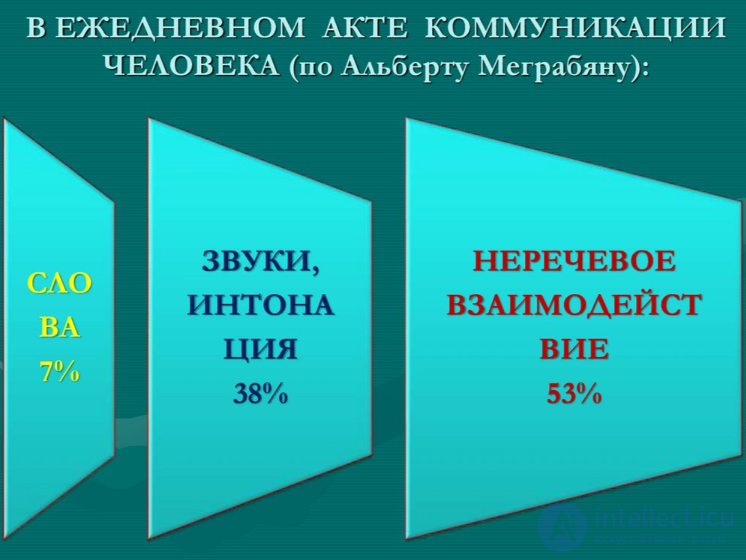
Act of communication (according to Albert Mehrabian)
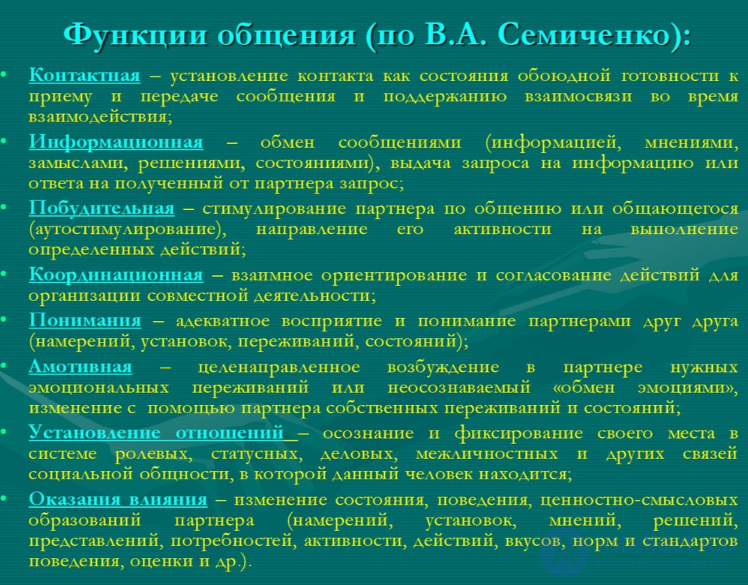
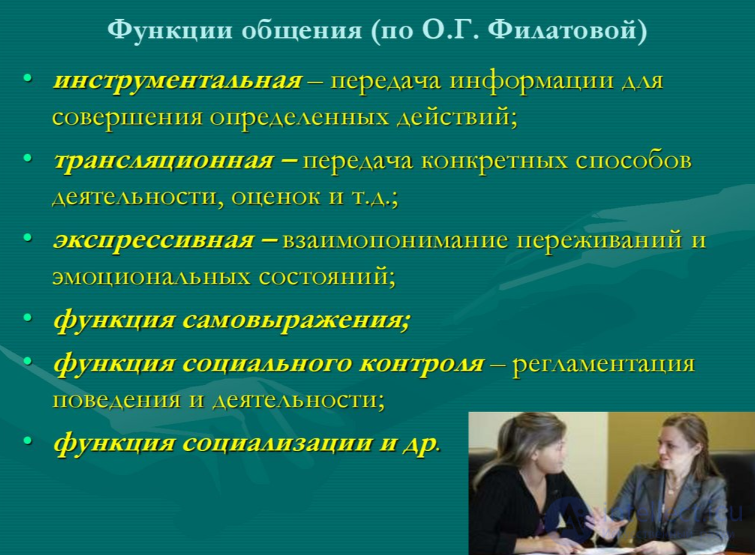
Functions of communication according to O.G. Filatova
The goal of communication – the communicator must answer the question: «What is he entering the act of communication for?». Here the same principle applies as already mentioned in the point about the content of communication. For a person, these goals can be quite diverse from one another — means of satisfying social, cultural, creative, cognitive, aesthetic and other needs.
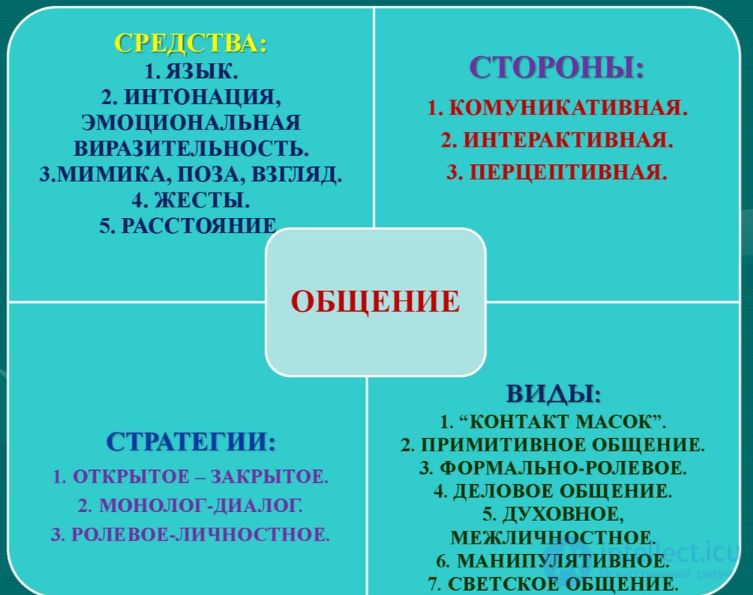
Every individual performs many functions associated with social roles: professional (boss, subordinate, student, doctor, teacher, etc.), family (mother, father, husband, wife, sister, etc.), which determines the different types of communication. Communication conditioned by social functions, regulated both in content and in form, is called formal.
People have an inherent desire for informal communication, for revealing the inner makeup of the personality. Informal communication is filled with subjective personal meaning, conditioned by the personal relationships established between partners. The highest forms of informal communication are love and friendship.
The ability to establish informal communication depends on personality traits (orientation toward communication, trust, openness) and possession of the «technique» of communication (establishing contact, the ability to see and understand another person), etc.
By content, communication can be material, cognitive, conditioning, motivational and activity-based. Inmaterial communicationsubjects, being engaged in individual activity, exchange its products, which in turn serve as a means of satisfying their current needs. Inconditioning communicationpeople influence one another, aiming to bring each other into a certain physical or mental state.Motivational communicationhas as its content the transmission to one another of certain impulses, attitudes or readiness for action in a certain direction.Cognitive communication– an exchange of knowledge,activity-based communication– an exchange of actions, operations, skills and abilities. Communication related to cognitive or educational activity can serve as an illustration of these types.
By purpose communication is divided into biological and social.Biological communication– is communication necessary for maintaining, preserving and developing the organism, connected with satisfying basic organic needs.Social communicationpursues the goals of expanding and strengthening interpersonal contacts, establishing and developing interpersonal relationships, and the personal growth of the individual.
By means communication can be direct and mediated, direct and indirect.Direct communicationis carried out with the help of natural organs given to a living being by nature (organs of hearing, sight, speech, etc.).Mediated communicationis connected with the use of special means and tools for organizing communication and exchanging information (sign systems, print, radio, television).Direct communicationpresupposes personal contacts and the immediate perception of the communicating people by one another in the very act of communication.Indirect communicationis carried out through intermediaries, who may be other people.
By duration are distinguishedshort-term and long-term communication. The time during which communication takes place influences its character.Short-term communication– communication within a single topic and a span of a few hours. Short-term communication with an unfamiliar person unfolds on two levels: on the one hand it is aimed at solving the task at hand, and on the other – at getting to know this person. It is impossible to get to know a person in detail in a short time, but there is gradually an attempt to grasp the person's main personal qualities.Long-term communication(within one or several topics, intermittent or continuous) presupposes not only solving the tasks at hand, but also the self-disclosure of each side and, thus, getting to know one another. A long period of communication creates the precondition either for the emergence and strengthening of positive business and friendly relationships and, consequently, psychological compatibility, or for the emergence of confrontation, opposition, i.e. psychological incompatibility.
Among the types of communication one can also distinguish business and personal,instrumental and goal-directed.Business communication– a type of communication whose defining content is the joint activity of people, their common cause.Personal communicationis focused mainly around psychological problems of an internal nature, those interests and needs that deeply and intimately affect a person's identity (the search for the meaning of life, the resolution of some internal conflict, etc.).Instrumental communication– is communication which is not an end in itself, is not driven by an independent need, but pursues some other goal besides gaining satisfaction from the act of communication itself.Goal-directed communication– is communication which itself serves as a means of satisfying a specific need – the need for communication.
The means of communication change and improve along with the development of human society. Their use depends on the conditions in which the activity is carried out, and on the degree of mastery of the relevant means. The main means of communication in human society is speech. However, alongside speech, non-verbal means are also widely used (facial expressions, pantomime, gestures, etc.). Sign systems can also be used as means of communication (mathematical symbols, musical notation, Morse code, etc.).
The transmission of any information is possible only through signs (sign systems). In this regard, a distinction is made between: verbal communication(speech is used as the sign system) andnonverbal (various non-speech sign systems are used – gestures, facial expressions, pantomime).
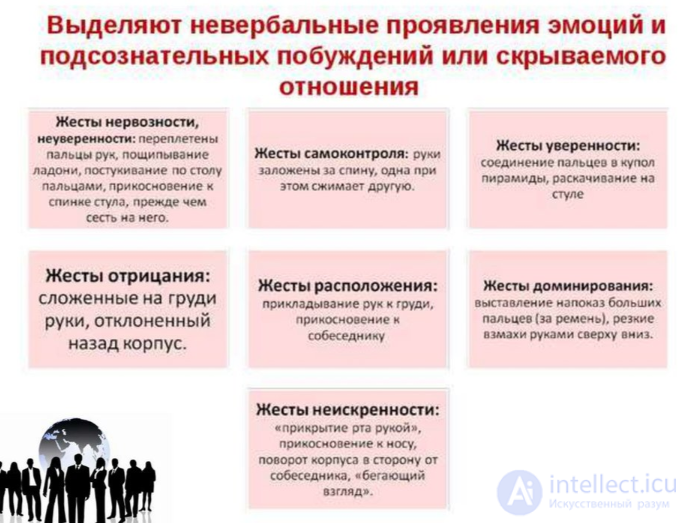
Fig. Nonverbal expression of emotions
In socio-psychological research, various classifications of nonverbal means of communication have been developed, which include:
1) kinesic means– visually perceived movements of another person that perform an expressive-regulatory function in communication. These includeexpressive movements, manifested in facial expressions, posture, gesture, gaze, gait;
2) prosodic and extralinguistic means, which regulate the flow of speech and economize the linguistic means of communication; they supplement, replace and anticipate speech utterances, express emotional states (intonation, loudness, timbre, pause, sigh, laughter, crying, coughing);
3) tactile means include dynamic touches in the form of a handshake, a kiss, a pat;
4) proxemic means include the orientation of partners during communication and the distance between them.
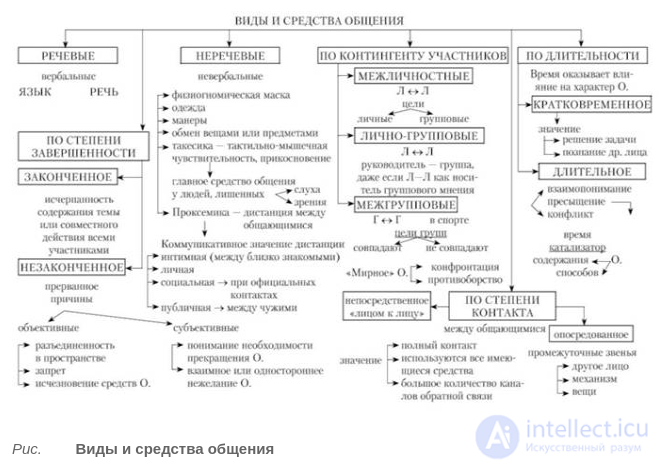
Fig. Types and means of communication
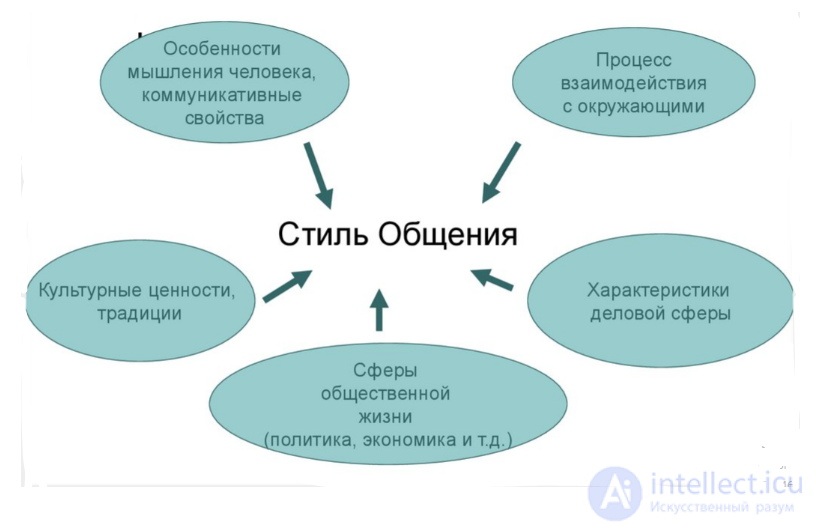
Communication style is a system of principles, norms, methods, and techniques of interaction and behavior of an individual.The style is closely related to the psychological characteristics of the person's thinking, communicative properties, etc.; Communication style is not an innate quality; The description and classification of communication styles to a certain extent reproduce the content of the characteristics of the business sphere; Socio-economic, political, socio-psychological and other external factors influence the nature of the formation of communication style; Communication style is conditioned by the cultural values of the immediate environment, its traditions, established norms of behavior, etc.
Mask contact is formal communication, when there is no desire to understand and take into account the personality traits of the interlocutor. Familiar masks are used (politeness, courtesy, indifference, modesty, sympathy, etc.) a set of facial expressions, gestures, standard phrases that allow one to hide true emotions and attitude toward the interlocutor.
Spiritual interpersonal communication (intimate-personal) reveals the deep structures of personality.
. The following are distinguished:
In professional communication, the following styles are distinguished:
The following types of everyday communication are distinguished
Aggressive communication style: A person using an aggressive communication style displays hostility, assertiveness, and disrespect toward others. They often violate the rights and boundaries of other people and strive to dominate in communication.
Assertive communication style: A person using an assertive communication style expresses their needs, opinions, and feelings clearly and confidently, while maintaining respect for others. They actively listen and take into account the viewpoints of other people.
Passive-aggressive communication style: A person using a passive-aggressive communication style expresses their displeasure or denial of their needs in an indirect way, often through sarcasm, passive resistance, or messages with hidden subtext.
Every person has their own preferences and communication style, which can be used in various situations. It is important to develop effective communication skills and the ability to adapt to different styles and types of communication in order to achieve successful interaction and mutual understanding with others.
A.B. Dobrovich distinguishes seven levels of communication according to the criterion of «ethical impeccability» of the partners. The lowest level in this classification is primitive interaction, in which the partner is perceived as a passive object, either useful or hindering. The highest level is spiritual interaction, in which the partner is perceived as a bearer of a spiritual principle.
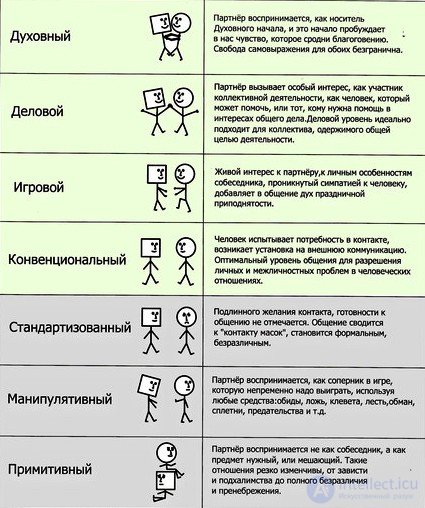
A brief description of the levels of communication, according to A.B. Dobrovich, is given in Table 1.
Table 1 Levels of communication according to A.B. Dobrovich [Dobrovich, 1996]
|
Levels of communication |
Brief characteristics of the levels |
|
Spiritual |
«The partner is perceived as a bearer of a spiritual principle, and this principle awakens in us a feeling akin to reverence» |
|
Business |
«In such contact people sometimes stop thinking about how they look and what individual roles they reveal to the partner: this is not so important; business comes first» |
|
Play |
«Possessing fullness and humaneness, it surpasses the conventional level in subtlety of content and richness of nuances» . «Interest in the personal characteristics of the interlocutor, and an interest that is not self-serving but imbued with sympathy for the person» . «Partners «play each other», that is, «are reflected in each other,… in order to be interesting» . |
|
Conventional |
«Full-fledged human communication» «Convention (or agreement) is a set of rules of behavior, mostly unwritten, but passed down from generation to generation, because these rules embody people's mutual agreement as to which forms of behavior, according to collective experience, are most acceptable both to the individual and to society» |
|
Standardized |
«Communication is based on certain standards. This is «contact of masks» » |
|
Manipulative |
«For one who chooses this level, the partner is a rival in a game that must certainly be won» |
|
Primitive |
«For one who sinks to the primitive level of contact, the interlocutor is not a partner but an object, either useful or an obstacle» |
A.B. Dobrovich characterizes each level of interpersonal interaction in accordance with the structure of the behavioral act proposed by the well-known American psychologist D. Mead. Every act of behavior (interaction) includes four phases: 1) impulse to action - mutual orientation, 2) the individual's clarification of the situation of action - mutual reflection, 3) the action itself - mutual informing, 4) the winding-down of the action - mutual disengagement.
The lowest level of communication in A.B. Dobrovich's classification is primitive.
Primitive level of communication. The interlocutor is perceived not as a partner but as an object, either useful or an obstacle.
Mutual orientation is determined by the desire to occupy the «one-up» position. If the interlocutor is useful, one must gain control of him; if he is an obstacle, one must push him aside.
Mutual reflectionis characterized by the primitiveness of the image of the partner's perception. Perceptual templates are used. Superficial qualities play a significant role in assessing the partner's role: appearance, clothing.
As for grasping one's own actual role through the partner's eyes, things do not get to such subtleties; the subject naively believes that he is seen exactly as he sees himself, or as whoever he presents himself to be…
The phase of mutual informing is characterized by an open display of one's attitude toward the partner. The subject, without the slightest internal restraint, expresses sympathy for the «object» he likes, or antipathy toward the one he dislikes.
The disengagement phase from the partner is characterized by the absence of any farewell rituals in accordance with the rules of etiquette and ethical norms. If confrontation occurred at the previous stage, then communication with a weak partner ends in curses and mockery, while with a strong one it ends in apologies or threats (the threats being uttered once the partner has moved to a safe distance). If, on the other hand, there was agreement, the subject, having obtained what he wanted from the partner, does not hide his boredom. He may leave without saying goodbye to attend to his own affairs.
The way to deal with a partner using the primitive style of communication is to calmly and confidently put him in his place, without humiliating the interlocutor's human dignity in the process. For example: «Citizen A is sitting on a bench in the square, reading a newspaper. Another person, B, walking past, feels the urge to sit down and plops down next to A without caring whether he has crowded him. B, having quickly sized up A and concluded that he is a «four-eyes», «overdressed», deliberately sprawls on the bench. Physical advantage is on his side. The «one-up» maneuver has been carried out. A may respond as follows. He moves away from the uninvited neighbor, looks at him amiably, and cheerfully asks: «Hot, isn't it?» or «Tired?». «Mm-hm», the other mumbles vaguely and glumly in reply. «Our bench isn't bad, a pity there's not much shade,» A says, as if inviting him into conversation. And immediately catches himself: «Actually, excuse me, I won't bother you.» With these words he becomes completely absorbed in reading the newspaper. The main thing has been achieved: a calm and humane tone has been set, and the atmosphere of a brewing scandal has vanished» [Dobrovich, 1996, pp. 103-104].
A primitive communication partner is, in a sense, deficient; to react to him just as primitively is to admit one's own deficiency.
Manipulative level of communication. For the manipulator, the partner is a rival in a game, which must certainly be won. Winning means gain: material or psychological.
In the phase of orientation toward the partner the manipulator prepares in advance to subordinate the interlocutor, to position himself «above» him.
In the phase of reflecting the partner the manipulator grasps his current role and his own current role through the partner's eyes fairly well, but all of this is done as a form of «setting a trap». Those features of the interlocutor that can be used as his weak points are seized upon.
In the phase of mutual informing the manipulator uses various tactics to influence the interlocutor in order to achieve a win. A series of «thrusts» are made to expose the partner's true face: a flattering phrase; a risky joke bordering on mockery; a plaintive tone counting on human sympathy. The interlocutor's reactions are keenly picked up on; a tactic that brings no success is instantly discarded in favor of another that promises «success».
Manipulations vary in technique and purpose; manipulators do not necessarily act according to a conscious plan – for some it happens subconsciously. Manipulators are not only self-serving, cruel, and cold people, but also unhappy people deeply dissatisfied with life. In the latter case the manipulator is pitiful, and many play along with him out of pity.
The disengagement phase from the partner is characterized by the fact that the manipulator ends the communication once he has achieved his win, but unlike primitive behavior, manipulative behavior involves the observance of rituals.
«Anti-manipulative defense» requires great maturity and composure from a person, manifested in the ability «not to play along» but to «step out of the game».
Standardized level of communication. Communication is based on certain standards. This is «contact of masks» – superficial, «formal communication».
The phase of orientation toward the partner is unsatisfactory here because genuine readiness for communication is absent for various reasons: feelings of resentment and distrust, fear of communication, laziness, indifference to others, arrogance, fatigue. The way to communicate without communicating is «putting on various masks»: «the mask of zero» (detachment, politeness, courtesy); «the mask of the tiger» (aggressiveness, arrogance, unapproachability), to inspire fear; «the mask of the hare» (timidity, obsequiousness), to protect oneself; «the mask of the clown» (recklessness, eccentricity, simple-heartedness), so as not to be taken seriously.
In the phase of reflecting the partner the subject determines how «dangerous» the interlocutor is, i.e. how active he is in his effort to «remove the mask» from the other. At the same time the subject is concerned about whether he conforms to accepted standards, in other words – «whether the partner can see something more than just his mask».
In the phase of mutual informing the mask becomes sharpened, made more pronounced; thereby the subject «informs» the partner of his desire to wind down the contact as quickly as possible.
Genuine communication is also absent in the phase of disengagement from the partner – an unemotional, unnatural conclusion to the communication that leaves the interlocutor with an unpleasant impression of the subject – a difficult, insincere, secretive person.
Conventionallevel represents full-fledged human communication.
The phase of mutual orientation has the following content. A person feels a need for contact. He prepares for this by positioning himself «alongside»: caring for the partner, striving to put himself in his place. Such consideration for the partner, even before he is reflected in consciousness, testifies to good upbringing and communicative literacy.
The mutual reflection of partners phase. At this level of communication, "reflecting the partner" means, first, grasping his actual role. Second, grasping one's own actual role through his eyes. In this way, the partners establish what their role expectations of each other are.
In the mutual informing phase, partners confirm or fail to confirm the mutual role expectations established at the previous stage of communication. Mutual disclosure toward one another takes place, with regard for the partner and the situation as a whole. The ethical integrity of the contact is maintained regardless of whether the communication takes on the character of confrontation or congruence (mutual agreement).
Mutual disengagementalso occurs in a spirit of equality between partners and their attentiveness to each other. Both take care not to impose their persona on the other once the topic of conversation has been exhausted.
Play-based level of communication. This level of communication is characterized by fullness and humanity, as well as subtlety of content and richness of nuance.
The phase of orientation toward the partner involves not merely a concern that he have the basic possibility of "attaching alongside." Here there is already a genuine interest in the personal characteristics of the interlocutor, an interest that is not self-serving but imbued with sympathy for the person. We reach the play level of communication (as with other high levels) only with those people whom we already know at least a little and with whom we are connected by some positive feeling – if not mutual, then at least not yet clouded by grievances and disappointments.
In the phase of reflecting the partner, this feeling provides a special sensitivity, a caring attentiveness toward the partner, and the attribution to the interlocutor of reciprocal interest and goodwill.
The specifics of the play level of communication are easiest to grasp by turning to the psychology of falling in love. This is not meant to refer only to relationships between the sexes. One can be "in love" with a teacher, with a lonely old man living next door, with someone else's child, with a film actor known only from the screen.
In the mutual informing phase, the subjects want to be interesting to each other, and they involuntarily "play" in order to "look interesting." Here it is not necessary to like each other right away: the main thing is to arouse interest, to intrigue, and for this one must be extremely sensitive to the partner's reactions in conversation, controlling oneself so as not to spoil the game with tactlessness, haste, clumsiness, or excessive pressure.
In communication at the play level, partners, in the words of K.S. Stanislavsky, "play each other," i.e. "are reflected in each other."
That is why the phase of mutual disengagement does not require the mutual performance of farewell rituals; one can do without them, "releasing" one another with a glance, an imperceptible gesture, a touch…Everything is clear to the partners without words.
Business level of communication. Communication as a dialogue within joint activity.
In the phase of orientation toward the partner, the interlocutor is given in advance the possibility of "attaching alongside." The partner arouses particular interest as a participant in joint activity, one who may help or who may need help in the interests of a common cause.
In the phase of mutual reflection, partners are attentive to one another with respect to displays of mental and business activity, and involvement in the shared task.
The phase of mutual informedness is characterized by the fact that partners sometimes stop thinking about how they appear and which of their individual roles they reveal to the partner: this is not so important; the business at hand comes first. "Two scholars meet: they discuss a professional problem, and a discussion arises between them. Both are so absorbed in the subject of conversation that from the outside they may look comical: one, trying to formulate a thought more precisely, throws his head back and switches to a falsetto; the other, expressing decisive disagreement, crouches down and slaps his hands on his thighs… Both know perfectly well how to look solid and dignified when needed, but right now they have no time for that. What matters to both of them is the truth" [Dobrovich, 1996, p.124].
At the business level of communication, people are united by special, usually implicit bonds in their joint work: steady feelings of mutual attachment, trust and warmth, a «sense of camaraderie».
These bonds also determine the character of the disengagement phase. Here there is no ceremony, no pomp in the expression of feelings, but beneath the outwardly dry farewells (and greetings) warmth can be felt.
Spiritual level of communication – the highest level of human communication. «The partner is perceived as a bearer of a spiritual principle, and this principle awakens in us a feeling akin to reverence» [Dobrovich, 1996, p. 126]. Examples of spiritual communication are: the teachings of wise elders, respectfully heeded by young people yearning for «spiritual thirst»; a conversation between an adult and a child about the mysteries of the universe, the problems of good and evil, etc.; the highest degree of love between a man and a woman; lifelong friendship based on spiritual contact. Spirituality is ensured not by the selection of topics for conversation, but by the depth of the «dialogical penetration» of people into one another.
The phase of mutual orientation of partners is imbued with more than just interest and sympathy for the interlocutor; here there is a belief in the possibility of drawing closer, in conversation, to grasping the genuine values of existence.
In the phase of mutual reflection, and then mutual awareness, the interlocutors are extremely sensitive to each other's emotional state, to the slightest «turn» of each other's thought. They are so absorbed in one another that one is able to finish a phrase begun by the other. Freedom of self-expression is characteristic of the partners. The dejection, woundedness, or helplessness of a partner in expressing a thought – all of this is perceived by the interlocutor as their own distress. The persistent misconceptions of the interlocutor (or rather, those that seem to be such) leave the partner with a feeling of anxiety, and then, in the process of self-analysis – a repeated return to his words and one's own arguments, agonizing questions: «Or maybe I'm wrong? Or maybe I misunderstood him?..».
The phase of disengagement of partners is often difficult at the spiritual level of communication. There is still so much they want to say to each other that parting seems impossible. Spiritually active people can never speak themselves out «completely», and contact is usually interrupted due to mutual fatigue or under the pressure of each person's pressing everyday obligations.
In A.B. Dobrovich's opinion, real communication is polyphonic, meaning that it unfolds on several levels simultaneously and can shift from one level to another. Based on this, the author draws the conclusion about what constitutes a culture of communication: «it does not consist in conducting a dialogue with a constant wary eye (lest one slip below the conventional level), but rather in preserving, at any level that arises in the conversation, the possibility for both interlocutors to rise to the conventional and higher levels – all the way up to the spiritual» [Dobrovich, 2001, p. 136]. Therefore, a culture of communication cannot be reduced to a set of rules; it is ensured by the intellectual, emotional and moral maturity of the individuals entering into contact.
The psychotherapist D. Bugental, reflecting on the establishment of trusting relationships between people, devised the following scheme.
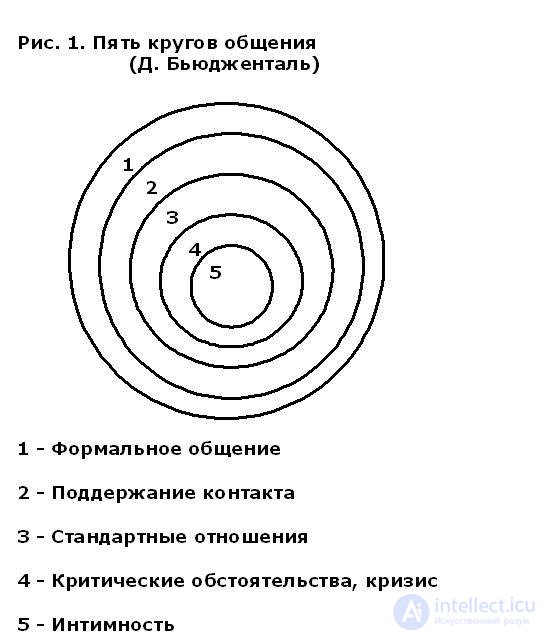
Dale Bugental argued that at the very center of communication lies intimacy, which we all, consciously or unconsciously, strive to achieve. However, this moment of intimacy often quickly vanishes in the bustle of everyday life, and some people never experience true close communication. Bugental explained that this happens because achieving intimacy in communication with another person requires overcoming four more levels, or circles, of communication.

Comments