
Lecture
Social communications – is the interaction of a small number of communicators who have the opportunity to see, hear, and touch each other, and to easily provide feedback. Social communications do not presuppose the presence of an intermediary, are distinguished by the immediacy of contacts, and are carried out at an interpersonal subject-subject level.
Communication is the process of creating, transmitting, processing, and exchanging information.
Social communication (SC) is a set of sign-symbolic forms of interaction of social subjects concerning the transmission, exchange, modification, and use of semantic content in various spheres of human activity.
Communication (obshchenie) is an interactive process of exchanging messages (information) to satisfy the needs of participants in the realization of joint activity.
Discourse – (speech, the process of linguistic activity) this is the language used by members of a certain linguistic community; the socially conditioned organization of the speech system, as well as certain principles according to which reality is classified and represented (presented) in one period of time or another
In defining interpersonal communications, two points are important:
The process of exchange, of orientation toward one another as the direct emotional interaction of people;
Mutual influence, mutual experience, and mutual understanding.
Hence social communications are the entire variety of social contacts that accompany a person throughout his life.
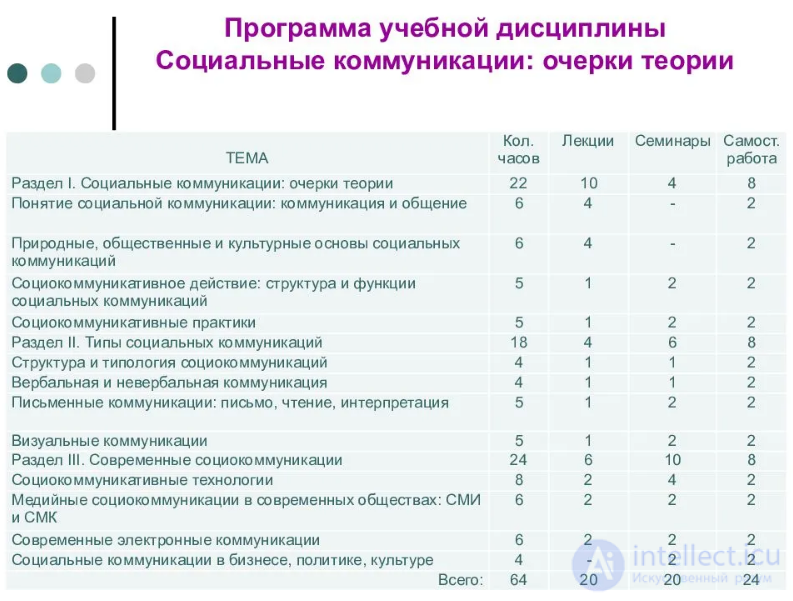
|
|
Section I. Social communications: essays on theory |
No. of hours |
|
1. |
The concept of social communication: communication (kommunikatsiya) and communication (obshchenie) |
4 |
|
2. |
Natural, social, and cultural foundations of social communications |
4 |
|
3. |
Socio-communicative action: the structure and functions of social communications |
1 |
|
4. |
Socio-communicative practices |
1 |
|
|
Section II. Types of social communications |
|
|
5. |
The structure and typology of socio-communications |
1 |
|
6. |
Verbal and non-verbal communication |
1 |
|
7. |
Written communications: writing, reading, interpretation |
1 |
|
8. |
Visual communications |
1 |
|
|
Section III. Contemporary socio-communications |
|
|
9. |
Socio-communicative technologies |
2 |
|
10. |
Media socio-communications in contemporary societies: mass media and mass communication media |
2 |
|
11. |
Modern electronic communications |
2 |
|
12. |
Social communications in business, politics, culture |
4 |
a) formal and informal;
b) institutional and spontaneous;
c) one-sided and two-sided
Absence of an intermediary.
Immediacy of contacts.
Interactivity.
Formation of a shared space of communication (shared joy, co-creation, participation).
Social communications as interpersonal interaction.
Social communications as part of mass communications.
Social communications and sociogenic needs
At the basis of social communications lies the satisfaction of sociogenic needs. Sociogenic needs are the needs for:
belonging;
success and achievement;
trust and security.
Formation of sociogenic needs in ontogenesis (E. Erikson)
| Stage | Age | Psychosocial crisis | |
| 1. | Infancy | Birth-1 year | Trust - mistrust |
| 2. | Early childhood | 1-3 years | Autonomy - shame and doubt |
| 3. | Early childhood | 3-6 years | Initiative - guilt |
| 4. | Late childhood | 6-12 years | Industry - inferiority |
| 5. | Adolescence | 12-19 years | Ego identity - role confusion |
| 6. | Early adulthood | 20-25 years | Intimacy - isolation, loneliness |
| 7. | Middle adulthood | 26-64 years | Generativity - stagnation |
conditions
Social communications - a way of understanding the surrounding world by means of:
The basis of social communications is interpersonal, dyadic communication.
The following areas of social communications are distinguished:
Interpersonal, through social perception.
Main mechanisms: identification, causal attribution.
Intergroup, through intergroup communication.
Main mechanisms: social comparison, stereotyping.
Intragroup, through relationships within the group.
Main mechanisms: conformity, leadership.
Means of social communications can be:
Direct (verbal and non-verbal) means.
Indirect (technical) means.
Non-verbal means of social communications
1. Visual means («eye contact»).
2. Kinesic means:
3. Acoustic means:
4. Tactile-kinesthetic means.
5. System of smells.
6. Spatio-temporal organization of communication (proxemic system).
7. Material attributes (clothing, badges).
8. Features of the color palette.
Socio-communicative action, behavior and activity Evolution of social and socio-communicative technologies: historical stages and trends Social and communicative technology Communication technique and technology Socio-communicative technique and technology Communicative technique and technology Diversity of socio-communicative actions, practices, technologies Economic, political, social and cultural context of the development and application of socio-communicative technologies Composition, structure, functions and orientation of communicative technologies. Foundations of the typology of socio-communicative technologies Evolution of socio-communicative technologies: historical stages and trends. Economic, political, social and cultural context of the development and application of socio-communicative technologies.
1. Basic concepts
Information and communication technologies (ICT) – are a set of methods and tools for collecting, processing, storing, and disseminating audio, graphic, textual, and digital information for the benefit of its users. Communicative technology (CT) – is a set of techniques, procedures, methods, and design schemes for constructing, transmitting, exchanging, modifying, and using semantic content in various sign-symbolic forms of human activity. techniques, procedures, methods, design schemes for constructing, transmitting, exchanging, modifying
2. Main approaches in communication theory
Cybernetic approach
Main claims: The concept of communication was developed within general systems theory and includes the basic principles and concepts of: hierarchy, homeostasis, adaptivity, equivalence, feedback. Communicative systems – are goal-oriented systems that regulate messages in order to achieve their goals based on the application of the most important principle of cybernetics – feedback. Communicative act. Communicative action. Communicative activity. Network organization of communicative space. The role of communication in organizing social order.
Cybernetic principles for managing communicative systems. Positive and negative feedback. First-order cybernetics (N. Wiener, change based on feedback) and second-order cybernetics (the mechanism of connection between the observer and the system, H. von Foerster). New principles for describing communicative systems in second-order cybernetics: autopoiesis and self-reference, operational closure, principles of the included observer. Practical management models in second-order cybernetics (P. Checkland's soft systems methodology, P. Merten's theory of spiral cycles, S. Beer's viable organizations, evolutionary management, and others) and their communicative aspects.
Informational approach
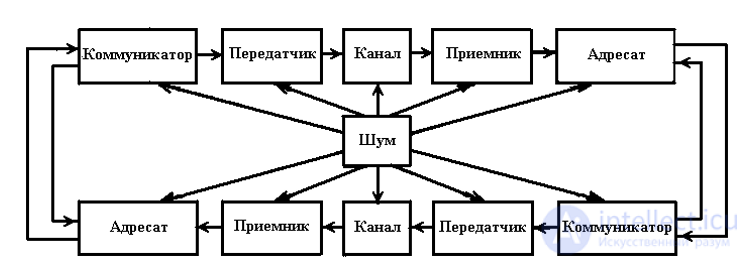
Main claims: Communication is based on the principles of transmitting and receiving information. The information that is transmitted is called a message. Messages have their own structure and can be transmitted over various types of channels (an «information channel»). There are various types of channels (presentational, representational, technical).
: The communicative process includes communicative noise, which affects the levels of understanding of information. Information and communication: an interdisciplinary interpretation. Authors of variant concepts: C. Shannon, W. Weaver, H. Lasswell. Basic models of communication (linear, interactional, transactional). Use of the information approach in the practice of PR activity, mass media, interpersonal, group, and public communication.
The model of the communicative process by Claude Shannon and Weaver. Initially the model included five elements: information source, transmitter, transmission channel, receiver, and final destination, arranged in a linear sequence (linear model). A later revised model included six components: source, encoder, message, channel, decoder, and receiver (cf. telephone). These terms, with varying success, were also applied metaphorically to other communicative systems. A message from the source is transmitted through the transmitter into the communication channel, from where, in turn, it reaches the recipient. In addition to these terms, Shannon also introduced the concepts of noise (later this came to be associated with the concept of entropy and, conversely, negentropy) and redundancy. Entropy (noise) in communication theory is related to those external factors that distort the message, disrupt its integrity, and its possibility of being perceived by the receiver
H. Lasswell's model of the communicative process The formula of the communication act consists in answering the following questions: “Who?” – “Says what?” – “Through which channel?” – “To whom?” – “With what effect?”» Subsequently, this construction, which became known as the Lasswell formula, was usually used to illustrate the range of main problems, the composition of communication: communicators, messages (content analysis), means of communication, audience and the results of the informational impact. Topic 1. The concept of social communication 2. Main approaches in communication theory
Linguistic approach
Main claims: a unique system of symbolic communication through vocal and written language signs; language is governed by rules and includes a set of conventional signs that have a common meaning for all members of the linguistic group; sign practice is a field for the formation and development of personality;
Semiotic approach
Main claims: Semiotics as the science of the properties of signs in communication. The relationship between the concepts of «sign» and «meaning». C. Peirce's structural-sign model. Direct and indirect (virtual) communication. C. Peirce's three types of signs (iconic, indexical, symbolic) and their use in communicative practice. Social functions of signs. C. Morris's semiotic concept: the connection of a sign with behavior and interpretation. Three levels of semiotic analysis of communications and their application in the sphere of business communications.
R. Barthes's two forms of meaning (denotation and connotation) and their role in communicative interaction. Barthes's concept of myth. Myth as a communicative system. The social-technological function of myth. Dominant, oppositional, and compromise myths. Technologies for constructing myths in advertising and PR. Metaphor and metonymy as ways of constructing messages and as forms of interpreting everyday experience. Semiotic theory of codes. Paradigm and syntagm. Codes in communication as rules for organizing signs and regulators of behavior. Social codes. Typology of codes: presentational and representational, complex and simple, mass and specialized, logical and conventional. Topic 1.
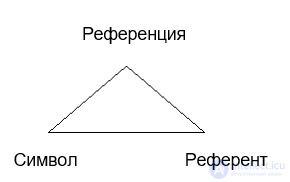
Semiotics as the science of the properties of signs in communication. The relationship between the concepts of «sign» and «meaning». In the first case, one speaks of models of the sign, rightly associating them with the names of F. de Saussure and C. Peirce, and the Ogden-Richards triangle; in the second case, it is a matter of the work of C. Morris and his distinction of syntactics, semantics and pragmatics. Sign models can be divided into dyadic and triadic. The best-known dyadic model is Saussure's model, according to which a sign is a combination of a concept and an acoustic image, the relationship between which can be compared to the two sides of a single sheet of paper. The triadic model is illustrated by the Ogden-Richards triangle:
Socio-communicative approach (theory of communicative action)
Main claims: Social communications possess the following properties and qualities: a) universality, ubiquity, permeability (diffuseness), and performativity of communicative action; b) heterogeneity and disorder of signs, meanings and senses; c) homogeneity and subordination of semantic structures; d) simultaneity of communicative flows; e) synchronicity of particular and general semantic unities.
Socio-communicative technologies arise spontaneously or deliberately in the course of numerous social actions aimed at achieving a beneficial effect. Thanks to developing socio-communicative actions, technologies and strategies, social agents deal both with real material things and people, and with ideal forms (signs, symbols, marks, etc.). A broad range of professional socio-communications in various fields provides for the flexible construction and management of consumption practices. This range includes public relations, branding, image-making, communication management, advertising, marketing, negotiation, mediation, and the mass media.
Elementary scheme of communication; basic communication links (communicant, object of communication, communication channel, recipient). Types of communication processes: genetic, spatial, semantic. Social communication as the movement of meanings in social time and space. Multidimensional classification of social communications.
Social communications as a complex socio-psychological system.
Socio-communicative activity: concept, forms (communication, management, imitation). The relationship between the concepts of social communication and communication. Communication as a form of communicative activity. Participants in communicative interaction and their communicative roles in various forms of socio-communicative activity.
Play and socio-communicative activity: the relationship between the concepts. The nature and purpose of play as a cultural phenomenon. Classification of game-based types of socio-communicative activity.
Communicative phenomena: concept, types (biogenic, sociogenic). Speech and memory (biological, individual, social) as communicative phenomena. Social memory: concept, structure. Retrospective (reified) and current (non-reified) social memory. Social memory and culture: the relationship between the concepts. Socio-cultural institutions as communicative phenomena. The pyramid of socio-communicative phenomena.
— Transcript:
Difficulties of interpersonal interactions
3 Factors of the social environment
Environmental factors
1. Physical factors (noise, temperature, lighting, design).
2. Frequency and nature of the use of technical means in communication.
3. Spatio-temporal characteristics («one's own» or «someone else's» territory, crowding, closeness ). 4. Hygiene habits.
Individual-personal factors
1. General personality traits (attentiveness, tactfulness, politeness, tolerance, hyperactivity, categoricalness, etc.).
2. Communicative traits (communication skills, verbal and nonverbal techniques, congruent reactions, code of politeness, ability to listen).
3. Self-presentation, self-disclosure and self-promotion.
4. Psychophysiological state of the partners (apathy, depression, sadness, emotional states).
|
Phenomena of the natural environment |
Phenomena of the social environment |
IT technologies |
Individual-personal qualities |
|
|
|
1. general personality traits; 2. specifically communicative traits. |
Communication channels: concept, multidimensional classification (natural, artificial, verbal, nonverbal, oral, documentary, electronic, hybrid types). Material and technical support for semantic social communication. Communication methods and means.
Channels of oral communication. Language and speech. Communicative functions of natural language. Scheme of oral communication. Verbal and nonverbal channels and means of communication. Natural language and sign language. Documentary channels of communication. Electronic channels and means of communication.
The law of cumulation of communication channels. The system of communication channels and means.
Meaning as a fundamental category of the theory of social communications. Meaning and the communicative message. The multidimensional semantic concept of meanings.
Meanings as the spiritual values of culture. Culturological meanings: concept, classification (personal, social, reified, non-reified, rational, irrational). Social memory and meanings (sign-based, instrumental, mental). Meaning and understanding.
The semiotic approach to social communications. Sign and sign systems: concept, classification (copy-sign, symbol-sign, communication signs). The relationship between the concepts: meaning, sign, text. Levels of sign systems.
The process of interpersonal communication (stages)
1. The beginning of communication (formation of attraction).
2. Continuation of interpersonal relations.
3. Stabilization of interpersonal relations.
4. Disintegration of interpersonal relations.
The beginning of communication: main levels
1. The perceptual (emotional) level.
2. The interactive (expressive) level.
3. The communicative (cognitive) level.
Formation of interpersonal attraction
1. At the perceptual level: –visual (physical) attractiveness; –emotional impressions (the law of irradiation of emotional relations (Wertsch)); –sex and age differences.
2. At the interactive level: –communicative competence; –behavioral characteristics; –level of self-disclosure; –the «law of trust» (Cheluni).
3. At the cognitive level: –the number of similarities generates trust (life plans, attitudes, goals, interests) («Byrne's law»); –the rule of «social comparison (Leon Festinger); –verification of viewpoints, self-assessments (the confirmation phenomenon); –the nature of interaction (psychological reinforcement).
Continuation of interpersonal relations
1. Degree of need satisfaction
. 2. Inclusion of various kinds of «filters» (K. Davis). –Perceptual filter (perception based on first impression). –Requirement of cognitive similarity. –Role interaction (complementarity theory).
Stabilization of interpersonal relations
Termination (disintegration) of interpersonal relations
The effectiveness of social communications
1. The beginning of communication - three gifts:
- mutual gaze - smile;
- compliment (indirect, «plus-minus», sincerity);
- proper name.
Civilization: etymology of the term, essence, definition. Civilization, culture and social communications: correlation of concepts. Sociotechnological revolutions and the change of civilizations: main stages.
Intercivilizational communications as a movement of meanings in social historical time and space. Synchrony and diachrony of intercivilizational communications. Intercivilizational communications in religion, science, fiction literature and other areas of human activity.
The concept of social communication systems. From zoo-communication to social communications: main classes of social communication systems (communal, manuscript, manufactory, industrial, electronic) and levels of development of communication culture (oral, verbal literacy, writing, book culture, screen culture).
Patterns of evolution of social communications.
Society as the environment of social communications. Social communications as a factor of sociogenesis. Social consciousness and mentality. Public communicative needs.
The state and social communications. Socio-cultural institutions and their role in the development of social communications.
Mass communications.
Personality and social communications. Interpersonal communications.
1. Social communications – this is:
Answer: c) a system of interrelation of people in society.
That is, this is communication, the transmission of one or another information between people in a separate social group (class, group, team).
2. Activity – this is:
Answer: c) an active form of realizing a life program, transmitted genetically from one generation to another, allowing successful adaptation to the environment, occupying and maintaining one's biological niche.
Since activity is essentially the performance of some work or actions, some are inherited, such as performing activities to provide oneself and loved ones with housing, food, and continuation of the family line.
3. Remove the element that is not part of the structure of social activity.
Answer: a) subjects;
c) means;
d) purpose.
The basis of social activity will always be the subject (the one who does), the object (at whom the actions are directed) and the purpose (achievement of the final result).
4. Aristotle's linear model includes:
Answer: b) source of information, encoding device, transmitter, channel, decoder, receiver, recipient of information.
Aristotle derived a linear model of interaction between people, in which at the beginning there is a source of information (for example, a person possessing some significant information), then an encoding device (a certain code for transmitting this information), then a transmitter (most often the one who issues the necessary information), then a decoder (engaged in deciphering the transmitted code), then a receiver and recipient of information (the person receiving the information).
5. Noise as a form of entropy in communication – this is:
Answer: d) external factors distorting the message, disrupting its integrity and the possibility of its perception by the receiver.
That is, entropy (noise) in communication theory is connected with those external factors that distort the message, disrupt its integrity and the possibility of its perception by the receiver.
6. «Synthesis of other forms of communication and integrated use of specialized communicative-informational means». Which form of communication does this definition characterize:
Answer: d) multimedia.
Multimedia is the simultaneous use of various forms of information presentation and its processing within a single container object. Based on this definition, one can conclude that it is precisely the "synthesis of other forms of communication and the integrated use of specialized communicative-information tools" that constitutes multimedia.
7. "Potentially dangerous due to falling out of general social communications and isolation of the communicant (group, individual)." Which type of communication is characterized by this definition:
Answer: a) autocommunication.
Autocommunication implies communicating with oneself. This is particularly clearly observed among people with disabilities and in groups with shared interests.
8. The goal of social communication is:
Answer: b) the intended result, its model.
This means that any interaction between people in society is in one way or another aimed at achieving a certain result.
9. The plane of expression of written communication is:
Answer: d) a pictogram.
A pictogram emphasizes the characteristic features of the depicted object. We encounter pictograms daily — these are icons denoting road signs, certain buildings (hospitals, schools, etc.), internet links to websites.
10. The denotation of a sign is:
Answer: b) a specific thing, phenomenon, process;
Denotation translates from Latin as designation, a set of ontologically articulated objects denoted by a given name. For example, the denotation of the name "Morning Star" is the planet Venus, the star visible longest in the morning sky.
11. Gestures as an element of nonverbal communication are:
Answer: d) a way of using the hands as signs.
That is, people, for example, who lack hearing or voice exchange information using a system of gestures, and gestures are certain sign systems reproduced with the help of the hands. Likewise, every person resorts to gesturing during communication, for example, pointing in the direction one should move.
12. Remove one of the characteristics that does not relate to the differences between communications in society and communications in communities:
Answer: a) consciousness;
c) presence of meanings;
d) use of speech.
Society is a group of people who have united at a certain stage of historical development. A community is a group of people united by a common task or interest (for example, a work team).
13. "The initial impetus for creating words was considered to be not the external world, but the internal emotional states of a person. A person expressed their emotional states not only verbally but also nonverbally." Which theory of the origin of speech does this characteristic relate to:
Answer: b) the social contract;
The social contract is an agreement concluded within a society (group), with all its internal experiences and emotional states.
14. Jakobson's model of social communication includes:
Answer: c) the communicant, the message, the recipient;
Jakobson developed a model of social communication in which there exists a communicant (who possesses information) – a message (transmission of information) – a recipient (who receives the information).
15. Interference as a form of entropy in communication is:
Answer: b) deliberate distortion of the message, disruption and hindrance of the communication process.
Entropy is noise, noise accordingly means interference in the process of perceiving information, from which arises inaccuracy of the information received and its distortion.
16. "Requires unification, leads to a constant increase in the number of documents – clutter, which creates management problems." Which form of communication does this characteristic relate to:
Answer: b) written.
Bureaucracy – or officialdom, from which comes paperwork. Currently, to achieve a certain goal (for example, processing a privatization) one needs to collect/provide a certain number of written documents. This process entails certain inconveniences and, in the end, problems.
17. The structure of the organization of signs, norms and principles of message construction is:
Answer: d) meaning.
Meaning in a sentence is its key phase. With a certain arrangement of signs, norms and principles, a sentence can convey the intended or a mistaken meaning.
18. A type of social communication characterized by the greatest degree of depersonalization and virtualization of its participants:
Answer: d) mass.
Mass character is an accumulation of a large number of people, which automatically leads to the depersonalization and virtualization of its participants.
19. The referent of a sign is:
Answer: b) a specific thing, phenomenon, process.
A referent is an object of extralinguistic reality that the speaker has in mind in the context of a specific linguistic situation; the subject of reference.
20. Facial expression as an element of nonverbal communication is:
Answer: a) a way of using facial expression.
Through facial plasticity a person can express their emotions: joy, sadness, anger, surprise.
21. Proxemics as an element of nonverbal communication is:
Answer: b) a way of using space.
Proxemics is the mutual positioning of interlocutors at the moment of their physical, visual or other contact.
22. According to E. Berne, «the interaction (exchange of remarks) of two «ego states» of personalities» is:
Answer: a) perception.
According to E. Berne, perception is the perception, evaluation and understanding by social subjects.
23. A smiley as a sign belongs to the following type of communication:
Answer: b) written.
A smiley is a certain sign thanks to which a certain emotional coloring can be given to a sentence (joy -, sadness - etc.).
24. A pictogram as a sign belongs to the following type of communication:
Answer: c) visual.
A pictogram enhances the characteristic features of the depicted object, and a person perceives the image visually.
25. A gesture as a sign belongs to the following type of communication:
Answer: c) visual.
Gestures are a visual type of communication since the reception of information occurs through sight.
26. An object (thing) as a sign belongs to the following type of communication:
Answer: d) multimedia
An object is a multimedia type of communication since it is the transmission of information by means of various objects/things.
27. In semiotics, «the type of phenomenon, process, object» in the structure of a sign is:
Answer: a) stigmat
28. In semiotics, «a specific thing, phenomenon, process» in the structure of a sign is:
Answer: d) significate
The significate is the area of semantic content of a linguistic unit, which contains characterizing information about the designated object.
29. In semiotics, «the representation of a process, object» in the structure of a sign is:
Answer: b) denotation
Denotation is a designation, a set of ontologically articulated objects designated by a given name.
30. In semiotics, a photograph, according to the degree of relation of the sign to the signified, belongs to the following type of sign:
Answer: a) iconic
An icon – is essentially an image of a person.
31. In semiotics, road signs, according to the degree of relation
Answer: c) symbolic
Symbolic since they are denoted by means of signs (triangles, lines, rectangles).
32. In semiotics, allegories, according to the degree of relation of the sign to the signified, belong to the following type of sign:
Answer: b) indexical
In combinations of signs they direct the interpreter's attention to parts of the environment.
33. Reflection belongs to the following type of communication:
Answer: a) mass
The mass (crowd, gathering of people) – here the reaction to information is displayed according to the reflex principle.
34. Addressing an imaginary interlocutor belongs to the following type of communication:
Answer: d) quasi-communication
An example of quasi-communication can be a child's communication, their play with imaginary friends.
35. The «Vesti» television program belongs to the following type of communication:
Answer: a) mass
«Vesti» is mass communication since it is aimed at conveying information not to a specific group of people, but to the entire population as a whole.
36. Publishing and distributing advertising booklets belongs to the following type of communication:
Answer: b) interpersonal
Magazines and newspapers (depending on their focus (technical, needlework)) are aimed at a specific category of the population, each person buys a magazine or newspaper for their own needs.
37. Friends talking on the phone belongs to the following type of communication:
Answer: b) interpersonal
Since the exchange of information takes place between specific people interested in transmitting and receiving this information.
38. Receiving an order from a superior by a subordinate and the latter's report to superiors according to regulations belongs to the following type of communication:
Answer: b) interpersonal
An order is most often addressed personally, to a specific person or group of people.
39. Discussion of a national idea (national dream) belongs to the following type of communication:
Answer: c) group
Most often these problems are discussed by a certain number of people.
40. Interpersonal communication is carried out at the following levels:
Answer: c) Microcommunication
Micro means small, interpersonal – implies a certain, small number of people.
41. International relations are carried out at the following level:
Answer: b) Macrocommunication
Macro, on the contrary, means large.
42. The search for extraterrestrial civilizations is carried out at the following level:
Answer: a) Megacommunication
Mega – that is, communication covering a huge number of people.
43. Intonation belongs to the following elements of nonverbal communication:
Answer: d) paralinguistic
Paralinguistic means are not part of the language system and are not speech units, however, to one degree or another, they are present in every speech unit, accompanying speech.
44. Touch belongs to the following elements of nonverbal communication:
Answer: c) tactile communication
45. A grimace belongs to the following elements of nonverbal communication:
Answer: a) facial expression
Facial expression is the expressive movement of facial muscles, which is one of the forms of manifestation of certain feelings.
46. Shaking one's head in response to a question belongs to the following elements of nonverbal communication:
Answer: d) gestures
A gesture - an element of pantomime, performed with the help of actions - with the hands. They are divided into illustrative, serving some expressed thought, and expressive -, indicating emotions- or intentions- of a person.
47. A handshake belongs to the following elements of nonverbal communication:
Answer: c) tactile communication
Tactile communication - the transmission of information by means of touch (contact).
48. Sighs during a conversation belong to the following elements of nonverbal communication:
d) paralinguistic
49. A half-turn of the body of one of the speakers toward their partner belongs to the following elements of nonverbal communication:
Answer: d) gestures
50. Distancing oneself from an intrusive interlocutor belongs to the following elements of nonverbal communication:
Answer: b) proxemics
1. Social management in the broad sense means:
A. Measuring social characteristics and recording the results
of empirical research and expressing them in terms of social management.
B. Managing all social processes.
C. Developing formalized models focused
on the choice of means of formal description relevant to the studied aspects of social systems.
D. A wide range of means ensuring the interaction
of the constituent elements of the social system through
social regulation.
2. How do the regularities of the functioning
and development of managerial relations manifest themselves?
A. Only through the subject of management, since the bearer of interests conditioned by the diversity of states and positions of participants in the management process is the subjects of management.
B. In the form of a stable interconnection of common and particular interests of participants in managerial activity. The main
connections underlying the manifestation of the regularities of social management are formed based on the nature
of the impact of the subject on the object of management.
C. Coordination of the special personal interests of the subjects of managerial activity forms the regularities of the functioning and development of managerial relations.
D. Such regularities include: the mutual influence
of the special interests of the subjects of management; the unity and independence of these interests; the social orientation of the responsibility of the subject of management.
3. What are the principles of social management?
A. The most important link in the mechanism of social management, the starting point of the theory of social management, synthesizing social laws, regularities
and specific approaches to their implementation, guiding the formation of the necessary qualities of managers.
B. Principles of social management — secondary requirements that are not always followed by elements
of the managed social system.
C. Provisions developed in accordance with the theory and technology of social management, applied
in crisis management situations.
D. Provisions of social management in society or specific communities conditioned by regularities,
manifested at the particular level.
4. Which of the options listed below most fully
reveals the entire complex of basic principles of social management (except organizational ones)?
A. State management and self-government, the impact of management bodies on social processes,
connections and relations.
B. Scientific validity, democracy and centralism,
social expediency, objectivity, complexity, systematicity, social orientation of management,
efficiency, self-regulation, competitiveness, competition, stimulation.
C. Ordering the system of social relations, comprehensive management of social processes based on initial rules and norms of activity.
D. Integration of individual types of management activity
at various levels of the management system, mutual coordination of management elements and coordination of efforts
to achieve common goals.
5. Identify the most important organizational principles applied in the practice of social management.
A. Principles of the main link, division of labor, hierarchy and feedback, problem orientation, purposefulness, targeting, publicity.
B. Organization of the management process, principles of close
interconnection and indissoluble unity.
C. Organizational principles built by various
authors based on their own classification of principles of social management.
D. A general classification, acceptable for all types and kinds
social systems and social management.
6. The simplest (basic) model of social management
can be represented as:
A. A model of innovative management, including the following components: rationalistic, innovative,
strategic, humanitarian, information-analytical, anti-crisis, personnel management.
B. An abstraction of a real phenomenon, a mathematical description
of specific social phenomena.
C. A concrete scheme of the interrelations of the subject and object of management,
simultaneously interacting with the external social
and natural environment and encompassed by direct and feedback links.
D. A set of connections in the management system, boundaries
or points of managerial influence.
7. The most general scheme of modeling in the system of social management includes the following stages:
A. Construction of the model's design; inference by analogy; construction of scientific hypotheses; practical verification of the information obtained by means of the model and the use of the information obtained for constructing
a generalizing theory.
B. Sequential description of the structural-functional,
causal, and genetic links between the components of the system.
C. Isolation of the rationalistic, innovative, strategic, humanitarian, information-analytical, and anti-crisis components of the social system.
D. Development of formalized models, choice of means of formal description.
8. In the technology of social management, models are used:
A. To solve problems first in the most general form, without any detail, and subsequently — to solve the simplest problems in a more concrete form.
B. To study the object of social management with the aim of subsequently constructing principles and methods of managerial influence on the object and as a construct
for various options for managing the social object.
C. For the obligatory qualitative description of the social system, without subjecting it to formalization.
D. To assess the state of the subject of management, prepare
a forecast, and on this basis make some decision.
9. The key problems in applying the method of social modeling in the sociology of management are:
A. The problem of creating basic conceptual models of social phenomena and processes, developing formalized models oriented toward the choice of means of formal description relevant to the aspects being studied
of social systems.
B. Rationalization of methods of managing objects, study
and application of models.
C. Methods of self-regulation of the system, ensuring the interaction of its constituent elements through normative (including legal mechanisms) regulation.
D. Reproduction of the properties, connections, and trends of the systems and processes under study
for the purposes of their systematization, assessment of state, and preparation of a forecast.
10. Social planning is:
A. Ensuring the rigor and validity of a decision based on a comprehensive examination of the problem, taking into account the real situation, and the most precise creation of a system
of indicators reflecting the real social object.
B. A function of social management, including the determination of goals, indicators, timeframes, and rates of development of social
processes, as well as the main means of their implementation.
C. Representation in the form of a concrete scheme of the interrelations of the object and subject of management.
D. Creation of basic conceptual models of social phenomena and processes.
11. The objects of social planning within the framework of social management are:
A. Subjects of social management.
B. Objects that are in a state of crisis.
C. Exemplary models of social systems.
D. Those social objects toward which social-managerial actions are carried out.
12. Social design/planning is:
A. One of the forms of developing and making a decision, an important element of control.
B. Necessarily a multivariate reflection of future reality
indicating some specific timeframes for the development of events.
C. Creating a prototype of the object proposed for study, by developing new social problems.
D. Expressing the prognostic function
of management in a specific form.
13. Social norm-setting makes it possible to:
A. Streamline social relations between social
groups, collectives and individual workers by
introducing various social norms.
B. Bring social norms into line with the expectations
of representatives of the most vulnerable segments of the population.
C. Standardize the physical workload on workers to
prevent excessive strain.
D. Sharply increase the life expectancy of the population.
14. The development and implementation of specific measures to solve social problems includes:
A. Purposeful managerial impact, including
goal-setting and goal implementation.
B. Leadership, the prestige scale, mechanisms of informal
group formation, social norms.
C. The core of the management mechanism, social self-organization, and organizational order.
D. Official decisions, administrative order, etc.
15. The subjects of social management include:
A. Leaders, social organizations that exercise purposeful influence on the object of management, as well as
social processes and other social phenomena that have a systematic, consistent impact on the social object and lead to its change.
B. The external social environment relative to the object (economic, political, cultural-spiritual and social components).
C. Social processes and other social subjects
that have a systematic, consistent
impact on the social object and lead to its change.
D. The highest management bodies.
16. The mechanism of social control includes:
A. Verification of the correctness of the execution of assignments and orders.
B. Observation of the process of task execution.
C. Punishment for poor performance of assignments or incorrect actions.
D. The mechanism of social control includes social norms, social sanctions, public evaluation, public opinion, as well as the influence of traditions (national,
family, etc.), value orientations, etc.
17. Social norms are:
A. A regulator of emotional relations that affects people.
B. A prohibitive mechanism operating through the activity of the judicial authorities, punishing citizens for unacceptable forms of behavior.
C. Accepted social standards of activity, forming relations, actions and behavior of people in accordance with certain values inherent in a given society, community, group.
D. A permissive mechanism providing citizens with certain rights in agreement with legislative authorities.
18. Social sanctions:
A. A means of social control over actions
within the requirements of social roles, stimulating
people to observe norms.
B. Means of encouragement and judicial punishment.
C. Legal sanctions applied for violation of economic, moral, religious and other norms.
D. Encouragement for actions desirable to a certain corporate system.
19. Sociological diagnostics in the system of social management plays the following role:
A. Information support for the management of relevant social objects based on theoretical
ideas and research methods developed by sociological science, technology for comprehensive analysis of the state of social objects and social aspects of other social systems.
B. Performs a sociological analysis and assessment of the state
of the subject of social management.
C. Comprehensively determines the properties of the object most easily amenable to management for its subsequent recruitment to one's side.
D. Comprehensively identifies problems requiring the involvement of additional resources.
20. What procedures are applied at the stage of monitoring the managed system:
A. A complex of sociological, psychological, statistical, mathematical, and other methods
B. A continuous process is organized for searching, grouping, and comprehensively processing indicators for the purpose of operational assessment and forecasting of possible states
of the managed object and its levels, and developing corrective-preventive measures of managerial influence.
C. Measurement (measurement of social characteristics)
and descriptive (recording the results of empirical research and expressing them in terms of social management) functions.
D. Explanatory (revealing the essence of managed objects and management subjects), criterial (verifying the truth of hypotheses and theoretical statements), and predictive (assessing the
future state of the managed system) functions.
21. What do indicators characterizing the state of a managed social object represent?
A. Indicators of a managed object are social phenomena external to the object.
B. The ratio of measured positive, neutral, or negative characteristics of the object to similar nominal characteristics.
C. Indicators represent a direct reflection of certain properties of a given object — a phenomenon, process, system, etc.
D. A quantitative measure of measuring any values
of the object.
22. What is the main condition for selecting indicators to characterize a managed object:
A. The presence of a set of indicators representatively reflecting the properties of the object in a given management cycle.
B. A description of the properties of the object, representing a set of interrelated elements used to create specific constructs formed by combining desirable characteristics of the object.
C. The presence of stable connections between the features that the indicator reflects and the characteristic that the researcher intends to measure.
D. In the modeled research system, a system of indices needs to be formed that can informationally represent the corresponding indicators, adequately
reflecting the properties of the subject of management
23. At the stage of developing a system of managerial actions,
the procedures for executing managerial acts implement the
following algorithm of actions:
A. 1) Determination of the object of observation.
2) Survey of the selected object.
3) Formation of a system of indicators by which
information will be collected and creation of a model for the informational analysis of the object of observation.
4) Determination of the measurement methodology.
5) Identification of the state of the object of observation.
6) Forecasting changes in the state of the object of observation.
7) Transformation of information into a form convenient for use.
B. 1) Forecasting changes in the state of the object of observation.
2) Transformation of information into a form convenient for use.
3) Survey of the selected object.
4) Formation of a system of indicators by which
information will be collected and creation of a model for the informational analysis of the object of observation.
5) Determination of the measurement methodology.
6) Identification of the state of the object of observation.
7) Determination of the object of observation.
C. 1) Determination of the object of observation.
2) Survey of the selected object.
3) Formation of a system of indicators by which
4) Forecasting changes in the state of the object of observation.
5) Converting information into a form convenient for use.
6) Determination of measurement methodology.
7) Identifying the state of the observation object.
D. 1) Determination of the observation object.
2) Examination of the selected object.
3) Forecasting changes in the state of the observation object.
4) Converting information into a form convenient for use.
5) Determination of measurement methodology.
6) Identifying the state of the observation object.
7) Formation of a system of indicators, by which
information will be collected and creation of a model for informational analysis of the observation object.
24. Feedback connections, adjustments of management decisions. What is produced at the stage of activating the feedback mechanism?
A. Synthesis of all factors and the system of information about the state of the managed object and the relations of the subject of management to the object.
B. An additional element is included in the feedback channel in order to check the reaction of other subjects
of management to the management action.
C. The action carried out by the subject of management is clarified, in the form of a system of information about the state of management commands that must be applied in accordance with the given program.
D. Analysis of information received via the feedback channel,
and on this basis corrections are made to the management process.

Comments