
Lecture
Cultural memory – this is memory preserved in rituals, commemorative practices, and cultural artifacts; it underlies identity. Communicative memory – this is memory formed in the process of everyday communication among all participants, thereby demonstrating their collective identity. Over time, communicative memory transitions into cultural memory. Assmann developed the concepts of cultural and communicative memory, which constitute a community's collective identity. Collective identity – is a conception of oneself, created through shared values and norms, experience, expectations, and interpretation of phenomena. It manifests itself in the memory, knowledge, and language of the community. A unit of a community's communicative memory can be considered, for example, internet memes or other works of art such as paintings, books, etc.
Collective memory — a conception of the past, shared and constructed by members of a social group. It has a meaning close to the concepts of: social memory, historical memory, cultural memory. The term was introduced by the sociologist, philosopher, and social psychologist, a representative of the French sociological school, Maurice Halbwachs — the founder of scholarly research into collective memory. Despite prolonged study of the phenomenon, there is still no unified conception of its object and subject matter, just as there is no unified theory of collective memory.
Social memory is – a set of sociocultural means and institutions that select and transform current social information into information about the past (retrospective) for the purpose of preserving accumulated social experience and passing it on from generation to generation.

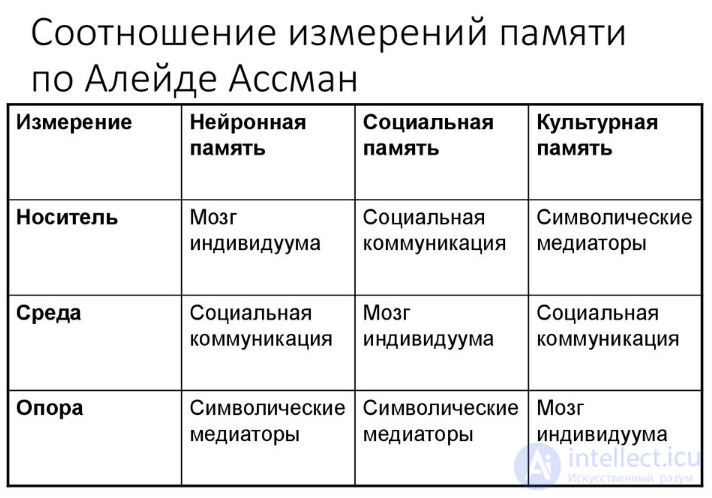
Communicative memory encompasses the content of memory that is constantly changing in the process of everyday communication within social groups. We exchange memories, rumors, or news with colleagues, friends, and family members in places such as train compartments, waiting rooms, or the family dining table. Drawing on the work of the sociologist Maurice Halbwachs on collective memory, Jan Assmann argues that the individual forms their memories by constantly exchanging them with other members of the groups to which they themselves belong. Unlike cultural memory, communicative memory is characterized by informality and instability, since within this type of memory there occurs not only an exchange of information but also a constant change in the spheres of its use:
«The horizon of communicative memory does not exceed 80-100 years, the lifespan of three generations, which means that this memory is embodied in those who serve as its bearers and find new uses for it» (Assmann, J. and Czaplicka, 1995).
Once memory of the everyday has been formed, the boundaries of communicative memory shift into the realm of cultural memory. Ephemeral speech needs to be embodied in text, images, rites, or monuments in order to acquire the stability of a cultural sign. This embodiment frees it from its former bearer and turns it into an object of memory with long-term semantics, which will be drawn on by the institutions of social memory: media, libraries, archives, museums, universities, and so on. (Assmann, J.,2002, Assmann, J. and Czaplicka, 1995)
Unlike communicative memory, cultural memory is not limited to three generations. On the contrary, it is fixed within the framework of a calendar, holidays, and commemorative events, and is thus distanced from everyday life (Assmann, J. and Czaplicka,1995). Like communicative memory, cultural memory maintains closeness to social groups and makes possible the construction of identity, the reconstruction of the past in the present (ibid.: 128,130). It is precisely these properties of cultural memory that allow Aleida and Jan Assmann to consider it a form of memory.
The main function of collective memory is to maintain group identity and resolve the problem of identity crisis. A phenomenon such as a community's representation of itself cannot do without knowledge and ideas about the group's or collective's past. Concepts concerning collective memory arise during periods when society is experiencing an identity crisis. This explains the surge of interest in the problem of collective memory in the last decade of the 20th century.
Collective memory is an interdisciplinary field of research (sociology, history, social psychology, philosophy and other sciences). Among the main contemporary studies of collective memory in Russian scholarship one can include the numerous works of T. P. Emelyanova, in particular, studies of ideas about historical figures, a study of different generations' memories of the Great Patriotic War, and a study of ideas about the era of Peter I. Among the most important contemporary foreign studies one should mention the works of J. Assmann, who divided collective memory into communicative and cultural memory, and the studies of J. Olick, who examines memory from the standpoint of process-relational methodology, among others.
Aleida Assmann distinguishes two types of autobiographical memories: me-memory and I-memory (Assmann, A., 2006).
The passive form of memory — me-memory (mich-gedächtnis) — catches us unexpectedly. Words, photographs, smells, sounds, and places act as detonators for memory images breaking through to us. For example, the smell of coffee being made transports me to childhood — to my grandparents' house; and this, in turn, evokes other images and emotions in memory. In contrast, active I-memory (ich-gedächtnis) means a conscious attempt to remember the past. Verbal and declarative by nature, I-memory explains our identity to those around us and to ourselves, supplementing the past with its interpretation.
We use the resources of this type of memory to create a story about ourselves. Let me give just one example of how the spaces of the National Gallery turn out to be decisive for understanding the nature of I-memory.
In 2005, the writer Gerd Brantenberg spoke out against the new principles of exhibiting paintings in the National Gallery, recounting her past in the article «The Sacred Space of Art Has Been Shattered»:
«I first came to the gallery when I was twelve years old. I went there alone, on my father's advice, to see Johan Dahl's painting «View of Stalheim». I felt brave, I felt my own importance, as I climbed the enormous stairs to the first floor. My father had explained to me exactly where this painting hung: after climbing the stairs, I had to turn into the room on the right. And there it was — a gigantic, darkened painting, with a rainbow over the mountains and countless tiny objects at their foot» (Brantenberg, 2005).
Gerd Brantenberg goes on to describe exactly how she remembers the intense experience of looking at the landscape painting displayed in that hall. Fifty years later, the writer particularly notes how upset she was by the restructuring of the exhibition. Everything that happened to the exhibition in the National Gallery «trampled her human soul». In her personal experience, her own history and the fate of national art and architecture were united.
Maurice Halbwachs argues that there is no such thing as purely personal memory. Every day we share our memories with other people in the process of communicating with them. And even if we experience something alone, our memory of that event is shaped by how the people around us perceive that event. Over time, as the exchange of impressions is repeated, our memory becomes increasingly colored by emotions and subjective opinions. Individual images suddenly begin to express a full-fledged attitude toward life, to highlight a person's or a family's character, to reveal the moods of an entire period of one's personal life.
If we agree with Maurice Halbwachs's reasoning, then we cannot fail to recognize that Gerd Brantenberg's memory most likely arose thanks to the repeated reliving of events from half a century ago. By saying «my father said then» and «my father explained then» instead of «my father said» and «my father explained», Gerd Brantenberg indicates that she most likely remembers this poorly. But the writer remembers much better the later accounts her parents gave of this heroic adventure of hers. Gerd Brantenberg managed to create a laconic memory of the image of the gallery, which at the same time reveals a great deal about her independent character and about her inherited ability to appreciate Norwegian landscape painting.
Maurice Halbwachs also points out that the man-made environment is the main instrument for constructing our past experiences. By objectifying the environment, we appropriate it and inhabit it: houses, streets, and cities are transformed into spatial contextual frameworks for the new living-out of various stories of our lives (Halbwachs, 1980).
In the example under consideration, Gerd Brantenberg turns to the spaces of the gallery mainly not so much in order to remember the building itself, but in order to tell the story of her childhood. She used personal memories as an argument for preserving the building and the exhibition display.
The French historian Pierre Nora found a crystallization point for national communities, using the term lieux de mémoire. This term can be translated as sites of memory, spaces, or realms of memory. Appearing in an era of transition from a culture of memory to a culture of history (i.e. from oral to written — translator's note), these sites of memory arise because spontaneous memory no longer exists. Institutions must activate memory, which does not arise by itself in society (Nora, 1989).
Through institutions, the nation produces shared sites of memory that are simultaneously material, symbolic, and functional. Their task is — «to stop time, block the workings of oblivion, fix the state of things, move from death to immortality, materialize the immaterial — exactly as if gold became the sole memory of money — and all this in order to pack the maximum meaning into the minimum of signs» (ibid.: 19). These sites of memory serve to preserve the identity of a human community and link its present to its past.
Now it becomes clear why the architect Peter Butenschøn repeated almost the same words that were spoken in parliament more than a hundred and fifty years ago: the gallery was built for the purpose of «establishing cultural autonomy and dignity, as well as affirming Norway's belonging to the international community». In today's reality, given Norway's involvement in international affairs, no one would question its cultural autonomy or its belonging to the international community. However, the history of the gallery, having become a shared narrative of a comparatively young state, is as relevant today as it was in the 19th century. The gallery became the contextual framework for this narrative.
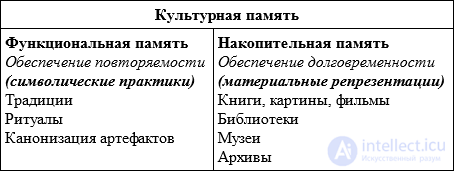
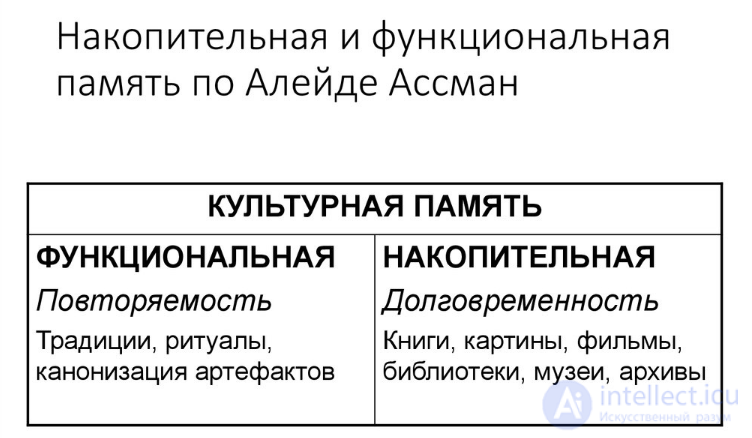
Instead of opposing subjective and selective memory to objective and critical history, Aleida and Jan Assmann propose distinguishing two perspectival modes of existence in culture, inherent simultaneously to both culture and history (Assmann, A., 2006a:130ff, Assmann, J. and Czaplicka,1995). Functional memory (Funktionsgedächtnis) — is the mode of actuality, which becomes the foreground of cultural memory. It is what a community or nation actively uses for the continuous reproduction of its identity.
This mode determines a group's relationship to its past and future through a strict selection of canons, exhibitions, curricula and, as we have already seen, sites of memory. One of the tasks of functional memory becomes the development of a «politics of memory», which determines exactly what a given group should remember: such memory legitimizes the group's existence, endowing it with a genealogy (Assmann, A., 2006a:138). Storage memory (Speichergedächtnis) exists only in the mode of possibilities, thereby forming the background of cultural memory (ibid.: 140). It houses a variety of relics of the past that are either not introduced into functional memory or have lost their former relevance within it.
Such memory cannot serve to preserve identity, but represents an archive of an indeterminate volume of information, data, and documents. Not tied to the bearers of a society's identity, storage memory can be regarded as a reservoir for future states of functional memory and as a corrective for the already existing functional memory. Society obliges certain institutions ― libraries, universities, museums, archives, etc. ― to fill, organize, and preserve storage memory.
The National Gallery faced the task of contributing to the storage and functional memory of the history of Norwegian art. From a report on the state of art museums in Norway, presented in the 1970s, it is clear that this task was already recognized at that time: «Indeed, there are very few research institutions, let alone museums, that stand, on the one hand, in close connection with material assets and, on the other hand, in contact with the public, in whose activities the distance between direct scholarly research and its popularization is reduced to a minimum» (Willoch et al., 1972)
While the exhibition halls served functional memory, unfolding the official history of Norwegian art before the wider public, the storerooms and archives served storage memory, weaving together the scattered threads of the history of Norwegian art. In 2005, the hall known as the Munch Room (Munchsalen) was closed: changes were being made to the exhibition. Starting from 1937 — with the exception of the period of German occupation — this hall had continuously displayed the best works of Edvard Munch, including the artist's most outstanding paintings — «Madonna» and «The Scream».
When the hall was reopened, some of the paintings found no place in it, while the remaining ones were placed in a different context, ending up in the company of works by Picasso, Van Gogh, Degas, and Gauguin (Harbo, 2006). The artist Karl-Erik Harr asked the Swede Sune Nordgren — the gallery director responsible for the changes to the exhibition: what is it like «to juggle history, the past, the future… as if you were the almighty Lord» (Harr, 2005).
For him, as for many other representatives of the Norwegian intelligentsia, the change to the canon of the Edvard Munch exhibition was unacceptable. Soon the National Gallery reopened the Munch Room. But when it was announced this year that the art collection would be moved to a new building, Sjur Harby spoke as follows about the coming losses in the exhibition in the Munch Room and in the other exhibition spaces:
«Of course, this is, first and foremost, painting, pictures, but at the same time also concepts, phenomena, which, being displayed on the walls of the gallery, are inseparably linked with our awareness of ourselves as a people and as a nation» (Harby, 2009).
The artistic canon did not simply become a shrine for the nation that must be kept inviolable. The exhibition halls themselves also had to form a spatial framework context for experiencing the artistic canon. Just as Gerd Brantenberg organizes her personal memories within the spaces of the collections, so too does the nation organize its cultural history with reference to buildings. This statement obviously applies to the canon, in other words, to functional memory.
Storage memory and functional memory
If living memories are irretrievably lost with the passing of the person who carries them, material traces of culture have a chance at a «second life» in institutions outside their former functional context
. What finds a place in museums, libraries, and archives, and is collected, stored, and catalogued there, gets a chance at an extraordinary extension of its existence. However, the prerequisites and conditions for the emergence of cultural memory are still described quite incompletely in this way. For cultural memory is created not only after the fact, through the collecting and preserving of objects of the past, but also through the purposeful selection and shaping of what must be carried over from our own day into the future for an indefinite period. To better understand both of these aspects of cultural memory, a distinction should be drawn in the dynamics of cultural memory between the «storage memory» and the «functional memory» of a society. This distinction reflects the contradictory structure of memory, in which remembering and forgetting are combined, mutually interpenetrating one another. For much of what we forget is not lost forever, but merely becomes temporarily inaccessible.
What sinks into the indistinctness of oblivion in individual memory can, under certain circumstances, resurface, just as the «madeleine» cake awakened in Proust's lyrical hero memories of what had been deeply forgotten. Often what we call forgetting is merely a latent memory to which we have lost the password; if it happens to be found, a piece of the sensuously tangible past unexpectedly returns to us. One can speak of such a return when certain elements that have settled into storage memory are newly actualized in consciousness, and, conversely, it is precisely these preserved elements that shape present-day thought. In Walter Benjamin's words, traces of the past, coming into contact with present-day thought, give rise to a state of «legibility». Ever new kinds of «elective affinity» keep arising between the ongoing present and past eras. The same role that, in Proust's definition, «involuntary memory» («m?moire involontaire») performs for the individual is played for cultural memory by the archive, or storage memory: a repository for latent memories whose hour has already passed or has not yet come. The material relics of past eras — already fallen out of use and not integrated into the present, but still existing somewhere — correspond at the cultural level to Proust's involuntary memory. For what a society, at a given moment in time, discards, deprives of its attention, and neglects, is not yet entirely lost and forgotten; material traces can be collected and preserved for another era, when they will be rediscovered and reinterpreted anew.
The distinction between storage memory and functional memory can be vividly demonstrated using the example of an art museum, which in its permanent exhibition displays a certain set of paintings, fixing it in the consciousness and memory of visitors; however, the museum's storerooms hold a far greater number of artworks of various genres and eras. Such a museum performs two clearly distinguishable functions: first, this is the function of value canon with its orientation of reflecting and shaping tastes, and secondly, it is the function of a historical archive. The preservation, the conservation of things, is only one side of cultural memory; its other side consists in strict selection, active evaluation, and individual appropriation. Functional memory constantly suffers from a shortage of space. Whatever ends up there – from the canon of biblical texts to the canon of literary classics – undergoes the harshest selection. The procedure of «canonization», which entails, alongside selection, the fixing and auratization of texts or paintings, secures them a place not only in the passive but also in the active memory of society. For canonization also means taking on transhistorical obligations to continue, again and again, readings and interpretations. Therefore, despite the dynamics of accelerated innovation, what enters functional memory remains in the curricula of educational institutions, in the repertory plans of theaters, in museum halls, in concert or publishing programs. What has taken its place in the functional memory of society lays claim to ever new productions, exhibitions, ever new readings, interpretations, and discussions. Such preservation of cultural artifacts, and the return to them, results in some of them not becoming alien or wholly silent, but instead being revitalized from generation to generation through contact with a changing present.
Accumulative memory also stores only a small part of cultural heritage. It, too, is always a product of forgetting; here as well mechanisms of selection, devaluation, destruction, and loss come into play. But it provides much more space and does not carry out such rigid selection, which is why the accumulative memory of libraries and archives ends up filled to the brim. This fullness of the repository, as Montaigne noted already, and later Nietzsche, is the reverse side of its emptiness. Conservation and storage serve as a necessary precondition for cultural memory; however, only individual perception, evaluation, and assimilation of the preserved materials, as happens through the mass media, cultural and educational institutions, make it cultural memory. Accumulative memory – is the archive of culture, where a certain portion of the material traces of past time is stored, having lost their living and contextual connection to their eras. Visual or verbal documents become mute witnesses of the past, for the narratives and recollections associated with them have been lost. This content of accumulative memory differs sharply from the cultural artifacts stored in functional memory, since the latter are especially protected from the processes of forgetting and estrangement. Of course, the institutionally secured longevity of artifacts does not exclude their return to cultural memory. This occurs because the boundary between functional and accumulative memory is not hermetically impermeable; this boundary can be crossed in both directions. Elements of functional memory, which is activated by will and consciousness, constantly recede into the archive once interest in them fades; and from «passive» accumulative memory, discoveries made within it return once again to functional memory.
The structure of cultural memory is determined by the tense relationship between functional and accumulative memory, between remembering and forgetting, between the conscious and the unconscious, between the manifest and the latent. Such dynamics make cultural memory a far more complex formation, far more changeable and at the same time more heterogeneous, fragile, and contested than national memory, which is oriented toward unity and unambiguity. The purpose of both national and cultural memory lies in the transmission of experience and knowledge from generation to generation, through which long-term social memory is formed. But the two kinds of memory differ in the very forms of their reproduction. Whereas political memory achieves stabilization through extraordinary density of content, high symbolic intensity, collective rituals, and normative obligation, cultural memory is characterized by the necessary multiplicity of its embodiment in texts, visual images, three-dimensional artifacts. Both kinds of memory are based on symbolic means, which ensure either «long-term duration» through such preservation technologies as writing and imagery, or «repeatability» through such performative technologies allowing for renewal as ritual, participation, and internalization. Political memory favors collective forms of internalization, while for cultural memory individual ways of accessing it play the central role.
The contents of cultural memory — localized in the form of libraries, collections, sculptures, or architectural structures, and temporalized in the form of festivities, customs, and rituals — need, over the course of history, constant interpretation, discussion, and renewal, since this content is absorbed by succeeding generations and must correspond to current needs and the challenges of the present day. Political memory has a tendency toward unification and instrumentalization, whereas cultural memory, by virtue of its medial and material properties, resists such narrowing. The contents of cultural memory cannot be subjected to radical unification. This is prevented by the very structure of storage memory, which takes in precisely that which loses its current relevance and thereby opens up a historical dimension within itself. The same can be said of functional memory, whose components are in principle open to a multitude of different interpretations and must be rethought anew, drawing on a multitude of different individual positions and a diversity of experience.
storage memory and functional memory

Comments