
Lecture
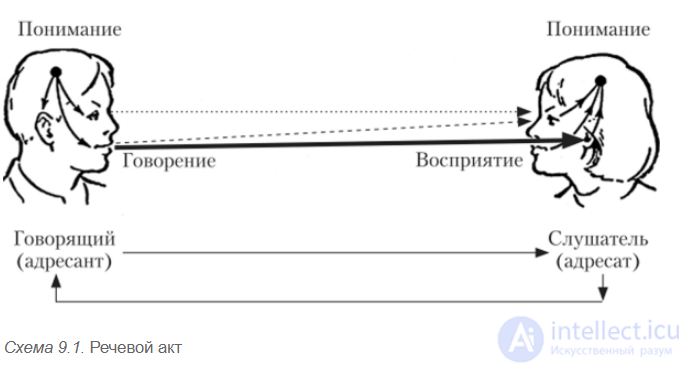
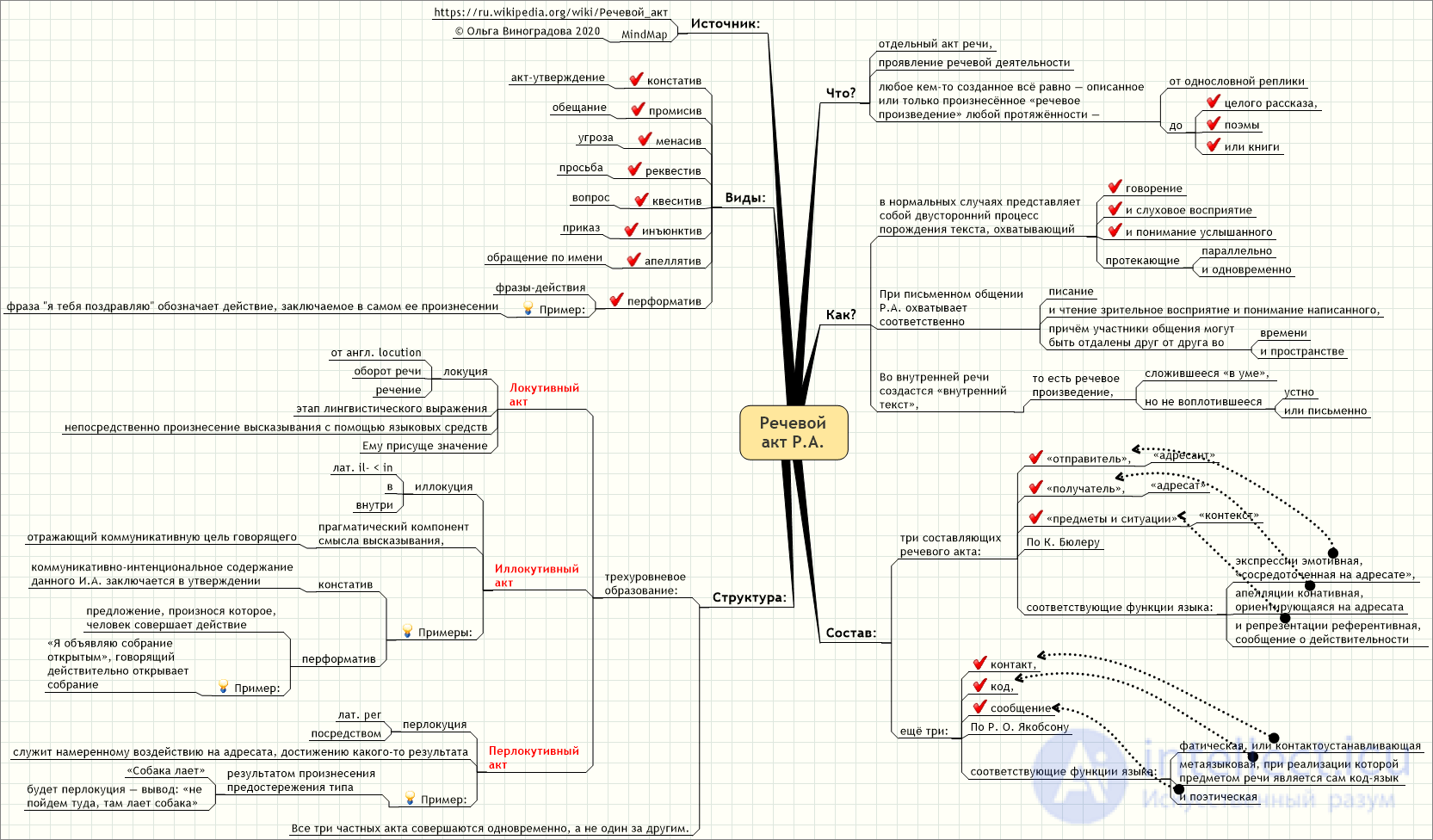
Speech act — a separate act of speech, in normal cases representing a two-sided process of text generation, encompassing speaking and the auditory perception and comprehension of what is heard, occurring in parallel and simultaneously. In written communication, the speech act correspondingly encompasses the writing and reading (visual perception and comprehension) of what is written, whereby the participants in the communication may be separated from each other in time and space. A speech act is a manifestation of speech activity.
A text is created in a speech act. Linguists use this term to denote not only a text recorded or fixed in some way, but also any «speech work» of any length created by someone (whether written or merely spoken) — from a one-word remark to an entire story, poem, or book. In inner speech an «inner text» is created, that is, a speech work that has taken shape «in the mind» but has not been realized orally or in writing.
K. Bühler distinguished three components of the speech act: the «sender», the «receiver», and «objects and situations», and correlated them with certain functions of language (the names of the functions according to R. O. Jakobson are given in brackets, see the following paragraph): expression (emotive, «focused on the addresser»), appeal (conative, oriented toward the addressee), and representation (referential, a message about reality) .
R. O. Jakobson adds three more components to those distinguished by K. Bühler for the speech act: contact, code, message, and names the functions corresponding to these components (phatic, or contact-establishing; metalingual, in the realization of which the subject of speech is the code-language itself; and poetic). The «sender», «receiver», and «objects and situations» are called by Jakobson «addresser», «addressee», and «context» respectively .
The British philosopher of language J. L. Austin regarded the speech act as a three-level formation, distinguishing:
All three particular acts are performed simultaneously, not one after another. Distinguishing them is necessary for methodological purposes .
The transmission of any information is possible only by means of signs, or more precisely, sign systems. Verbal communication uses human speech, a natural sound language, as its sign system, i.e. a system of phonetic signs that includes two principles: lexical and syntactic. Speech is used to encode and decode information: the communicator encodes it in the process of speaking, and the recipient decodes this information in the process of listening.
The sequence of actions of the speaker and listener has been studied in fairly detailed fashion. From the point of view of the transmission and perception of the meaning of the message, the scheme C – M – R (communicator – message – recipient) is asymmetrical. This can be explained by a diagram (fig. 4).
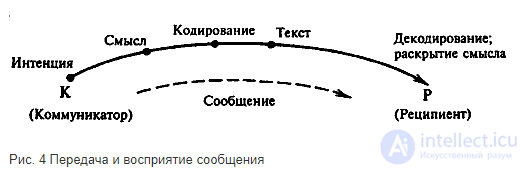
Fig. 4 Transmission and perception of a message
For the communicator, the meaning of the information precedes the encoding process (the utterance), since the "speaker" first has a certain intention and then embodies it in a system of signs. For the "listener", the meaning of the received message unfolds simultaneously with decoding. In this case, the significance of the situation of joint activity is especially clearly manifested: awareness of it is included in the decoding process itself; the disclosure of the meaning of a message is unthinkable outside this situation.
The accuracy of the listener's understanding of the meaning of an utterance can become evident to the communicator only when a change of "communicative roles" occurs (a conventional term denoting the "speaker" and the "listener"), i.e., when the recipient turns into a communicator and, through their own utterance, signals how they have understood the meaning of the received information. Dialogue, or dialogic speech, as a specific type of "conversation", represents a sequential change of communicative roles, in the course of which the meaning of the speech message is revealed, i.e., the phenomenon occurs that has been referred to as "enrichment, development of information". This can be clearly seen in Fig. 5.
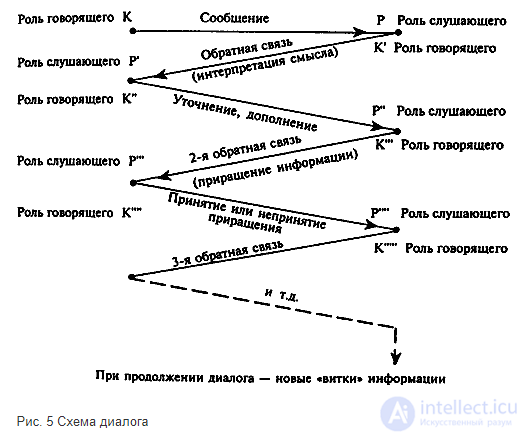
Fig. 5 Diagram of a dialogue
speech acts in conflict situations
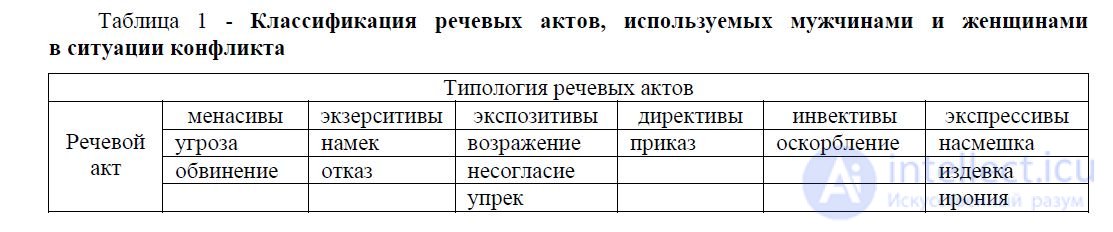
Speech actions can be analyzed at several levels:
Speech acts are common in everyday communication and are important for communication, and they occur in many different contexts. Examples of them include:
The concept of the illocutionary act occupies a central place in the concept of the speech act. Although there are several scholarly opinions on how to define «illocutionary acts», there are certain kinds of acts that are widely recognized as illocutionary. Examples of these widely recognized acts are orders or promises.
The first of these opinions belongs to the man who introduced the term «speech act» in his book « How to Do Things with Words» (published posthumously in 1962) , John L. Austin . According to Austin's preliminary informal description, the idea of an «illocutionary act» can be conveyed by emphasizing that «in saying something, we do something », for example when someone orders someone to go by saying «Go!», or when a priest joins two people in marriage by saying: «I now pronounce you husband and wife». (Austin eventually defined the «illocutionary act» more precisely.)
An alternative to Austin's explanation of the illocutionary act is that of John R. Searle . According to Searle, «speech act» often means the same thing as the term illocutionary act. Searle's work on speech acts is considered a further refinement of Austin's concept. However, some philosophers have pointed to a significant difference between the two concepts: while Austin emphasized the conventional interpretation of speech acts, Searle emphasized the psychological interpretation (based on beliefs, intentions, etc.). [16]
While illocutionary acts relate more to the speaker, perlocutionary acts are centered around the listener. Perlocutionary acts always have a «perlocutionary effect», that is, the effect that the speech act has on the listener. This can affect the listener's thoughts, emotions, or even physical actions. [17] An example of this could be the phrase «I'm hungry». The perlocutionary effect on the listener could be the persuasive effect of the utterance. For example, upon hearing the phrase, the listener might be persuaded to make a sandwich for the speaker.
An interesting type of illocutionary speech act is what Austin calls performatives, typical examples of which are «I appoint John president», «I sentence you to ten years in prison», or «I promise to pay you back». In these typical, rather explicit cases of performative sentences, the action described by the sentence (nominating, sentencing, promising) is carried out by the very utterance of the sentence. J. L. Austin argued that performative sentences can be «happy or unhappy». They were happy only if the speaker performs the actions he speaks of. They were unhappy if this did not happen. Performative speech acts also use explicit verbs instead of implicit ones. For example, stating: «I'm going to go». conveys information, promises to go; therefore this is not considered a "performance" of an action ("such as" the action of promising to go). Consequently, it [the word «to intend»] is an implicit verb; i.e. a verb that is not suitable for use in performative speech acts. [18]
In the process of performing speech acts we communicate with one another. The content of the message may be identical or nearly identical to the content intended to be conveyed, for example when a stranger asks: «What is your name?»
However, the meaning of the linguistic means used (if they exist at all, since at least some so-called «speech acts» can be performed non-verbally) can also differ from the content intended to be conveyed. Under certain circumstances one can ask Peter to wash the dishes simply by saying: «Peter ...!», or promise to wash the dishes by saying: «I will!».
One common way of performing speech acts is by using an expression that indicates one speech act and does indeed perform that act, but also performs an additional speech act that is indirect. One can, for example, say: "Peter, can you close the window?", thereby asking Peter whether he will be able to close the window, but also requesting that he do so. Since the request is performed indirectly, by means of a (direct) answer to the question, it is considered an indirect speech act.
An even more indirect way of making such a request is to say, in Peter's presence in a room with an open window: "I'm cold." The speaker in this request must rely on Peter's understanding of several pieces of information that are not explicit: that the window is open and is the reason they are cold, that cold is an unpleasant sensation and they want it addressed, and that Peter is trying to fix this situation by closing the window. This, of course, depends greatly on the relationship between the requester and Peter — he might understand the request differently if they were his boss at work than if they were his girlfriend or boyfriend at home. The more assumed information relevant to the request, the more indirect the speech act can be considered.
Indirect speech acts are commonly used to decline offers and make requests. For example, if the speaker asks: "Would you like to meet me for coffee?" and the other replies: "I have class." The second speaker used an indirect speech act to decline the offer. This is indirect because the literal meaning of "I have class" does not entail any refusal.
This creates a problem for linguists, since it is not clear (on a fairly simple approach) how the person who made the offer can understand that their offer was declined. Searle suggests that the illocutionary force of indirect speech acts can be derived through a process of Gricean reasoning; [19] however, the process he proposes does not seem to precisely solve the problem [ citation needed ] .
In other words, this means that one does not need to utter words of apology, oath, or praise to show that they are performing an action. All the examples above show how actions and indirect words make something happen, rather than simply being expressed through specific words and stated as such.
Dore (1975) suggested that children's utterances were realizations of one of nine primitive speech acts: [20]
There is no agreed-upon formalization of speech act theory. The first attempt to substantiate illocutionary logic was made by John Searle and D. Vanderveken in 1985. [21] Per Martin-Löf proposed other attempts at treating the concept of assertion within intuitionistic type theory, and Carlo Dalla Pozza proposed a formal pragmatics linking propositional content (given classical semantics) and illocutionary force (given intuitionistic semantics). To date, the main formal application of speech act theory has been in the field of human-computer interaction (in chats and other tools: see below).
Models of computational human-computer speech acts have been developed. Speech act theory has been used to model conversation for automated classification and retrieval. Another highly influential application of speech acts was in the work "Effective Conversations," developed by T. Winograd and F. Flores in the text "Understanding Computers and Cognition: A New Foundation for Design." Probably the most important part of their analysis lies in the state transition diagram, at the core of which are speech acts that attempt to coordinate with one another (regardless of whether this is human-to-human, human-to-computer, or computer-to-computer). Part of this analysis is the claim that one aspect of the social domain — tracking the illocutionary status of an agreement — is very easily assigned to a computer process, which depends on whether the computer has the capability for adequate representation of the actual issue. Thus, the computer has a useful capacity to model the state of the current social reality independent of any external reality to which social claims might apply. This kind of speech-act agreement has significant applications in many fields in which (human) individuals had different roles, for example a patient and a doctor agree on an appointment, in which the patient makes a request for treatment, as a result of which the doctor responds with a proposal involving treatment, and the patient, during a lengthy course of treatment, feels much better. Similarly, in the work "Effective Conversations" one can describe a situation in which an external observer, for example on a computer, can track the illocutionary state of negotiations between the patient and the doctor, even in the absence of an adequate model of the illness or the proposed procedures. The key point is that the state transition diagram represents the social negotiation of two parties who are participating much more simply than any other model; in short, the "Effective Conversations" status-tracking system does not need to deal with modeling the external world, but rather depends on certain stereotyped statements about the state of the world made by the two parties. Thus, "Effective Conversations" can be easily tracked and can facilitate the device, with practically no ability to model real-world circumstances beyond the claims of specific agents about the domain. In short, the "Effective Conversations" status-tracking system does not need to deal with modeling the external world, but rather depends on certain stereotyped statements about the state of the world made by the two parties. Thus, "Effective Conversations" can be easily tracked and can facilitate the device, with practically no ability to model real-world circumstances beyond the claims of specific agents about the domain. In short, the "Effective Conversations" status-tracking system does not need to deal with modeling the external world, but rather depends on certain stereotyped statements about the state of the world made by the two parties. Thus, "Effective Conversations" can be easily tracked and can facilitate the device, with practically no ability to model real-world circumstances beyond the claims of specific agents about the domain.
Computational models of the speech act in human-computer conversation have been developed [22], and speech act theory has been used to model conversations for automatic classification and retrieval. [23]
Another very influential view of speech acts was found in the language/action perspective, developed by Terry Winograd and Fernando Flores in their 1987 text "Understanding Computers and Cognition: A New Foundation for Design." Perhaps the most important part of their analysis is the state-transition diagram (in chapter 5), which, as Winograd and Flores argue, underlies significant illocutionary (speech act) statements made by two parties attempting to coordinate actions with each other (regardless of whether the agents involved are human–human, human–computer, or computer–computer).
A key part of this analysis is the claim that one dimension of the social domain — tracking the illocutionary status of the transaction (regardless of whether individual participants claim their interests are being met or not) — is very easily transferred to a computer process, regardless of whether the computer has the means to adequately represent the actual issues underlying that claim. Thus, a computer instantiating a conversation for action possesses a useful ability to model the status of the current social reality independent of any external reality on which social claims might be based.
This transactional view of speech acts has an important application in many domains in which people play different roles — for example, a patient and a doctor may meet during an appointment where the patient makes a request for treatment, the doctor responds with a counter-proposal involving the treatment they believe is appropriate, and the patient may respond, and so on. Such a conversation for action can describe a situation in which an external observer (for example, a computer or a healthcare information system) can track the illocutionary (or speech act) statusof the negotiation between the patient and physician participants even in the absence of an adequate model of the illness or the treatments being proposed. The key conclusion drawn by Winograd and Flores is that the state-transition diagram representing the social (illocutionary) negotiation of the two parties involved is generally much simpler than any model representing the world in which those parties state their claims; In short, a system tracking the status of a conversation for action does not need to concern itself with modeling all the realities of the external world. A conversation for action depends critically on certain stereotyped assertionsabout the status of the world made by both parties. Thus, a conversation for action can be readily tracked and facilitated by a device that is practically incapable of modeling real-world circumstances, other than the ability to register the claims specific agents make about the domain.
In the past, philosophy discussed the rules for the use of expressions. These two kinds of rules are constitutive and regulative . [24]
The concept of constitutive rules finds its origin in Wittgenstein and Rawls , [25] and was developed by G.C.J. Midgley , [26] Max Black , [27] G.H. von Wright , [28] David Shwayder , [29] and John Searle . [30]
Whereas regulative rules are prescriptions that regulate a pre-existing activity (whose existence is logically independent of the rules), constitutive rules constitute an activity whose existence is logically dependent on the rules.
For example: traffic rules are normative rules, which prescribe certain behavior for regulating traffic. However, without these rules, movement would not stop. In contrast: the rules of chess are constitutive rules, which constitute the game. Without these rules, chess would not exist, since the game logically depends on the rules. [31]
In multi-agent systems, speech act labels are sometimes used to express the intention of an agent when it sends a message to another agent. For example, the intention «inform» in the message «inform (content)» can be interpreted as a request for the receiving agent to add the «content» item to its knowledge base; this contrasts with the message «request (content)», which can be interpreted (depending on the semantics used) as a request to see whether the content item is currently in the knowledge base of the receiving agents. There are at least two standardizations of speech acts, denoted as KQML and FIPA messaging.
KQML and FIPA are based on Searlean, i.e. psychological, semantics of speech acts. Munindar P. Singh has long advocated moving from psychological to social semantics of speech acts – one that would correspond to Austin's conception. [32] Andrew Jones [33] was also a critic of the psychological conception. A recent collection of manifestos by researchers of agent communication reflects a growing recognition within the multi-agent systems community of the advantages of social semantics. [34]
In political science, the Copenhagen School accepts the speech act as a form of a successful speech act (or simply «facilitating conditions»), according to which the speaker, often politicians or players, acts in accordance with truth, but in preparing the audience for actions. in the directions of the player, which are driven or induced by the action. This forms an observable structure within a certain subject on the part of the player, and the audience, which is «insufficiently theorized [will] remain outside the structure itself, and will benefit from being drawn in and pulled along». [37]This is because the audience will not be informed of the player's intentions, except to focus on the demonstration of the speech act itself. Consequently, from the player's point of view, the truthfulness of the subject does not matter, except for the result obtained through the audience. [38]
The study of speech acts is widespread in legal theory, since laws themselves can be interpreted as speech acts. Laws issue a command to their constituents, which can be realized as an action. In concluding a legal contract, speech acts can be produced when people make or accept an offer. [39] From the standpoint of free speech theory, some speech acts cannot be protected by law. For example, a death threat is a kind of speech act and is considered to exist outside the protection of free speech, since it is regarded as a criminal act.
From a sociological point of view, Nicolas Brisset adopts the concept of the speech act to understand how economic models participate in the creation and dissemination of representations within and beyond the field of science. Brisset argues that models perform actions in different fields (scientific, academic, practical and political). This multiplicity of fields gives rise to a multitude of felicity conditions and types of actions performed. This point of view is a critique of the essentialism of philosophical modeling studies. [40]
In finance, mathematical models can be understood as speech acts: the concept of «financial Logos» [41] is defined by Walter (2016) as a speech act of mathematical models of financial risk. The effect of financial logotypes on financial practice consists in the following: the shaping of financial decision-making through risk modeling.

Comments