
Lecture
A communicative personality — is one manifestation of personality, conditioned by the totality of its individual properties and characteristics, which are determined by the degree of its communicative needs, the cognitive range formed in the process of cognitive experience, and communicative competence itself — the ability to choose the communicative code that ensures adequate perception and purposeful transmission of information in a specific situation.
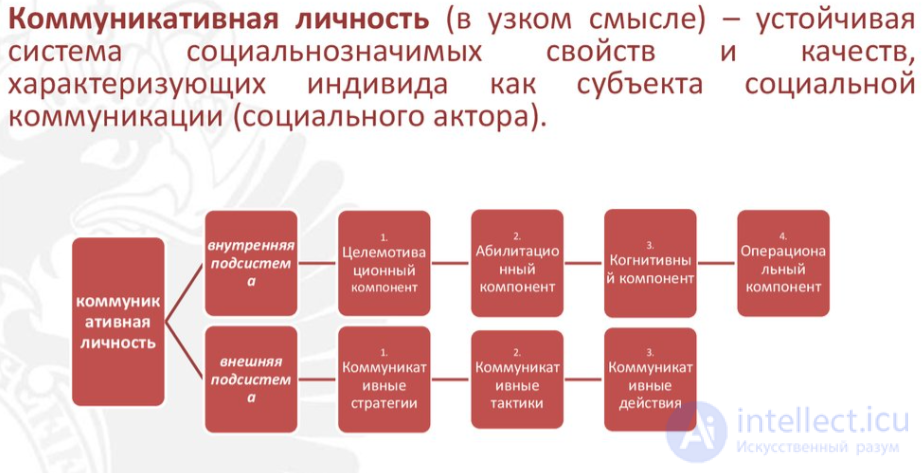
Kashkin defines communicative personality as the totality of individual communicative strategies and tactics, cognitive, semiotic, and motivational preferences formed in the processes of communication as an individual's communicative competence, their «communicative passport», «calling card». Communicative personality is the content, center, and unity of communicative acts directed at other communicative personalities — a communicative agent.
From the point of view of this model, in order to adequately reflect the internal structure of a communicative personality, one needs to use structural and functional approaches based both on the model of personality as such and on the model of the communication process. These approaches include:
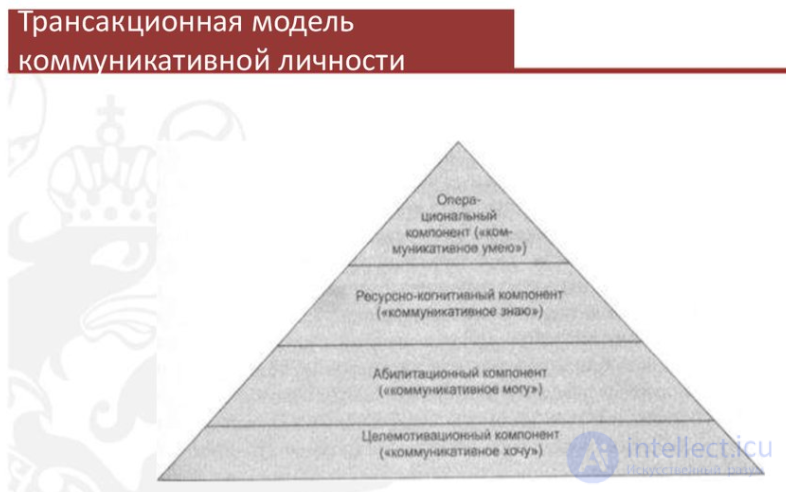
1. The most complete and systematic substantiation of the concept of «linguistic personality» is presented in the works of Yu.N. Karaulov and his followers. Linguistic personality is understood as «the totality of abilities and characteristics of a person that determine the creation and perception of speech works (texts) by them, which differ in:
In Yu.N. Karaulov's theoretical-epistemological model of linguistic
personality, three levels are distinguished:
This three-level model allows us to consider various qualitative features of linguistic personality within three essential characteristics ‒ the linguistic proper, cognitive, and pragmatic. The linguistic characteristic proper consists of the individual's lexicon ‒ the entire stock of words and phrases they use in natural verbal communication.
The cognitive characteristic is related to the intellectual sphere of the personality, the person's cognitive activity, which involves thought processes. This is reflected in the use of
favorite speech formulas and individual speech patterns, by which we often «recognize» people. The pragmatic characteristic is determined by the goals and objectives of communication ‒ the sender's intention, their interests, motives, and specific communicative
attitudes.
Of the three levels of linguistic personality, only the last characterizes the individual specifically in terms of their communicative abilities. The most important thing in the study of communication is the analysis of the communicative function of personality, actualized in a person's diverse communicative activity, which, according to scientists, makes up about 80% of their entire existence, namely: listening ‒ 45%, speaking ‒ 30%, reading ‒ 16%, and writing ‒ 9%. As a specific concept, «communicative personality» is much broader than the concept of «linguistic personality», since it presupposes characteristics related to the choice of not only a verbal but also a non-verbal code of communication, using artificial and mixed communicative codes. Communicative personality is understood as one manifestation of personality, conditioned by the totality of individual properties and characteristics, which are determined by the degree of its communicative needs, the cognitive range formed in the process of cognitive experience, and communicative competence proper – the ability to choose the communicative code that ensures adequate perception and purposeful transmission of information in a specific situation.
Parameters of communicative personality.
The defining characteristics of a communicative personality are those that make up three main parameters — motivational, cognitive, and functional.
The motivational parameter, which is determined by communicative needs, occupies a central place in the structure of communicative personality. It is precisely the need to convey something or to obtain necessary information that serves as a powerful stimulus for communicative activity and is a mandatory characteristic of the individual as a communicative personality.
If there is no such need, communication will not take place.
The degree of motivation is determined by the strength of the need: the more insistent the need, the more stable the communicative attitude, and the more consistent its expression in utterances and discourses. In the actualization of a communicative attitude, one observes either the use of the same communicative means (a reinforcement effect through repetition), or of different means (a reinforcement
effect through hidden repetition by varying the communicative means).
The cognitive parameter includes the characteristics that, in the process of the individual's cognitive experience, shape his inner world in intellectual and emotional terms. The most essential characteristics for the cognitive parameter of a communicative personality are the following: the ability to adequately perceive information, the ability to influence a partner, the assessment and self-assessment of one's cognitive range, and knowledge of the socially conditioned norms of verbal and nonverbal communication. The cognitive parameter is a transitional link between the motivational and functional parameters. The functional parameter includes three characteristics that, in essence, determine that property of the personality known as communicative competence:
a) practical command of an individual's stock of verbal and nonverbal means for actualizing the informational, expressive, and pragmatic functions of communication;
b) the ability to vary communicative means in the process of communication in connection with changing situational conditions of communication;
c) constructing utterances and discourses in accordance with the norms of the chosen communicative code and the rules of speech etiquette.
2. The participants in communication are always people with their inherent social, psychological, cognitive, and worldview characteristics, who during the course of communication occupy various communicative roles and positions.
A social role is a way a person behaves, conditioned by his social status and by the rules (norms) accepted in society. A social role indicates behavior determined for a person by his social (age, gender, occupational, etc.) position, or status. Social roles can be status-based, positional, and situational. Status roles are roles that a person receives at birth; they are the most permanent (constant). These are gender roles, racial, ethnic, national roles, the role of a citizen of a given state, or roles that a person inevitably passes through during life; status roles usually change rarely.
Positional roles are roles in communication that are determined directly by a person's place in society. At the same time, a person, as a rule, performs several positional roles simultaneously.
Situational roles are more or less fixed standards of behavior not directly tied to other roles. An individual masters situational roles at relatively early stages of socialization; they are played out at the level of conscious control or at the level of the unconscious. Social roles are revealed in a person's actions (primarily verbal) and
are determined by profession, type of activity, gender, age, and the real relationships of people in society. Communicative roles are relatively stable, internally connected, and mutually expected systems of an individual's communicative acts, which are largely determined by his social status, age, gender, and other factors. They are considerably narrower than social roles, and therefore their repertoire is considerably broader. Communicative roles manifest themselves only in the course of communication and significantly influence the nature of the communicative act. Today
linguistic science is only working on the description and typology of communicative roles. Depending on the mode of realization of communicative behavior, standard and initiative communicative roles are distinguished. A standard communicative role is the communicative behavior of a person accepted in society for the corresponding social role and situation. An initiative communicative role is the image that a person consciously creates in communication to achieve a certain goal; what he decides to do in a specific communicative situation, pursuing a particular substantive goal. Communicative roles can be understood immediately, from the first remarks of the participants in communication, or they may reveal themselves gradually, in the process of the interaction unfolding. A person's speech behavior is linked to the communicative positions that he chooses in various communicative situations.
A communicative position is the communicative role that each of the communicants subconsciously performs in accordance with his individual psychological characteristics.
3. Any communicative act is an interaction between at least two people by means of a language code. One of the participants in the communicative act acts as the addresser, the other as the addressee.
The role of the addresser is that he begins (initiates) the communicative act. It is believed that it is the initiator who holds the interaction scheme in his hands, and it largely depends on him how successfully this scheme will be realized in the course of the communicative act. However, the success of the speaker's actions depends on a number of factors, which include preliminary conditions, the choice of correct strategies and tactics, one's own communicative role and position, and the correct determination of the social and communicative roles and positions of the addressee. No less important is the role of the addressee, although he is often perceived as a passive participant. His role consists in reaction, that is, response – verbal or non-verbal, and these reactions shape the communicative act throughout the entire process of communication.
Thus, the addressee and the addresser are active participants in communication, while the addresser appears in the communicative act from the moment of initiation, and the addressee automatically becomes a participant in the communication.
4. In accordance with their goals, the addresser and the addressee employ communicative strategies and communicative tactics in the course of a communicative act. A communicative strategy is a set of theoretical moves planned by the speaker and realized in the course of the communicative act, aimed at achieving the communicative goal. The choice of communicative strategy in accordance with the communicative goal depends on the level of the speaker's communicative competence. Communicative competence is a system of knowledge about the rules of language communication, consisting of knowledge of models of communicative behavior, knowledge of speech etiquette, patterns of communication (knowledge of national-mental and ritual features of communication, its social conditioning, stylistic, situational-thematic features). Thus, the speaker, using communicative competence, sets his own goal and, following a certain intention, formulates his own strategy. In every real communicative situation, the communicative strategy is embodied in communicative tactics. Communicative tactics are a set of practical moves in the real process of speech interaction, that is, communicative tactics, unlike communicative strategy, correlate not with communicative tasks but with speech moves. A communicative (speech) move is a tactical move that is a practical means of achieving the communicative goal; in other words, it is an element of communicative tactics, a set of communicative moves that make up communicative tactics. T.A. van Dijk defines a speech move as a functional unit of a sequence of actions that contributes to the solution of a local or global task under the control
strategies.
Communicative moves are coordinated with the preceding and following ones, building up a tactic. Through the application of communicative tactics, the speaker enriches their communicative experience ‒ a body of notions about successful and unsuccessful communicative tactics, which do or do not lead to the realization of the corresponding communicative tactics. Thus, the speaker produces a communicative strategy, which turns (or does not turn) into a communicative tactic as a set of communicative moves, thereby adding to their communicative experience.
Depending on the criteria chosen, there are various typologies of communicative strategies. According to the degree of the «global» goal, general and particular strategies are distinguished. For example, the general strategy of discrediting is realized in particular strategies ‒ accusations, insults, mockery.
From a functional point of view, primary and auxiliary strategies are distinguished. The primary strategy is the most significant one in communicative interaction in terms of motives and goals.
The auxiliary strategy is a strategy that facilitates the effective organization of speech interaction, for example, status and
role strategies aimed at creating an emotional mood and the like. Among communicative strategies, manipulative ones are distinguished.
Manipulation is an influence on a person aimed at prompting them to act unconsciously or contrary to their own opinion or intention. Manipulation is implicit in nature, since the object of manipulation may not be aware of the influence, whereas coercion is always made explicit.
A modern person must possess a variety of strategies, since in different communicative situations, audiences, and when dealing with different types of interlocutors, there arises a need both for speech action and for manipulation (compare, for example, the need for manipulation with regard to children, emotionally agitated people, drunk people, hysterics, conflict-prone individuals, etc.). Thus, manipulative strategy as a type of strategy is not a dirty word or a morally condemnable way of influencing people.
5. Communicative failure ‒ a negative outcome of communication, an ending of interaction in which the goal is not achieved. Failures occur for various reasons: when speech influence is constructed incorrectly, that is, the wrong means of influence are chosen, the characteristics of the addressee are not taken into account, the rules of conflict-free communication are not observed, and so on.
Communicative failures — are a disruption of the communication process in which the goals of communication are not achieved. This can occur in interpersonal, group, or mass communication alike. The main cause of such failures lies in a mismatch between how the sender and the receiver perceive the message.
Causes of communicative failures
Linguistic barriers:
Cultural differences:
Psychological factors:
Informational problems:
Nonverbal barriers:
Physical barriers:
Ways to eliminate communication failures
Clear and precise expression of thoughts:
Taking cultural characteristics into account:
Developing active listening:
Controlling nonverbal signals:
Emotional literacy:
Improving technical conditions:
Checking feedback:
Communication failures — are a natural part of interaction that can occur even among experienced communicators. However, understanding the causes of their occurrence and using effective strategies to eliminate them helps minimize their impact. The main thing — is a commitment to clear, respectful, and open communication, which fosters mutual understanding and harmonizes relationships.

Comments