Distributive negotiation (English: distributive negotiations) — negotiations in which strategic influence and withholding of information prevail over dialogue and relationships .
There are two alternative approaches to conducting negotiations, based on the Harvard concept: distributive and integrative negotiations. In distributive negotiations, the parties implement particular declared positions, and each of the participating sides claims a «piece of the existing pie». Participants in a distributive negotiation process consider their goals and interests to be mutually exclusive and competing. One of the negotiating parties seeks to gain as much benefit as possible at the expense of the other's interests (the «zero-sum» principle, where there is only one winner as a result), that is, one party's gain leads to the other's loss.
Kaltner wrote that distributive negotiations occur when «the participants are overt rivals, the goal of the negotiations is victory, as a condition of the relationship the parties demand concessions from each other, they are very strict and distrustful with people, firmly stick to their position, make threats, conceal their true interests, or mislead others»
There are various approaches to the classification of negotiations described in the book by R. Walton and R. McKersie . The following types of negotiations are distinguished:
- Distributive negotiations, based on maximizing one's own profit.
- Integrative negotiations, based on solving problems and increasing overall benefit.
- Positional structuring, for building good relationships between the parties.
- Intra-organizational negotiations, aimed at reaching consensus within a team.
Main characteristics of the distributive approach
The distributive approach is based on strategic influence and the desire to withhold information. These processes prevail over dialogue and relationships in the course of the negotiation process. The negotiating participants are rivals, and the goal of each is to achieve victory. At its core lies the striving to divide the mythical «fixed pie» and obtain the larger share of it. Competition and conflict arise. Distrust between the parties may arise, along with misleading, threats, and bluffing. It is characterized by inflating initial demands, striving to stick to one's position at any cost, asymmetry in presenting demands, and unwillingness to make concessions. The distributive approach is applied in divorce proceedings, sports negotiations, international negotiations, and in sales.
According to M. A. Bazerman , the drawback of the competitive approach to negotiation is that the losers remember their defeat for a long time. If the negotiating participants have to deal with each other again, negotiating will be much more difficult. This orientation toward a «zero-sum» approach appeared in our society as a result of sports competitions and is most often manifested and reinforced in American culture.
Features of the distributive strategy:
- In fighting for their interests and wanting to defend their own positions, the parties accept that the partner will suffer losses ;
- Negotiations are conducted on the basis of initially advanced extreme positions, which each side seeks to defend;
- The opponents' actions are directed at each other, rather than at solving problems, let alone finding a mutually beneficial solution;
- The parties try to distort or conceal information about their interests, intentions, and goals;
- Often, the agreement reached satisfies each of the parties to a lesser degree than it could have.
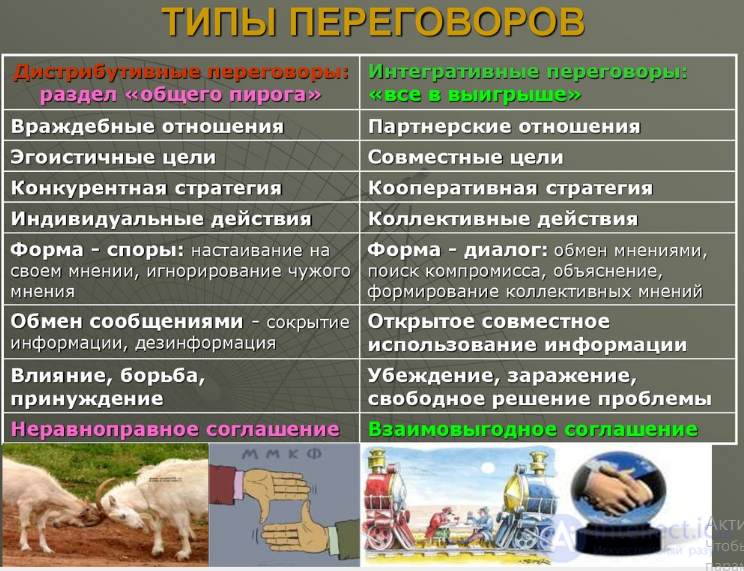
the difference between distributive and integrative negotiations
Behavioral styles and shortcomings in positional bargaining
Distributive negotiations are often called positional bargaining. The bargaining zone lies between the minimum condition presented by one side and the maximum condition presented by the other, which are discussed during the negotiation process.
Two main styles are distinguished in positional bargaining :
A «hard» approach may end in a result of the «win — lose» type, in which only one of the sides comes out ahead, otherwise it can lead to a deadlock.
A «soft» approach to negotiating leads to accommodation, in which one side yields to the other, or to compromise, in which each side sacrifices something in favor of the other in order to reach an agreement. Even if «soft» distributive negotiations end in compromise, a feeling of dissatisfaction may arise, since neither side got what it wanted.
Shortcomings of positional bargaining:
R. Fisher, W. L. Ury, and B. Patton identify the main shortcomings of positional bargaining:
- Such a strategy often leads to destructive behavior and the breakdown of negotiations, and in the case of an agreement, to unwise agreements that fail, to one degree or another, to meet the interests of the parties;
- A side adhering to a soft style is vulnerable and almost always ends up at a disadvantage compared to an opponent with a hard behavioral strategy;
- Opponents see each other as enemies, which strongly affects further relations between the parties;
- Bargaining is not effective if more than two parties take part in the negotiations
Components of distributive negotiations
Participants in distributive negotiations are characterized by excessive talkativeness, insistence on their positions, and manipulation. Successful negotiators possess knowledge of the contextual factors that influence the development of negotiations. In order to achieve a decision favorable to themselves, negotiators use various manipulation components.
Main components :
- concealment of information;
- insistence on one's own interests;
- positional discussion;
- presence of selfish goals;
- coercion;
- argument;
- sacrificing the relationship;
- a strict attitude toward people.
Tactics used in distributive negotiations
- Disorienting the partner — this tactic is active, it is planned in advance and implemented using the following techniques: criticism of constructive points, use of unexpected information, deception, bluffing, threats. The main goal of disorientation is to compel the partner to act in the direction of one's own interests.
- Ultimatum — this tactic is one of the harshest and is characterized by one of the negotiation participants presenting an ultimatum to the other at the very beginning of the negotiations. The main technique of the ultimatum — a threat. Issuing an ultimatum presupposes an extremely disadvantageous position for the opponent in the negotiations. Waiting techniques are used: delaying the start of negotiations, deliberately being late or not arriving for the meeting, and so on
- The alternatives technique — consists in offering the opponent a choice between two or more unattractive options for solving the problem, options that satisfy one's own interests.
- The lock technique presupposes an ultimatum-like effect on the opponent, by deliberately weakening one's own control over the situation.
- The tactic of squeezing out concessions. When applying it, various means of positional pressure on the opponent are used, weakening their will to resist. This tactic differs from an ultimatum in that the demands are presented to the opponent not all at once, but in stages.
Techniques of positional pressure on the opponent
Techniques of positional pressure include:
- the "closed door" technique — refusal to appear at the negotiations.
- the "checkpoint" technique — involves putting forward a preliminary concession as a condition for beginning negotiations or for their further continuation.
- the "sign-off" technique — used when an agreement on some issue has almost been reached, but it does not fully satisfy the party seeking to extract concessions. Then, to obtain a further concession, they declare that their authority to accept the decision in the form it has been prepared is limited, and that the matter needs additional approval from higher authorities. This technique is calculated on the assumption that the opponent cannot wait and is ready to make further concessions, as long as the agreement is concluded now.
- the "external danger" technique — used as a demonstration of readiness to accept the opponent's proposals, while at the same time declaring that fulfilling them is being put at risk by the interference of external forces.
Psychological techniques:
Whereas techniques of positional pressure are based on creating specific conditions that force the opponent to make concessions, techniques of psychological pressure are aimed at weakening the opponent's will, at prompting a subconscious urge in them to end the negotiations more quickly at the cost of unplanned concessions.
Techniques of psychological pressure :
- The "reading hearts" technique — this is a ploy whose essence is as follows: hidden meaning is attributed to the opponent's words, and the "true" motives supposedly concealed behind the words spoken are exposed.
- The "last demand" technique is used when lengthy negotiations have reached their final stage. An opponent worn out by difficult negotiations is offered one more demand, which they, as a rule, agree to.
Errors in distributive negotiations
The negotiation process rests on a complex foundation of culture and other factors, and it is characterized by confusion arising from the interference of interpersonal and group dynamics.
Characteristic errors of distributive negotiations:
- The myth of the "fixed size of the pie" represents a purely distributive approach to conducting negotiations. The "size of the pie" can be increased or used to maximum benefit for all parties, not just one.
- High escalation of commitment, which is starting negotiations with inflated demands. Having stated their demands, the parties continue to insist on them, unwilling to back down. This can lead to an escalation of the conflict. Avoiding the manifestation of this tendency in people's behavior requires firm self-discipline.
- Each negotiating party's confidence that only their position is correct leads them to ignore the needs of the other side. Negotiating parties are unable to see the fairness of the opposing side's positions. Such overconfidence hinders the achievement of agreement.
- Communication problems. The negotiation process can be disrupted by communication problems — the parties do not actually talk to each other or do not try to speak as clearly as possible. The negotiation process can also be disrupted by problems of perception — the parties cannot or do not want to hear and understand what the other side is saying.
See also
See also


Comments