
Lecture
Communicative vacuum is a feeling of dissatisfaction, loneliness, and alienation caused by obstacles to quality communication based on mutual understanding, discussion, and the exchange of thoughts, whether for an individual, a group of people, or states.
In today's world, where information and interaction permeate every aspect of our lives, the concept of a communicative vacuum has become especially relevant. This phenomenon refers to a situation of complete absence of communication between people or groups, when the exchange of information either stops or was never established. A communicative vacuum can be temporary or long-term, and its causes and consequences deserve special attention.
A communicative vacuum arises when the process of exchanging information, ideas, or emotions between participants in communication is disrupted. This state can manifest at the level of:
In interrogation theory, a communicative vacuum refers to the investigator's temporary tactical refusal to engage in communication with the person being interrogated, expressing disapproval of the position taken by the interrogated person, and creating a lack of awareness in them about the circumstances of the case.
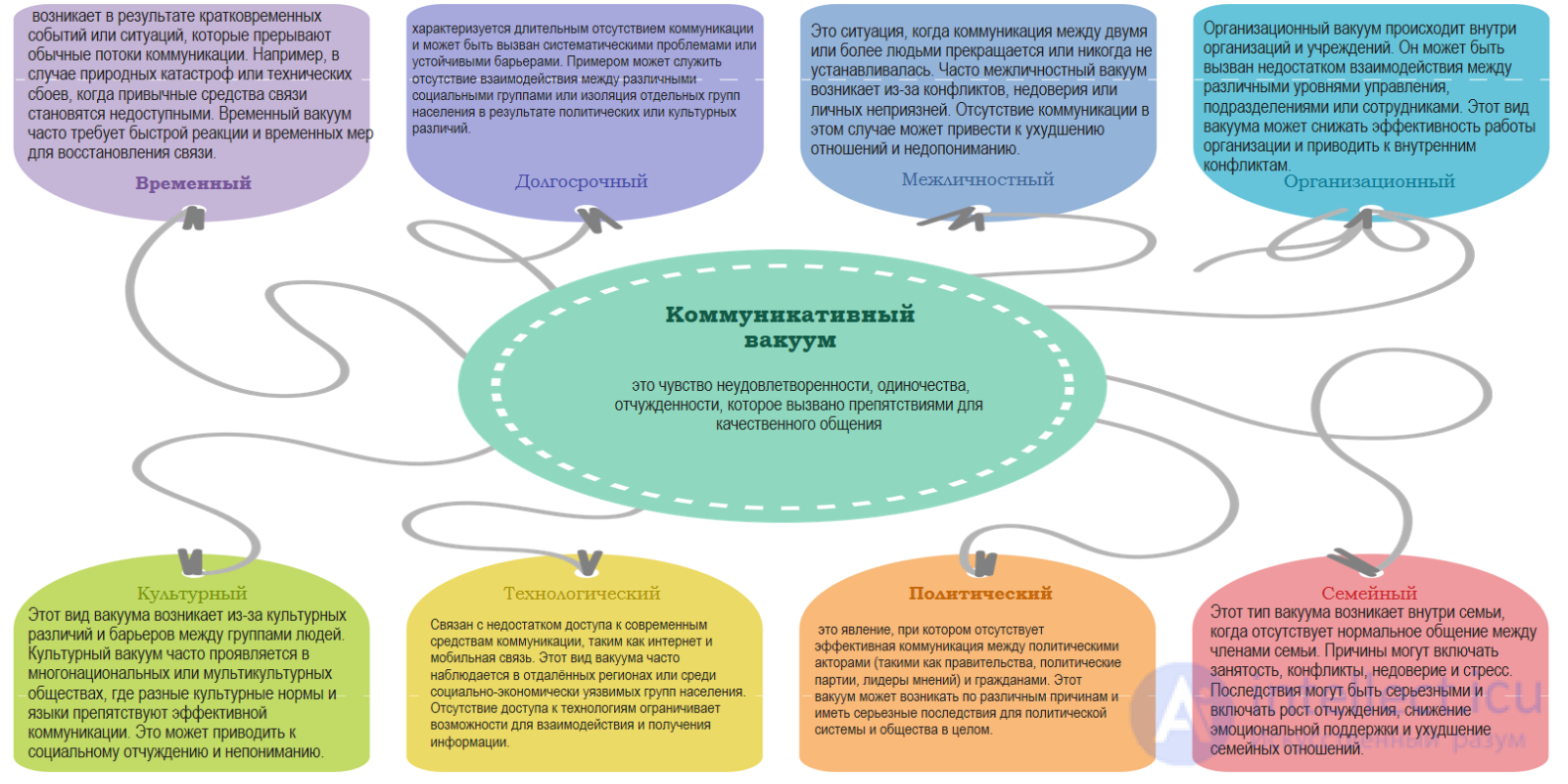
This type of vacuum arises as a result of short-term events or situations that interrupt the usual flows of communication. For example, in the case of natural disasters or technical failures, when the usual means of communication become unavailable. A temporary vacuum often requires a quick response and temporary measures to restore communication.
A long-term vacuum is characterized by a prolonged absence of communication and can be caused by systemic problems or persistent barriers. An example would be the lack of interaction between different social groups or the isolation of certain population groups as a result of political or cultural differences.
This is a situation in which communication between two or more people stops or was never established. Interpersonal vacuum often arises due to conflicts, distrust, or personal animosity. The absence of communication in this case can lead to deteriorating relationships and misunderstanding.
Organizational vacuum occurs within organizations and institutions. It can be caused by a lack of interaction between different levels of management, departments, or employees. This type of vacuum can reduce the organization's efficiency and lead to internal conflicts.
This type of vacuum arises from cultural differences and barriers between groups of people. Cultural vacuum is often manifested in multinational or multicultural societies, where different cultural norms and languages hinder effective communication. This can lead to social alienation and misunderstanding.
This is associated with a lack of access to modern means of communication, such as the internet and mobile communication. This type of vacuum is often observed in remote regions or among socioeconomically vulnerable groups of the population. Lack of access to technology limits opportunities for interaction and obtaining information.
Political communicative vacuum — is a phenomenon in which there is no effective communication between political actors (such as governments, political parties, opinion leaders) and citizens. This vacuum can arise for various reasons and have serious consequences for the political system and society as a whole.
This type of vacuum arises in a professional environment when there is no effective communication between colleagues, management and subordinates. The causes can vary: from a lack of well-established communication channels to conflicts within the team. The consequences can include decreased productivity, deteriorating working relationships and misunderstandings in carrying out tasks.
This type of vacuum arises between different generations, when there is no understanding and communication between older and younger people. This can be caused by differences in values, experience, interests and communication technologies. The consequences include the loss of the transfer of experience and knowledge, and growing misunderstanding and conflicts between generations.
This vacuum can be observed in educational institutions, when there is no effective interaction between teachers and students, as well as between educational institutions and parents. The causes may be a lack of time, resources, or the absence of suitable teaching methods. The consequences include a decline in the quality of education, a loss of interest in learning, and an increase in behavioral problems among students.
This type of vacuum arises within a family, when there is no normal communication between family members. Causes may include being busy, conflicts, distrust and stress. The consequences can be serious and include growing estrangement, decreased emotional support, and deteriorating family relationships.
This vacuum arises when people are located in remote or isolated areas with limited access to means of communication. The causes may be related to geographic conditions, economic constraints or political isolation. The consequences include limited access to information, social isolation, and difficulties in establishing connections with the outside world.
The causes of the communicative vacuum can be various. One of the main causes is the absence of trust between parties. When people or groups do not trust each other, they do not strive to exchange information, fearing that their words might be used against them. The language barrier can also be a cause, when the participants in communication do not have a sufficient command of a common language for effective communication. Technical problems, such as lack of access to means of communication, can also cause a communicative vacuum.
Psychological factors:
Social factors:
Technological factors:
Informational barriers:
Emotional causes:
The consequences of the communicative vacuum can be serious. First, it can lead to the isolation of people or groups, which aggravates the feeling of loneliness and alienation. The absence of communication hinders the exchange of ideas and information, which can slow down development and progress. Within a work team, the communicative vacuum can cause misunderstanding and conflicts, which reduces the team's effectiveness and leads to deteriorating working relationships.
Personal consequences:
Social consequences:
Global consequences:
To overcome the communicative vacuum it is necessary to take active measures to establish and maintain channels of communication. It is important to create conditions in which all participants in the interaction feel safe and trust each other. For this, various methods can be used: training and workshops on developing communication skills, providing access to modern means of communication, creating multilingual environments to overcome language barriers.
Developing communication skills:
Training in active listening, empathy and skills of constructive dialogue will help establish communication even in difficult situations.
Creating a favorable environment for communication:
Using technology:
Support from society and the state:
Working on oneself:
Thus, the communicative vacuum in the modern world requires serious attention and active action for its prevention and resolution. Only through effective and constant interaction can harmonious development and prosperity of society be achieved. The communicative vacuum — is not simply the absence of words, but a serious challenge capable of destroying connections between people and groups. In the conditions of the modern world, where cooperation and mutual understanding become the key to success, it is important to timely overcome the barriers that lead to isolation. Only open and sincere dialogue is capable of filling this vacuum, making our society more harmonious and stable.

Comments