
Lecture
Communicative competence — is command of complex communicative skills and abilities, the formation of adequate skills in new social structures, knowledge of cultural norms and constraints in communication, knowledge of customs, traditions, and etiquette in the sphere of communication, observance of proprieties, good manners, orientation in the communicative means inherent to the national and class-based mentality and expressed within the framework of a given profession .
Communicative competence — is a generalizing communicative property of the personality, encompassing communicative abilities, knowledge, skills, and sensory and social experience in the sphere of business communication.
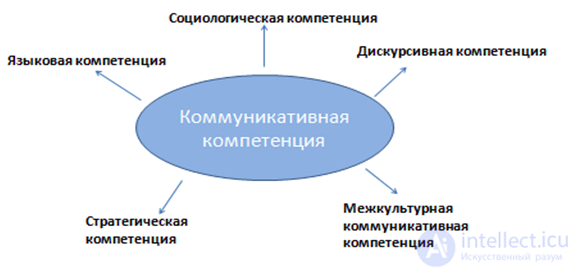
Communicative competence consists of the abilities:
Communicative competence acts as an integral quality that synthesizes general culture and its specific manifestations in professional activity. One of the conditions for communicative competence is compliance with certain rules and requirements. The most significant of these rules are as follows:
– another term common in sociolinguistics. This term refers to an area of extralinguistic reality characterized by relative homogeneity of communicative needs, for the satisfaction of which speakers carry out a certain selection of linguistic means and rules for combining them with one another.
As a result of such a selection of linguistic means and rules for combining them, a more or less stable tradition (for a given linguistic community) is formed, correlating a certain sphere of human activity with a certain linguistic code (subcode) – an independent language or subsystem of the national language. Thus, in medieval Europe Latin was the communicative means used in religious worship as well as in science, while other spheres of activity were served by the corresponding national languages and their subsystems. In Russia the role of the sacred communicative medium belonged for a long time to Church Slavonic.
The distribution of languages or their subsystems across spheres of activity may be not rigid: one of the languages or one of the subsystems may predominate in a given sphere, but the use of elements of other languages (subsystems) is allowed. Thus, in the family communication of residents of a modern Russian village the local dialect predominates, and it is also used by them in carrying out agricultural work. However, under modern conditions a pure dialect is a rarity, it is preserved only among some representatives of the older generation of rural residents, while in the speech of the majority it is heavily «diluted» with elements of the literary language and colloquial speech. Modern Belarus uses the Belarusian language in the sphere of humanities education, but here one can also encounter elements of the closely related Russian language. In the sphere of production, despite state support for the native language, the Russian language predominates (in specialized terminology, in technical documentation, in the professional communication of specialists), although the use of Belarusian is, naturally, not prohibited.
The term «communication» is polysemous: it is used, for example, in the phrase «mass communication media» (meaning the press, radio, television), in engineering it is used to denote communication lines, etc. In sociolinguistics «communication» is a synonym for «obshchenie» (interpersonal communication). The foreign-language term is more convenient in this case, since it easily forms derivatives, which are needed to denote different aspects of communication: «communicative situation», «communicants» (= participants in the communicative situation) and some others.
Communication can be verbal and non-verbal (or, in different terminology, verbal and non-verbal – from Latin verbum 'word'). For example, communication among people in a number of sports games (basketball, football, volleyball) does not necessarily include a verbal component or includes it minimally – in the form of exclamations: – Pass! – I've got it! and the like. Not every physical job requires verbal communication: for example, in workshops with a high noise level – stamping, forging, foundry – one has to manage without words, but communication among the people working in such workshops still occurs (for example, by means of gestures).
A significantly larger part of the types of human communication takes place by means of speech (after all, language itself is intended mainly for communication). These types of communication are of primary interest to sociolinguists. Verbal communication takes place within the framework of a communicative situation.
Non-verbal means of communication — facial expressions, body movements, intonational characteristics of the voice, tactile influence, used to convey cognitive or emotionally evaluative information. A general classification of non-verbal means of communication is given in Fig. 4.1. Its main elements consist of kinesic, prosodic, extralinguistic, proxemic and tactile means.
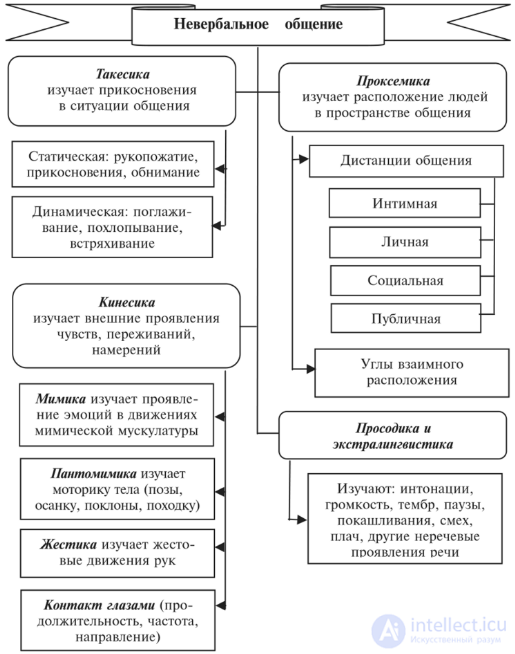
Fig. 4.1. Structural elements of the non-verbal system of communication
Kinesic means of communication — are visually perceived movements of another person (facial expressions, pantomime, postures), performing an expressive-regulatory function in communication.
Prosodic (paralinguistic) means of communication include the rhythmic-intonational aspects of speech (pitch, loudness of the voice tone, timbre of the voice, strength of stress).
Structural elements of the non-verbal system of communication
Fig. 4.1. Structural elements of the non-verbal system of communication
Extralinguistic means of communication consist of pauses included in speech and psychophysiological manifestations of a person (laughter, crying, coughing, sighs, humming, etc.).
Proxemic means — are the spatio-temporal elements of the communication situation, containing information important for the participants in communication.
Tactile means of communication are dynamic touches to the communication partner in the form of handshakes, pats, hugs, kisses, and so on.
The means of communication listed above can be used effectively only as part of holistic communicative techniques.
Communicative techniques — a set of methods for perceiving, interpreting, and influencing elements of the communication situation, aimed at achieving specific goals of interaction (building an accurate image of the partner, establishing contact, understanding the other person, conveying information and emotions, influencing and changing the behavior of participants in the interaction, etc.).
These techniques are divided into nonverbal and verbal.
Nonverbal communicative techniques — ways of effectively managing the spatial-temporal parameters of interaction, expressing expression and information through facial expressions, gestures and postures, "reading" the expressive manifestations of the communication partner, emotional contagion, and so on.
Among the whole variety of expressive means of nonverbal communication, the most important place is occupied by kinesic, tactile, and proxemic means. They are studied by special fields of scientific knowledge that have seen rapid development in recent years — kinesics, tactics (haptics), and proxemics.
Kinesics — a field of scientific knowledge that studies the outward manifestations of human feelings and emotions. Its objects of scientific interest are facial expressions, gesticulation, pantomime, and the expression of the eyes (eye contact).
Facial expression — the movements of the facial muscles that reflect an inner emotional state — plays a special role in conveying information. Facial expression has the status of a figurative language of communication, a specific code for conveying diverse feelings, assessments, and attitudes toward events and phenomena. At the same time, it is also a means of influencing people.
Among the basic emotions conveyed through expressive movements of the facial musculature are joy, surprise, anger, contempt, suffering, and fear.
Positive emotions (love, joy, etc.) are expressed more clearly and are recognized more easily. Negative emotions (anger, disgust, sadness) are somewhat harder to identify.
The most expressive elements of facial expression are the eyebrows and lips. Even a slight change in their position and configuration is significant, and sometimes fundamentally changes not only the shade but also the sign of the emotion. Thanks to this, a person is able to express hundreds of tones of emotional experience. It is claimed, for example, that Leo Tolstoy described 97 shades of smile.
Given that virtually any activity is above all about contact with people, a person must learn to accurately "read" and correctly interpret people's facial expressions, and to master their own facial expressions confidently, to the point of artistry.
In close unity with the work of a person's facial muscles are the eyes. Given that a person practically cannot control changes in pupil size or the muscles around the eyes, the eyes are an important source of truthful information about a person's actual feelings and experiences. For example, it is believed that if a partner maintains eye contact for less than 1/3 of the conversation time, there is a likelihood that they wish to conceal some information or are experiencing negative feelings such as guilt, shame, or distrust. But one must not forget that a person practically always looks away when trying to formulate a thought, though this lasts only a few moments.
By the duration of eye contact among several strangers, one can identify their social statuses. It has been proven that a person occupying a higher social position (a manager, a leader) looks at the partner significantly more often, and their gaze fixes on the interlocutor for a longer period of time.
The diverse range of people's feelings, moods, and attitudes is manifested in gestures, which represent a peculiar language of body movements, including gestural «words», «sentences», and «punctuation marks». The wise say that a gesture is not a movement of the body, but a movement of the soul.
Knowledge of the «alphabet» and «grammar» of gestures allows one to read a person like a book. This is possible because gestures are less subject to conscious control than facial expressions.
Specialists in the field of non-verbal communication A. Pease, J. Nierenberg, and G. Calero provide a detailed classification of gestures.
The verbal system of communication has a complex structure (see fig. 4.4).
Vocabulary (from the Greek lexikos — pertaining to a word) is understood in two senses: a) the vocabulary of a language; b) the set of words characteristic of a given variety of speech (everyday, military, business, etc.).
Phraseology (from the Greek phrasis — expression and logos — science, teaching) — the set of phraseological units of a given language. Phraseological units — stable word combinations whose meaning cannot be derived from the meanings of their constituent components (for example, «dat' sdachi» [to give change/to fight back], «Kuz'kina mat'» [Kuzka's mother], etc.).
Grammar (from the Greek gramma — letter, writing) — the structure of a language, the system of linguistic forms, methods of word formation, and syntactic constructions forming the basis for linguistic communication.
Structure of the verbal system of communication
Fig. 4.4. Structure of the verbal system of communication
Syntax (from the Greek syntaxis — order, construction) — ways of combining words and their forms into phrases and sentences.
Diction (from the Latin dictio — pronunciation) — pronunciation, the manner of articulating words.
Speech communication is not reducible to speaking. It is, rather, a complex process of shaping thought into words and sentences, involving the performance of such communicative actions as selecting adequate words, constructing sentences from them, speaking, listening to the partner, clarifying their thoughts, clarifying one's own position, etc.
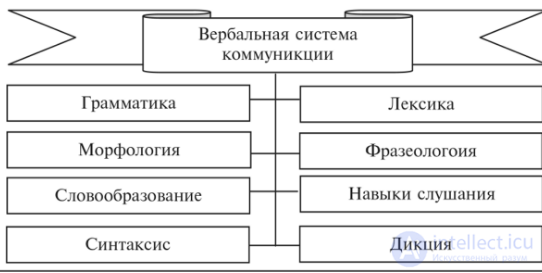
Fig. 4.4. Structure of the verbal system of communication
– this is a situation of speech communication between two or more people. A communicative situation has a certain structure.
It consists of the following components:
1) the speaker (addresser);
2) the listener (addressee);
3) the relationship between the speaker and the listener and the associated
4) the tone of communication (formal – neutral – friendly);
5) the purpose;
6) the means of communication (language or its subsystem – dialect, style, as well as paralinguistic means – gestures, facial expressions);
7) the manner of communication (oral/written, direct/remote);
8) the place of communication.
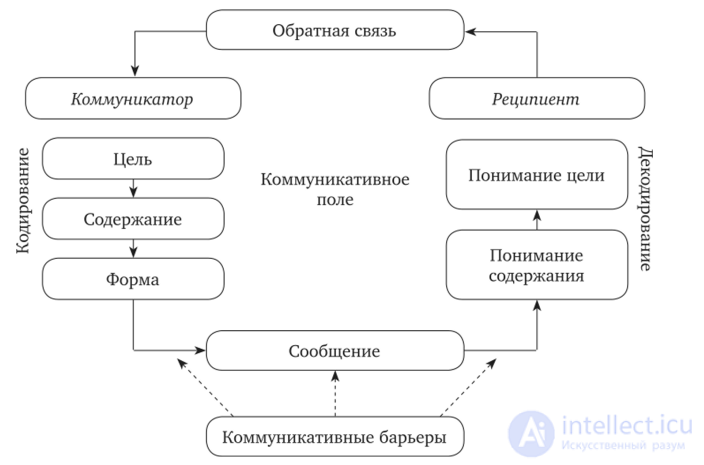
These – are situational variables. A change in the values of each of these variables leads to a change in the communicative situation and, consequently, to a variation in the means used by the participants in the situation, and their communicative behavior as a whole.
Thus, communication between a judge and a witness in a courtroom differs by a greater degree of formality of the linguistic means used by both parties than communication between the same persons outside of a court session: the place changes, but the social roles (see this concept below), like all the other situational variables, remain unchanged.
A judge's address to a witness with the purpose of clarifying biographical data necessarily presupposes a question-and-answer form of communication with the corresponding syntactic features of dialogue (ellipticity of utterances, repetition by the respondent of certain elements of the question, etc.). A judge's address to a witness with the purpose of reproducing the latter's testimony from the preliminary investigation presupposes the predominance of the judge's monologue and only a confirming or denying reaction from the witness (the purpose of communication changes, while all other situational variables remain the same).
Once the judge steps out of his official role, he is no longer bound to the witness by the relations that prescribe a certain speech behavior for both of them. Say, in a «transport» situation – if both are riding the same bus – in the roles of «passenger – passenger» their speech is, of course, less formal.
If the judge and the witness know each other, the setting of the court session and their roles nevertheless prescribe an official tone of communication for both of them; outside this setting, upon «returning» to the role relations of «acquaintance – acquaintance» (or perhaps even «friend – friend»), the tone of communication may shift to an informal, even familiar one, using colloquial language, vernacular speech, and jargon.
Communication between the judge and the witness at a meeting with the judge (outside the court session), when the communication is direct and oral, allows for elliptical forms of speech; whereas the witness's own handwritten testimony (a distanced and written form of communication) requires explicit, syntactically complete forms of expression.
Let us note that in reality, in actual communication, situational variables interact with one another and each of them acquires certain meanings together with the others: for example, if the place of communication changes, this often means a simultaneous change in its purpose, as well as in the relations between the communicants and the tone of communication; the directness of interaction between speaker and listener is usually associated with the use of oral-colloquial forms of speech, while distance is associated with the use of written speech (compare, however, telephone communication) and so on.
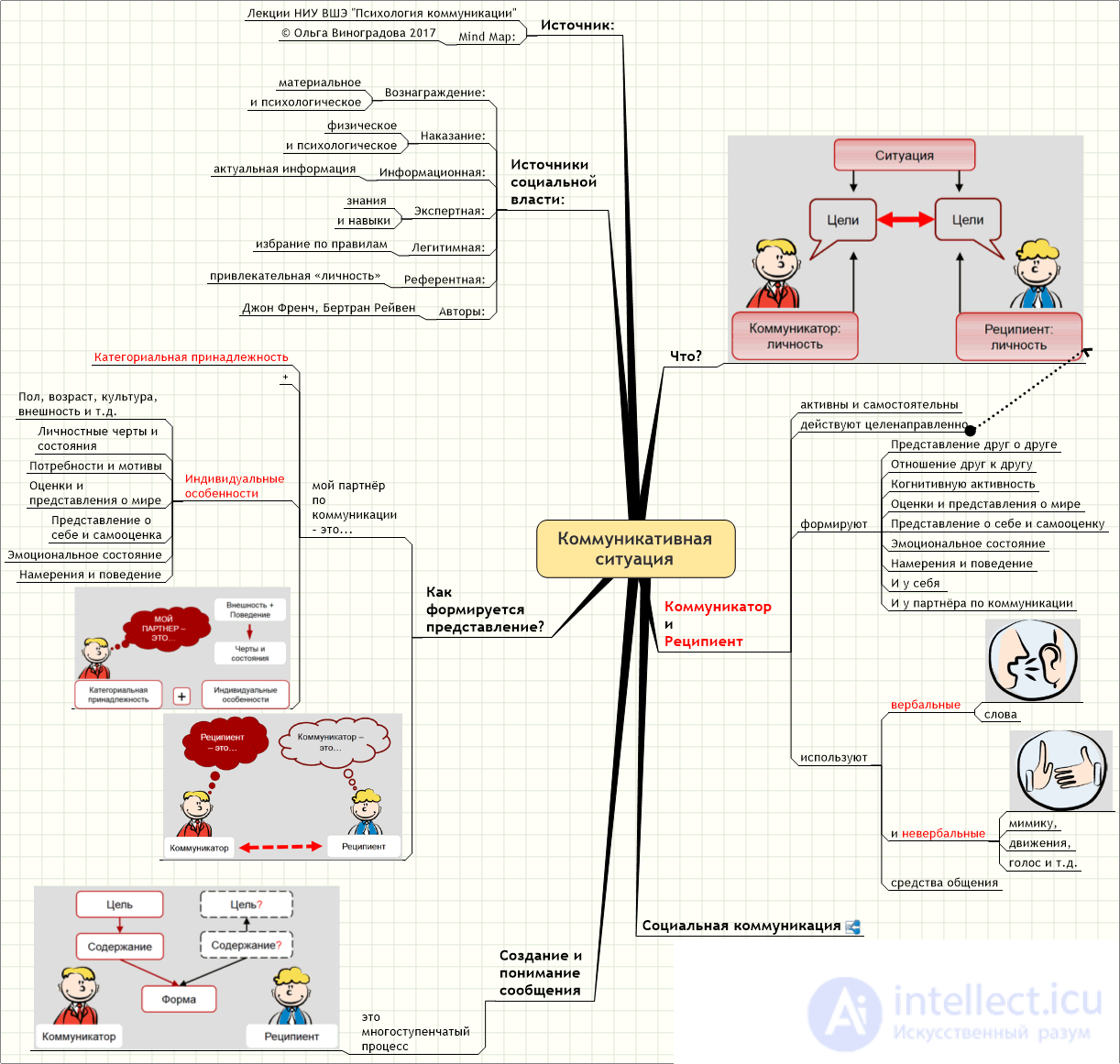
All three terms are directly related to speech communication. The first is a synonym of the term «speech communication». It is important to stress that both synonyms denote a two-way process, an interaction between people in the course of communication. In contrast, the term «speech behavior» emphasizes the one-sidedness of the process: it denotes those properties and features that characterize the speech and speech reactions of one of the participants in a communicative situation – either the speaker (addresser) or the listener (addressee). The term «speech behavior» is convenient for describing monologic forms of speech – for example, the communicative situations of a lecture, a speech at a meeting, at a rally, and so on. However, it is insufficient for analyzing dialogue: in this case it is important to uncover the mechanisms of mutual speech actions, not merely the speech behavior of each of the communicating parties. Thus, the concept of «speech communication» includes the concept of «speech behavior».
The term «speech act» denotes the concrete speech actions of the speaker within a particular communicative situation. For example, in the situation of buying goods at a market, a dialogue between the buyer and the seller may include various speech acts: a request for information (– How much does this thing cost? Who is the manufacturer? What material is it made of?), a statement (– Two thousand; South Korea; Genuine leather), a request (– Set it aside, please, I'll run for the money), an accusation (– You gave me the change wrong!), a threat (– I'll call the police right now!) and others.
In the middle of the 20th century, the English philosopher J. Austin, followed by the American scholars J. Searle and H. P. Grice, developed the theory of speech acts, in which they identified a number of regularities characteristic of the process of speech communication and formulated principles and postulates, adherence to which ensures the success of a given speech act and of speech communication as a whole: for example, «express yourself clearly», «be sincere», «be brief», «avoid obscure expressions» and others.
In the process of speech communication, people use the means of language – its vocabulary and grammar – to construct utterances that would be understandable to the addressee. However, knowledge of vocabulary and grammar alone is not sufficient for communication in a given language to be successful: one also needs to know the conditions of use of particular linguistic units and their combinations. In other words, in addition to grammar proper, a native speaker must acquire a «situational grammar», which prescribes the use of language not only in accordance with the meaning of lexical units and the rules for their combination in a sentence, but also depending on the nature of the relationship between the speaker and the addressee, on the purpose of communication, and on other factors, knowledge of which, together with linguistic knowledge proper, constitutes the communicative competence of a native speaker.
The nature of the communication skills that are part of communicative competence and that differ from knowledge of the language itself can be illustrated by the example of so-called indirect speech acts. An indirect speech act is one whose form does not correspond to its actual meaning in a given situation. For example, if a neighbor at the dinner table addresses you with the following words: – Could you pass me the salt?, then in form this is a question, but in essence a request, and the response to it should be your action: you pass the neighbor the salt shaker. If, however, you understand this request as a question and answer: – I could, without performing the corresponding action and waiting for the interlocutor to directly ask you to pass the salt, – the process of communication will be disrupted: you will act differently than the speaker expected and differently than is customary in response to such question-requests in similar situations.
Sociolinguistics has borrowed some terms and concepts from sociology and social psychology. The most important of these – social status and social role.
Living in society and belonging to various groups, each individual holds several social positions in society. For example, a student (which is itself a certain social position) may be an activist of a youth party, the institute's chess champion, a guitarist in a band; at home he is – a son and a brother, among friends – a buddy, etc. Each of these positions is associated with certain rights and obligations and is called a social status.
Most of the statuses a person has are achieved by themselves; such statuses are called achieved. The status of a student is achieved by successfully passing university entrance exams, the status of champion – by winning a competition, the status of husband – by getting married. Other statuses – such as sex, ethnic, or racial affiliation, we receive at birth; sociologists call these ascribed statuses. Some ascribed statuses we acquire later as well (the status of elder brother – upon the birth of a second son in the family, the status of adult – upon reaching a certain age). The essence of ascribed statuses is that they come to a person automatically, apart from their will and desire, and, once received, as a rule accompany them throughout their entire life. If the loss of an ascribed status is possible, it occurs according to certain rules and also apart from the will of the individual (such is, for example, the status of a person liable for military service).
Some statuses combine the properties of achieved and ascribed ones: a person invests significant effort in preparing and defending a dissertation, but the academic degree obtained as a result remains for life. Another example – the status of a criminal; it is ascribed by a court decision, but acquired through the individual's unlawful behavior. Some statuses are situational, of a short-term nature: a tram passenger, a customer in a bakery, a person speaking at a union meeting or a scientific conference. The significance of most such statuses is reinforced by their periodic recurrence.
Social statuses determine an individual's relationships with other members of society, their relatively permanent or temporary position within social hierarchies of various types.
Every status implies rights, obligations, and the corresponding normative behavior. The status of a student implies attending classes, taking exams, completing internships, having the right to use their university's library, and much more. The status of a professor implies competence in the relevant discipline, certain pedagogical skills, research activity, attendance at department meetings, and so on. Those around a person holding a given social status expect behavior appropriate to that status from them.
Such a complex of standard, generally accepted expectations is called a social role. A single status may correspond to several roles: for example, the expectations regarding a university professor held by students, colleagues, the head of department, and the administrative and technical staff of the university differ. The complex of roles "attached" to a single status is called a role set.
Many roles characteristic of a given society have special designations in language: father, wife, son, classmate, neighbor, teacher, customer, patient, passenger, client, chairperson of a meeting, and so on. All adult members of society know more or less well what to expect from a person's behavior when performing each of these roles, so that even the mere utterance of the role's name usually evokes, in the mind of both speaker and listener, a picture of the complex of rights and obligations characteristic of that role.
Role expectations do not depend on a specific person but are formed together with the type of social system within which that role exists; however, this is true only when statuses and their associated roles are considered in the abstract. A real individual, upon acquiring a certain status, begins to master the corresponding roles; sociologists call this process the internalization of the role (from Latin internus, 'internal').
Although the set of expectations inherent to a given role consists of a set of constants prescribing certain behavior to the individual, each person's internalization of roles occurs through the prism of their personal experience and under the influence of the micro- and macro-environment to which they belong. Therefore the performance of roles — both those conditioned by an individual's permanent, long-term social characteristics and those played out in one or another standard situation — varies from person to person, from one social group to another. It is important, however, that this variability stays within certain limits — as long as it does not contradict the expectations inherent to the given role and does not violate certain social norms.
Conceptions of the typical performance of a given social role form into stereotypes; they constitute an integral part of role behavior. Stereotypes are formed on the basis of experience, the frequent repetition of role features characterizing behavior, manner of speaking, moving, dressing, and so on. There are even stable expressions in language reflecting our conceptions of the typical speech behavior of a person in a given social role: drop your prosecutorial tone; shouts like a market trader; talks like a teacher; in the tone of a guilty schoolboy and so on.
Learning role behavior takes place within the framework of some social system, through the formal and informal sanctions imposed by that system; these sanctions can be positive (rewards) and negative (punishments). In this way the social system imposes on the bearer of a new status the normative understandings, accepted within it, of their new role set. However, a person has a certain freedom to rework standard roles "to fit themselves," in accordance with their own interpretation of the typical behavior corresponding to the status they have newly acquired. Conformists accept the role as given, ready-made. Others, by contrast, in accepting the role, persistently impose their own vision of it on their partners in social interaction and often succeed in modifying the role. If, in doing so, the reworking of the role becomes too radical, its bearer is met with incomprehension and condemnation in society.
The life of an individual as a member of society begins with the mastery of role behavior in the primary group, the family, in which he was born and raised; from this begins the process of his socialization – his entry into the society in which he is to live and act. Socialization is the process in the course of which an individual successively enters ever new groups for himself and assimilates, internalizes ever new roles. The acquisition of the language used in a given society, and of the rules for its use in accordance with the performance of one or another social role, is part of this process and is called language socialization.
The very idea of the social conditioning of language evolution is by no means new. It follows from the axiom according to which language is a social phenomenon, and if so, then, naturally, the development of language cannot be fully autonomous: it depends in one way or another on the development of society. The question is exactly how changes in social life affect changes in language, what the mechanism of this influence is.
In the works of E.D. Polivanov (the 1920s) the idea was first expressed that the influence of society on language does not occur directly, that changes in social life can accelerate or slow down the course of language evolution, but cannot influence its character and direction (which is determined by the internal laws of the language). Developing E.D. Polivanov's concept, M.V. Panov in the 1960s proposed the theory of linguistic antinomies – constantly operating tendencies opposed to one another, whose struggle is the driving stimulus of language development. The most important antinomies are the following: the antinomy of the speaker and the listener, of system and norm, of code and text, of regularity and expressiveness. At each specific stage of language development the antinomies are resolved in favor of first one and then the other of the opposing principles, which leads to the emergence of new contradictions, and so on – the final resolution of the antinomies is impossible: that would mean that the language had stopped in its development.
Antinomies are the most general regularities of language development. Of course, they do not cancel the action of the specific social factors that form the distinctive context of the evolution of each language. However, they are also not something separate from social factors: the close interaction of the two, the «overlaying» of certain social conditions onto the action of each of the antinomies, constitutes the specificity of language development at different stages of its history.
Unlike antinomies, whose action encompasses the language system as a whole, social factors are not equal in strength and range of their influence on language. They have different linguistic significance: some of them, global ones, act on all levels of the language structure, while others, particular ones, condition the development of only some levels to one degree or another. Examples of global social factors: a change in the circle of native speakers of the language; the spread of education; territorial movements of people (migration); the creation of a new statehood, influencing certain spheres of language in a new way; the development of science; major technical innovations and inventions (no one will dispute, for example, that the invention of printing, of radio, the introduction of television into everyone's daily life were social factors that affected the spheres of language use; the mass computerization of many kinds of activity is reflected in one form or another in language as well, and in the speech behavior of native speakers, and so on). A change in the composition of native speakers of a language, which can be regarded as a global social factor, leads to changes in phonetics, in the lexico-semantic system, in syntax, and, to a lesser degree, in the morphology of the language. Thus, the change in the composition of native speakers of the Russian literary language in the 1920s–1930s influenced pronunciation (in the direction of its literalization: instead of the old Moscow normative býlo[shn]aya,  , tú[khy]y people began to say býlo[chn]aya,
  , tú[kh'i]y), on the lexico-semantic system: the borrowing of words from dialects and colloquial speech entailed a restructuring of the paradigmatic and syntagmatic relations within the vocabulary; syntactic constructions that until then had been widespread in colloquial speech, dialects, and professional speech usage were drawn into literary usage (such, for example, in origin, are expressions of the type problems with firewood, testing water for contamination with chemical waste and the like); under the influence of uncodified subsystems of the language, the frequency increased of forms ending in -á
  in the nominative plural of masculine nouns (prozhektorá,
  and the like).
An example of a particular social factor is the change in the traditions of acquiring the literary language. In the 19th and early 20th centuries, in the noble-intellectual milieu, an oral tradition prevailed: the language was acquired through communication within the family, by passing down pronunciation and other speech patterns from the older generation to the younger. In connection with the processes of democratization of the composition of speakers of the literary language, the form of acquaintance with the literary language through books and textbooks began to spread and even predominate. This factor influenced mainly pronunciation norms: alongside the traditional pronunciation patterns, new ones began to spread that were closer to the orthographic appearance of the word (examples above).
Sociolinguistics also studies problems related to the social aspect of language proficiency, the social regulation of speech behavior, and the complex set of issues relating to the mixing of languages and the resulting formation of «intermediate» linguistic idioms — pidgins and creole languages. The problems of bilingualism and the processes of interaction and mutual influence of languages, conditioned by the presence of two or more languages in one society, are likewise within the competence of sociolinguistics. Finally, sociolinguistics is called upon to take part in resolving issues of language policy and language planning — for example, in multilingual regions, in situations of choosing one of the languages as the state language, in the development of alphabets and writing systems for unwritten languages, etc.

Comments