
Lecture
Performative (from Latin performo — «I create», «I form») — speech acts equivalent to a deed. This term was brought into wide use by John Austin, who divided utterances into performative and constative . Examples of performatives are oaths, promises, warnings, and orders.
Performatives have the following properties:
Incorrect performative use of verbs can give rise to wordplay and humor. For example, the verb «to argue» is not used performatively, which is why the reply «I argue!» to the request «Argue it?» in the stage dialogue of Roman Kartsev and Viktor Ilchenko produced a comic effect
In the philosophy of language and speech act theory, performative utterances are sentences that not only describe a given reality, but also change the social reality that they describe.
In his 1955 William James Lectures, which were later published under the title How to Do Things with Words, J. L. Austin objected to the positivist philosophical claim that utterances always «describe» or «construct» something and are thus always true or false. After mentioning several examples of sentences that are not used in this way and are not evaluated for truth (among them meaningless sentences, interrogatives, directives, and «ethical» sentences), he introduces «performative» sentences, or the illocutionary act, as another example.
A performative utterance is an utterance, as a rule containing a verb in the 1st person singular (or plural) of the actual present tense, the pronouncing of which is equivalent to performing a certain action.
Thus, in uttering the statement I ask you to be more careful, the speaker carries out the speech act (SA) of a request, while in uttering
the statement I promise you that this will not happen again, he performs the speech act of a promise.
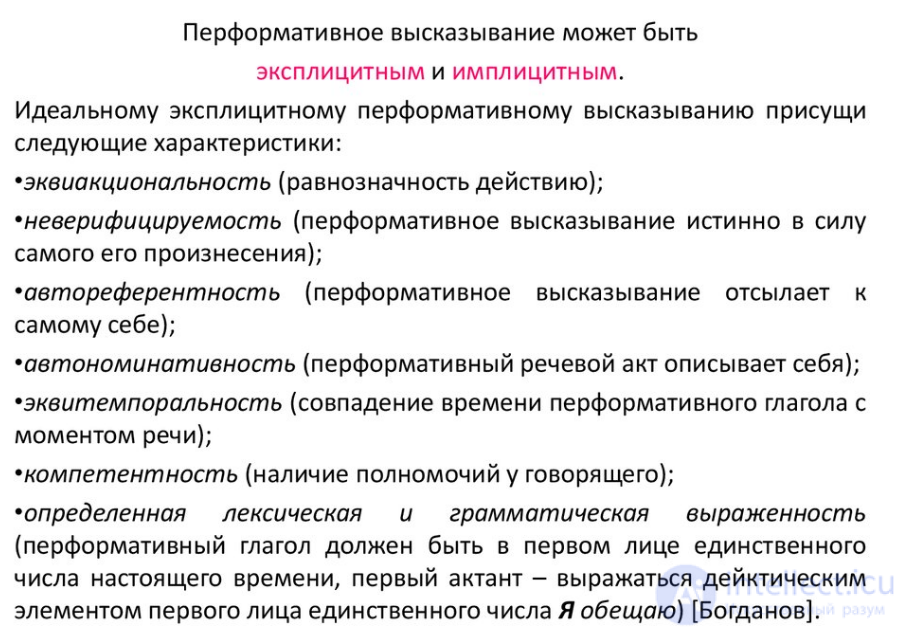
An ideal explicit performative utterance possesses
the following characteristics:
A given element of a performative
utterance
can
be
omitted
(IMPLICIT PERFORMATIVES):
Come here (= I ask you to come),
Read this book (= I advise you to read
this book)
Of two verbs close in meaning, one
can be performative, while another may not be.
For example, to accuse, to condemn in Russian
— are performatives, while to reproach, to criticize —
are not; to beg — is a performative, while to entreat —
is not; to assure — is a performative, while to convince — is not.
(E.V.Paducheva.
Utterance
and
Dialogue)
•semantic performative: Thanks (instead of I thank you), My fault
(instead of I apologize), Hi (instead of I greet you).
•modal component with would + infinitive of a verb capable of
performative use: I would like to apologize to you
(thank you, congratulate you, etc.);
•combination of an attenuated imperative with a performative infinitive:
Allow me, Permit me to thank you (congratulate you, ask you, etc.
);
•deverbative way of expressing intention, when the speech act
is actually named by the speaker: I have a request for you… My advice to you is …
I give my word …;
•elimination of a performative predicate clear from the situation,
by means of
which
the propositional
part
is translated
into
the intentional: Happy holiday! (I congratulate you on the holiday!), Good luck!
(= I wish you success!)
• plural (group performatives):
We do not judge you to be guilty of professional misconduct.
• written form :
D. Reagan's resignation letter: I hereby resign as Chief of Staff to the
President of the United States of America. Respectfully yours, Donald T.Regan
• 3rd person:
copyright notice on books: «The author asserts the moral right to be identified as the
author of this work»
The court finds the accused not guilty; You are asked to step into the office.
• passive voice:
Your employment is hereby terminated with immediate effect.
You are invited to the opening of the exhibition
• continuous tense:
- Are you denying that the Government has interfered?
- I am denying that.
• impersonal performative formulas:
No smoking here.
evaluation (to characterize, to understand as,
to interpret);
exercise of power (to appoint, to vote,
to order, to advise);
obligation (to invite, to promise,
to propose (marriage), to guarantee,
to swear);
social action (to apologize, to congratulate,
to greet, to protest);
reaction to another utterance (to answer,
to admit, to deny, to ask,
to agree) and others.
E.V.Paducheva. Utterance and Dialogue
• Performatives in speech are often perceived as
formal, insincere utterances:
I thank you for the criticism (formal gratitude)
I am grateful to you for the criticism (sincere gratitude).
• Utterances with a performative verb sound more
insistent and persuasive.
They are often used in repeated attempts to convince someone of something:
I swear I love you; I assure you, everything will be fine.
• Utterances with a performative verb often
imply a status inequality between the communicants or
that the speaker has certain rights.
I appoint you chairman.
At first the speaker tries to get by with an implicit performative
(when the performative is not in the surface structure of the utterance, but it
is implied and could be inserted), and upon an unsuccessful attempt
uses an explicit performative.
The man silently sank to his knees. It was Father Fyodor.
− Have you lost your mind! − exclaimed the engineer, jumping up. − Get up,
please!
− I will not get up, − answered Father Fyodor, turning his head to follow the engineer
[Bruns] and looking at him with clear eyes.
− Get up!
− I will not get up! And Father Fyodor carefully, so as not to hurt himself,
started knocking his head against the gravel.
− Musik! Come here! − shouted the frightened engineer.
− Look at what's happening. Get up, I beg you! Please, I implore you!
− I won't get up! − repeated Father Fyodor. Musik ran out onto the veranda,
who was keenly attuned to her husband's intonations.
(I. Ilf, E. Petrov. The Twelve Chairs)
1) Metalinguistic performatives: I protest, I promise,
I deny... object, apologize, deny, promise…
2) Group performatives are produced not by 1 speaker,
but by a group of people (a conference communiqué, a
commission's report, a jury's verdict).
We do not judge you to be guilty of professional misconduct.
3) Ritual performatives:
a formal
procedure,
a ritual,
strict
rules,
a specific person in a specific situation; culturally
conditioned
I absolve you from your sins; I baptize you; I name this ship…
4) Collaborative performatives:
performatives for whose successful execution
cooperation between the Speaker and the Hearer is necessary:
I challenge you to pistols at dawn (Thomas 1995).
• structural features differ across languages (in
English, one can always add the adverb hereby).
• national and cultural specifics:
– I baptize you – such a performative exists in Christian
countries
– Divorce
the verb to divorce is not performative
in many languages, whereas in Muslim countries,
(Pakistan,
India)
there is
a corresponding
performative verb (talaq).
In order to define performatives, Austin refers to those sentences that conform to the old prejudice in the sense that they are used to describe or state something and are thus either true or false; and he calls such sentences «constatives». In contrast, Austin defines «performatives» as follows:
(1) Performative utterances are not true or false, that is, they are not truth-evaluable; instead, when something is wrong with them, they are «unhappy», and if everything is in order, they are «happy».
(2) The uttering of a performative is or is part of the doing of an action of a certain kind (later Austin considers these under the name of illocutionary acts), the performance of which, again, is not normally described as simply «saying» or «describing» something (cf. Austin 1962, 5).
For example, when Paul says: «I promise to wash the dishes» in an appropriate context, he is thus not merely saying something and, in particular, not describing what he is doing; rather, in making the utterance he is performing a promise; and since promising is an illocutionary act, the utterance is a performative utterance. If Peter utters the sentence without any intention of keeping the promise, or if he ultimately fails to keep it, then, although something is wrong with the utterance, the problem is not that the sentence is false: it is rather «unhappy», or «infelicitous», as Austin also says in his discussion of the so-called felicity conditions. On the other hand, in the absence of such a defect, the utterance should be evaluated as «happy» or «felicitous» rather than as «true». Austin abandoned this distinction in favor of the distinction between explicit performatives («I promise that this will never happen again») and primary or implicit performatives («this will never happen again», functioning as a promise).
The first examples of performative sentences that Austin gives are as follows:
«I do (take this woman to be my lawful wedded wife)» - as said in the course of a marriage ceremony.
«I name this ship« Queen Elizabeth »»
«I give and bequeath my watch to my brother» - as stated in a will
«I'll bet you sixpence it will rain tomorrow» (Austin 1962, 5)
As Austin himself later notes, these examples belong (more or less strikingly) to what Austin calls: to utter an «explicit» performative sentence means to explicitly indicate what action is being performed. However, there also exist «implicit», «primitive», or. When, for example, the word «Go!» is used to order someone to leave the room, this utterance is part of the execution of the command; and the sentence, according to Austin, is neither true nor false; consequently, the sentence is a performative; - nevertheless, this is not an explicit performative, since it does not explicitly indicate that the action performed by the speaker is a command.
As Austin notes, the actions ostensibly performed by means of performative utterances may be contested by society. For example, a man saying to his wife three times «I divorce you» may be accepted as a divorce by some but not by others.
«I now pronounce you married» - used during a wedding ceremony
«I order you to go», «Go… that's an order «
« Yes »- an answer to the question« Do you promise to wash the dishes? »
« You are under arrest »- used to place someone under arrest
«I baptize you»
«I accept your apology»
«I sentence you to death»
«I divorce you, I divorce you, I divorce you "(Islamic: see: Talaq-i-Bid'a )
" I do "- wedding
" I swear to do this "," I promise to be there "
«I apologize»
«I dedicate this ...» (... book to my wife; ... the next song to the striking workers of Stella Doro, etc.)
«The meeting is adjourned», «Court is now in session»
«This church is hereby deconsecrated»
«War is declared»
«I resign »- employment or chess
« You are [hereby] fired ».
True / false value, and John Searle
John R. Searle argued in his 1989 article. How Performatives Work, that performatives are true/false, just like constatives. Searle further argued that performatives are what he calls declarations; this is a technical notion from Searle's account: according to his conception, an utterance is a declaration if «the successful performance of the speech act is sufficient to bring about a correspondence between the words and the world, so as to make the propositional content true». Searle believes that this double direction of fit contrasts with the simple «word to world» correspondence.
Kent Bach and Robert Harnish argued that performatives are successful only if the recipients infer the intention behind the literal meaning, and that, consequently, the success of a performative act is determined by the receiving side.
Performativity as a non-dichotomous variable
Eve Sedgwick argued that there are performative aspects to almost all words, sentences, and phrases. Furthermore, according to Sedgwick, performative utterances can be «transformative» performatives, which bring about an instantaneous change in personal or environmental status, or «promissory» performatives, which describe the world as it may be in the future. These categories are not mutually exclusive, so an utterance may have both qualities. As Sedgwick notes, performative utterances can be revoked either by the person who uttered them («I take back my promise»), or by some other party not directly involved, such as the state (for example, a same-sex marriage vow's prior legalization).
Words on a list can be either descriptive or performative. «Butter» on a shopping list means «I will buy butter» (a promise to oneself). But the word «butter» printed on a receipt means «you have purchased butter» (mere description).
The above ideas influenced performative writing; they are used as a justification for attempting to create a new form approximating performance (often approximating performance). It is argued that such a written form is itself a form of performance. It is said to more accurately reflect the fleeting and ephemeral nature of a performance, as well as the various tricks of memory that occur in the viewer's mind during and after the performance.
In the philosophy of language, the concept of the performative conceptualizes what a spoken or written text can bring about in human interaction.
In the 1950s, the philosopher of language John Langshaw Austin introduced the term "performative" to clarify that "to say something is to do something" . Developing this idea, scholars theorized about the connection of spoken or written text with its broader context, that is, with everything outside the text itself. The question of whether a performative can be separated from the situation in which it arose is relevant, for example, when it comes to the status of individual intentions or speech as a resource of power. Today there are two main theoretical directions in research. One emphasizes the predetermined conventions surrounding a performative utterance and the clear distinction between text and context. The other emphasizes the active construction of reality through spoken and written texts and is linked to theories of subjectivity and discourse. Ideas about performance and text contributed to the performative turn[en] in the social sciences and humanities, proving their methodological usefulness, for example, in the interpretation of historical texts
Early theories recognize that performance and text are embedded in a system of rules and that the effects they can produce depend on conventions and repeatability. In this sense, the text is an example of "restored behavior," a term introduced by Richard Schechner, who views performance as a repeatable ritual. Here the main focus is on individual sentences in the active voice from the first person, rather than on politics or discourse. Syntactic analysis is firmly rooted in analytical epistemology, since the distinction between the object of study and its context is not considered problematic.
J. L. Austin introduced the performative utterance as an additional category alongside "constatives," statements that can be either true or false. Language not only represents but can also do something. Austin distinguishes two types of performative speech acts. The illocutionary act relates to what the actor does by saying something (for example, when someone says hello, they are greeting another person). The perlocutionary act involves the unforeseen consequences of an utterance and refers to what the actor does by saying something (for example, when someone says hello, and this frightens the person who is greeted).
Every performative utterance has its own procedure and risks of failure, which Austin calls "infelicities." He sees a sharp distinction between an individual text and the surrounding "total speech act situation." According to Austin, for an illocutionary act to be successfully performed, certain conditions must be met (for example, the person announcing a marriage must be authorized to do so). Besides the context, the performative utterance itself must also be unambiguous. The words of the illocutionary act must be uttered seriously; otherwise Austin dismisses them as a parasitic use of language.
Building on Austin's thought, the language philosopher John Searle attempted to develop his own view of speech acts, suggesting that these actions are a form of rule-governed behavior. On the one hand, Searle distinguishes rules that merely regulate language, such as address and prediction. These rules determine the «propositional content» of our sentences. On the other hand, he distinguishes rules that are constitutive in nature and define behavior (for example, when we make a promise). [10] These rules are the conventions underlying performative utterances, and they allow us not only to represent and express ourselves, but also to communicate. [11]
This emphasis on effect implies a conscious actor, and Searle suggests that language stems from the internal intentionality of the mind. [12] These intentions establish the preconditions for the performance of speech acts, and Searle intends to map their necessary and sufficient conditions. [13] Like Austin, he thinks in terms of a delimited context and transparent intentions - two issues that in the 1970s led him into a polemic with the postmodernist thinker Jacques Derrida. [14]
The second set of theories of performance and text diverged from the traditions represented by Austin and Searle. Bearing the stamp of postmodernism, it maintains that neither the meaning nor the context of a text can be determined in its entirety. Rather than emphasizing linguistic rules, researchers in this direction stress that performative utterances are intertwined with structures of power. Since a text inevitably changes the situation or discourse, the distinction between text and context is erased.
The postmodern philosopher Jacques Derrida shares Austin's and Searle's view that, through illocutionary force, language itself can transform and influence. [15] However, he criticizes the notion of «felicity conditions» and the idea that the success of a performative utterance is determined by conventions. Derrida values the singularity of each individual speech act, because it exerts a particular influence in the specific situation in which it is performed. [16] It is precisely because of this effect, or «disruptive force», that Derrida calls the possibility of repeating a text «iterability», a word derived from the Latin iterare, meaning to repeat.
According to Derrida, the effects produced by a performative text are, in a sense, also part of it. Thus the distinction between the text and what lies outside it disappears. For this reason it is pointless to try to define the context of a speech act. [17] Besides side effects, the disappearance of the gap between text and context is also caused by iterability. Because of the possibility of repetition, the intentions of an individual actor can never be fully present in the speech act. [18] The core of a performative utterance thus consists not of animating intentions, as Austin and Searle would say, but of the structure of language.
The philosopher Judith Butler offers a political interpretation of the concept of the performative utterance. Power in the form of active censorship defines and regulates the sphere of a given discourse. [19] Drawing on the work of Michel Foucault, Butler explains how subjects are created by their context, because the possibilities of speech are predetermined.
Despite such social constraints, Butler emphasizes the possibility of agency. The boundaries of discourse need constant renewal of demarcation, and it is precisely here that speech can escape constraint. The emphasis on the boundaries of what can be said also frames what is silenced. [20] Performativity has a political aspect, which consists in what Derrida described as the disruptive force by which an utterance changes its context. [21] Butler assigns an important role to what Austin called misfires and the parasitic use of language. Quotations, parodies, and other deviations from official discourse can become instruments of power that influence society. [22]
The historian Quentin Skinner turned classical and postmodernist theories of performative texts into a concrete research method. Using Austin's vocabulary, he attempts to reconstruct what historical authors were doing when writing their texts, which corresponds to the performance of illocutionary acts. [23] According to Skinner, philosophical ideas are intertwined with claims to power. Every text is an act of communication that positions itself in relation to the status quo it seeks to change. [24]
Skinner agrees with Derrida that contexts are, on the whole, irrecoverable, but nevertheless maintains that there is a relevant context outside the text that can be described in a plausible way. [25] Extensive research is required to link historical texts to their contemporary discourses. According to Skinner, «in a sense we need to understand why a particular proposition was put forward if we want to understand the proposition itself». [24] He values agency over structure and emphasizes the importance of the author's intentions. [26] Skinner therefore proposes to study historical sources in order to reconstruct the author's beliefs, reflect on their coherence, and explore the possible motives of the illocutionary act. [27] This practical method aims to eliminate the blurred distinctions between text and context and offers a substantive way of interpreting historical reality.

Comments