
Lecture
Confident, aggressive and passive-aggressive behavior are different styles of interaction and communication that differ in their characteristic features and criteria.
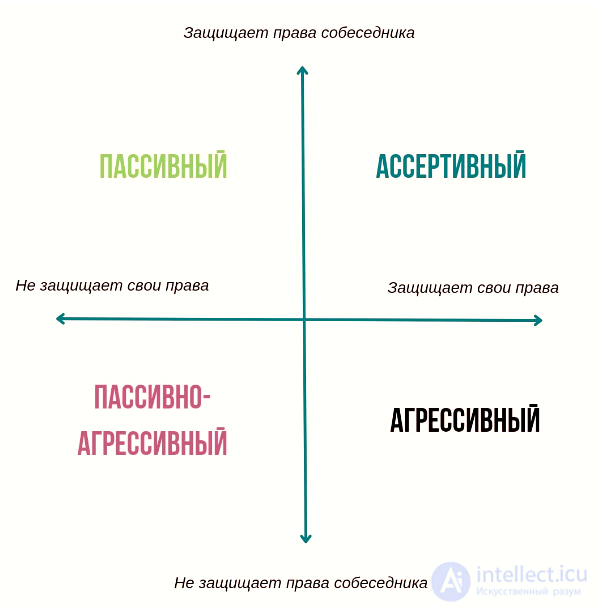
Let's look at each of them in more detail:
Confident behavior:
Confidence is a behavior style characterized by the following features:
The goal of confident behavior is self-actualization, that is, the realization of one's potential and the achievement of personal goals. For example, confident behavior can manifest itself in the ability to express one's wishes or requests to another person directly and respectfully, which promotes open and healthy communication
Confident people usually communicate openly and honestly, but with respect for others.
They do not avoid responsibility for their actions and decisions.
Confident people usually strive to find constructive solutions to resolve conflicts and problems.
They take into account the interests and needs of other people in the process of communication.
Aggressive behavior:
Aggressiveness is behavior characterized by the following features:
Aggressive people often use a hostile and forceful communication style to achieve their goals.
They may try to avoid responsibility for their actions, blaming others for their own problems.
Aggressive behavior is often associated with a desire to dominate and control the situation.
Aggressive people may try to forcibly impose their will on others, without taking into account their own preferences.
Aggressive behavior usually looks hostile and may aim at coercion and punishment of other people. This is a communication style that often causes tension and conflict in interpersonal relationships.
Passive-aggressive behavior:
Passive-aggressive behavior (or passive aggression) — a behavior pattern in which aggressiveness is expressed, but in a rather passive than active way. Such behavior is characterized by hidden, indirect aggressiveness, usually concealed by a display of submissiveness or benevolence. Active aggressive behavior is usually not used in these cases because of possible retaliatory reprisals. Many people are passive-aggressive only toward stronger people (including those occupying a higher social position), while displaying open hypercompensatory aggressiveness toward those who cannot respond to them.This definition was first given by Colonel William Menninger during World War II.
In passive-aggressive behavior, passive resistance to the opponent's negative remarks is expressed, whereby, nevertheless, the goals set by the person using this behavior are achieved. People who engage in a passive-aggressive style of communication will not openly oppose what they dislike. In these people, accumulated tension requiring release manifests itself through refusal to perform some action. This manner of behavior expresses aggressiveness through the fact that «no» is expressed in a passive way
Passive-aggressive behavior in interpersonal relationships is often aimed at indirectly punishing another person by making them feel guilty. It is important to note that in this case it is difficult for the partner of a passive-aggressive person to accuse them of overt aggression or demands aimed at punishment. An example of such behavior might be that a person does not speak directly about their wishes, but expresses them through indirect hints, with some anxiety and unease, or does not even try to achieve their desired goals and remains silent. The predominance of passive-aggressive behavior patterns usually leads to dissatisfaction with one's own relationships with others, since unresolved grievances become permanent companions of these relationships. In response to such behavior, people around begin to avoid contact with such a person, tired of the feeling of guilt that constantly accompanies their interaction with them.
Unassertive behavior is often aimed at manipulation, meaning covert and indirect attempts to control and influence the people around one for one's own interests.
Passive behavior is characterized by inactivity and an inability to express one's needs, opinions, or emotions in accordance with the situation or expectations. It can be caused by various factors, such as low self-esteem, fear of conflict, or a desire to avoid negative consequences. Let's look at the features and criteria of passive behavior:
Features of passive behavior:
Refusal to express opinions: Passive people usually avoid expressing their opinions, even if they have their own views on the situation.
Avoiding conflict: They try to avoid conflict at any cost and, consequently, often give in to others, even if it does not align with their own interests.
Unclear and insufficient expression: When they do express their needs or opinions, it is often unclear, insufficiently clear, or passive-aggressive.
Hidden dissatisfaction: Passive people may experience dissatisfaction and irritation, but they rarely express it openly.
Compliance: They can easily give in to pressure from others and agree to compromises, even if it contradicts their own interests.
Criteria of passive behavior:
Avoiding confrontation: Passive people avoid open conflicts and often give in, even when they believe they are right.
Self-forgetfulness: They tend to forget about their own needs and desires in order to satisfy the requests of others.
Vagueness: Their statements and requests can be vague and unclear, making it difficult to understand their needs.
Lack of initiative: Passive people often do not show initiative in interpersonal relationships and rely on others to make decisions.
Substitution of aggression: Sometimes passive people may display passive-aggressive behavior, expressing their dissatisfaction in an indirect or hidden way.
Passive behavior can have negative consequences for interpersonal relationships, as it can lead to misunderstanding, dissatisfaction, and conflicts. Effective communication and the ability to express one's needs and opinions openly and respectfully are important for healthy interpersonal relationships.
|
A confident person |
A passive person |
An aggressive-passive person |
An aggressive person |
|
Acknowledges their shortcomings.
|
Stays silent.
|
Deliberate avoidance of conflict or dialogue. |
Brags.
|
|
Gives and accepts compliments.
|
Does not give compliments and does not know how to accept them.
|
ignoring, silence, or lack of reaction. |
Seeks approval and criticizes others.
|
|
Initiates and sustains interaction.
|
Does not start speaking first and does not sustain conversation.
|
Hidden expression of dissatisfaction or aggression, often through indirect remarks or complaints. |
Initiates interaction only when they need something from another person (manipulation).
|
|
Expresses positive feelings.
|
Does not express positive feelings.
|
A feeling of misunderstanding and incompleteness in communication |
Expresses mostly negative feelings.
|
|
Voices unpopular opinions or ones that differ from others.
|
Does not voice their opinion.
|
there is a probability of revenge |
Reacts hostilely to any opinion that differs from their own.
|
|
Asks other people to change their behavior.
|
Indulges other people, allows themselves to be used and permits any treatment of themselves.
|
Gets angry at other people without explaining why, and does not ask for anything to be changed.
|
|
|
Can answer «no» to an unfeasible request.
|
Feels offended, but agrees to everything.
|
Gets angry at the person, not at the request.
|
These behavior styles can affect interpersonal relationships and conflicts. Confident behavior often promotes healthy and constructive communication, while aggressive and passive-aggressive behavior can lead to conflicts and misunderstandings. The ability to recognize and choose the appropriate behavior style depending on the situation is an important skill in interpersonal relationships.
How to communicate with people exhibiting confident, aggressive, passive and passive-aggressive behaviors in communication?
Interacting with people exhibiting different behavior styles (confident, aggressive, passive and passive-aggressive) can be difficult, but it is an important skill in interpersonal relationships. Here are some recommendations on how to communicate with such people:
With confident people:
With aggressive people:
With passive people:
With passive-aggressive people:
It is important to remember that every person is unique, and effective communication methods may differ depending on the specific situation and personality. The main thing is to strive for open, respectful, and constructive communication, where the needs and interests of all parties are taken into account.
Changing behavior depends on the specific communication style (assertive, aggressive, passive, or passive-aggressive) and on which aspects of this behavior need to be improved. Here are some general recommendations for changing certain negative aspects of each communication style:
For assertive people:
For aggressive people:
For passive people:
For passive-aggressive people:
A key aspect of any behavior change is awareness of one's own behavior patterns and the desire to improve them. If necessary, you can consult a psychologist or communication coach to get individual support and the skills needed for successful behavior change.
The ability to express one's thoughts and feelings in a socially acceptable form, that is, without humiliating others in the process: Assertive people usually communicate openly and honestly, but with respect for others.
Willingness to take responsibility for one's actions: They do not avoid responsibility for their actions and decisions.
Constructive approach to problem-solving: Assertive people usually strive to find constructive solutions to resolve conflicts and problems.
Striving not to infringe on the interests of others: They take into account the interests and needs of other people in the process of communication.
<p style="border: 0px solid rgb(217, 217, 227); box-sizing: border-box; --tw-border-spacing-x:0; --tw-border-spacing-y:0; --tw-translate-x:0; --tw-translate-y:0; --tw-rotate:0; --tw-skew-x:0; --tw-skew-y:0; --tw-scale-x:1; --tw-scale-y:1; --tw-pan-x: ; --tw-pan-y: ; --tw-pinch-zoom: ; --tw-scroll-snap-strictness:proximity; --tw-gradient-from-position: ; --tw-gradient-via-position: ; --tw-gradient-to-position: ; --tw-ordinal: ; --tw-slashed-zero: ; --tw-numeric-figure: ; --tw-numeric-spacing: ; --tw-numeric-fraction: ; --tw-ring-inset: ; --tw-ring-offset-width:0px; --tw-ring-offset-color:#fff; --tw-ring-color:rgba(69,89,164,0.5); --tw-ring-offset-shadow:0 0 transparent; --tw-ring-shadow:0 0 transparent; --tw-shadow:0 0 transparent; --tw-shadow-colored:0 0 transparent; --tw-blur: ; --tw-brightness: ; --tw-contrast: ; --tw-grayscale: ; --tw-hue-rotate: ; --tw-invert: ; --tw-saturate: ; --tw-sepia: ; --tw-drop-shadow: ; --tw-backdrop-blur: ; --tw-backdrop-brightness: ; --tw-backdrop-contrast: ; --tw-backdrop-grayscale: ; --tw-backdrop-hue-rotate: ; --tw-backdrop-invert: ; --tw-backdrop-opacity: ; --tw-backdrop-saturate: ; --tw-backdrop-sepia: ; margin: 1.25em 0px 0px; color: rgb(55, 65, 81); font-family: Söhne, ui-sans-serif, system-ui, -apple-system, " segoe="" ui",="" roboto,="" ubuntu,="" cantarell,="" "noto="" sans",="" sans-serif,="" "helvetica="" neue",="" arial,="" "apple="" color="" emoji",="" "segoe="" ui="" symbol",="" emoji";="" font-size:="" 16px;="" white-space:="" pre-wrap;="" background-color:="" rgb(247,="" 247,="" 248);"="">The goal of assertive behavior is self-actualization, that is, realizing one's potential and achieving personal goals. For example, assertive behavior can manifest itself in the ability to express one's wishes or requests to another person directly and respectfully, which promotes open and healthy communication

Comments