
Lecture
Quaternions (from Latin quaterni, "four each") are a system of hypercomplex numbers forming a four-dimensional vector space over the field of real numbers. Usually denoted by the symbol  . Proposed by William Hamilton in 1843.
Quaternions are convenient for describing the isometries of three- and four-dimensional Euclidean spaces and therefore have become widely used in mechanics. They are also used in computational mathematics — for example, in creating three-dimensional graphics .
Henri Poincaré wrote of quaternions: «Their appearance gave a powerful impetus to the development of algebra; starting from them, science followed the path of generalizing the concept of number, arriving at the concepts of matrix and linear operator that permeate modern mathematics. This was a revolution in arithmetic comparable to the one Lobachevsky made in geometry» .
Quaternions can be defined as the sum

where  are real numbers
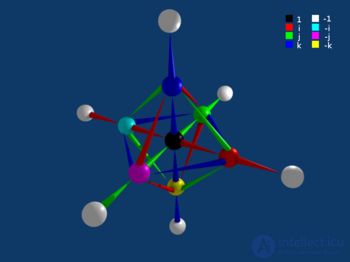
Graphical representation of the multiplication table of the basis quaternions (the color of the sphere indicates the first factor, the color of the outgoing arrow indicates the second factor, and the arrow points to the result of the multiplication)
 — imaginary units with the following property:
  , and the result of their pairwise product depends on the order (it is not commutative):
  , while
  .
.
| X | 1 | i | j | k |
|---|---|---|---|---|
| 1 | 1 | i | j | k |
| i | i | -1 | k | -j |
| j | j | -k | -1 | i |
| k | k | j | -i | -1 |
A quaternion is a pair  where
where  is a vector in three-dimensional space, and
  is a scalar, that is, a real number.
Addition is defined as follows:

The product is defined as follows:

where ⋅ denotes the dot product, and ×
 denotes the cross product.
In particular:



Note that:
An arbitrary quaternion q=a+bi+cj+dk can be represented as a pair of complex numbers in the form

or equivalently

where  are complex numbers, since
  holds both for complex numbers and for quaternions, and
  .
.
Quaternions can also be defined as real matrices of the following form, with the ordinary matrix product and sum:
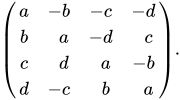
With this representation:
 ;
;
Alternatively, quaternions can be defined as complex matrices of the following form, with the ordinary matrix product and sum :

here  and
and  denote the complex conjugates of
  and
and  .
.
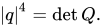
This representation has several remarkable properties:
 ;
;
For a quaternion
the quaternion is called the scalar part of  and the quaternion
  the vector part. If
  the quaternion is called purely scalar, and if
  purely vector.
For a quaternion  the conjugate is defined as :

The conjugate of a product is the product of the conjugates in reverse order :
.
For quaternions the following equality holds

Just as for complex numbers ,

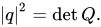
is called the modulus . If  then is called the unit quaternion.
The modulus of a quaternion is usually taken as its norm:  .
.
Thus, a metric can be introduced on the set of quaternions. Quaternions form a metric space isomorphic to  with the Euclidean metric.
Quaternions with the modulus as norm form a Banach algebra.
From the four-square identity it follows that  in other words, quaternions have a multiplicative norm and form an associative division algebra.
The multiplicative inverse of is computed as follows :  .
.
The set of quaternions is an example of a skew field, that is, a division ring with a unit. The set of quaternions forms a four-dimensional associative division algebra over the field of real (but not complex) numbers.
By the Frobenius theorem, the division rings  ,
,  , are the only finite-dimensional associative division algebras over the field of real numbers.
The noncommutativity of quaternion multiplication leads to unexpected consequences. For example, the number of distinct roots of a polynomial equation over the quaternions can be greater than the degree of the equation. In particular, the equation  has infinitely many solutions — these are all unit purely vector quaternions.
The four basis quaternions and the four quaternions opposite to them in sign form a group of quaternions (of order 8) under multiplication. It is denoted:
.
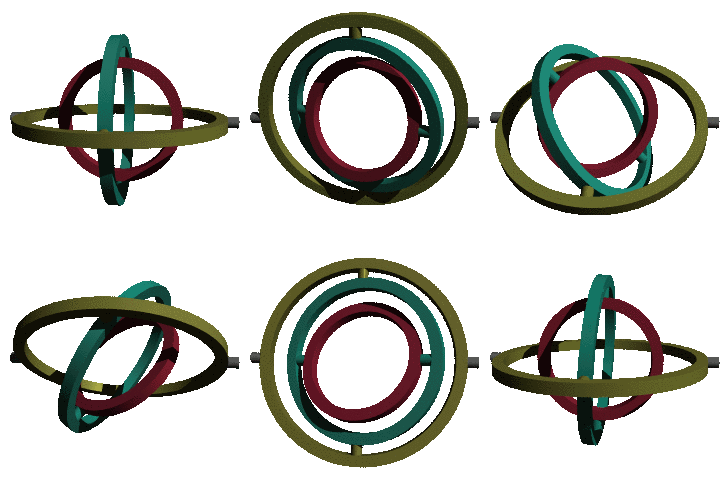
Arrangement of three degrees of freedom, but the final degree of freedom of the smaller rings depends on the position of the larger rings
Quaternions, considered as an algebra over , form a four-dimensional real vector space. Any rotation of this space about 0 can be written in the form  , where
  and
and  are a pair of unit quaternions, and the pair
  is determined up to sign, that is, one and the same rotation is defined by exactly two pairs — and
  . It follows that the Lie group
  of rotations is the quotient group
  , where S3
 denotes the multiplicative group of unit quaternions.
Purely vector quaternions form a three-dimensional real vector space. Any rotation of the space of purely vector quaternions about 0 can be written in the form  , where is some unit quaternion. Accordingly,
  , in particular,
  is diffeomorphic to
  .
.
As the norm of a quaternion, let us take the square of its modulus:  .
.
Hurwitz integer quaternions are conventionally the quaternions  such that all
  are integers and of the same parity.
An integer quaternion is called
if its norm has the same property.
An integer quaternion is called primitive if it is not evenly divisible by any natural number other than 1 (in other words,  ).
).
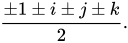
There are 24 integer unit quaternions:
.
They form a group under multiplication, and lie at the vertices of a regular 4-dimensional polytope — the 3-cuboctahedron (not to be confused with the 3-dimensional cuboctahedron polyhedron).
For primitive quaternions, an analogue of the fundamental theorem of arithmetic holds.
Theorem. For any fixed order of the factors in the factorization of the norm of the quaternion  into a product of prime positive integers
  there exists a factorization of the quaternion into a product of prime quaternions
  such that
  . Moreover, this factorization is unique up to multiplication by units — that is, any other factorization has the form
 ,
,
where  ,
,  ,
,  , …
, …  are integer unit quaternions.
For example, the primitive quaternion  has norm 60, so, up to multiplication by units, it has exactly 12 factorizations into a product of prime quaternions, corresponding to the 12 factorizations of the number 60 into a product of primes:


The total number of factorizations of such a quaternion equals 24³⋅12=165888
The sign of a quaternion is computed as follows:

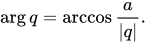
The argument of a quaternion is the angle in four-dimensional space between the quaternion and the real unit:
In what follows, we use the representation of a given quaternion q in the form

Here is the real part of the quaternion,  . Since i2=−1
 , the plane passing through and the real line has the structure of the algebra of complex numbers, which makes it possible to carry over arbitrary analytic functions to the case of quaternions. They satisfy the standard relations if all arguments have the form
  for a fixed unit vector i
 . If quaternions with different directions need to be considered, the formulas become considerably more complicated, owing to the noncommutativity of the algebra of quaternions.
The standard definition of analytic functions on an associative normed algebra is based on expanding these functions in power series. The arguments proving the correctness of this definition are completely analogous to the complex case and rely on computing the radius of convergence of the corresponding power series. Given the «complex» representation described above for a given quaternion, the corresponding series can be brought to the compact form given below. Only a few of the most commonly used analytic functions are given here; any analytic function can be computed analogously. The general rule is as follows: if  for complex numbers, then
 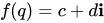 , where the quaternion is considered in its «complex» representation
  .
.
Power and logarithm


Note that, as is usual in complex analysis, the logarithm turns out to be defined only up to  .
.
Trigonometric functions



A mapping  of the algebra of quaternions is called linear if the following equalities hold

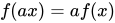

where is the field of real numbers. If  is a linear mapping of the algebra of quaternions, then for any
  the mapping

is a linear mapping. If is the identity mapping  ), then for any we can identify the tensor product ⊗
  with the mapping

For any linear mapping there exists a tensor  ,
,  , such that

In the equalities above, summation over the index  is assumed. Therefore we can identify the linear mapping with the tensor .
There are various ways to define regular functions of a quaternionic variable. The most explicit is to consider quaternionically differentiable functions, where one can consider right-differentiable and left-differentiable functions, which do not coincide because of the noncommutativity of quaternion multiplication. It is clear that their theories are completely analogous. Let us define a quaternionically left-differentiable function as one having the limit

It turns out that all such functions have, in some neighborhood of the point , the form

where  are constant quaternions. Another approach is based on using the operators


and considering quaternionic functions , for which

which is completely analogous to the use of the operators  and
and  in the complex case. This yields analogues of the Cauchy integral theorem, residue theory, harmonic functions, and Laurent series for quaternionic functions
A continuous mapping is called differentiable on the set  , if at every point
  the change in the mapping can be represented in the form

where
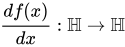
is a linear mapping of the algebra of quaternions;  is such a continuous mapping that
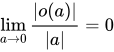
The linear mapping  is called the derivative of the mapping .
The derivative can be represented in the form
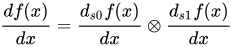
Accordingly, the differential of the mapping has the form

Here summation over the index is assumed. The number of terms depends on the choice of the function . The expressions  and
and  are called the components of the derivative.
For an arbitrary quaternion the following equality holds

This is another name for the standard multiplication of quaternions (  ).
).
It differs from the standard one in that the conjugate of the first factor is used instead:  . It is likewise noncommutative.
Analogous to the operation of the same name for vectors:
2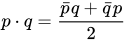 .
.
This operation can be used to extract one of the coefficients, for example,  .
.
The definition of the modulus of a quaternion can be modified:
 .
.
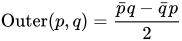 .
.
Not used very often, but nevertheless considered as a supplement to the dot product.
Analogous to the operation of the same name for vectors. The result is likewise a vector:
2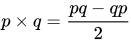 .
.

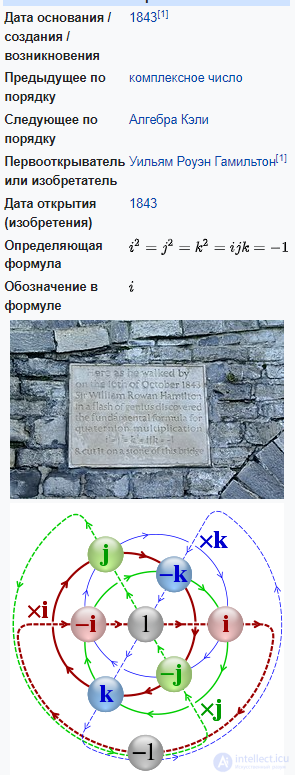
Commemorative plaque on Broom Bridge in Dublin: «Here, while out walking, on 16 October 1843, in a flash of genius, Sir William Rowan Hamilton discovered the formula for multiplying quaternions»
The system of quaternions was first published by Hamilton in 1843. Historians of science have also found sketches on this subject in Gauss's unpublished manuscripts dating from 1819—1820[13]. Quaternions were also considered by Euler. B. O. Rodrigues (1840), while examining the rotations of an absolutely rigid body, derived the rules for multiplying quaternions .
The rapid and extremely fruitful development of complex analysis in the 19th century stimulated mathematicians' interest in the following problem: to find a new kind of number, similar in properties to the complex numbers, but containing not one but two imaginary units. It was assumed that such a model would be useful for solving spatial problems in mathematical physics. However, work in this direction proved unsuccessful[15].
A new kind of number was discovered by the Irish mathematician William Hamilton (who had also been working on this problem) in 1843, and it contained not two, as expected, but three imaginary units. Hamilton worked first with couples (points in the plane) and easily obtained multiplication rules corresponding to the complex numbers, but for points in space (triplets) he could not obtain any multiplication formula for such sets. In the end, he decided to try quadruples — points in four-dimensional space. Hamilton called these numbers quaternions[16]. Later, Frobenius rigorously proved (1877) the theorem according to which it is impossible to extend the complex field to a field or division ring with two imaginary units .
The development of quaternions and their applications in physics followed three paths, associated with the algebraic approach, whose advocates were Cayley, who discovered the matrix representation of quaternions in 1858 , Clifford, B. Peirce, C. Peirce and Frobenius; with the theory of complex quaternions, whose representatives were Clifford, Study and Kotelnikov; and with physics, through the names of Maxwell and Heaviside[18]. Despite the unusual properties of the new numbers (their noncommutativity), this model quite quickly proved to be of practical use. Maxwell used a compact quaternionic notation to formulate his equations of the electromagnetic field. Later, three-dimensional vector analysis was created on the basis of the algebra of quaternions (Gibbs, Heaviside)[20]. The use of quaternions was displaced by vector analysis in the equations of electrodynamics. However, the close connection between Maxwell's equations and quaternions is not limited to electrodynamics alone, since, besides Minkowski's formulation of special relativity in terms of 4-vectors, a theory of special relativity was also built using quaternions by A. W. Conway. and Silberstein (Polish) Russian.[21]. The postwar period of applications of quaternions in physics is associated with the widespread use of group theory and its representations in particle physics. It is also possible to replace the standard Hilbert space of quantum mechanics with its definition over the division ring of quaternions[22].
In the 20th century, several attempts were made to use quaternionic models in quantum mechanics[23] and in the theory of relativity[24]. Quaternions have found real application in modern computer graphics and game programming , as well as in computational mechanics , in inertial navigation and control theory . Since 2003, the journal «Hypercomplex Numbers in Geometry and Physics» has been published[30].
In many areas of application, more general and practical tools than quaternions have been found. For example, nowadays matrix calculus[31] is most often used to study motions in space. However, where it is important to specify a three-dimensional rotation using a minimal number of scalar parameters, the use of Rodrigues — Hamilton parameters (that is, the four components of the rotation quaternion) is very often preferable: such a description never degenerates, whereas when rotations are described by three parameters (for example, Euler angles), there always exist critical values of these parameters at which the description degenerates .
As an algebra over  , the quaternions form a real vector space
  , equipped with a rank-three tensor
  of type (1,2), sometimes called the structure tensor. Like any tensor of this type, maps each 1-form
  on and a pair of vectors
  from to a real number
  . For any fixed 1-form turns into a covariant tensor of rank two, which, in the case of its symmetry, becomes a dot product on . Since every real vector space is also a real linear manifold, such a dot product generates a tensor field which, provided it is non-degenerate, becomes a (pseudo- or properly) Euclidean metric on . In the case of quaternions this dot product is indefinite, its signature does not depend on the 1-form , and the corresponding pseudo-Euclidean metric is the Minkowski metric ]. This metric is automatically extended to the Lie group of nonzero quaternions along its left-invariant vector fields, forming the so-called closed FLRW (Friedmann — Lemaître — Robertson — Walker) metric — an important solution of Einstein's equations. These results shed light on some aspects of the problem of compatibility between quantum mechanics and general relativity within the framework of quantum gravity theory .


Comments