
Lecture
The pseudoscalar or skew product (English: skew product) of vectors  and
and  (or the signed area of the parallelogram spanned by the vectors and) on an oriented Euclidean plane is the number

where  is the angle of rotation (counterclockwise, i.e., in the positive direction) from to . If at least one of the vectors and is zero, it is assumed that
  . In this definition it is worth paying attention to what is meant by the angle
  . Here this is not simply the ordinary angle between vectors, which can only take values from
  to
to  . Here it is the angle through which the vector must be rotated in a specific direction, namely counterclockwise, and so it can take values from to
  . The sine of such an angle can well be negative, and moreover, the pseudoscalar product changes sign when the factors are swapped.
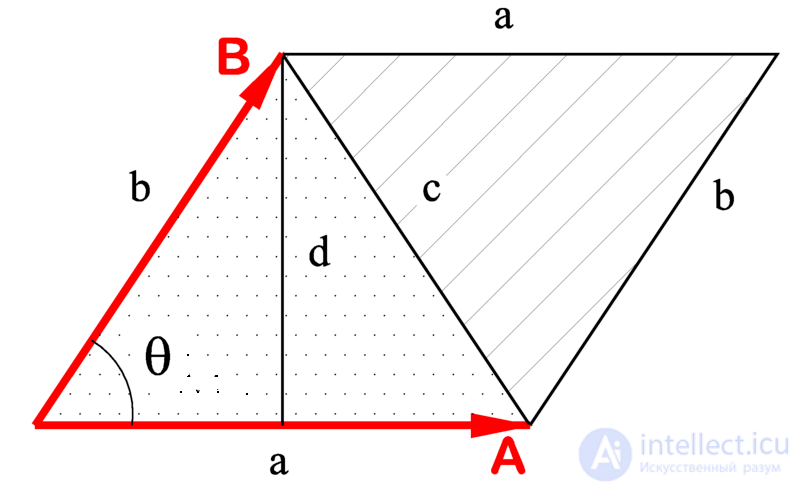
Geometrically, the pseudoscalar product of vectors represents the signed area of the parallelogram spanned by these vectors. It is convenient for working with the areas of polygons, expressing collinearity conditions for vectors, and finding the angles between them. The pseudoscalar product is defined only for 2-dimensional vectors; its analogue in three-dimensional space is the scalar triple product. In a certain sense, the cross product is also an analogue, which is why the pseudoscalar product is sometimes informally called the cross product as well and is denoted as  or
or  .
.
Let  be an oriented Euclidean plane. A number
  is called the pseudoscalar product of the vectors and if:
equals the square root of the determinant of the Gram matrix of the vectors and ;, is taken to be plus if the pair of vectors and is positively oriented, and minus if it is negatively oriented.It is not hard to see that this definition is equivalent to the usual geometric definition. The product of the lengths of the vectors and the sine of the angle between them is the area of the parallelogram spanned by these vectors. The determinant of the Gram matrix, in turn, is the square of the area of this same parallelogram. How the sign is determined is also clear: the orientation of a pair of vectors is the direction of the smallest rotation, so if the smallest rotation is in the positive direction, the sign will be positive, and if in the negative direction, the sign will be negative. Similarly, if the smallest rotation is in the positive direction, the angle will be less than 180∘, and then the sine is positive, while if in the negative direction, the angle will be greater than and the sine is negative.
Let be a Euclidean plane. The pseudoscalar product can also be defined for the case when a positive orientation has not been chosen, but then the result of the product will be a pseudoscalar. A pseudoscalar is called the pseudoscalar product of the vectors and if:
equals the square root of the determinant of the Gram matrix of the vectors and ;, is taken to be the orientation of the pair of vectors and . Here
Here  ,
,  are arbitrary real numbers.
 .
. be given, and two vectors having coordinates
  in it. Then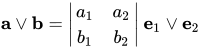
This formula works both for the pseudoscalar product on an oriented plane and on an unoriented one. In the second case, the expressions  and
and  are understood as the numerical values of these pseudoscalars in the basis .
For the special case of an orthonormal positively oriented basis (or, on an unoriented plane, an arbitrary orthonormal basis), the formula takes the form:
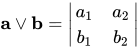
In a negatively oriented basis this formula is taken with a minus sign.
is the signed area of the parallelogram spanned by the vectors and .
 is the area of that parallelogram.
 is expressed by the formula

and its area is therefore equal to the absolute value of this quantity.

where «× » and « ⋅
 » are, respectively, the cross product and the dot product, and
  is the unit normal vector to the plane. The plus sign is taken if the right-handed basis of the plane, augmented by the vector , also forms a right-handed basis; otherwise the minus sign is taken.
 is the necessary and sufficient condition for the collinearity of nonzero vectors in the plane. For convenience when working with the more commonly used dot product, the zero vector is usually considered orthogonal to every other vector, although this is an arbitrary convention.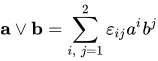

Comments