
Lecture
Colloid chemistry (from ancient Greek κόλλα — glue) is the science of dispersed systems and surface phenomena arising at the interface between phases. It studies adhesion, adsorption, wetting, coagulation, and electro-surface phenomena in dispersed systems. It develops technologies for construction materials, rock drilling, and sol-gel technologies. It plays a fundamental role in modern nanotechnology, medicine, biology, geology, and the technology of producing raw materials, food products, and goods of various purposes.
Modern colloid chemistry is a science at the intersection of chemistry, physics, and biology. The special interdisciplinary position of colloid chemistry is emphasized by the fact that in the English-language literature the names «colloid science» or «interface science» are often used.
The object of colloid chemistry is dispersed systems, which lie between true solutions.
and mechanical mixtures. Dispersions are quantitatively assessed by dispersity D =1/a[m-1]. Colloidal systems (CS) D = 107 – 109
. True solutions; D>109
Mechanical mixtures D< 107
Colloid chemistry as a science has a relatively short history, but humans have used the properties of colloidal systems and colloid-chemical processes since ancient times. These include such crafts as making dyes, ceramics, glazes, spinning flax, cotton, and wool, and tanning hides.
Starting from the 18th century, descriptions of individual studies appear that later became part of the corresponding sections of colloid chemistry. These include the work of M. V. Lomonosov on crystallization and the production of colored glasses using the dispersion of metals (1745—1755). In 1777, K. Scheele and F. Fontana independently discovered the phenomenon of gas adsorption by charcoal. In 1785, T. E. Lowitz discovered the phenomenon of adsorption from solutions. P. Laplace obtained the first quantitative relations for capillary pressure in 1806. In 1808, F. F. Reuss, while conducting experiments with the voltaic pile, discovered the phenomena of electrophoresis and electroosmosis.
Some of the earliest studies of colloidal systems were carried out by the Italian F. Selmi in 1845. He studied systems consisting of silver chloride, sulfur, and Prussian blue distributed throughout the volume of water. These systems obtained by Selmi closely resembled true solutions; however, Selmi believed that neither the substances he studied nor other similar substances could exist in water as particles as small as those forming in true solutions, that is, as individual molecules or ions.
Views close to those of Selmi were expressed by K. Nägeli, who believed that in such systems the particles of sulfur, silver chloride, and other substances were larger aggregates than individual molecules. For polymolecular aggregates he introduced the concept of the «micelle». To distinguish systems containing micelles from solutions in which the dissolved substance exists as individual molecules, Nägeli called micelle-containing systems «sols». The terms «micelle» and «sol» became generally accepted.
M. Faraday in 1857 studied systems containing gold distributed throughout the volume of water, systems already known to the alchemists, who obtained them by reducing gold salts and gave them the name aurum potabile (drinkable gold). While studying the optical properties of gold sols, M. Faraday concluded that the gold in them was present in the form of very small particles.
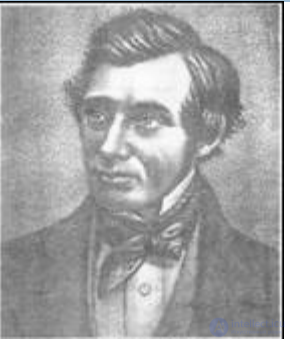
T. Graham is considered the founder of colloid chemistry, having carried out in the 1860s the first systematic studies of colloidal systems (sols). He is also credited with introducing the term «colloid». Subsequently, colloid chemistry incorporated results obtained in other areas of physics and chemistry, and by the late 19th — early 20th centuries it had formed into an independent branch of chemistry.
On the basis of the mechanical theory of capillarity, developed in the early 19th century by T. Young and P. Laplace, and the thermodynamics of surface phenomena created by J. W. Gibbs in 1878, the main directions of research in colloid chemistry were formulated: the study of processes of new-phase formation in homogeneous systems, the thermodynamic stability of colloidal systems, and the quantitative description of adsorption at the phase interface. The concepts of the structure of the electric double layer developed by H. Helmholtz in 1853 made it possible to explain electrokinetic and electrocapillary phenomena. The creation by J. Rayleigh of the theory of light scattering contributed to the quantitative study of the optical properties of colloidal systems. The study by J. Perrin, T. Svedberg, and R. Zsigmondy of the Brownian motion of colloidal particles, based on the theory developed in 1905 by A. Einstein and M. Smoluchowski, made it possible to prove the reality of the existence of molecules and the correctness of molecular-kinetic concepts. Based on the kinetic theory of adsorption proposed in 1917 by I. Langmuir, methods were developed for studying the state of surfactant molecules in monomolecular layers. In 1928, P. A. Rehbinder discovered the adsorption-induced decrease in strength (the Rehbinder effect), and in the 1940s–1950s, building on this direction and on research into structure formation in dispersed systems, he created physicochemical mechanics. The physical theory of the stability of colloidal systems was developed in 1937 by B. V. Deryagin together with L. D. Landau, and independently by E. Verwey and J. Overbeek (the DLVO theory). Deryagin also introduced the concept of the mechanism of action of thin liquid layers — disjoining pressure.
The science of interphase and colloidal processes remained empirical for a long time. There were individual mathematical models, such as Marian Smoluchowski's electrokinetic theories in 1903 or Albert Einstein's theory of Brownian motion in 1905. However, these were exceptions that highlighted the more empirical approach to the main problem of this science, including the stability of colloids and thin films.
The situation changed dramatically after the invention of DLVO theory in the 1940s by the schools of Boris Deryagin and Theodoor Overbeek. The progress of DLVO theory was described by Pierandrea Lo Nostro and Barry Ninham in 2019 as follows:
Thus, in just one generation, colloid science moved from a backwater of physical chemistry, like a puddle in the mud, to the forefront of theoretical physics!
Further research, carried out by many different groups, revealed cracks in the foundations of the science of interphase and colloidal processes. Two main problems were formulated by Ninham and co-authors in several papers. The first concerns the interaction between the macroscopic electrostatic double layer and van der Waals forces. The second concerns the role of dissolved gas and its self-organization, which is ignored in modern theories.
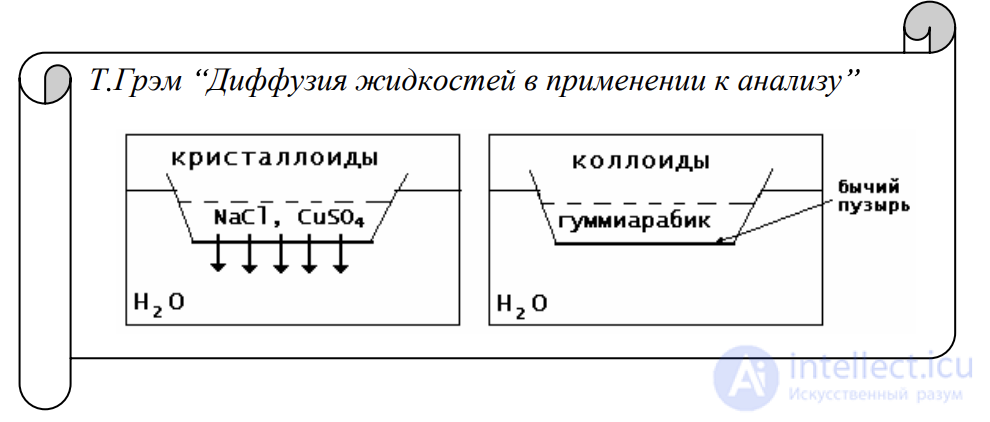
The practical use of dispersed materials and the related processes and surface phenomena was known in early craft chemistry as far back as deep antiquity, thousands of years distant from us, and related to the ancient cultures of India, China, Egypt, Greece, and other countries (dyes and fabric coloring, ceramics and glazes, colored glass, soap-making, etc.). However, colloid chemistry traces its history from 1861, from T. Graham's discovery of colloidal solutions. Graham gave the name colloids to substances that form aqueous solutions with glue-like properties and do not pass through semi-permeable partitions – membranes. In Greek, kolla (æωλλα) means glue, and eidos (ei∆oσ) means form. (In colloidal solutions the smallest particles of a substance form one phase, and the medium in which they are found – another. Graham called substances that give molecular or ionic solutions crystalloids. These substances, as Graham wrote in his work «The Diffusion of Liquids Applied to Analysis», are not retained by the membrane.
Next came the “chemical” period in the development of colloid chemistry, and until the end of the 19th century researchers' efforts were directed at synthesizing various colloids – inorganic, organic, and protein colloids. By 1910, several methods were already known for obtaining sodium chloride – a typical «crystalloid» – in the colloidal state in organic media. Later, P. Weimarn obtained more than 200 sols from typical crystalloids. Thus, the conventionality of the name «colloids» became clear, and it became understood that most substances can be obtained in a colloidal, i.e. dispersed, state, which produces specific properties. All this made it possible to speak of the colloidal state of matter as a universal state of matter, intermediate between the molecular (atoms, ions, molecules) and phase (macroscopic bodies) states. It is important to understand that the properties of a substance in the colloidal state are determined not by its nature but by the particle size. Studies of the dependence of system properties on particle size formed the content of the next stage in the development of ideas about the objects of colloid chemistry. The main result of this stage was the conclusion that the characteristics of objects of colloid chemistry include not only dispersity but also heterogeneity (multiphase nature). At the beginning of the 20th century, the ideas and methods of physics and physical chemistry entered colloid chemistry. They quickly led to fundamental discoveries: the heterogeneous nature of colloidal solutions was established; sedimentation-diffusion equilibrium in suspensions and emulsions was discovered; a method was developed for measuring the size of highly dispersed particles and macromolecules using ultracentrifuges; the kinetic theory of adsorption and the structure of adsorption layers of surfactants was created. Combined with Gibbs's thermodynamics of surface phenomena, these works formed the theoretical foundation of colloid chemistry.
Modern colloid chemistry is a distinctive borderline field of knowledge. Close contacts with other sciences have contributed to the creation of an experimental base that combines its own historically established methods of research with modern methods borrowed from other sciences.
Classical colloid-chemical research methods: determination of surface tension, in particular by the maximum bubble pressure method, determination of surface pressure, ultramicroscopy, dialysis, ultrafiltration, dispersion analysis, porometry, light scattering, etc. Research methods borrowed from other sciences: X-ray phase analysis, various spectral methods (NMR, EPR, optical, UV and IR spectroscopy, luminescence quenching, ellipsometry), all types of electron microscopy (transmission, scanning), atomic force microscopy, fluorescence microscopy, etc. Promising modern physical methods for studying surfaces include the use of slow electrons, secondary ion mass spectrometry, and the like.
Main directions of modern colloid chemistry:
Since the dispersed state of matter is universal and the objects studied by colloid chemistry are highly diverse, colloid chemistry is closely connected with physics, biology, geology, soil science, medicine, and other fields.
The current trend in the development of colloid chemistry: chemical processes in colloidal systems (chemical reactions in microemulsions, thin films, adsorption layers, foams, gels; micellar catalysis, etc.). Modern colloid chemistry is a major field of chemical science that studies the properties of substances in the dispersed state and surface phenomena in dispersed systems. Surface phenomena (SP) are processes occurring at the interface between phases, in the interfacial surface layer, arising as a result of the interaction of conjugate phases having different composition and structure. The concept of “surface” in colloid chemistry differs from the geometric one.
In geometry
A surface has area but no thickness. It is the common boundary of two adjacent regions of space.
In colloid chemistry
The interface between phases is a boundary region between phases, a layer of finite thickness in which properties change from values characteristic of one phase to values characteristic of the other.
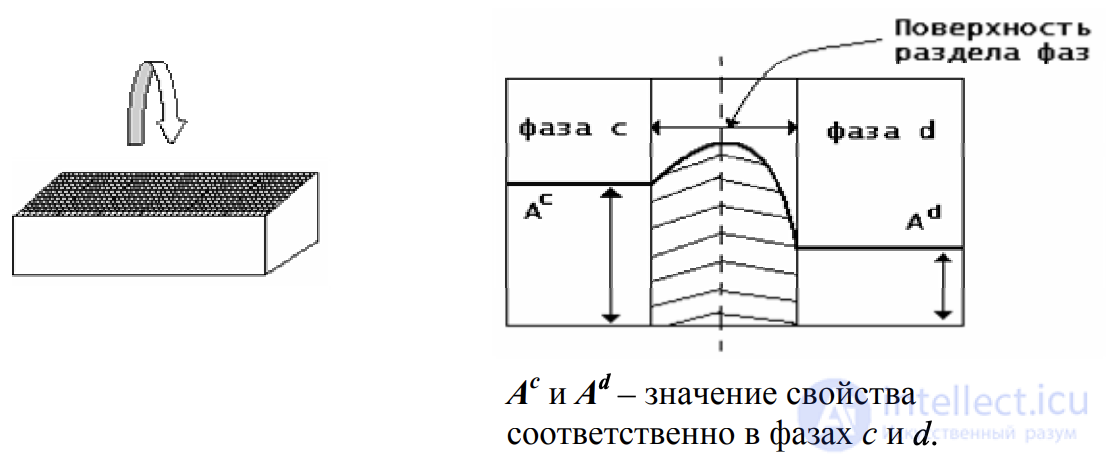
So, the interface between phases is not simply a boundary with no thickness. At the phase interface a surface layer (interfacial surface) forms, with a thickness of one or several molecular sizes (diameters). Gibbs regarded the surface layer as a separate phase. Gibbs's theory treats the surface layer of a substance as an independent phase, whose thermodynamic parameters differ from the corresponding parameters of the bulk phase of the same substance. For example, the structure of a liquid's surface will differ from the structure of the liquid in its interior. What, then, is the cause of surface phenomena? Suppose that of two neighboring phases, intermolecular interactions are stronger in the first than in the second. Then in that phase the most important property of the surface layer is that the molecules located in it possess excess Gibbs energy (compared with the molecules in the interior of the same phase). For interior molecules the resultant of all intermolecular interactions is zero, while for surface molecules it is directed perpendicular to the surface, into the phase. Can you guess why?
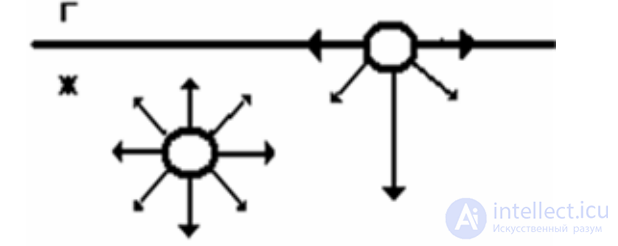
Consequently, to bring molecules from the interior to the surface this force must be overcome, i.e. work must be done and a certain amount of energy imparted to the molecules. An increase in surface area leads to an increase in the number of surface molecules, and the surface energy increases. Consequently, the molecules located in the surface layer are «special» from the point of view of their energy state. The fraction of special molecules increases as particle size decreases. Surface phenomena are inherent in all systems having a phase interface, but they are most strongly manifested in dispersed systems, which are heterogeneous and have a highly developed surface.
Schematic representation of a dispersed system: 1 – dispersion medium DM (continuous phase), 2 – dispersed phase DP (fragmented phase). Dispersed systems are multiphase systems (for example, two-phase) in which at least one of the phases is fragmented (i.e. represented by more or less large particles) and distributed within the second (continuous) phase. A necessary condition for the existence of dispersed systems is the insolubility of the DP in the DM.
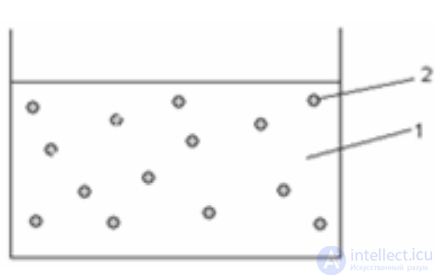
Dispersed systems are multiphase systems (for example, two-phase) in which at least one of the phases is fragmented (i.e. represented by more or less large particles) and distributed within the second (continuous) phase. A necessary condition for the existence of dispersed systems is the insolubility of the DP in the DM. 7 The real world around us, like ourselves, consists of dispersed systems:


3. CS are obtained either by condensation or by dispersion.
Condensation methods: physical (evaporation – condensation) and chemical
(obtaining insoluble substances via exchange reactions or solvent replacement).
Dispersion methods: mechanical and ultrasonic, carried out in the presence of
surfactants.
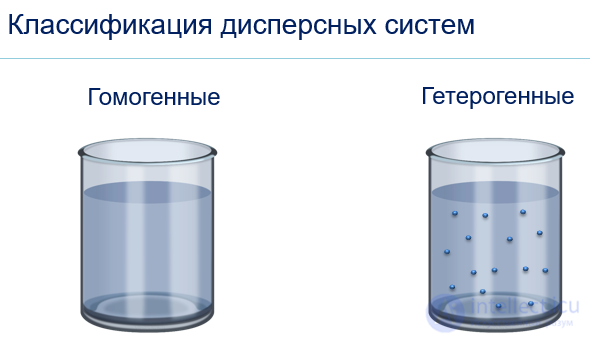
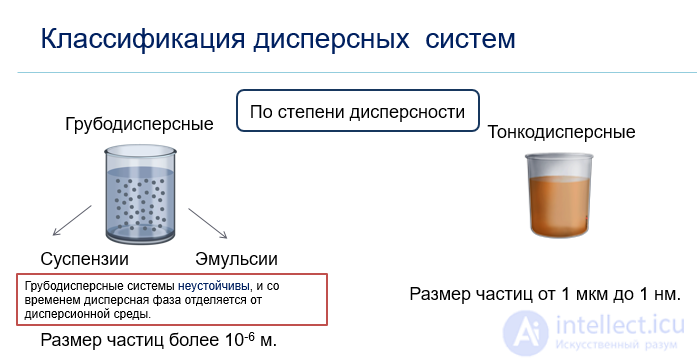
The constituent parts of a CS are the dispersed phase (DP) and the dispersion medium (DM). Colloidal solutions are called sols.
Based on the interaction between DP particles, colloidal systems are divided into unstructured and structured. Based on the interaction between the DP and the DM, colloidal systems are divided into lyophobic and lyophilic.
Colloidal systems are classified by the aggregate state of the DP and the DM.
| Dispersed phase (DP) | Dispersion medium (DM) | Type of system | Example |
|---|---|---|---|
| Gas | Liquid | Gas in liquid | Foam |
| Gas | Solid | Gas in solid | Pumice |
| Liquid | Gas | Liquid in gas | Fog |
| Liquid | Liquid | Liquid in liquid | Emulsion |
| Liquid | Solid | Liquid in solid | Soil |
| Solid | Gas | Solid in gas | Smoke |
| Solid | Liquid | Solid in liquid | Suspension |
| Solid | Solid | Solid in solid |
Alloy |
What size of particles should be considered colloidal? Colloidal particles occupy an intermediate position between atoms and real-world objects:
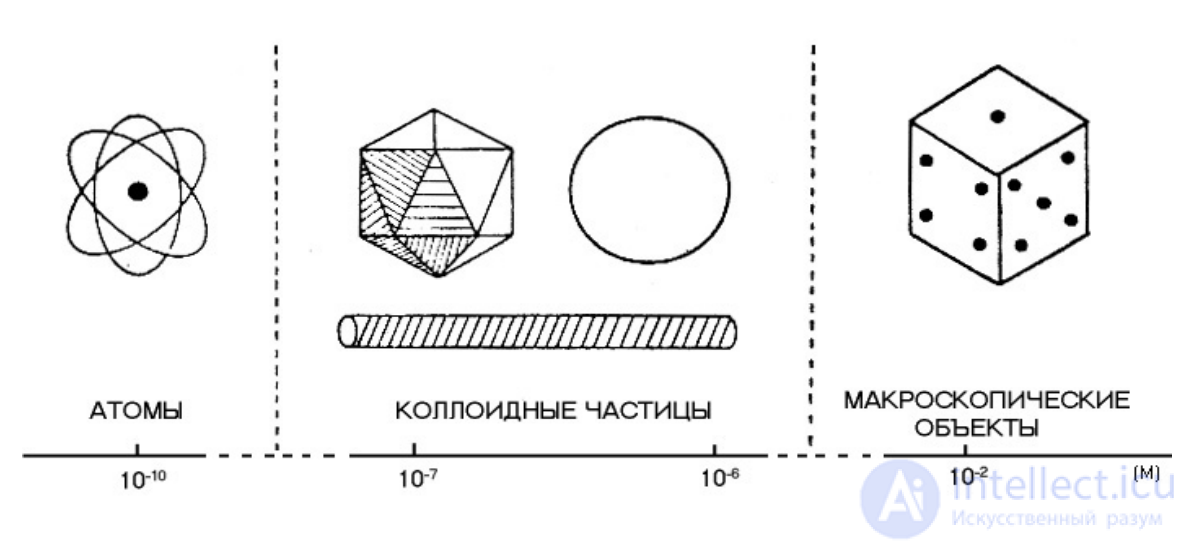
If we imagine an ordinary molecule to be the size of a small grain of sugar, then a colloidal particle of average size would be the size of an apple! The term “colloid” refers to any substance, regardless of its chemical composition, structure, geometric shape, or aggregate state, if at least one of its dimensions is less than 1 µm but more than 1 nm. M.G.Hill. Encyclopedia of Science and Technology. 1987, Vol. 4, P. 162. This definition is given in the traditional understanding of «colloid-disperse» systems, which are characterized by the active participation of particles in Brownian motion with the resulting molecular-kinetic phenomena (diffusion, osmosis). The range of sizes considered by modern colloid chemistry is broader: from larger than simple molecules to visible to the naked eye, i.e. from 10-9 to 10-4 m.
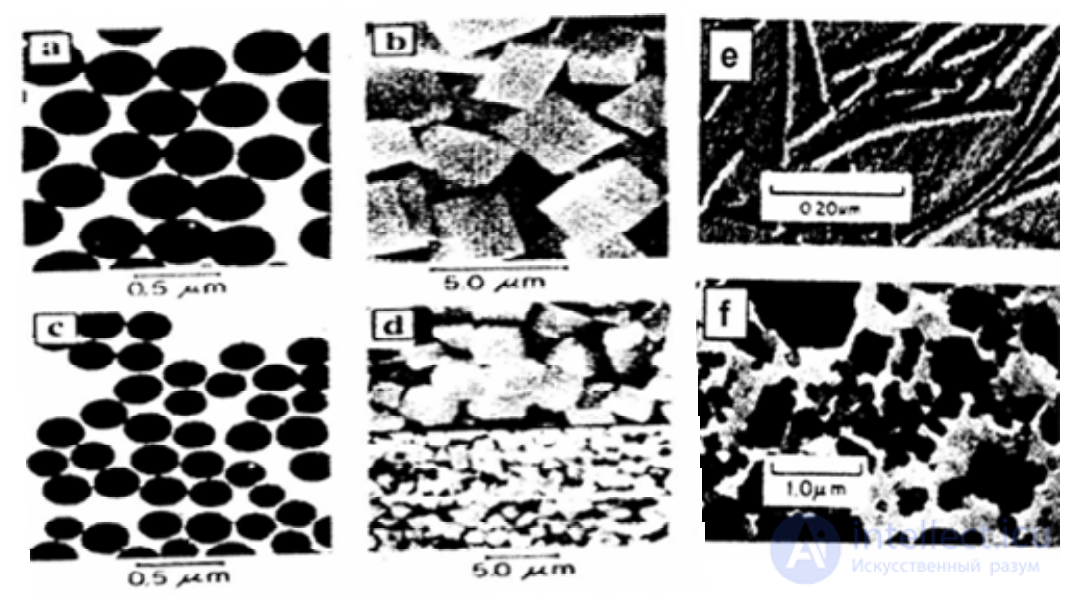
The shape of the particles of the dispersed phase can vary: Electron micrographs of colloidal particles of zinc sulfide ZnS (a) and lead sulfide PbS (b), magnesium phosphate Mg3(PO4)2 (c), cadmium carbonate CdCO3 (d), tobacco mosaic virus (e), and soot (f).
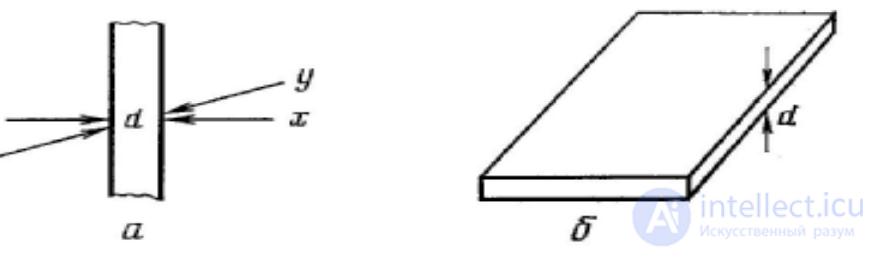
Besides particles, threads, fibers, and films can also serve as the dispersed phase. Threads (a), for example, have two dimensions that determine dispersity, while films (b) have one
If the dimension that determines dispersity is the same for all particles, such a system is called monodisperse, for example, the pollen of certain plants, synthetically produced polymer microspheres, and the like.
If particles of various sizes are present in the system, such a system is called polydisperse.
1) What is interesting about monodisperse colloidal systems?
2) What are colloidal crystals?

Comments