
Lecture
In order to obtain a colloidal solution or sol, it is
necessary to fulfill two conditions: 1) create in the liquid solid or liquid insoluble particles of colloidal degree of dispersity; 2) ensure the stability of these particles, protecting them from sticking together (from coagulation), i.e., stabilize the system. Stabilization of colloidal systems
can be achieved by introducing a new component into the system – a stabilizer, which is adsorbed on the surface of the colloidal particles and
imparts a charge to the particles and/or forms a protective shell.
Freely disperse systems (powders, suspensions, emulsions,
sols) can be obtained by two methods: dispersion and condensation.
Dispersion is based on obtaining smaller particles of the disperse phase 2 from a continuous and large
body 3.
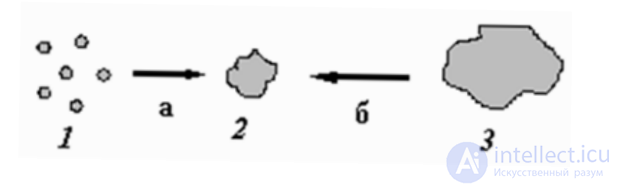
Condensation, in contrast, is associated with the enlargement of particles 1, including
particles of molecular size, up to particles of a certain class of disperse systems 2.
We do not even suspect that in many processes the formation and
destruction of disperse systems occurs.
It is known that the analgesic effect of drugs such as chloroform, diethyl ether, cyclopropane, is associated with the formation in the blood vessels of the brain of disperse-phase particles from hydrate
microcrystals (clathrates). The duration of anesthesia is determined by the lifetime of the clathrates. Over time, the disperse system breaks down and the anesthetic effect ceases.
Dispersion can be spontaneous and non-spontaneous.
Spontaneous dispersion is characteristic of lyophilic systems.
The thermodynamic possibility of a spontaneous process, including
dispersion, is determined by the condition ΔG = ΔH – TΔS < 0.
Dispersion requires a certain amount of work to be expended, or
an equivalent amount of heat. These expenditures are determined by the change in
enthalpy ΔH. To destroy the existing bonds within a body it is necessary to overcome cohesion (the bond between molecules, atoms, or ions)
within the body within a single phase and expend a certain amount of work, which is called the work of cohesion, Wκ. For an ideal solid body, the quantity Wκ is called the cohesive strength. After the formation of new phase interfaces at the interphase boundary,
adhesion arises (the bond between dissimilar condensed bodies upon their
molecular contact). As a result of adhesion, the surface energy
decreases by an amount that characterizes the work of adhesion Wα. Therefore, the change in enthalpy during dispersion can be represented as Δdisp H = Wκ – Wα.
Let us explain this condition with an example. In order to obtain several lumps from a piece of dough, it is necessary to overcome the interaction of
particles of the dough itself, i.e., its cohesion (Wκ). The newly formed
surface of the lumps is characterized by a certain adhesion with respect to the surrounding medium, i.e., adhesion between the dough and air or some other surface (Wα).
In spontaneous dispersion:
ΔH < 0, ΔS > 0, ΔG < 0, Wα > Wκ
Lyophilic systems include critical emulsions, highly disperse paraffin sols in hydrocarbons, aqueous solutions of emulsols – hydrocarbons with a high content (10-40%) of soaps, and solutions of micelle-forming surfactants, etc.
According to Rehbinder and Shchukin, spontaneous separation of particles
of colloidal size from the macrophase is possible if the interfacial tension
is small. In this case, the work expended on forming a new surface is compensated by a decrease in enthalpy during solvation and
an increase in entropy due to the participation of the resulting particles in Brownian motion.
The Rehbinder-Shchukin criterion for the formation of lyophilic systems:
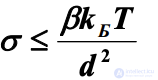
where
d – linear particle size,
β – a coefficient accounting for particle shape and entropy change.
In non-spontaneous dispersion:
ΔH > 0, ΔS > 0, ΔG > 0, Wα < Wκ.
Non-spontaneous dispersion is characteristic of lyophobic systems.
Here the dispersion process is carried out at the expense of external energy.
Approximately 5% of the energy produced in the world is spent on the process
of dispersion.
Non-spontaneous dispersion can be:
- mechanical
- physical (dispersion by ultrasound, electrical methods)
- physicochemical (peptization).
Mechanical dispersion, depending on the aggregate
state of the disperse phase:
- grinding, abrasion, crushing, etc.;
- spraying;
- bubbling (barbotage).
Grinding is carried out in mills of various designs, for example
in ball (a) or colloid (b) mills.
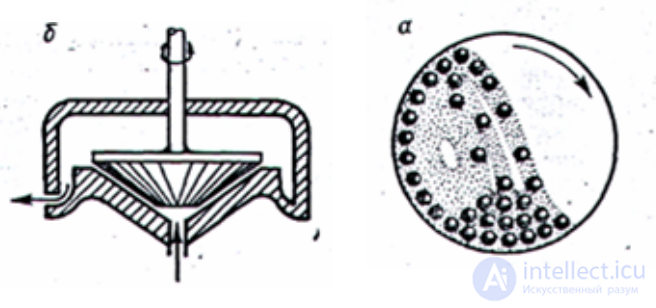
In ball mills, particles of 6·104 nm size are obtained by dry grinding and less than 103 nm by wet grinding; in
colloid mills – 100 nm and less.
Grinding in colloid mills is carried out very quickly. Before the invention of the colloid mill, graphite, for example, was ground on ball mills, which took 15-20 days. Colloid mills
perform this work in 15-20 minutes.
Grinding produces systems of type S/G, S/L, spraying – L/G,
L/L, bubbling – G/L.
The destruction of materials during the dispersion process can be facilitated by using the Rehbinder effect – the adsorption-induced reduction
in the strength of solid bodies. This effect consists in reducing surface energy with the help of surface-active substances.
Dispersion by high-frequency ultrasound is effective only
if the substance being dispersed has low strength.
When ultrasound acts on a suspension, mechanical vibrations arise (on the order of several thousand per second), which tear particles into smaller ones. In this way, organosols of brittle metals, hydrosols of sulfur, graphite, metal hydroxides, various polymers, etc. are obtained.
During dispersion in electrical apparatus, excess electric charges are imparted to the sprayed liquid, and as a result of repulsion of like charges, the liquid breaks up into droplets.
Physicochemical dispersion includes the method of peptization.
Peptization is the transition of precipitates under the action of peptizers into the state of a colloidal solution. Only "fresh"
(freshly prepared) precipitates can be peptized, in which particles of colloidal size
are joined into larger aggregates through DS interlayers. As precipitates are stored, recrystallization and aging phenomena occur, leading to the fusion of particles with each other, which prevents peptization.
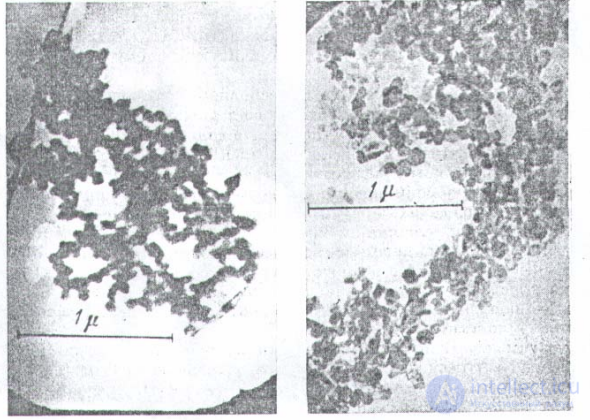
On the left - amorphous spherical particles of a fresh aluminum hydroxide sol
On the right - crystalline particles of a sol of the same substance 2-3 months after preparation of the sol
Peptization is distinguished as:
- adsorption;
- dissolution;
- washing of the precipitate with a solvent
Let us consider the production of sols by the peptization method using examples:
Production of a silver bromide sol by adsorption peptization.
Let us prepare a silver bromide precipitate AgBr:
AgNO3 + KBr → AgBr↓ + KNO3
fresh precipitate
Let us take an excess of AgNO3 (which plays the role of peptizer)
A SOL IS FORMED, the structural unit of the disperse phase of which is called a micelle. How does the formation of a micelle occur??? Ag+ ions
(potential-determining ions) are adsorbed on the surface of the AgBr precipitate
particles, giving them a positive charge; ions of the opposite sign are attracted to the positively charged surface of the resulting micelle core – counterions (NO3
-
ions). Part of these ions, forming the adsorption layer, is firmly held at the surface of the core by
electrostatic and adsorption forces. The core together with the adsorption layer constitutes the colloidal particle. The remaining counterions are bound to the core only by electrostatic forces. These counterions form the diffuse layer. The presence of a charge on colloidal particles leads to their
repulsion and ensures the stability of the sol.
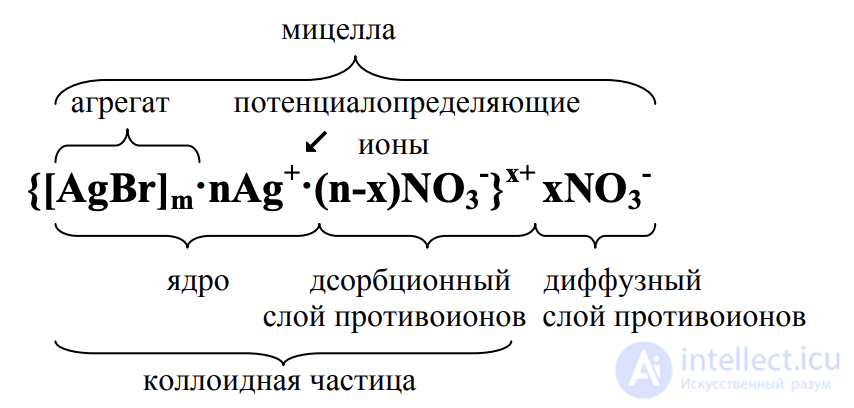
V So it turns out that the micelle as a whole is electrically neutral???
The AgBr sol micelle can also be represented in another (graphical) form:
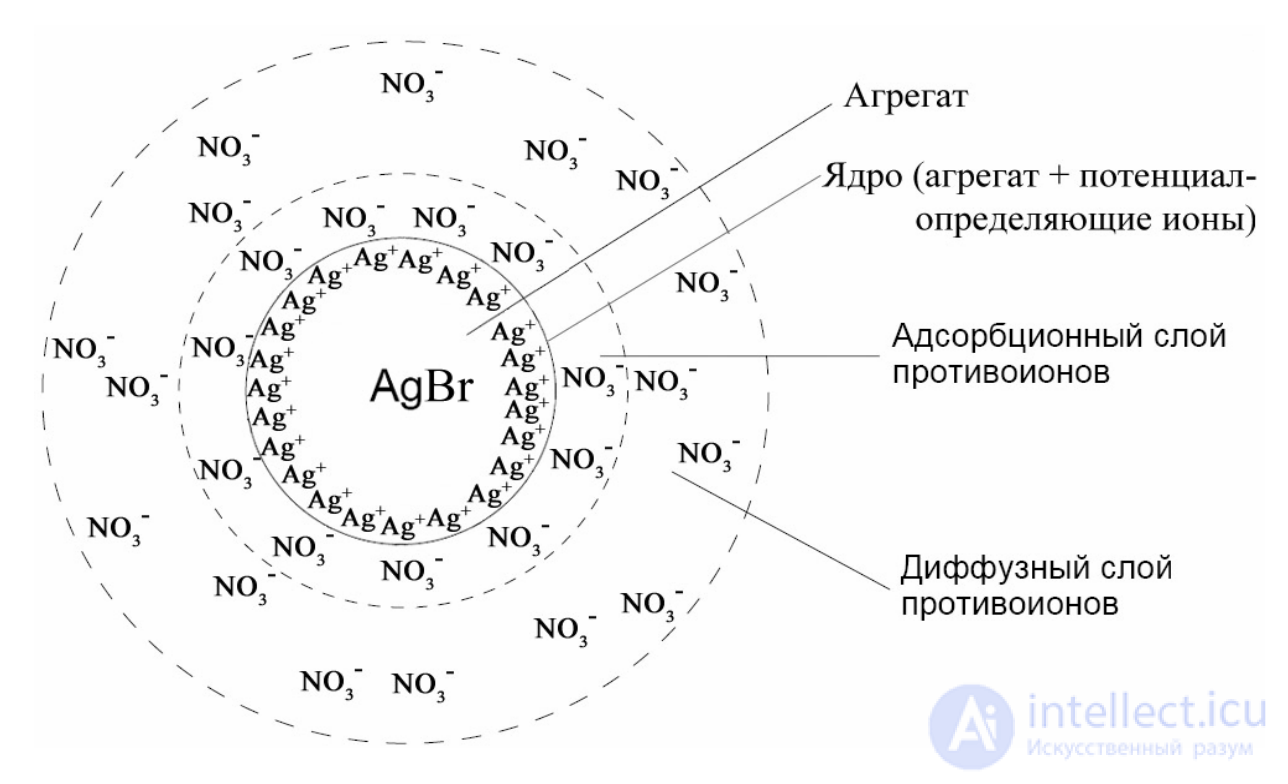
As follows from the figure and the structural formula of the micelle given above, ions of opposite22
sign, which are spatially separated, are located on the surface of the solid precipitate particles. These
ions form an electric double layer.
Dissolution peptization differs from adsorption peptization only in the absence of a ready-made electrolyte-peptizer. Let us consider this using the example of
obtaining an iron hydroxide sol.
FeCl3 + NH4OH → Fe(OH)3↓ + NH4Cl – we obtained a fresh precipitate, which
we place on a filter and carefully add HCl:
Fe(OH)3 + HCl → FeOCl + 2H2O
The resulting FeOCl is an electrolyte – peptizer. Next,
the same processes occur as in adsorption peptization, with the formation of micelles:
{[mFe(OH)3]·nFeO+
·(n-x)Cl-
}
x+·xCl-
.
The method of washing the precipitate with a solvent is used if the precipitate is obtained with a significant excess of one of the reagents. A high concentration of ions in the solution causes compression of the electric double layer. Ions of the diffuse layer penetrate into the adsorption layer, as a result of which the charge of the colloidal particle becomes equal to 0 and aggregation of particles occurs:
{[mFe(OH)3]·nFe3+·3nCl-
}
0
.
After washing the precipitate with a solvent, the micelles will have the form:
{[mFe(OH)3]·nFe3+·3(n-x)Cl-
}
3x+·3xCl-
.
But wait, the precipitate being peptized is already dispersed material, brought to a colloidal degree of fineness, in which
the particles, as a result of sticking together, have formed large aggregates! Can
the peptization method be unambiguously regarded as a dispersion method?
After all, the starting precipitate was obtained by the condensation method!
Despite the widespread use of dispersion methods, they (with
the exception of peptization) cannot be used to obtain disperse systems of maximum dispersity. Such systems are obtained
by condensation methods, which do not require the expenditure of external work.
Condensation methods include condensation, desublimation, and crystallization.
Condensation can be homogeneous or heterogeneous.
Homogeneous condensation involves the formation of a new phase on nuclei that arise spontaneously as a result of fluctuations in density and concentration in the system, while heterogeneous condensation involves the formation of a new phase
on already existing surfaces (condensation nuclei – vessel walls, impurity particles).
A necessary condition for condensation is supersaturation and non-equilibrium distribution of substance in the volume, as well as the formation of condensation centers or nuclei.
Condensation is distinguished as
Physical condensation includes the Bredig method
and the Roginsky and Shalnikov method. The Bredig method
can be regarded as both condensational
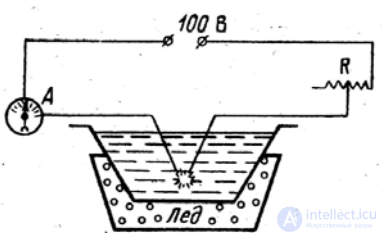
and dispersional. Two metal electrodes
are immersed in a liquid (it will become the dispersion
medium of the sol), their ends are brought close together and an
electric current is passed through them. The resulting arc partly sprays the metal into colloidal particles, partly vaporizes it, and the vapor condenses in the cold
liquid also in the form of colloidal particles. In this way, sols of
many metals are obtained.
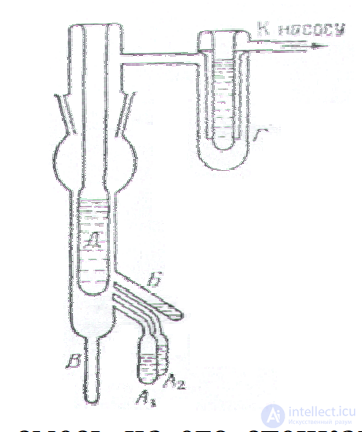
The Roginsky and Shalnikov method was proposed in 1943. Solvent is placed in vessels A1 and
A2, and the substance to be dispersed is placed in vessel B. Vessels A1 and A2 are immersed in liquid air and the entire apparatus is evacuated,
placing a trap with liquid air
G in the path to the pump. After this, liquid air is poured into vessel D, and
vessels A1, A2, and B are each individually heated
with electric heaters. In doing so, both substances condense on vessel D in a ratio that
is determined by the ratio of temperatures in A1, A2, and B.
The liquid air is removed from vessel D, whereupon the solid
mixture on its walls settles and flows down as a colloidal dispersion into
vessel V. This method makes it possible to obtain, in very pure form, colloidal
dispersions of various substances: for example, red-violet sodium sols, blue-green cesium sols in ether, benzene, and other organic liquids.
Physicochemical condensation includes the solvent replacement method, which amounts to the fact that the substance from which
a sol is to be obtained is dissolved in an appropriate solvent in the presence
of a stabilizer (or without one), and then the solution is mixed with an excess of another
liquid in which the substance is insoluble. As a result, a sol is formed.
This is how sulfur and rosin sols are obtained.
V What causes supersaturation to arise in this case?
The chemical method of condensation is based on reactions leading to
the formation of a solid product. These are reactions
a) of reduction. For example, obtaining gold and silver sols by
the reaction of salts of these metals with reducing agents:
2KAuO2 + 3HCHO + K2CO3 → 2Au + 3HCOOK + KHCO3 + H2O.
{[mAu]·nAuO2
-
·(n-x)К+
}
x-·xК+
– gold sol micelle.
b) of oxidation. For example, obtaining a sulfur sol:
Н2S + 1 2O2 → S + H2O.
In parallel, more complex processes occur, leading to the formation of pentathionic acid H2S5O6, which is a stabilizer of sulfur
sols. The structure of the resulting sol's micelle can be represented by the following
formula:
{[mS]·nS5O6
2-·2(n-x)H+
}·2xH+
.
c) of hydrolysis. For example, a red-brown iron hydroxide sol is obtained if a small amount of iron chloride is added to boiling water:
FeCl3 + H2O → Fe(OH)3 + 3HCl
Fe3+
Potential-determining ions – FeO+
H+
Thus, depending on which ion is the stabilizer, the micelle of the Fe(OH)3 sol can be expressed by the formulas:
{[mFe(OH)3]·nFeO+
·(n-x)Cl-
}
x+·xCl- or {[mFe(OH)3]·nFe3+·3(n-x)Cl-
}
3x+·3xCl- or [mFe(OH)3]·nH+
·(n-x)Cl-
}
x+·xCl-
.
d) of exchange. For example, obtaining a barium sulfate sol.
When using exchange reactions, the composition of the micelles depends on the order in which
the reagent solutions are combined!
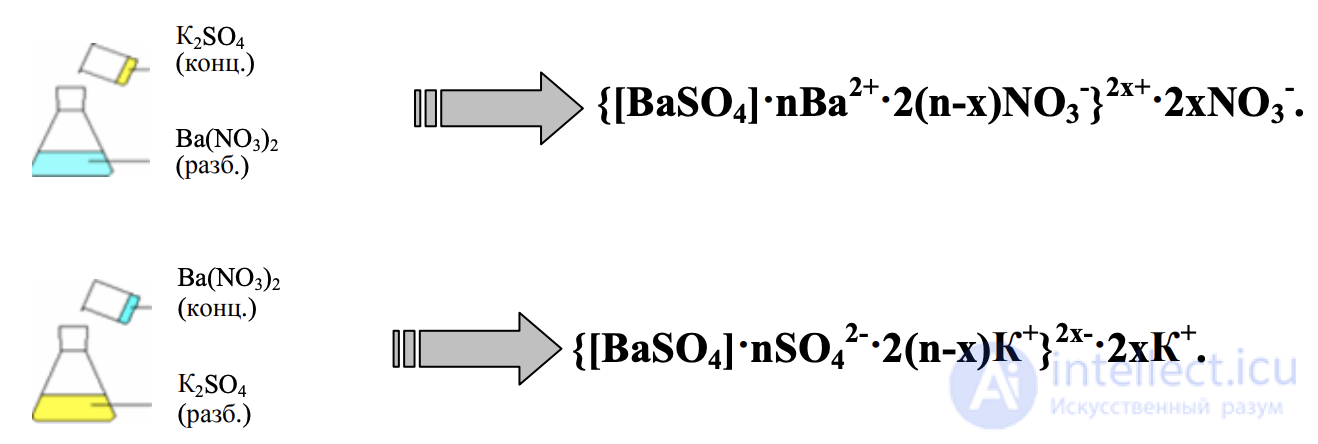
An example of obtaining colloidal systems by crystallization is
crystallization from a supersaturated sucrose solution in sugar production. The process of desublimation takes place during cloud formation, when, under
conditions of a supercooled state, crystals form directly from water vapor, rather than
droplets of water.

Comments