
Lecture
Recondensation, or Ostwald ripening — the process of condensation of a supersaturated phase of a substance, observed in liquid sols or solid colloidal solutions at late stages of development, once the nucleation stage has ended and the growth of larger grains of the new phase (for example, droplets from vapor) occurs at the expense of smaller ones under conditions of «suppression without consumption», that is, dissolution of droplets without their coalescence. The phenomenon was first described by Ostwald. Recondensation can proceed in two regimes: controlled by the absorbing capacity of the droplet surface (Wagner's theory), when the mean free path of a molecule is much greater than the radius of a spherical grain, or, in the other case, controlled by diffusion in the vapor (the Lifshitz–Slyozov theory). The latter is presented in the final chapter of the last volume of the well-known course of theoretical physics by Landau, Lifshitz, and Pitaevskii. When this phenomenon occurs in solid microdisperse solutions or precipitates, the term Ostwald recrystallization is used.
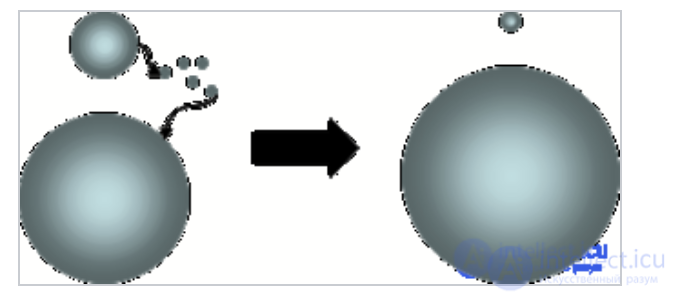
Diagram of Ostwald recondensation.
Wilhelm Friedrich Ostwald (German: Wilhelm Friedrich Ostwald)
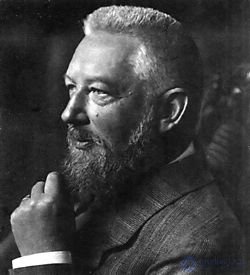
September 2, 1853 - April 4, 1932
The regimes of recondensation differ in the character of the growth of the droplet radius, but both are determined by an important quantity of nucleation theory — the critical radius (if a grain formed as a result of fluctuations is smaller than the critical size at a given moment, it dissolves; otherwise it continues to grow according to macroscopic growth laws). At late times, according to the theory under consideration, an asymptotic expression is used for the critical radius:
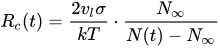 .
.
Here  — the volume per one liquid molecule, σ — the surface tension coefficient, k — the Boltzmann constant, T — the absolute temperature, N(t) — the mean number of vapor molecules per unit volume (dimensionless concentration), and
  — the equilibrium vapor concentration above a flat boundary of the liquid phase, which corresponds to large droplet sizes at late ripening times and the minimal vapor concentration, whereby the critical radius grows to infinity, and those droplets that fall below the critical threshold dissolve.
Thus, for the diffusion regime, the droplet radius growth equation has the form:
 ,
,
where D — the diffusion coefficient. For the other regime, up to coefficients, this equation is the same except that the division by the radius before the brackets is absent.
In addition to the expression for the critical radius and the droplet growth equation, two more equations below are written for a closed description of the theory.
The mass balance equation (constancy of the total number of substance molecules in the form of vapor and condensed liquid):
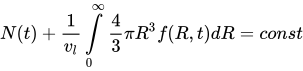 ,
,
where f(R,t) — the droplet size (radius) distribution function, normalized to the total number of droplets. Note that the integration limits actually extend not from zero to infinity, but from the smallest droplet (conventionally treated) to the largest at the current moment in time.
The continuity equation for the distribution function (since droplets change their sizes continuously in time):
 .
.
| Science / field | Manifestation | Practical significance |
|---|---|---|
| Physical chemistry | Coarsening of droplets or crystals in solutions and colloids | Determines the stability of disperse systems, affects the shelf life of emulsions |
| Materials science | Grain growth in metals and ceramics during heat treatment | Affects the strength, ductility, and durability of materials |
| Geology | Coarsening of mineral grains in igneous and metamorphic rocks | Forms the texture and properties of rocks |
| Medicine and pharmaceutics | Changes in the size of liposomes, nanoparticles, and drug formulations | Affects the bioavailability and stability of preparations |
| Cosmochemistry and astrophysics | Growth of dust particles in protoplanetary disks | One of the mechanisms of planetesimal formation |
| Food industry | Changes in the structure of fat emulsions (for example, ice cream) | Determines the texture, taste, and shelf life of the product |
| Economics | Rapid growth of the wealthy due to their ability to attract investment. Accelerated concentration of wealth | Wagner's theory (surface capacity) |
| Economics | Slow, structural transfer of wealth through taxes, credit, and markets. Gradual consolidation of capital | Lifshitz–Slyozov theory (diffusion) |

Comments