
Lecture
1. Diffusion. The chaotic thermal motion of the molecules of the DM causes the chaotic
Brownian motion of the particles of the DP. To describe this motion, the concept
of the mean square displacement of a particle ∆ over time τ is used.
The Einstein – Smoluchowski law relates ∆ to the diffusion coefficient
(∆)2 = 2Dτ
The motion of spherical particles is described by the Stokes equation, therefore
(∆)2 = (kB
. T
.
τ )/(3πηr), or D = kB T(6πηr)
Here: η – viscosity of the DM, and r – radius of the DP particles.
2. Sedimentation. If the density of the DP and DM differ, then in the gravitational field heavy
DP particles will settle.
This process is called sedimentation.
During the motion of DP particles, the gravitational force FGR. = mg is balanced
by the friction force FT = BU and the Archimedean force.
For balanced motion
(4/3)πr
3g∆ρ- 6πηrU = 0, i.e. U =2g∆ρr2
/9η;
U/g = 2∆ρr2
/9η – sedimentation constant
In centrifuges, forced sedimentation is carried out due to the fact that
a>>g. To calculate the distribution of DP particles, the following equation is used:
ℓn X/X0 = 2 r
2∆ρω2
t/9η; Here: ω- angular velocity; X – distance from the center
of rotation.
3. Due to sedimentation, the concentration of DP changes with height. The gradient
of concentration that arises causes a diffusion flux in the direction opposite
to sedimentation. When these flows are balanced, there is established
a diffusion-sedimentation equilibrium, which characterizes the kinetic stability
of the CS. The distribution of DP particles by height is described by the Laplace formula:
Ch = C0 exp( - Vg ∆ρh/ kBT)
In a centrifuge:
ℓnC1 /C2 = V∆ρω2
(X1
2 – X2
2
)/ (2 kBT)
Kinetic sedimentation stability is assessed by the ratio
KSS = 9η/2 r
2 ∆ρ
4. Sedimentation analysis of a CS The basis of sedimentation analysis is the dependence
of the settling rate of DP particles on their size. Only CS with a
low concentration of DP are used.
For the analysis, a sedimentation curve is obtained – the dependence of the sediment mass on τ .
If the CS is monodisperse, the dependence of m on τ is clearly linear
m = 2 r
2∆ρQτ/9ηH
Here: m – mass of sediment at time τ; Q – total mass of DP;
H- height of the CS column.
In the case of polydisperse systems, the dependence of m on τ is nonlinear.
Therefore, the tangent method is used for analysis
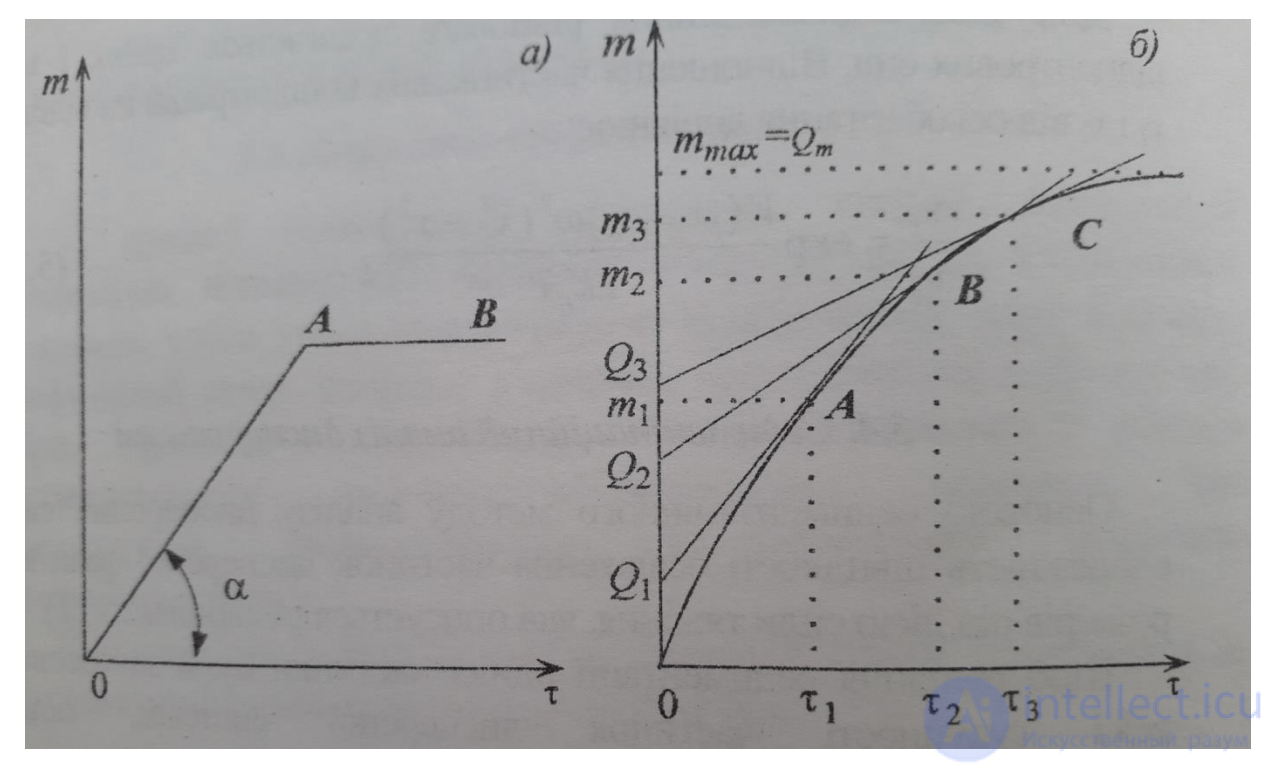
Calculations are carried out using the equation
ri = [(9ηHmi)/(2g∆ρQi τi)]1/2
Based on the obtained data, integral and differential curves
of particle distribution by their radii are plotted.
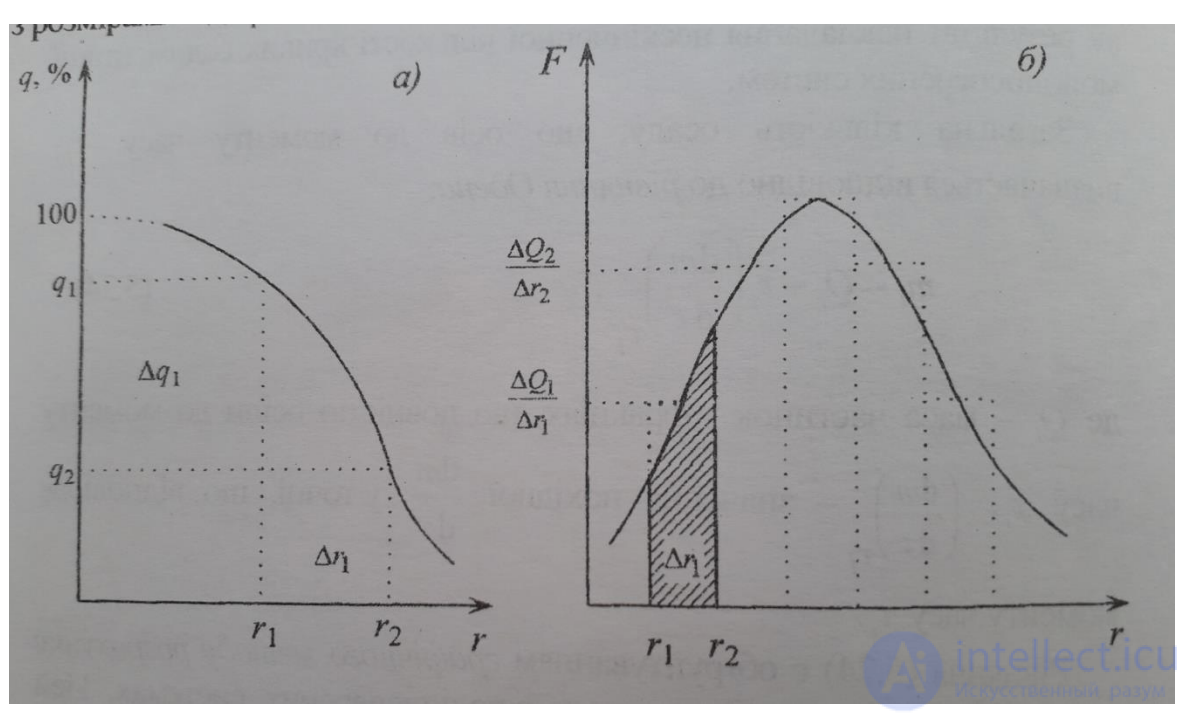
For this, qi = (Qi/Qmax)
. 100 and F = dq/qr ≈ ∆q/∆r

Comments