
Lecture
1. Structural-mechanical properties of a CS are studied (determined) using the methods
of rheology – the science of the deformation and flow of material objects.
2 The mechanical properties of a CS are determined by its structure.
Based on the nature of interaction between the DP and the DM, all sols are divided into free-dispersed and
bound-dispersed.
Free-dispersed (unstructured) – in these CS the DP particles do not form
spatial structures and therefore take part in Brownian motion.
Bound-dispersed (structured) – here the DP particles, due to active
intermolecular interaction, form frameworks.
3. By their rheological properties, CS are distinguished as liquid-like and
solid-like. Liquid-like systems are divided into Newtonian and non-Newtonian.
The viscosity of non-Newtonian liquids depends on the intensity of the mechanical action on them.
The viscosity of Newtonian liquids does not depend on the shear stress (P):
P =η . dɣ/dt.
Here: ɣ- deformation, η – coefficient of internal friction, or dynamic viscosity.
4. The viscosity of lyosols depends on the concentration of the DP:
η = η0 (1 + αφ), or ηsp. =( η - η0 )/ η0 = αφ
Here: φ-volume fraction of the DP, α - shape coefficient of the particles.
The equation given is valid for dilute CS.
5. For lyophilic CS (solutions of high-molecular-weight compounds) the following equation is used
ηsp. = K. M. C, or ηsp/C = K.M
Here: M – molecular mass of the polymer; C – its mass concentration; K –
a coefficient that depends on the nature of the DM and the polymer.
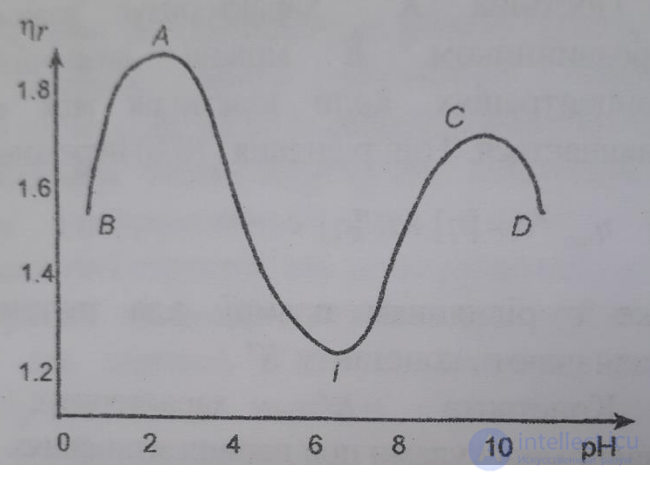
6. When dealing with ampholytes (polymers with ionogenic groups)
it is necessary to take into account the dependence of η on pH
Fig. Dependence of η on pH for a gelatin solution
At the isoelectric point the ampholyte molecules are coiled into a ball, so here
the minimum viscosity is registered. A certain decrease in viscosity is also observed
in strongly acidic and strongly alkaline media (sections AB and CD in the
figure), which corresponds to complete unfolding of the polymer molecules and the absence
of mutual attraction owing to the presence in them of a large and identical in sign
charge.
7. Experimental determination of viscosity:
a) Falling ball method. The velocity of its uniform motion (U) is measured, and
with known r and ρ η is found:
η = (2r
2Δρg)/9U
b) Viscometry. The time of outflow of a certain volume of CS (V) through
a capillary of radius r, length ℓ is measured. η is calculated by the formula:
η=(πr
4
t
.ΔP)/8Vℓ
For small ℓ and correspondingly small ΔP the simplified equation is valid
η = A.ρ .
t
Here: A = capillary constant; ρ – specific density of the CS.
For determining the viscosity of dense CS, rotational viscometers are used.
η is calculated by the formula:
η= km/ω
Here: m - torque; ω - angular velocity; k – viscometer constant

Comments