
Lecture
Lyophobic CS
1. ∆G of these systems >0 , that is – they are thermodynamically unstable, which
manifests itself in a change of the concentration of DP particles.
2. There are two ways to decrease ∆G : adsorption of a surfactant and the merging of small particles
into large ones. In the first case the surface energy decreases, in the second –
the specific surface area of the DP decreases.
3. A distinction is made between the kinetic and aggregative stability of a CS.
Kinetic – is determined by the diffusion – sedimentation balance
Aggregative – is determined by the ability of DP particles to stick together, that is –
by the nature of the adsorption layer at the phase boundary between the DP and the DM.
4. For unstructured polydisperse CS a characteristic feature is the dependence
of DP solubility (L) on particle size (α):
ln (L1/L2) = (4 Ϭ Mr/ρRT) / (1/α1 – 1/α2)
(the Gibbs – Ostwald – Freundlich equation)
5. Thus, in a CS large particles continue to grow either due to
the complete absorption of small ones, or as a result of gradual deposition onto their own
surface of DP substance that is the product of dissolution of small particles.
The first variant is mostly realized in a CS with a liquid or gaseous
DP phase, the second – with a solid one.
6. Coagulation – the merging of DP particles (sticking together).
7. Coagulation can be caused, or accelerated, by the action of various factors:
heating, cooling, irradiation, mechanical action, ultrasound, an electric field,
chemical reagents, etc.
The minimum intensity of a factor that causes coagulation is the coagulation
threshold.
If the barrier at the phase boundary has an electrostatic nature – then coagulation can
be caused by the action of a strong electrolyte. Then the coagulation threshold (Υ) is expressed in
millimoles of this electrolyte per 1 L of CS.
8. The coagulating action (strength) of the factor that caused coagulation is a quantity
inverse to Υ.
9. The coagulation threshold is determined optically by the appearance of intense light scattering
in the CS, resulting from a sharp increase in the size of DP particles.
10. The coagulating action of a factor manifests itself after a certain time – the induction
period, when dʊ/dt →0. Then comes the slow coagulation phase, when collisions of DP
particles are numerous, but not all of them end in merging.
11. When the intensity of the coagulating factor reaches the coagulation threshold,
the rate becomes maximal because here every collision ends in the
merging of particles. The kinetics of fast coagulation is described by the
Smoluchowski equation
ʊt = ʊ0/ (1+t/Ɵ), here Ɵ – is the coagulation period, corresponding to the time when ʊt = ʊ0/2, ʊ -
the concentration of DP particles.
12. Coagulating power is possessed by those electrolyte ions introduced into the CS which
carry a charge opposite to that of the granules, or in other words have a potential
opposite to the ξ- potential.
13. The Hardy – Schulze rule: the coagulating action of an ion is proportional to its charge raised to the
power «n». The value of «n» depends on the radius of the ion and its hydration.
14. There are concentration and neutralization mechanisms of electrolyte action on a CS.
Neutralization – adsorption of counter-ions decreases ξ.
Concentration – an increase in ionic strength (I) decreases ξ.
15. The main theory describing the coagulation process in lyophobic CS is the
Derjaguin – Landau – Verwey – Overbeek theory (DLVO).
It takes into account that in the contact zone of two DP particles the following forces act:
electrostatic, molecular, adsorptive, disjoining pressure
Disjoining pressure – is created by the resultant of surface forces,
depends on Ϭ.
Electrostatic component – corresponds to the action of the electrostatic field of the granules.
Molecular component – van der Waals interaction.
Adsorptive component – an increase in concentration at the surface increases the
osmotic pressure.
16. In the simplified DLVO variant only the electrostatic and
molecular components are present u = uel. + umol. = 64CRTƛ
. ɣ
2 . exρ(-h/ƛ) – A/12πh2
Here h – is the distance between micelles,
A – the Hamaker constant,
ɣ - a function of the electric potential of the adsorption layer (ψa)
ƛ – the thickness of the EDL
ɣ = [exρ(ZF ψa / 2RT) – 1] / [exρ (ZF ψa / 2RT) + 1]
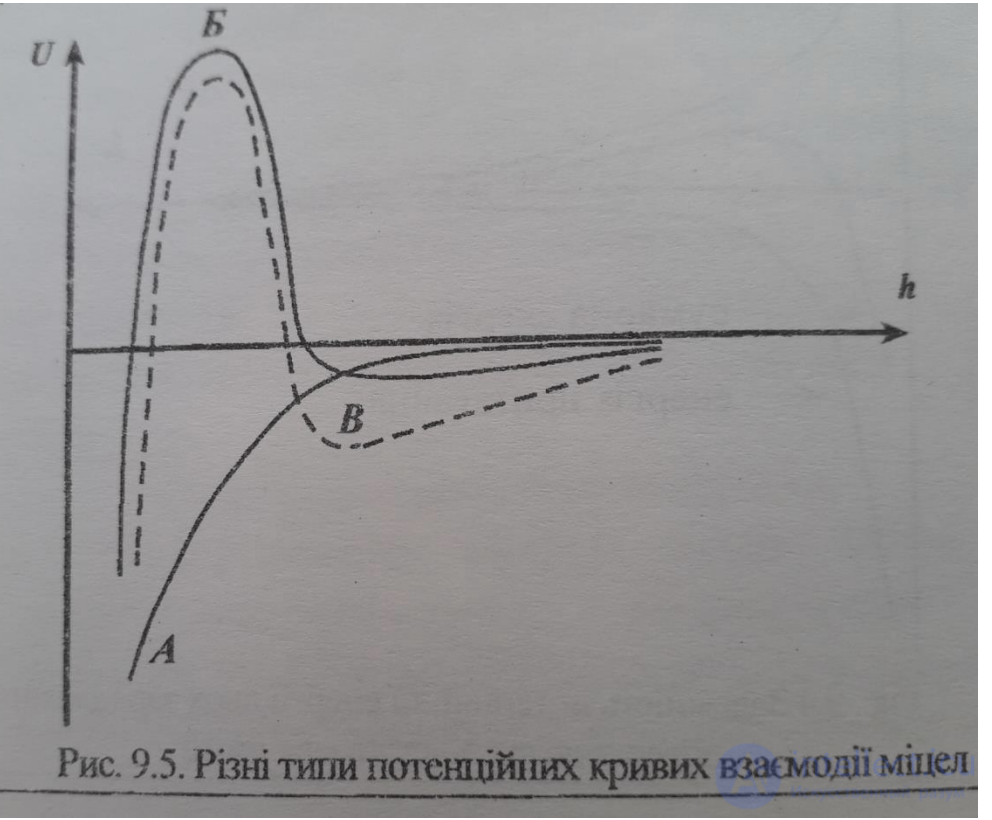
17. The shape of the u - f(h) dependence in a specific CS is determined by the ratio
of the parameters in the main equation. There are three variants of characteristic cases.
A – there is either no barrier between micelles, or it is small, so their sticking together is inevitable.
In this CS coagulation is irreversible.
B – there is a high barrier (umax>>kT), the CS is aggregatively stable.
C – besides the high barrier there is a zone of noticeable attraction, which creates
a «secondary barrier», when particles that have fallen into point «B» cannot move apart
under the action of thermal energy. Such CS self-structure.
18. By changing the electrolyte concentration one can reach a state where umax = 0 and
du/dh = 0. This corresponds to fast coagulation, and Cmax = Υ. That is, according to
DLVO theory Υ=const/z
6
. For ions with Z=1,2,3 the following relationship holds
1/Υ(Z=1):1/Υ(Z=2):1/Υ(Z=3) = 1:64:729.
In practice, due to various causes, the exponent of Z varies from 2 to
6.
19. Features of coagulation under the action of electrolytes:
When a mixture of electrolytes acts, there can be either a synergistic or antagonistic
effect.
Some multiply-charged ions, owing to specific adsorption, can at
low C cause coagulation, and at high C – stabilize the CS.
A fresh precipitate can be dissolved by the action of a peptizer.
The coagulating power of electrolytes can be reduced by the action of a surfactant. The protective action
is best in HMC (high molecular weight compounds).

Comments