
Lecture
1. CS is a heterogeneous system consisting of DP (a =1-100nm) and DM
2. Molecules of DM and everything that is dissolved in DM
are adsorbed on the surface of DP particles.
3. Ions are adsorbed on the ionic crystals of DP, which leads to the formation of an EDL.
4. 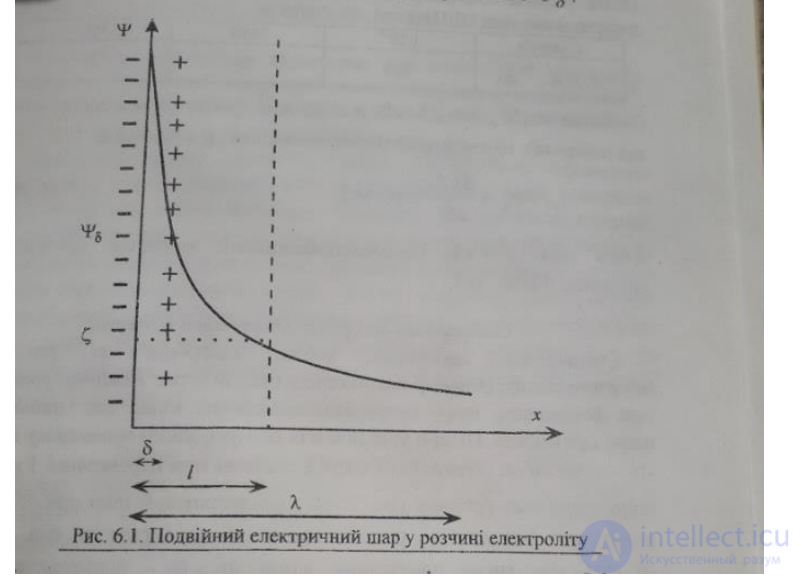
5. Three components of the EDL are distinguished:
the first – is the dense part with thickness «δ» (delta);
the second – corresponds to the immobile film of DM on the surface of DP and has thickness «l»
(l);
the third – is the total thickness of the EDL, denoted «ƛ» (lambda).
6. For CS the potential drop in the second part of the EDL is of great importance.
It is denoted as «ζ» (zeta potential, or electrokinetic potential)..
7. The magnitude of the electrokinetic potential is influenced by the following factors:
ion adsorption (↑Γ→↑Ψ→↑ζ; ↑Γ at ↑C, ↓T)
rate of movement of the DP particle (↑u →↓l→ ↑ζ; ↑ u at ↑T,↓ η )
electrolyte concentration in DM (↑C→↑I→↓ζ)
lnζ = lnΨ – l
.
const (I/ Ɛ.T)
1/2 , here I is the ionic strength of the electrolyte
8. DP particles of crystalline structure are called micelles
9. The formula of the micelle and its structure depend on the conditions of formation of the DP crystals.
Basic rule: ions that are part of the
crystal lattice composition and are present in DM are adsorbed on the surface of the DP crystal.
10. Example. AgNO3 + NaCl + AgCl↓ + NaNO3
With excess AgNO3 :{m [AgCl] n Ag+ (n-x) NO3
-
} x NO3
-
With excess NaCl: { m [AgCl] n Cl-
(n-x) Na+ } x Na+
Square brackets denote the aggregate, curly brackets – the granule, and together they form the
micelle.
11. The sign of the granule's charge determines the sign of the electrokinetic potential, therefore the ions,
which are adsorbed on the surface of the aggregate are called potential-determining ions.
12. The presence of electrokinetic potential in DP particles leads to
the occurrence of electrokinetic phenomena in CS.(electrophoresis, electroosmosis, the Dorn
effect, the Quincke effect)
13. Electrophoresis – directed movement of DP particles under the action of an external
electric field
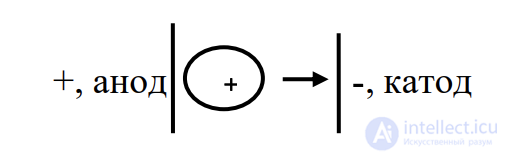
+, anode -, cathode
The sign of the electrokinetic potential of DP particles is opposite to the sign of
the electrode toward which they move. The magnitude of the electrokinetic potential
is calculated using the Helmholtz – Smoluchowski equation
ζ = η
. u0/ ε ε0 E
here η- viscosity of DM, ε- dielectric permittivity, ε0 – dielectric constant,
E – electric field strength, E = ∆φ / x
For this purpose, the velocity of DP particles moving toward the electrode is measured
(u0).
14. Electroosmosis – directed movement of DM under the action of an external
electric field. Occurs in CS with an immobile DP.
15. The Dorn effect – the occurrence of an electric field in CS due to
sedimentation or flotation of DP particles. Along the height of the CS column (x) the
corresponding potential difference (∆φ) is measured.
16. The Quincke effect – the occurrence of an electric field in CS due to
forced movement of DM (under the action of external pressure) through an immobile DP.

Comments