
Lecture
1. A feature of this type of CS is that they are thermodynamically stable, since upon
their formation ΔG < 0.
2. Lyophilic CS include micellar solutions of colloidal surfactants and solutions of HMCs (high-molecular-weight compounds).
3. The difference between HMC solutions and classical CS lies in the asymmetry and
flexibility of polymer molecules, which gives rise to a multiplicity of
conformations.
4. The criterion of lyophilicity of a CS (the Rehbinder–Shchukin criterion)
α
2Ϭ ≤ βkT
Here: α is the linear size of the particle, β is the particle shape coefficient.
HMC solutions
5. Dissolution of an HMC proceeds through a swelling stage – absorption of
solvent by the HMC phase. If the solvation energy is small, swelling is
limited. If it is large, swelling is unlimited.
6. Among HMCs, polyelectrolytes occupy a special place – these are polymers that
contain ionogenic groups in their composition. If both acidic (-
COOH) and basic (-NH2) groups are present simultaneously, these are ampholytes.
7. Depending on the conditions, ampholyte groups can dissociate to varying degrees,
which forms a charge that differs in sign and magnitude. This affects the type of HMC conformations
and the stability of the solution. The molecular form of the HMC, when q- = q+, exists at the
isoelectric point. It corresponds to a specific pH value. At this point
ampholytes coil up into a random coil (globules).
Surfactant solutions
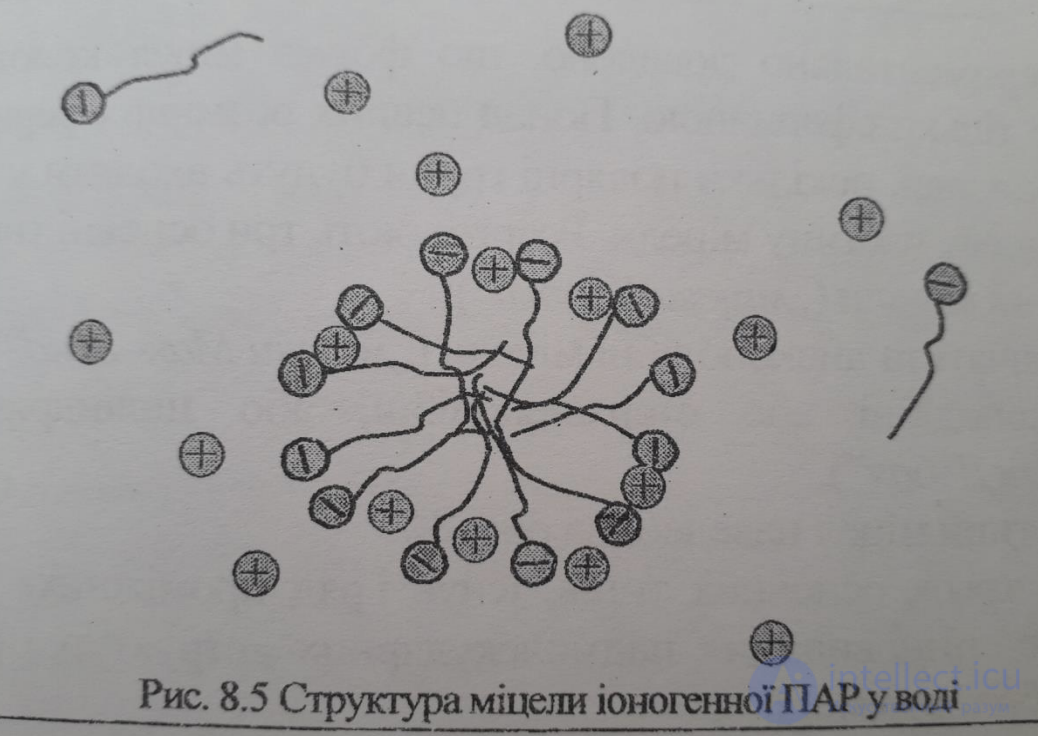
8. Amphiphilic surfactants are capable of forming micelles by combining their
hydrophobic parts into a core and forming a shell of hydrophilic groups.
9. The ability of surfactants to form micelles is assessed by the value of the hydrophilic–
lipophilic balance (HLB): this is the ratio of the solvation energies of the polar and
nonpolar parts of the surfactant.
10. Surfactants with a high HLB are not only capable of forming micelles, they are
stabilizers of oil/water emulsions. With a low HLB, they are stabilizers
of water/oil emulsions.
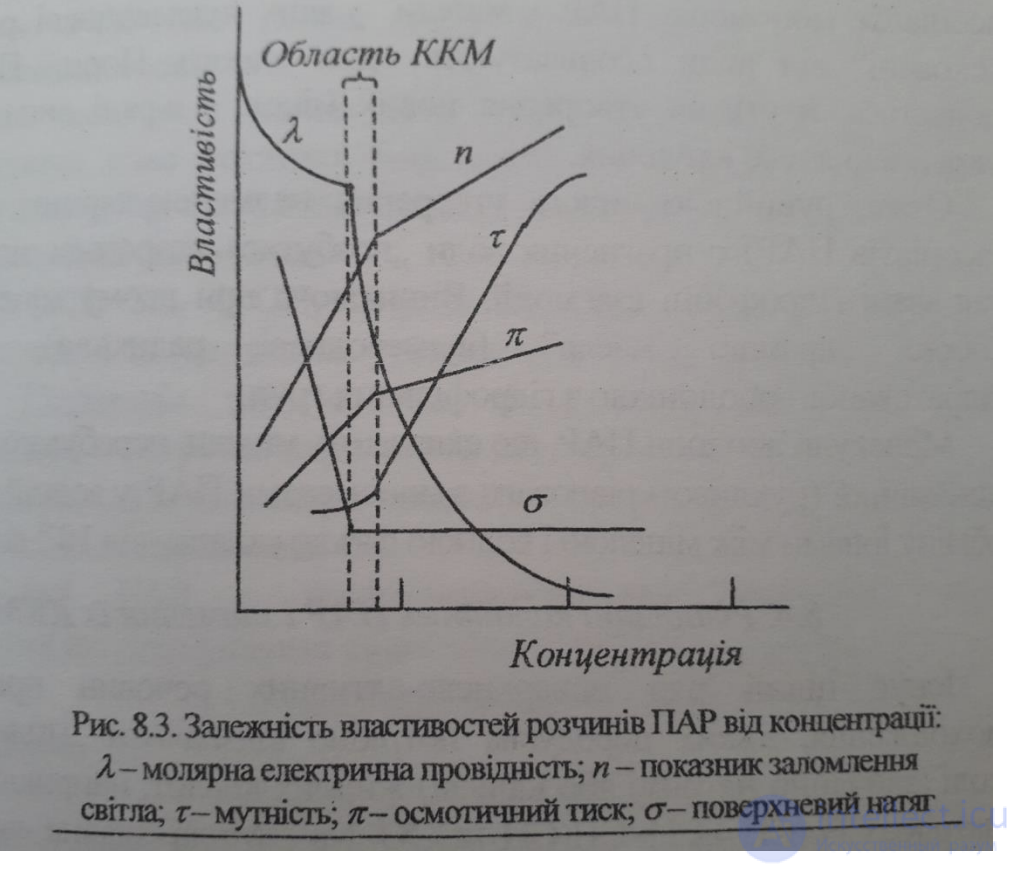
11. Micelles in solutions of colloidal surfactants form only upon reaching
a certain threshold concentration, denoted by the abbreviation CMC (critical
micelle concentration).
12. The CMC is determined at the point of a sharp change in the dependence of «physical property
of the solution» on «surfactant concentration»
13. The number of surfactant molecules bound in a micelle is called the aggregation number
(Nagg). Depending on the nature of the surfactant, Nagg varies from tens to thousands
of units.
14. Three types of surfactant micelles are distinguished:
spherical (Hartley micelles)
lamellar (McBain micelles)
rod-shaped (Debye micelles)
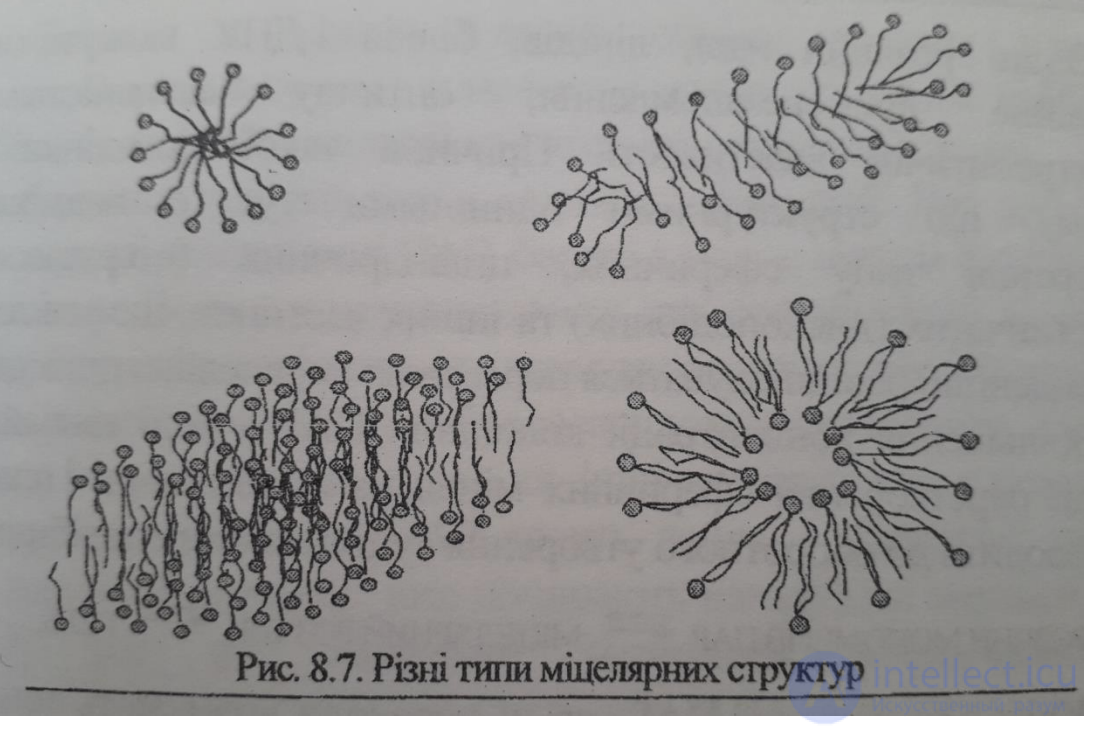
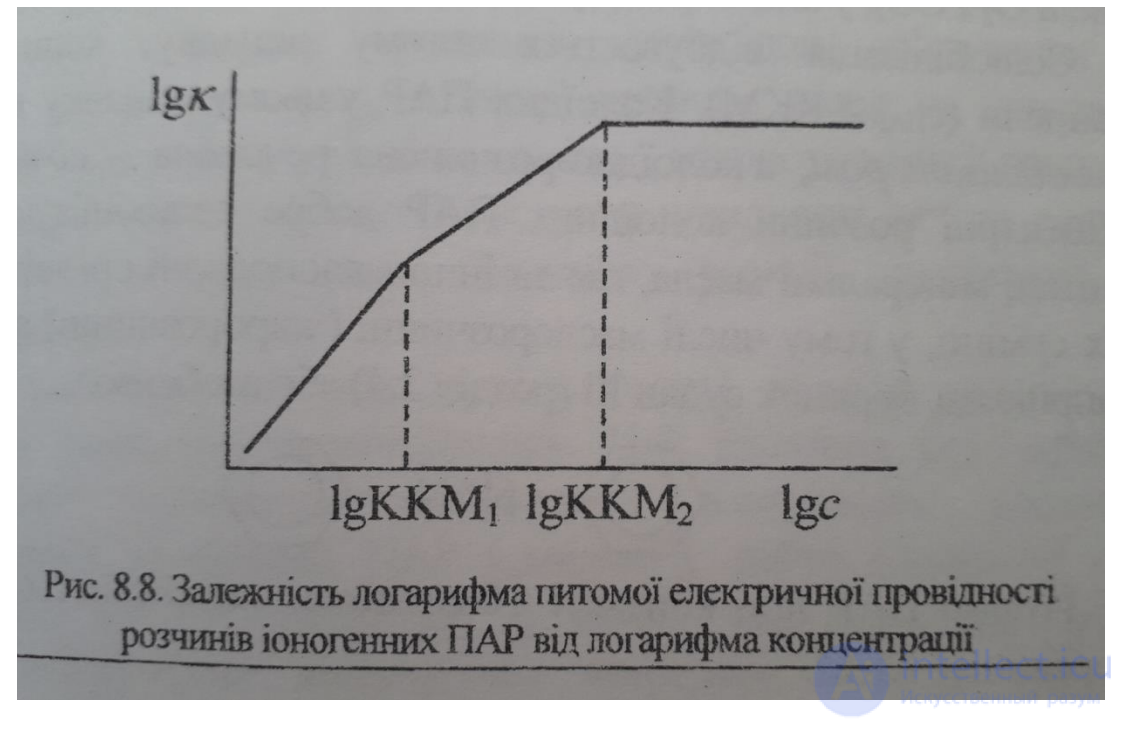
15. Depending on the conditions, the shapes of micelles can reversibly change
(transform into one another). Such solutions have several CMCs.
16. Micellar surfactant solutions are capable of absorbing substances insoluble in the DP (dispersion medium). This
is called solubilization. This phenomenon is used in living organisms
(assimilation of fats, vitamins), in pharmacy (delivery of drugs in forms
convenient for the body), in chemical technology (micellar catalysis, emulsion polymerization), and in
everyday life (detergents).
17. The main factors responsible for the detergent action of surfactants
Ensuring good wetting of the fabric surface, its hydrophilization due
to adsorption.
The amphiphilicity of surfactants ensures their adsorption also on the surface of water-insoluble
dirt particles, which leads to their separation from the fabric.
Ionic surfactants stabilize foam and thereby promote flotation of
dirt particles on air bubbles.
Micelle formation and solubilization complete the removal of small
dirt particles

Comments