
Lecture
1. A colloidal system (CS) is a heterogeneous system and is characterized by a large interfacial area
of the phases. For spherical particles of the dispersed phase (DP), the specific surface area is Ssp. = 6D.
2. The interphase boundary has excess energy ∆GS = Ϭ
.S, therefore CS with a
large interfacial area are thermodynamically unstable. ∆GS can be reduced and thereby
the CS can be stabilized through adsorption at the phase boundary
of surface – active substances (surfactants).
3. Adsorption – is the phenomenon of an increase in the concentration of a dissolved substance at
the phase boundary.
4. The substance that is adsorbed is called the adsorbate. The substance on the surface
of which the adsorbate is adsorbed is called the adsorbent.
5. Quantitatively, adsorption is evaluated by the values A= nS/S (total adsorption) or
Γ = ∆nS/S (Gibbs adsorption).
Here nS – the amount of adsorbed substance in moles,
∆nS – the excess of adsorbate relative to the bulk content of this substance in
the solution (∆nS = nS - nʋ )
6. Adsorption is characterized by the adsorption isotherm Γ= f(c). This is the dependence
of the values Γ and A on the volumetric concentration of the substance at constant temperature.
7. Types of adsorption isotherms. Practically all isotherms at very low
adsorbate concentrations have a linear character. This is the Henry isotherm type:
A=K. C. Over a wide range of C, the following types of isotherms are distinguished.
Langmuir monomolecular adsorption isotherm (fig. 1)
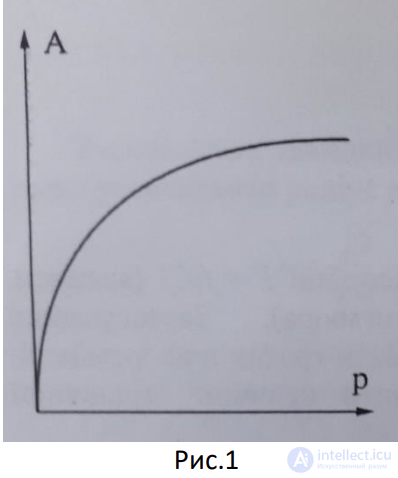
Fig.1
Isotherm equation
A = A∞ bC/(1+bC), or Ɵ = bC/(1+bC).
Here Ɵ – is the degree of surface coverage by the adsorbate.
Polymolecular adsorption isotherm (BET) (fig.2)
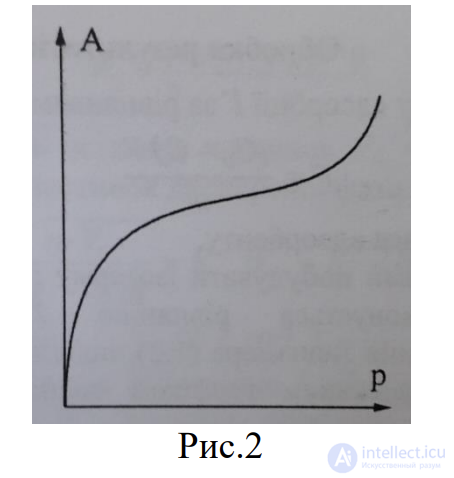
Fig.2
Isotherm equation
Ɵ = (K . P/PS)/(1- P/PS)(1+(K-1) P/PS)
Here P – partial pressure, PS – saturated vapor pressure of the adsorbate.
Freundlich isotherm A = βC1/n
(fig.3)
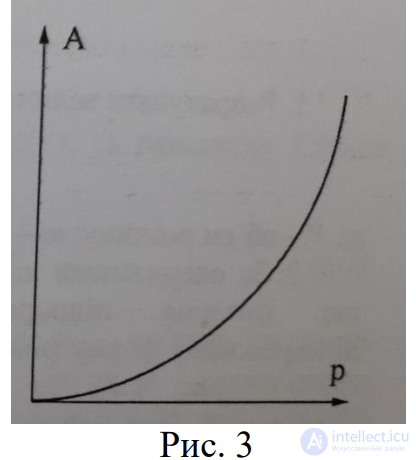
Fig. 3
Here β and n – are parameters that account for the energetic heterogeneity
of the adsorbent surface.
8. Adsorption can be measured from the change in the value of surface tension,
using the Gibbs equation:
Γ = - C/RT(dϬ /dC)
The effectiveness of a surfactant is evaluated by the value of surface activity
q = - (dG/dC)C→0
9. Other interfacial interactions (cohesion, adhesion, wetting)
Cohesion - the interaction of phases of the same substance.
Adhesion - the interaction of phases of different substances.
They are evaluated by the work of cohesion (WC) and adhesion (WA).
In a three-phase system WA = ϬP/Γ + ϬT/Γ – ϬT/P (Dupré equation)
WC = 2 ϬP/Γ, or WC = 2 ϬT/Γ , or WC = 2 ϬT/P depending on which phase's cohesion
we are considering.
10. Wetting is evaluated by the contact angle Ɵ (fig.4)
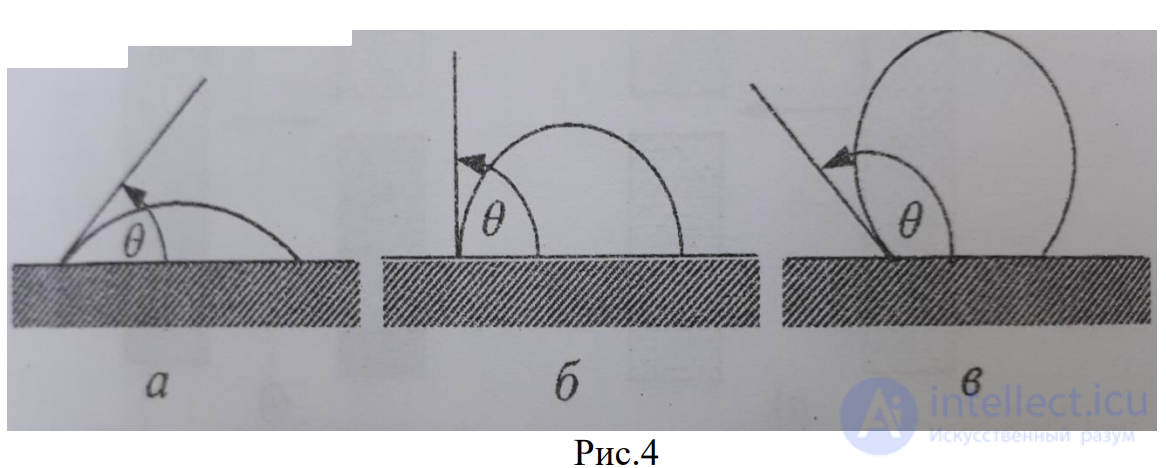
Fig.4
Complete wetting (Ɵ=0) (ϬT/Γ – ϬT/P)>> ϬP/Γ
Complete non-wetting (Ɵ=1800
) (ϬT/Γ – ϬT/P)<< ϬP/Γ
cos Ɵ = (ϬT/Γ – ϬT/P)/ ϬP/Γ (Young equation)
cos Ɵ = (2WA – WC) / WC (Dupré – Young equation)
Spreading coefficient (Harkins) f = WA – WC .
11. The small size of dispersed-phase particles creates an excess pressure effect
∆P = 2Ϭ(dS/dV)= 2ϬK; (Laplace formula).
In capillaries, wetting creates capillary pressure
∆P = 2Ϭ/rcr.; rcr = r/cosƟ, here rcr – is the radius of the meniscus, r – is the radius of the capillary.
Because of this, the liquid in the capillaries rises to a height h,
balancing the mass of the liquid.
h = 2Ϭ cosƟ/(r.g
. ρ).

Comments