
Lecture
1. A characteristic feature of CS is light scattering
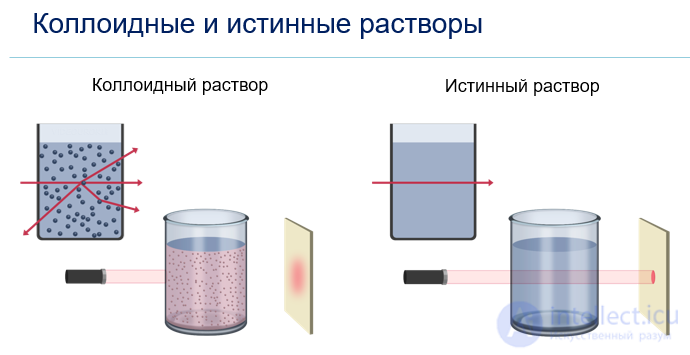
2. If the DM does not absorb light, the attenuation of its intensity occurs
due to reflection from DP particles
I = I0
.
exp (- τ
. ℓ )
τ - turbidity coefficient
3. If the DM absorbs light, the equation takes the form:
I = I0
.
exp [ - (k+τ) ℓ]
4. For dilute CS with spherical DP particles, the working equation is the Rayleigh equation
τ = 24[π3VCʋ / ƛ4 ] .
[(n1
2 – n2
2 ) /( n1
2 + 2n2
2
)]2
V – volume of a DP particle;
CV - volume fraction of DP;
ƛ – wavelength of light;
n1 and n2 – refractive indices of DM and DP
Optical methods for studying CS
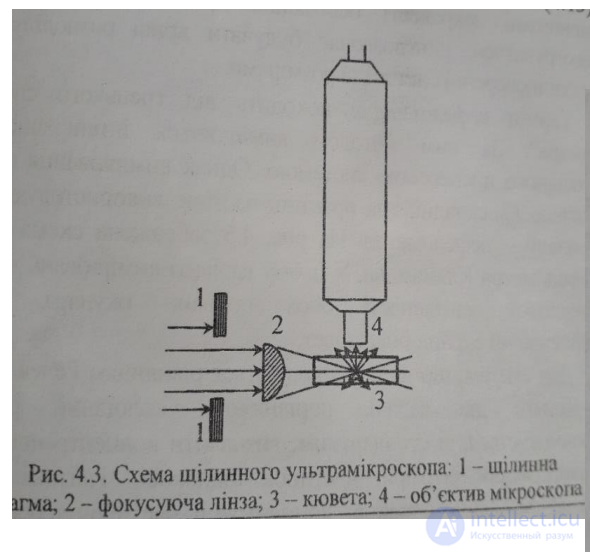
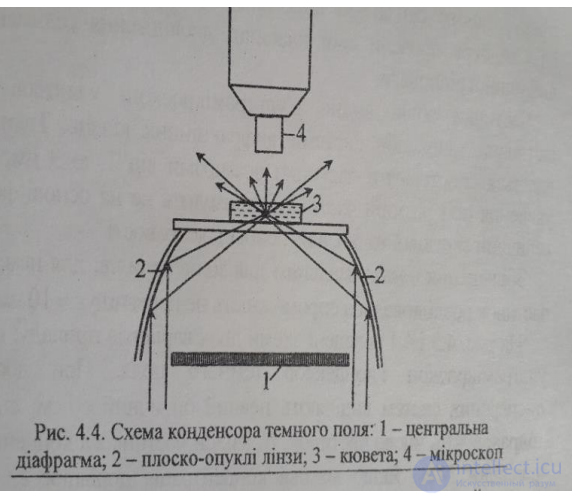
5. Ultramicroscopy. Due to the fact that the halo of scattered light (diffraction
rings) around DP particles is much larger than the size of the particles themselves, it is
possible to see these «fireflies» with an ordinary microscope. Two
types of microscopes are used: slit-type and dark-field condenser.
The concentration of particles in the selected volume (ʋ) is counted, and knowing the mass
concentration of DM (C) and its specific density (ρ), the volume of the particles V= c/ʋ ρ is found
and accordingly their diameter.
6. Nephelometry. The intensity of scattered light is measured
for the test CS sample in comparison with a standard sample
Cx = Cst
. hst / hx
Here C – concentration of DP, h – height of the open part of the cuvette for
the standard and the test sample, respectively.
7. Turbidimetry. The intensity of light that has passed through the cuvette
with the CS is measured, and the turbidity coefficient τ = 2.3A/l is determined, where A= lg (I0/Itr).
This method yields the turbidity spectrum – the dependence of τ on the wavelength
of light ƛ
lg τ = const – x lg ƛ. The basis is the Heller equation A = const . ƛ
-x
.

Comments