
Lecture
1. The concept of «social community» and «social group».
2. The social structure of society.
3. The essence and historical types of social stratification.
4. Social mobility, types of mobility.
The concept of «social community» and «social group» is key in sociology, since it is precisely these associations of people that, on the one hand, act as the primary subjects of social action, and on the other hand, mediate the interaction between the individual and society. In sociology, society is understood as a historically formed type of social organization and of social ties and relations among people. Relations among people within society take place in social communities and social groups, which is why sociologists call groups the «foundation» of human society.
In sociology, a distinction is drawn between the concepts of «social group» and «social community». A social community is a set of individuals sharing one or several characteristics (origin, sphere of activity, place of residence, common goals, tasks, etc.) and united by social ties. In this definition a number of points should be emphasized: social communities are not abstract abstractions, they exist in reality; social communities themselves are a source of their own development, of self-motion. The main types of social communities are distinguished:
1. Aggregation - a set of individuals located in the same place at the same time (a queue, passengers on public transport);
2. Quasi-group:
a) crowd - an internally unorganized set of individuals possessing spatial proximity, common external stimuli and emotional commonality (passers-by observing the aftermath of a road traffic accident)
b) audience - a set of individuals connected with a communicator for the purpose of obtaining information or emotions (viewers in a cinema, at a public lecture hall, at a conservatory);
c) social circles - these are social communities created for the purpose of exchanging information among their members.
The Polish sociologist J. Szczepanski distinguishes the following varieties of social circles: contact circles - communities that regularly meet on the basis of certain shared conditions (interest in sporting competitions, types of sport, etc.); professional circles - which gather to exchange information exclusively on a professional basis; status circles - formed around the exchange of information among people of the same social status (aristocratic circles, women's or men's circles, etc.); friendly circles - based on jointly spending time at various events (companies, groups of friends). In conclusion, let us note that quasi-groups represent certain transitional formations which, upon acquiring such features as organization, stability and structuredness, turn into a social group.
A social group is a set of individuals who interact with one another on the basis of each group member's expectations regarding the others, who are aware of their belonging to the given group and are recognized as members of that group from the point of view of others.
Social groups are the foundation of society. Social groups are classified according to various criteria:
By the nature of the individual's ties with the group, we distinguish:
1. Membership groups - any group of which the individual is a member.
2. Reference group - the group whose values matter to the individual, and against which he compares himself as against a standard. For example, teenagers orient themselves toward the lifestyle of their idols, while an employee of an organization who wants to make a career orients himself toward the behaviour of senior management.
Depending on the size of the group and the nature of the interaction among its members, we distinguish:
1. Small groups - these are small (from two to several dozen people) social groups whose members are in direct, stable, personal communication (family, student group, work team, circle of friends, etc.).
2. Large groups - these are numerous groups of people, dispersed over a large space, characterized by mediated, solidary interaction (class, territorial, national communities).
Small groups, in turn, are primary and secondary. Primary groups are characterized by the intimacy of communication, the purpose of their formation being communication as such (family, friends). Secondary groups are characterized by the formality of contacts (study group, work collective); they are created to achieve instrumental goals (obtaining an education, profit, and so on).
By the nature of the characteristics of the individuals making up the group, the following types of large groups are distinguished: socio-demographic, socio-residential, socio-ethnic, socio-professional, socio-class, and so on.
Unlike small and medium-sized groups, large groups are characterized by:
Depending on the way interaction is organized and regulated, formal and informal groups are distinguished.
1. A formal group is a group possessing legal status, in which interaction is regulated by a system of formalized norms, rules, and laws. These groups have a consciously set goal, a normatively fixed hierarchical structure, and act according to an administratively established order (organizations, enterprises, etc.).
2. An informal group arises spontaneously, on the basis of shared views, interests, and interpersonal interactions. It lacks official regulation and legal status. Such groups are usually headed by informal leaders. Examples include circles of friends, associations of informal youth groups, fans of rock music, and so on.
Depending on individuals' belonging to groups, in-groups and out-groups are distinguished. 1. In-groups are a group in which the individual feels a direct sense of belonging and identifies it as "mine", "ours" (for example, "my family", "my class", "my company," etc.). 2. Out-groups are a group to which the given individual does not belong and which he therefore regards as "alien," not his own (other families, another religious group, another ethnicity, etc.).
Structura (Lat.) - structure, arrangement, order. Structure is understood as a set of functionally interrelated elements, connections and dependencies that make up the internal organization of an object. The structure of an object is characterized by:
The socio-professional structure of society is a set of social groups distinguished by the nature and content of labour and related characteristics. First of all, this concerns occupational and positional groups. An occupational group is a large social group uniting people by a common type of activity connected with the social division of labour. Occupational groups are formed, for example, by lawyers, doctors, engineers, drivers, salespeople and the like. Positions are formed within a single occupational group (for example, among medical workers there is a division into nursing assistants, nurses, doctors, department heads, chief physicians, etc.) and differ in the scope of authority, the presence of managerial functions, and the level of knowledge and qualification. The set, number and size of socio-professional groups change over time. The direction of these changes is determined by the industrial-technical and socio-economic level of development of society.
The socio-demographic structure is a set of social groups that differ by age, sex, marital status, presence of children and migration status. The total population of Ukraine is 42,953,889 people as of December 1, 2014 (according to the State Statistics Committee), placing it 30th in the world by population.
By age, the following are distinguished:
By sex, the following are distinguished:
By marital status, the following are distinguished:
By presence of children, the following are distinguished:
By migration status, the following are distinguished: emigrants - people who have left for another country, and immigrants - people who have entered the country; rural and urban migrants; the migration of the population from «village to city» is of great importance, but with the development of urbanization the role of «city to city» migration is increasing; labour migrants, student migrants and others - depending on the purpose of departure.
The socio-territorial structure is a set of social groups that differ by the type of settlement in which they live, and by type of region. By type of settlement, the following are distinguished:
Ukraine had 460 cities, of which 5 had a population of more than 1 million people, 46 were large cities with a population of more than 100 thousand people, 885 urban-type settlements, and 28,397 villages. By type of region, Ukraine distinguishes residents of the eastern, western, southern, northern and central regions.
The socio-ethnic structure is the totality of ethnic groups inhabiting a country. At present, representatives of more than 130 ethnic groups live within the territory of Ukraine. In terms of national composition, Ukraine belongs to the mononational states. Ukrainians make up the absolute majority of Ukraine's population.
The socio-class structure is the totality of social groups distinguished by their rank in the social hierarchy. The socio-class structure consists of classes and of the social strata that exist within those classes.
The types of structures listed are not exhaustive; others can be added to them, such as the educational, religious, political, and so forth. In real society, all of these structures exist in interconnection. Every individual belongs to some occupational group, has a sex, an age, an ethnic and class affiliation, lives in some region and type of settlement — that is, all kinds of social structures overlay one another and together form the structure of society. Thus, the social structure is treated as a totality of interconnected and interacting social groups and the relations between them. Combining the conclusions of the two models, we can define social structure as the totality of the elements of society — statuses, roles, groups, organizations, social institutions — together with the ties and relationships among them.
Society consists of a large number of social groups. Some of these groups lie on a single plane, that is, at one level, while another part is arranged on different levels or is layered one upon another, meaning that society is not a flat formation but rather resembles a layered cake, something like a "Napoleon" pastry. At the top of the social hierarchy are the privileged strata, and at the bottom are the most disadvantaged. This phenomenon has come to be known in sociology as "social stratification".
Social stratification (from the Latin stratum — layer) is the layering of social groups that differ in their access to social resources. The term "social stratification" denotes both the process of stratification and the result of that process. Sociology contains various methodological approaches to analyzing the essence, origins, and prospects for the development of social stratification.
Table 2.1 — Methodological approaches to the analysis of social stratification
| The functional approach | The conflict approach | The evolutionary approach |
| 1. Stratification is natural, necessary, and inevitable, because it is connected with the diversity of needs, functions, and social roles | 1. Stratification is not necessary or inevitable. It arises out of conflict between groups | 1. Stratification is not always necessary or beneficial. It arises not only from natural needs but also on the basis of conflict, and is determined by the distribution of surplus product. |
| 2. Reward is distributed in accordance with role, and is therefore just | 2. Reward is unjust; it is determined by the interests of the groups that hold power | 2. The reward can be either fair or unfair |
| 3. Stratification ensures the optimal functioning of society | 3. Stratification hinders the normal functioning of society | 3. Stratification can either promote or hinder the development of society |
The division into layers occurs in relation to the basic resources that are called criteria of social stratification, among them:
1. Property and income - social layers differ from one another, first of all, in the amount of property they own and the income they receive. This criterion is universal and convenient, since the property (real estate, cars, paintings, etc.) owned by an individual can be assessed in monetary terms.
2. Power - this is an individual's ability to influence others and make them perform certain actions. The scope of an individual's power is determined by the number of subordinates for whom that individual's decisions are binding.
3. Prestige - a high evaluation of a person, determined by respect for their status. Nowadays this is primarily linked to professional activity. Worldwide, the highest prestige belongs to professions associated with skilled mental labor, while the lowest belongs to unskilled, manual, physical labor. Thus, according to a sociological survey conducted in Ukraine in 2017, respondents named programmer, businessman, doctor, and manager as the most prestigious professions, and blue-collar occupations (plumber, machinist), driver, and service-sector worker (hairdresser, waiter) as the least prestigious.
4. Education - this criterion of stratification has been identified relatively recently, since the function of education in the modern world is growing, and through education one can gain access to the three previous resources.
In order to more clearly reflect social inequality in society, a graphic model of the division of the population into social layers is used, known as the profile of social stratification. Modern Western society has the shape of a rhombus, whereas Ukrainian society resembles an irregular pyramid. The profile clearly reflects the fact that most members of Western society are concentrated in the middle of the social hierarchy, whereas in Ukrainian society most are concentrated closer to the lower part of the hierarchy. This is why Ukraine is characterized by sharp polarization of society (that is, a significant difference in income and standard of living between the "rich" and the "poor"), as well as a small middle class.
Social stratification has existed in various types of societies, each of which had its own specific features, but all its manifestations can be combined into two basic forms of stratification: closed and open.
Closed stratification is characterized by the presence of clear boundaries between layers and a prohibition on crossing these boundaries. A person born into a society with a closed form of stratification was forced to spend their entire life within the caste to which they belonged by birth, and to die in it as well. An example of closed stratification is the division of society into castes and estates.
Open stratification is characterized by more permeable boundaries between strata, through which an individual can move up to another layer by their own efforts or by chance. An example of open stratification is the division of society into classes.
The development of humankind has been accompanied by changes occurring in systems of social stratification. In their pure form, four basic historical types of social stratification can be distinguished:
1. Slavery - the most rigid manifestation of social inequality, in which one person, in the literal sense of the word, is the property of another person. Attitudes toward slaves differed from society to society. In some societies slaves were treated as servants and were entrusted with such a responsible task as raising children; in others, slaves were used exclusively for heavy physical labor on plantations. The rights of slaveholders also differed: in some societies an owner could kill a slave with impunity, while in others this was forbidden. In any case, slavery proved economically inefficient and was abolished.
2. Caste - a closed group, membership in which is determined by an individual's birth; each caste has its own role, rights, and duties, and moving from one caste to another is forbidden. The caste system existed in India and Pakistan. A distinctive feature of the caste system was endogamy (that is, a ban on marriage between members of different castes). At present it has been abolished de jure, but individual manifestations still persist de facto. The caste system rests on the Hindu religion, which is based on the idea of reincarnation. That is, from the point of view of Hinduism, during this life a person must perform the function assigned to them: Brahmins - to rule society; Kshatriyas - to protect the population from external enemies; Vaishyas - to provide society with everything necessary through trade; Shudras - to produce everything necessary. If in this life a person performs their role well, then in the next they will pass into a higher caste.
3. Estate - a social group whose rights and duties are fixed by legal statutes, religious doctrine, and the traditions of society, and are passed down by inheritance. A classic example of an estate-based organization of society was medieval Europe, where three main estates existed: the nobility, the clergy, and the peasantry. In Russia, by the end of the 18th century, five main estates had become established: the nobility, the clergy, the merchantry, the burghers (middle urban strata), and the peasantry. Each estate included its own layers, ranks, levels, and titles. Movement between estates occurred very rarely. A characteristic feature of estates was the presence of social symbols and signs: titles, uniforms, orders, and ranks. The nobility, as the highest estate, had special symbols that underscored its privileged position.
4. Classes - broad social groupings of people who have similar economic resources and, as a consequence, share common political views, lifestyles, values, and preferences. Classes are fundamentally different from previous stratification systems. Four basic distinctions that set classes apart from other historical types of stratification should be highlighted:
1. Classes are a purely economic formation, that is, an individual's membership in a class is determined by his material position, by the volume of economic resources that the individual possesses. If the individual's economic position changes, he moves into another class. Other types of stratification rest on non-economic factors (the influence of religion, etc.).
2. Unlike other types, classes do not rest on the force of religion or law, that is, they are more fluid.
3. An individual can end up in one class or another through his own efforts (or inaction), and not only acquire class status at birth.
4. Relations between classes are impersonal in nature, whereas in all other systems there are always personal relations present between, for example, a serf and a feudal lord, a slave and a master. Class systems function on the basis of large-scale ties of an impersonal nature, which is especially clearly manifested in the era of the separation of such functions of capital as ownership and management. When companies are run by hired managers, while ownership belongs to groups of shareholders, the workers may have no idea who the owner is.
The concept of «social class» was introduced into scholarly use at the beginning of the 19th century by the French historians Thierry and Guizot, who invested it, above all, with political meaning. The truly active use of this term began with K. Marx. In contemporary sociology there is no universal interpretation of the term; one can speak of several main approaches to analysing the phenomenon. Let us dwell on two main approaches, namely: the Marxist and the Weberian.
1. The Marxist tradition of class analysis. K. Marx considered the main class-forming characteristic to be the ownership of the means of production. By this criterion he divided any society into two main classes - the class possessing ownership of the means of production, and the class that does not own them. The concrete manifestations of these two classes change depending on the society. In a slave-owning society there exist the classes of slaves and slave-owners, in a feudal one - serfs and feudal lords, in a capitalist one - workers and capitalists. Marx acknowledged the existence of other large social groups, for example, in capitalist society - the peasantry and the petty bourgeoisie, but, in his opinion, these remnants of the pre-capitalist economy disappear in the course of the development of the capitalist system.
The owning classes simultaneously act as ruling, non-productive and exploitative, that is, they appropriate the surplus product that was produced by others. The class deprived of ownership is subject to exploitation, is governed, and is productive.
In the Marxist conception, classes were somewhat more than simply a way of describing the economic position of social groups. Marx viewed classes not only as a convenient analytical model, but also as real social forces capable of changing society.
Although Marx's economic approach emphasizes the primary importance of objective characteristics, serious attention is also given to the subjective aspects of the functioning of classes, namely class consciousness. Marx distinguished between a «class in itself» - that is, a class that has not become aware of its interests, and a «class for itself» - a class with developed class consciousness, which clearly understands its interests and sees the methods of struggle for defending them.
Marx did not give a precise definition of classes, so many scholars who considered themselves his followers tried to fill this gap. In Soviet social science the following definition became widespread and commonly used: «Classes are large groups of people differing by their place in a historically defined system of social production, by their relation to the means of production (mostly fixed and formalized in law), by their role in the social organization of labour, and consequently by the mode of acquiring and the share of social wealth which they dispose of».
Later an attempt to refine the Marxist class scheme was made by Erik Wright, and this theory came to be called neo-Marxism. It was linked to an attempt to fit into the scheme the numerous group of managers, which had arisen as a result of the separation of such functions of capital as ownership and management. Within the classical Marxist concept, managers fall into the working class, although the income of this group, its place in the system of production organization and, consequently, its lifestyle differ substantially from that of the proletariat. In addition to ownership of the means of production, Erik Wright proposed one more criterion of class formation - the presence of managerial functions - as a result of which he distinguished not two, but four classes:
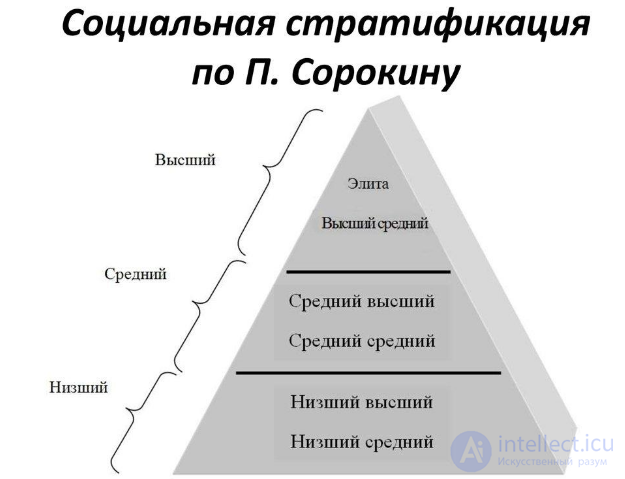
2. The multifactor approach takes into account not one, but several criteria of class formation (occupation, source and amount of income, level of education, lifestyle, type of housing, area of residence, etc.). Within this approach, three classes are most often distinguished (upper, middle and lower), each of which consists of several strata. This approach arose in the United States and remains popular to this day, so we shall provide data on the distribution of the population by class in contemporary American society.
The upper class. This class includes people and families who have concentrated in their hands control over the principal social resources: land, means of production, finance, the political and information spheres. This is why the class may include the landed aristocracy (in countries where remnants of the feudal system survive, such as present-day Great Britain), entrepreneurs who run large businesses, owners of major companies and enterprises, including media and show-business magnates; financiers and bankers who control the flow of money in the country; senior administrators and politicians of the country, members of governments, ministers, and commanders of the armed forces, police, and security services. Representatives of the creative or sporting elite, who enjoy high status and high personal incomes, may also join the financial and political elites.
The upper class has an important shared resource — social connections, the solidarity of those who belong to the top of society, and a system of mutual favors. As a rule, children from upper-class families, starting from school and university, are consciously groomed for the role of top managers, owners, and politicians. They study mainly in closed private educational institutions and prestigious, expensive universities. The lifestyle of this class remains a favorite topic of the press, especially the so-called "yellow" press specializing in high-society gossip and scandals "in the upper circles." On the whole, representatives of the "upper circles" try to lead a closed and inconspicuous lifestyle away from the general public, avoiding public scandals and press intrusion. Displaying luxury is unpopular today; on the contrary, people from the wealthiest families try to behave democratically and not to stand out outwardly from other people.
The upper-upper class — wealthy families of noble origin who possess great wealth received through inheritance (less than 1%).
The lower-upper class — people of great wealth who have recently become rich (nouveau riche). This class includes stars of sport and cinema, "computer geniuses" (about 4%).
Middle class. The middle class is something intermediate in the social space between the positions of the "poor" and the "rich".
The status of the middle class has a number of qualitative features that make this class a community with its own "face". Thus, the middle class unites those who:
In the last quarter of the 20th century, in developed countries, the absolute majority of the population turned into the middle class. This was the most significant event in terms of the transformation of the social structure.
The upper-middle class — highly qualified persons engaged in mental labor (lawyers, doctors, the scientific elite, top-level managers), owners of medium-sized businesses, whose incomes in the United States equal more than 80 thousand dollars a year (about 15%).
The middle-middle class — persons engaged in less prestigious mental labor (secondary school teachers, mid-level managers, accountants, etc.), whose annual incomes in the United States range from 40 to 80 thousand dollars (about 30%).
Lower middle class - unskilled workers - clerical workers, secretaries, cashiers, waiters, as well as small business owners and manual laborers, whose income does not exceed 40 thousand dollars a year (about 30%).
Lower class. The lower class comprises individuals and families whose status does not reach that of the middle class; the lifestyle and standards of this class depend on the country's economic situation, but they are neither prestigious nor an object of envy. This class includes manual laborers, people employed predominantly in physical labor, or those who subsist thanks to the social insurance system (for example, pensioners).
The characteristics of the lower class are determined by its economic position. For members of this class, the threat of poverty is ever-present. That is why they look for cheap goods and services, do not shy away from sales and discount stores, make use of various social assistance programs for the poor, rent inexpensive housing in unprestigious neighborhoods, send their children to ordinary public schools, and so on. Overall, it makes up about 20%.
Upper-lower class - unskilled manual laborers, temporary and seasonal workers.
Lower-lower class - beggars, the unemployed, the homeless, migrant workers.
Sociology also has a concept of the very lowest class (the underclass, literally "subclass," used in the sense of "the social bottom") - a term for the strata that remain left out of industrial society. This includes social failures, the chronically unemployed, as well as vagrants, alcoholics, and drug addicts who have sunk to the bottom. In the United States, these strata are predominantly made up of first-generation immigrants, people of Latin American origin, and Black Americans. The lowest class forms its own residential areas - slums, the slums of large cities, a kind of modern ghetto where members of the middle class never set foot, except when a criminal investigation is being carried out or some charitable action is taking place. It is believed that it is precisely the underclass that serves as a breeding ground for the criminal world.
Regardless of the society into which individuals are born, they possess an inherent drive toward something better; they constantly make efforts to obtain higher income, more power, and to earn the respect of others. On a societal scale, the result of these efforts manifests itself in the phenomenon known as social mobility.
Social mobility refers to the movement of an individual from one social position to another. Every time we earn a higher education diploma, change jobs, or move to another city, we are demonstrating social mobility.
Types of social mobility:
1. Horizontal mobility is movement that does not lead to a rise or fall in an individual's social status. An example would be a specialist, say a lawyer, moving from one company to another, provided their position, income, and amount of power remain unchanged.
Vertical mobility refers to movements that lead to changes in social status associated with access to social resources. Vertical mobility can be upward or downward.
2. Upward social mobility is the movement of an individual or group that leads to a rise in social status. For example, a student earns a higher education diploma and becomes a young professional, or an IT specialist becomes a project manager.
Downward social mobility is the movement of an individual or group that results in a decline in social status. For example, a party fails to gain support in parliamentary elections, and its leadership loses its seats in parliament.
3. Intergenerational mobility is a change in children's social status relative to the social status of their parents. That is, if the social status of a son (daughter) is the same as that of the father (mother), there is no intergenerational mobility; if the social statuses of children and parents differ, we observe intergenerational mobility.
Intragenerational mobility is a change in an individual's social status over the course of his or her life; here we mainly mean changes in professional status, that is, the individual's career. One and the same individual may exhibit intergenerational mobility while showing no intragenerational mobility, and vice versa.
4. Individual mobility is a change in an individual's social status owing to his or her own efforts and personal achievement.
Group mobility is a change in the social statuses of entire social groups as a result of certain historical events. For instance, P. Sorokin cites the example of the Great October Revolution, which resulted in a decline in the social status of the nobility. In the post-revolutionary period, it was not only unfashionable to take pride in a noble title, it could even become a threat to one's very life. The opposite picture was observed among representatives of the working class. This group's social status rose after the revolution, and belonging to the group was seen as a guarantee of political reliability and opened the door to advancement through the party hierarchy, and so on.
5. Structural social mobility is a change in individuals' social status resulting from structural changes that have taken place in society, particularly in the economic sphere. One example is the peasants who, in the 1930s, raised their social status by joining the ranks of the working class. This became possible thanks to the process of industrialization that took place in Soviet society and to the accompanying changes in its social-class structure. Structural changes can also trigger mass processes of downward mobility. For example, the development of computer technology led to the release from employment of a large number of individuals who performed unskilled non-manual labor (typists, clerks, and so on).
Exchange social mobility refers to changes in individuals' social statuses that occur owing to the expansion of social opportunities, the development of social support systems for vulnerable segments of the population, and expanded access to higher education. Thus, in the period after World War II, countries in Western Europe and America created scholarship systems for talented youth, and children from lower-class families gained access to higher education.
In order to raise their social status, individuals may make use of the so-called channels of social mobility (sometimes called lifts) - social institutions that facilitate upward social movement. P. Sorokin, one of the greatest theorists of social stratification, noted that wherever there is powerful vertical mobility, there is life and movement. The fading of mobility gives rise to social stagnation. Today the following main lifts of vertical mobility can be identified, by which people move up or down the rungs of the social ladder over the course of their personal careers:
• The army functions as a channel not in peacetime but in wartime. In wartime, soldiers advance through talent and bravery. Having risen in rank, they use the power they gain as a channel for further advancement and the accumulation of wealth. They gain the opportunity to plunder, pillage, and seize property. Of 92 Roman emperors, 36 (Julius Caesar, Octavian Augustus, and others) achieved their position through service in the army. Of 65 Byzantine emperors, 12 achieved their status for the same reason.
• The Church, as a channel of social mobility, moved a great many people from the bottom to the top of society. P. Sorokin studied the biographies of 144 Roman Catholic popes and established that 28 had risen from the lower classes, and 27 from the middle strata. The Prophet Muhammad was at first a simple merchant, and later became the ruler of Arabia.
• The school, as an institution of education and upbringing, whatever specific form it took, has in every age served as a powerful channel of social mobility. The intense competition for places at colleges and universities in many countries is explained by the fact that education is the fastest and most accessible channel of vertical mobility. Today in the United States it is possible to hold a government post without a university degree. Of 829 British men of genius, 71 were sons of unskilled laborers. 4% of Russia's academicians came from the peasantry - Lomonosov, for example.
• Property reveals itself most vividly in the form of accumulated wealth and money. P. Sorokin established that not all, but only a few occupations and professions contribute to the accumulation of wealth. According to his calculations, in 29% of cases this is achieved through the occupation of manufacturer, in 21% through that of banker and stockbroker, and in 12% through that of merchant. The professions of artists, painters, inventors, statesmen, and the like do not offer such opportunities.
• Family and marriage serve as channels of vertical mobility in cases where representatives of different social statuses enter into union. An example of such mobility can be seen in antiquity. Under Roman law, a free woman who married a slave herself became a slave and lost the status of a free citizen. Today there exists an "attraction" between wealthy brides and impoverished aristocrats, whereby, in the event of marriage, both partners gain a mutual benefit: the bride receives a title, and the groom receives wealth.
• The political lift (that is, governing groups and parties), and professional associations.
• Art, sport, show business. Among the most famous literary figures in France, 13% came from a working-class background.
• The press, television, radio. Newspapers and television can provide popularity and advancement.
As P. Sorokin demonstrated using an enormous body of historical material, group mobility occurs when the social significance of an entire class, estate, or caste rises or falls. The causes of group mobility included such factors (also called channels of group mobility) as social revolutions, foreign interventions, invasions, interstate wars, civil wars, military coups, changes of political regime, the replacement of an old constitution with a new one, peasant uprisings, internecine warfare among aristocratic families, and the creation of empires.
In moving from one group to another, a person may find themselves in a marginal state.
Marginality is the state of an individual or a community that finds itself at the intersection of different cultures. Not only an individual but also a society can be marginal. For example, Ukraine at present, as a result of its period of transition, can be characterized as a marginal society.
Thus, all people, as social beings, belong to various associations (groups and communities), which may be large or small, temporary or existing over a long period. The totality of interconnected and interacting social groups, together with the relations between them, constitutes the social structure of society, which sociologists sometimes call the anatomical "backbone" of society. However, social space must also necessarily have a vertical dimension; this is a general social regularity. It means that people are not equal to one another, and are likewise included in groups located at different rungs of the social ladder. Social inequality, which underlies many social interactions, is studied within the framework of stratification theory.
Stratification is the layering of social groups that differ in their access to social resources. From the point of view of many sociologists, inequality and stratification have existed at all times, but their historical types and concrete manifestations have differed. A. Giddens includes among them slavery, the caste system, estates, and class. Class is the modern historical type of stratification. The Great French Revolution and other revolutions, along with democratic constitutions, proclaimed that all people are born free and equal. Thus, for the class system the main criterion of stratification is economic position; classes are not formally fixed, are not recorded in legal documents, and membership in a class can be attained through one's own efforts. That is why, in a civilized democratic society, a person has many opportunities for movement and for changing their living conditions. The movement of an individual from one social position to another has been given the name social mobility.

Comments