
Lecture
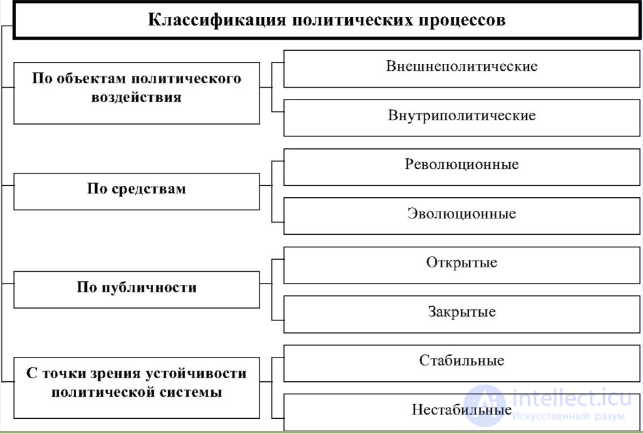
In political science literature, it is customary to distinguish the following types of political processes: revolution, counter-revolution, uprising, riot, rebellion, putsch, political campaign, direct action in politics.
Revolution - is a fundamental transformation of the social order, the creation of a new political system based on different principles of legitimacy. Revolution arises as a consequence of growing contradictions in society.
Because not all members of society share the views of the new authorities, a counter-revolution may occur. Counter-revolution is a political process involving groups seeking to overthrow the new political elite and restore the former order.
Reform - is the gradual transformation of the economic and political system while preserving its foundations and the power of the ruling elite. In carrying out reforms, of paramount importance is securing their public support and reaching agreement on the content, types, and methods of the transformations. The success of reforms depends on their timeliness.
Uprising - a mass movement against the given authority or the existing order. The goal of an uprising is, as a rule, declarative and vague, finding justification in a primitive programme and slogans. Every uprising has a certain level of organisation. Purposefulness and organisation distinguish uprisings from riots.
Riot - is a mass spontaneous action possessing a high degree of intensity. A riot is almost always a reactive response to extraordinary actions by representatives of the dominant political groups or state bodies. Close to a riot in terms of intensity is rebellion, which arises as a result of deliberate, purposeful preparation on the part of a certain group of people. It is usually armed in nature, relying on part of the army. As the composition of participants expands, a rebellion loses organisation and purposefulness, acquires the qualities of a riot, and fades away. If a rebellion does not gain mass support, it becomes a putsch, that is, it results in the armed actions of a narrow group of people lacking any serious prospects.
A political (election) campaign is a system of collective actions aimed at changing the structure of power, redistributing political authority, and forming government bodies. Its success largely depends on support from the population.
A number of political processes fall under the term direct action. This is the direct influence of citizens on political authorities through rallies, demonstrations, and strikes.
Rally - a gathering of people devoted to discussing a particular issue. When holding rallies, it is necessary to take into account the factor that it may become an arena of confrontation between various political forces, a site of various excesses. This requires clear organisation, a well-thought-out scenario, and readiness for various scenarios of how events might unfold from both the rally organisers and the authorities.
Demonstration - is a mass procession of supporters of a particular idea or demand, an expression of support for or protest against actions of the authorities. It requires prior planning and preparation: advertising in newspapers, official permission from the authorities, the making of banners, the distribution of roles, the route, and the speakers.
Strike - a cessation of work for the purpose of economic or political pressure on the authorities. Thanks to strikes, a huge mass of people can join an active political stance in a short time.
The practice of political reality shows that of all political processes, revolution and reforms lead to the most profound transformations.

Comments