
Lecture
1. Social control and social norms
Society is a historically formed set of relations between people. These relations (interactions) are largely spontaneous in nature, but they are not chaotic or disorderly. In the process of historical development, regulators of behaviour, activity, social ties, and relations objectively arise within society, as a result of which society exists and develops as an integral system. The mechanism of social control plays the most important role in maintaining the integrity of society. No society can do without it.
Social control is the set of norms, values, and sanctions of society applied to support them. Social control performs a protective and stabilising function with respect to society.
Social control is a special mechanism for maintaining public order through the use of power and includes the following elements: 1) social values; 2) social norms; 3) sanctions; 4) power.
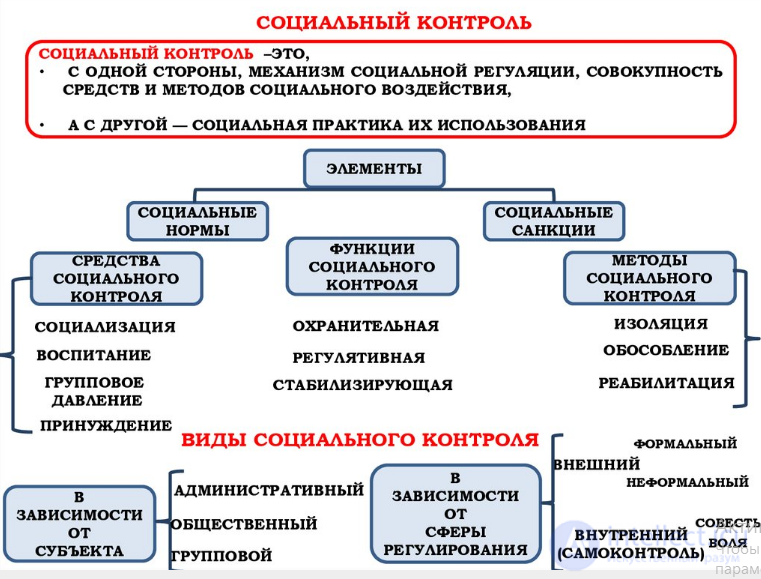
Fig. 1 social control
1. Social values are the fundamental, foundational guidelines of public life. Values are generally accepted beliefs about the goals a person should strive for.
2. Social norms - generally binding rules of behaviour that are sanctioned by society or a social group.
According to the ways they are created and the means by which their requirements are protected from violations, the following are distinguished:
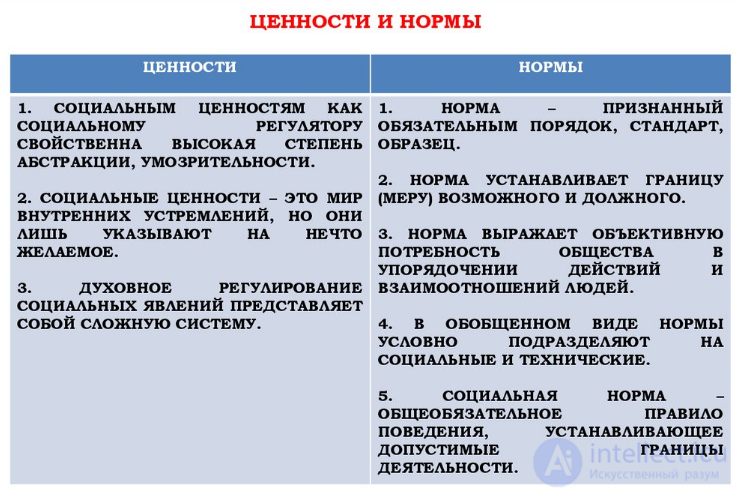
Fig. 2 social values and norms
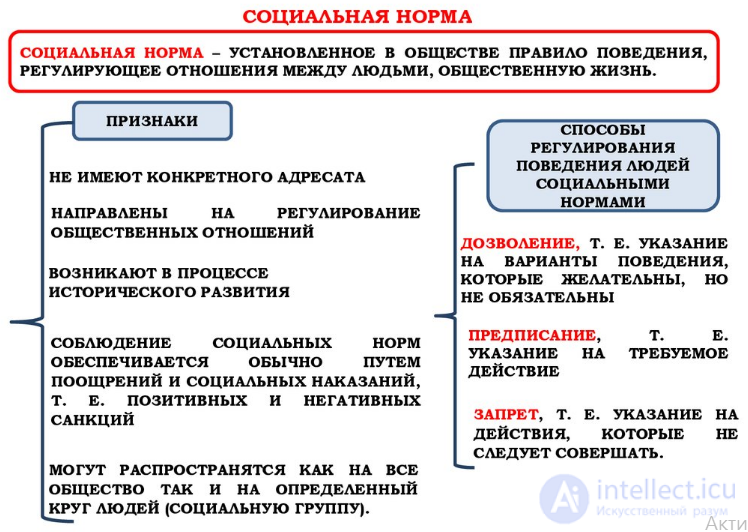
Fig. 3 social norm
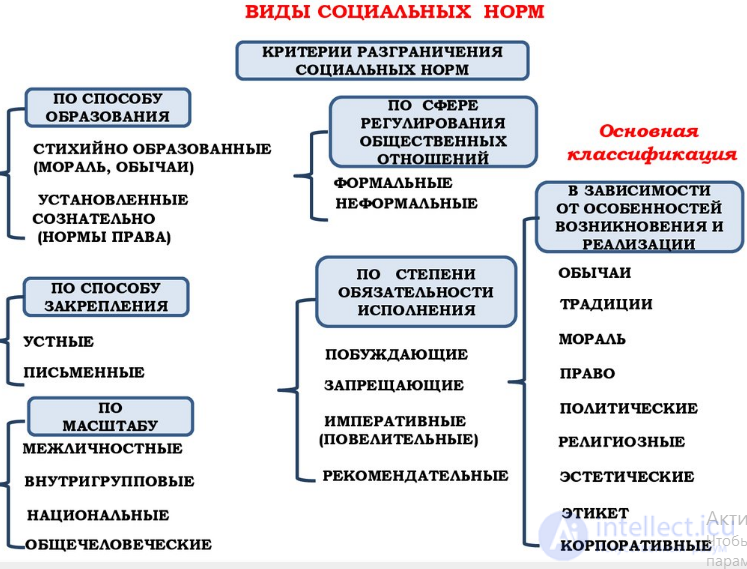
Fig. 4 types of social norms
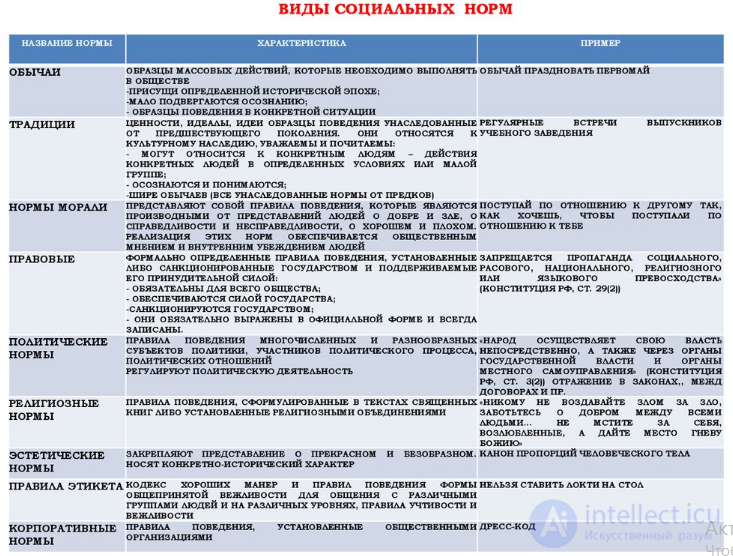
Fig. 5 types of social norms
3. Social sanctions - punishments or rewards that stimulate compliance with norms. Sanctions gain legitimacy on the basis of norms. Sanctions together with values are responsible for why people strive to fulfil norms. Thus, norms are protected from both sides - from the side of values and from the side of sanctions.
Four types of sanctions are distinguished:
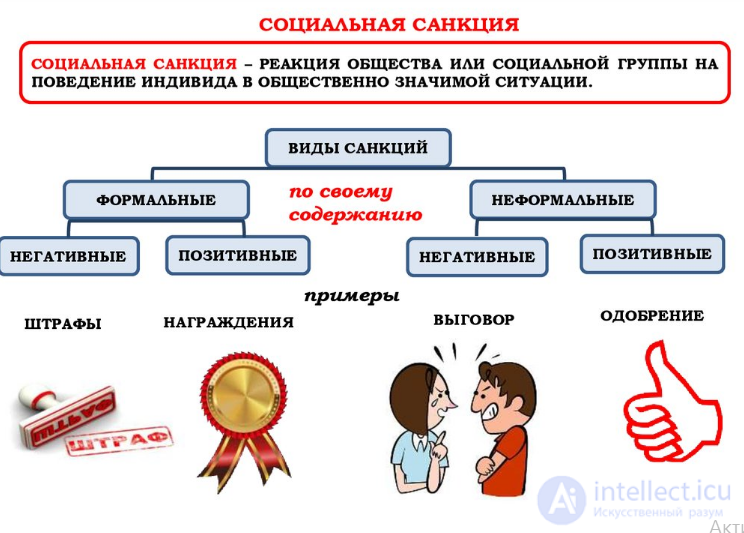
Fig. 6 social sanctions
4. Power - is the ability to achieve desired results despite the resistance of others.
Power includes the following elements:
Power is exercised by way of: direct violence; economic coercion; legitimate domination through the assertion of authority.
Authority may be based on: personal qualities (charismatic power); the force of law (the power of right); custom (traditional power).
Social control can be carried out by various methods:
Formal - carried out by organisations that monitor compliance with formal norms, above all those enshrined in legislation, and that regulate the most important spheres of society's life (the police, the courts, the psychiatric hospital).
Informal - presupposes informality, is carried out by small groups, and can be carried out by means of: social reward (a smile, a nod of the head, a compliment, and so on), punishment (a disapproving look, a critical remark, a threat, and so on), persuasion.
T. Parsons singled out the following methods of social control:
1. Isolation - applied with the aim of separating a norm-violator from other people; it does not envisage any attempt at rehabilitation (life imprisonment or confinement in a psychiatric hospital).
2. Segregation - limiting a norm-violator's contacts with other people, but not full isolation from society (temporary isolation).
3. Rehabilitation - a system of measures and procedures thanks to which a norm-violator, without severing ties with society, can prepare to return to normal life and to the performance of their roles (an Alcoholics Anonymous club).

Comments