
Lecture
The concept of "power" is used in different senses both in everyday life and in academic circles. Philosophers speak of power over the objective laws of society, sociologists of social power, economists of economic power, jurists of state power, natural scientists of power over nature, politicians of political power, psychologists of a person's power over themselves, and parents of power within the family, and so on.
The phenomenon of power has drawn the close attention of all the outstanding representatives of political science. Even the ancient thinkers Plato, Aristotle, and others tried to penetrate the essence of the social nature of political power. In the Middle Ages and the early modern period, N. Machiavelli, T. Hobbes, J. Locke, I. Kant, and many others took a keen interest in the problems of power. Significant contributions to the development of the theory of power were made by G. Mosca, V. Pareto, R. Michels, and M. Weber.
The question of power stands at the center of attention of contemporary political science and sociology. Yet despite the close attention scholars devote to the problems of power, many foreign researchers write of an aura of mystery and secrecy surrounding power, noting that the concept of power is "sad". The French scholar Chevalier wrote that real power has always attracted more interest than discourse about it. M.S. Khrushchev, in his memoirs, said of power: "One can be satisfied with everything - food, women ... - but one can never be satisfied with power alone; one wants more and more of it."
So what, then, is power?
Historical experience shows that wherever a need arises for coordinated action among people (be it an individual family, a group, a social stratum, a nation, or society as a whole), their activity becomes subordinated to the achievement of certain common goals. At the same time, leaders and followers, the ruling and the ruled, the dominant and the subordinate come to be defined. The motives for submission are quite varied. They may rest on an interest in achieving the stated goal, on a conviction of the need to carry out instructions, on the authority of those who dominate, or simply on a feeling of fear of the undesirable consequences of disobedience.
Thus, power relations are objectively inherent in social life. They are necessary for maintaining the integrity and unity of society, and for organizing social production.
Given the multidimensional nature of power, only the most general definition of it can be offered here.
Power is the ability and capacity to exercise one's will, to influence the activity and behavior of people by means of various kinds of resources - law, authority, coercion, persuasion, and violence.
Political power is power exercised through the state and within the state system, within the system of political parties, organizations, and movements. It is in one way or another connected with the state and with state regulation, but it is not necessarily identical to state power.
It should be noted that political power and state power, while largely coinciding, are nevertheless not identical. Every instance of state power is political power, but not every instance of political power is state power. The content of political power is far broader, while state power is its central institution.
Political power is exercised not only by the state apparatus, but above all through the activity of political parties, public organizations, socio-political movements and other subjects of politics.
State power is a distinctive core of political power, since only the state possesses a monopoly on the enactment of laws binding on the whole of society, and on legitimate physical coercion.
Thus, political parties carry out their will and influence their members and sympathizers through statutes, programmes, instructions and the like. State power dominates society because it makes use of its monopoly right to coercion. The social content of state power lies in its ability to impose its will on the whole of society, up to overcoming the resistance of its opponents through coercion and, when necessary, violence. This ability is sanctioned by a system of legal and ideological norms.
Parties are subjects of politics; the arsenal of their means includes purely political techniques: the reconciliation of interests, the coordination of the actions of social groups, and the search for compromises on common issues. The state, as the principal subject of power, governs society by political and administrative means.
Political power, unlike other forms of power, has its own specificity. Its distinguishing features are:
• supremacy - the binding nature of its decisions for the whole of society and, accordingly, for all other kinds of power. It can restrict the influence of other forms of power within reasonable limits, or eliminate them altogether;
• universality, that is, publicity. This means that political power acts on the basis of law on behalf of the whole of society;
• legality in the use of force and other means of exercising power within the country;
• a wide range of means used to gain, hold and exercise power.
The main components of power are its sources, subjects, objects, resources and process; it is the result of the interaction of all its components and is characterized, above all, by the mechanism that ensures the stability of the entire process of dominion (see Fig. 1).
The sources of power are the primary foundation of power. Authority, force, law, wealth, knowledge, social and political status, charisma and so on may serve as sources of power. The American futurologist O. Toffler, in his book "Powershift: Knowledge, Wealth and Force on the Threshold of the 20th Century", analyzes in detail three principal sources feeding power. According to A. Toffler, force, wealth and power are linked into a single system, are interchangeable under certain conditions, and together are aimed at supporting power. Each of these sources gives power a certain quality: force, or the threat of its use, is capable only of crude coercion, is functionally limited, and is characteristic only of power of a lower level. Wealth is a source of power of medium quality, which can have at its disposal both negative and positive means of stimulation. Knowledge lies at the basis of power of the highest quality, the most effective kind. Toffler asserts that in the modern world, knowledge (in its various forms: information, science, art, ethics), by virtue of its advantages - its infinity (inexhaustibility), its general accessibility, its democratic nature - has subdued force and wealth, becoming the determining factor in the functioning of power.
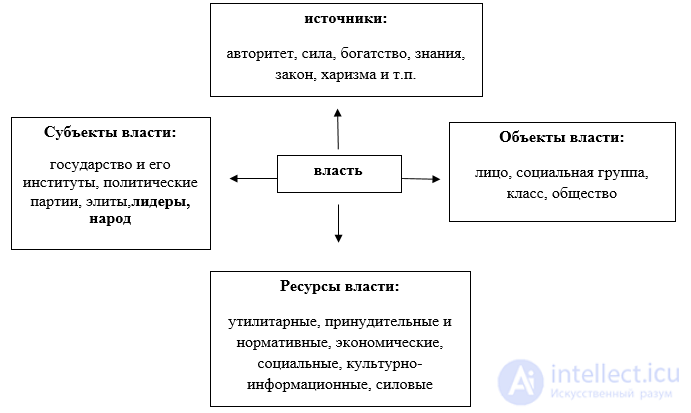
Figure 1. Structure of power
Subjects of power are the bearers of power, the active agent within the system of power from whom influence emanates, along with the resulting orders and directives.
Subjects of power, viewed from another angle, can be, and indeed are, themselves objects for a higher-standing power.
Objects of power are phenomena, things, bodies, institutions, enterprises, and populations toward the direction (management) of which the activity of power is directed by law or by subordinate legal acts.
The subjects of political power have a complex, multilevel character. Its primary agents are individuals and social groups; its secondary agents are political organizations; and the subjects at the highest level, who directly represent various groups and organizations in power relations, are political elites and leaders. The connection between these levels can be disrupted.
Thus, the subject of power can be an individual person, an organization, a community of people such as a nation, or even the world community, united for example within the UN.
The direct subject of power is usually made up of those people who concentrate in their hands enormous influence and trust, financial power, and powerful levers of influence over other people.
A republican form of government and a democratic political regime presuppose the power of the people, which the people exercise directly (direct democracy) and indirectly through their representatives in the highest bodies of political power (representative democracy). However, the possibilities of direct democracy are limited by many circumstances. First, there are too few forms that allow the entire people to be involved at once in resolving political questions (foremost among these forms being free elections and referendums). Second, the political governance of society is constant, expert work. It is simply impossible to cast the entire people in the role of such a governing body. That is why the power of the people is, above all, representative democracy: the people delegate their powers of authority to the appropriate bodies (legislative, electoral, judicial) and to specific persons (the president, the prime minister).
Power is impossible without the submission of the object. Beyond the means of coercion, the subject always seeks to bend the object to its will. The object's readiness to submit depends on a number of factors: the object of rule's own qualities, the nature of the demands made upon it, and the situation and the means of influence available to the subject. In the final analysis, the object of a ruling will always retains a choice, however extreme - to perish rather than submit. The recognition that power depends on the population's level of submissiveness has found its practical political expression in acts of civil disobedience, widely used in the contemporary world, including in Ukraine, as a means of nonviolent struggle.
An important social reason for the submission of some people to others is the uneven distribution of the resources of power.
The resources of power are all those means whose use secures influence over the object of power in accordance with the subject's goals. The resources of power are extremely varied. They can be used for reward, punishment, or persuasion.
The resources of power are as diverse as the means of satisfying the various needs and interests of people. Several classifications of resources exist. The American political scientist A. Etzioni distinguishes utilitarian, coercive, and normative resources.
Utilitarian resources are material and other social goods connected with people's everyday interests. With their help, those in power can "buy" not only individual politicians but entire strata of the population. These resources are used both for reward and for punishment (increasing or decreasing wages, granting or depriving social benefits, and so on).
Coercive resources are measures of administrative and social censure or punishment. They are used when utilitarian resources fail to work. This includes, for example, the criminal prosecution of strike participants who are not frightened by economic sanctions.
Normative resources are means of influencing a person's inner world, value orientations, and norms of behavior. They are intended to persuade subordinates of the shared interests of leader and subordinates, and to secure approval of the actions of the subject of power and acceptance of its demands.
There is also a classification of resources according to the most important spheres of life activity: economic, social, cultural-informational, and coercive-force resources.
Economic resources are the material values necessary for social and personal production and consumption, money as their universal equivalent, technology, land, mineral resources, and so on.
Political power uses economic resources to solve many problems of a nationwide and international character. With the help of economic means, political power can stimulate investment in the national economy, encourage structural restructuring of the economy, prevent the monopolization of economic sectors by one or two companies, slow the rate of inflation, and substantially reduce unemployment, among much else. To achieve these goals, political and state power relies, above all, on the resources of the state budget.
Social resources are the ability to raise or lower a person's social status or rank, their place in social stratification. They partly overlap with economic resources. For example, income and wealth, being an economic resource, simultaneously characterize social status as well. At the same time, social resources include such indicators as position, prestige, medical care, social security, and so on.
In those countries with a high level of development of social programs — thanks to which the population is provided with a broad system of insurance, a high level of pensions, a developed system of charitable organizations, and so on — the majority of citizens are interested in preserving the existing political power.
Cultural-informational resources are knowledge and information, as well as the means of obtaining and disseminating them: the institutions of science and education, the mass media, and others. Control over knowledge and information is usually directly linked to the ownership of economic resources and is of paramount importance. At the same time, in the contemporary world a fairly clear tendency toward an increasing role for cultural-informational resources as a source of power is evident. This concerns, first and foremost, the mass media. Informational resources can serve various purposes: not only the dissemination of objective information about the activities of the government and the situation in society, but also manipulation — the control of people's consciousness and behavior against their own interests, and often against their will, based on special methods of deception.
Coercive resources are the army, the police (militia), various security services, the prosecutor's office, the courts, as well as the equipment, weapons, and prisons that belong to them, and so on. This type of resource is traditionally considered the most effective, decisive source of power. Its use is capable of depriving a person of life, freedom, and property - their highest values. Political power resorts to this kind of resource especially often in cases where its own strength, might, and influence over society are weakening.
The various resources of power are usually applied by its subjects in combination, especially by the state, which possesses, to a greater or lesser degree, all types of resources.
Under modern conditions, political power employs various methods of functioning:
The dominant principle of the mechanism by which political power functions is the principle of separation. The founders of the theory of separation of powers are considered to be the English philosopher J. Locke and the French Enlightenment thinker, jurist, and philosopher Ch. L. Montesquieu. According to this theory, for the correct and effective functioning of the state there must exist a legislative, executive, and judicial power that are independent of one another. This creates a system of "checks and balances" against the strengthening of any one branch of power, the concentration of power in a single center, and its abuse; it fosters deliberateness, precision, and balance in decision-making, and hence the effectiveness of political leadership and governance. Accordingly, a special mechanism is formed for ensuring the freedom and independence of the individual and their protection.
The bearer of legislative power is the highest representative state body - the parliament; executive power is held by the president, the government, ministries and agencies, and state administrative institutions; judicial power is held by independent courts, subject only to the law.
The principle of separation of powers first found its legal formulation in the Constitution of the United States (1787), and later in the constitutional acts of the Great French Revolution. In today's world, most countries have enshrined the separation of powers in their constitutions, including Ukraine

Comments