
Lecture
The problem of the individual as a subject of political activity is not limited to the conditions under which their political functions are carried out. Much depends on a person's political activity, on the degree to which they realise their role as a subject of politics. In this regard, two aspects are usually distinguished - the participation of ordinary citizens in socio-political life, and the political activity of persons for whom politics has become effectively a professional occupation.
The concept of "political participation" is used to describe the actions of ordinary citizens in the sphere of politics. It refers to the participation in politics of autonomous citizens who are neither political leaders nor functionaries of power structures or political parties. Political participation presupposes overcoming the alienation of the individual from power and politics, and their active involvement in the political process.
The political activity of citizens varies. In modern democracies, the political activity of citizens is manifested mainly through participation in voting at elections and referendums, and in various forms of pressure on power structures in the adoption and implementation of important decisions.
The most important mechanism for drawing citizens into the political process is the activity of political parties, socio-political organisations and movements. It is they who most often act as the initiators and organisers of such citizen actions as participation in election campaigns, demonstrations, rallies, and the collection of signatures for petitions, etc. The bulk of the population shows a moderate interest in politics and limits itself to voting in elections and episodic participation in local government events. A sharp rise in political activity occurs during periods of political instability. However, such activity can be destructive in nature.
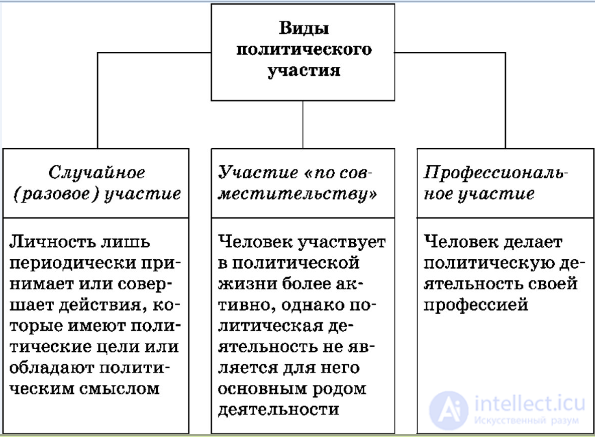
Fig. 1 Types of political participation
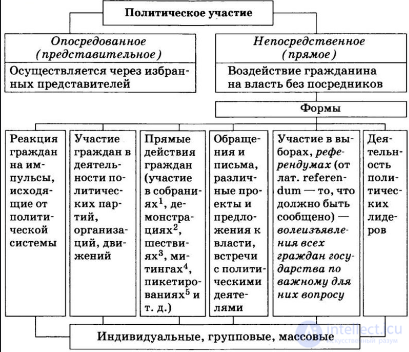
Fig. 2 Forms of political participation
Citizens' participation in politics is one of the central indicators of the qualitative features of political systems and the degree of their democratisation. In a democratic society this participation is mass, free and effective in resolving issues affecting the essential interests of citizens. In an authoritarian society, part of the population is wholly or partially excluded from participation in politics. A totalitarian society, on the contrary, strives to mobilise the maximum share of the population into ritual actions of support for the regime.
Political scientists classify political participation according to the following criteria:
Conventional participation is behaviour that uses lawful means, or means that correspond to generally accepted norms, of expressing interests and influencing the authorities. The main form of conventional behaviour is participation in elections. Participation in elections makes it possible to limit the manifestation of forms of mass activity that are dangerous for the political system, channelling them into an institutional (norm-regulated) course, whereby people dissatisfied with government policy express their protest by voting for change. Another part of the citizenry, through elections, demonstrates support for the government's course. Even from this example one can see that conventional participation is oriented toward achieving various tasks.
The American political scientists K. Janda, J. Berry and J. Goldman identified two types of actions:
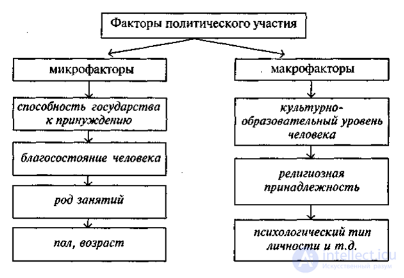
Fig. 3 Factors of political participation
This group brings together the following forms of participation:
Unconventional participation is behaviour that is unlawful or contrary to generally accepted political norms. It manifests itself in forms of protest, in disobedience to state authority. Citizens resort to such actions in cases where other channels for expressing their interests are absent, or traditional forms of participation prove ineffective, and people themselves experience distrust toward the political system.
Unconventional behaviour is divided into non-violent and violent types. The former include rallies and protest marches against certain actions of official authorities, pickets, sit-in strikes in public places and under the windows of government buildings, and blockades of transport routes. These actions may be carried out in violation of current legislation.
Not all protest actions achieve their result; moreover, they may escalate into forms of confrontation involving violence. Unconventional violent forms of participation cover a spectrum of actions ranging from mass riots and destruction of property to terrorism.
In a broad context, terrorism is understood as the political terror of a state against its own people or against political figures of other countries. The killing of political rivals. In a narrower sense, terrorism is regarded as the oppositional activity of extremist organisations or individuals whose goal is the systematic or single use of violence (or the threat thereof) to intimidate the population and threaten the government. A characteristic distinction between political terrorism and purely criminal offences is the carrying out of violent actions intended to cause shock in society, a broad negative resonance, and thereby to influence the adoption of political decisions and the entire political process.
The measures and methods of terrorism include: the assassination of political figures; hijackings; threats; blackmail; the organisation of explosions in public places; the seizure of buildings and organisations; the taking and holding of hostages; the provocation of armed clashes, the hijacking of aircraft and other means of transport. Members of terrorist groups typically try to justify their actions by some "lofty goals," by the impossibility of influencing the situation otherwise. However, the motivation behind terrorist activity is in fact broader - it includes material interest, social dissatisfaction, the psychopathology of the agents of terrorism, and, of course, ideological and political convictions.
Political participation is opposed by a type of political behaviour known as political alienation.
Political alienation is a process characterised by the perception of politics, the state, and power as external, alien forces that dominate over the individual and suppress them.
Alienation may be a consequence of the influence of the objective conditions of political life, the political system, and the political regime. It is connected with the structural relations of domination and subordination, appropriation and exploitation, power and control in society.
Political alienation is also conditioned by such causes as the loss of social ideals, disillusionment with any power structures, and psychological fatigue from the endless stream of political demagogy, ill-considered decisions and blatantly cynical lies.
Contemporary political apathy can also be viewed from the standpoint of a person's desire for self-insulation from politics. One of the factors behind such an attitude is the restrictions that authorities place on freedom of speech and the expression of personal views. There are other reasons as well. An individual may be influenced by the weak political activity of other members of society. They may belong to a group in which political apathy is a positive behavioural model.
Political behaviour is also significantly affected by the awareness of political efficacy. That is, this refers to an individual's personal sense connected with a real influence on the political process, on the basis of which a person asks themselves whether there is any point in performing their civic duties.
Manifestations of alienation include conformism (adaptive behaviour, passive unquestioning acceptance of the existing order), social apathy, absenteeism (the avoidance by voters of participation in voting in parliamentary, presidential and local government elections, etc.), lack of interest in political knowledge and events, and refusal to perform one's civic duty as a form of protest against politics, power, and its leaders.

Comments