
Lecture
Society's recognition of the legitimacy, the lawfulness, of official authority is expressed in political science by the concept of legitimacy. This concept points to the public recognition of power, to the fact that society, the people, extends trust and support to it - not to the legal, juridical formalization of political power in the relevant state documents. Obtaining legal, juridical validity for those who have seized power is not difficult. That is why the value of such formal recognition of power is not as great as recognition of political power by the people, that is, the legitimacy of political power. Accordingly, one should distinguish between the concepts of "legitimacy of power" (public recognition of its lawfulness) and "legality of power" (its legal, formal codification).
The formation of people's conviction in the legitimacy and effectiveness of the existing political power can be achieved in various ways. The German sociologist M. Weber identified three types of legitimate domination (see Figure 2).
The first type is traditional - the power of chiefs and monarchs. The legitimacy of their power was based on the right of succession to the throne, on the recognition of the divine character of the monarch's power. Power itself rests on the population's tradition of obedience. The traditional type of legitimacy has survived in countries with a monarchical form of government (Saudi Arabia, Jordan, Kuwait and others) and in primitive societies.
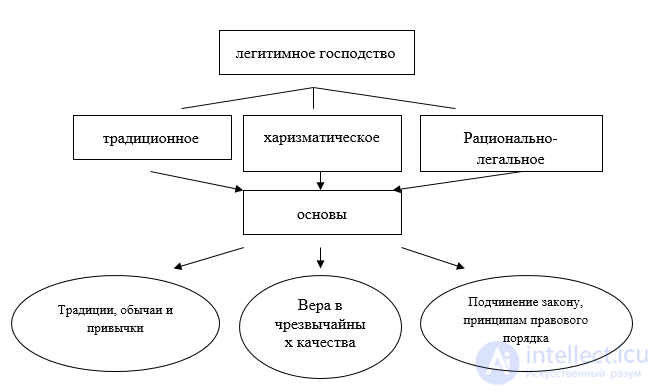
Figure 2 - Typology of legitimate domination according to M. Weber
The first type - traditional, is the power of chiefs and monarchs. The legitimacy of their power was based on the right of succession to the throne, on the recognition of the divine character of the monarch's power. Power itself rests on the population's tradition of obedience. The traditional type of legitimacy has survived in countries with a monarchical form of government (Saudi Arabia, Jordan, Kuwait and others) and in primitive societies.
The second type - charismatic. The term "charisma", translated from Greek, means "divine gift". Initially the content of the term had a religious character. Among the bearers of true charismatic authority, M. Weber included the prophet Moses, King David, Muhammad, and Buddha. In contemporary society, the presence of exceptional qualities in a given leader's personality is not directly linked to God. However, in social consciousness there exists a notion that this person is not like everyone else, that he has something unusual, extraordinary, supernatural about him, that he enjoys the patronage of certain higher forces. Among well-known historical figures, Napoleon, Lenin, Stalin, Hitler, Mao Zedong and others have been endowed with charismatic qualities. The charismatic type of power is characterized by the population's absolute trust in the leader by virtue of his outstanding qualities. Thus, legitimacy in the charismatic type of power rests on the population's belief in the leader's exceptional abilities. Naturally, the charismatic type of power arises in transitional and unstable societies. This type of power retains its significance in developing countries as well.
The third type - rational-legal. It is based on belief in the correctness of the formal rules by which power is formed: free elections, the rule of law, equal responsibility of authority and citizens before the law, etc. This type of legitimacy is characteristic of democratic countries.
In practice, however, these ideal types of Weber's are curiously intermixed. Thus, even in industrially developed and democratically stable countries, such as Great Britain, the legitimacy of power rests both on tradition (the institution of the monarchy) and on the recognition of the results of free elections.
The English researcher D. Held distinguishes the following types of legitimacy:
The legitimacy of power is not a permanent, fixed state, but a fairly fluid variable. At various stages of its existence, the legitimacy of power may rise or fall. Society experiences fluctuations in the legitimacy of power. These fluctuations are linked to the processes of legitimization and delegitimization of power. Legitimization is the process by which public recognition of the leaders and institutions of political power grows. Delegitimization is the process by which the authority of a leader and the institutions of political power declines.
The most important signs of a decline in the legitimacy of power are:
The last sign is the most significant indicator of the delegitimization of power.
The legitimacy of power can be challenged by its opponents either openly or covertly. The most extreme point of a decline in the legitimacy of power is revolution or a coup d'état.
On the whole, the legitimacy of power is in direct dependence on its effectiveness, that is, on the degree to which authority fulfils its tasks and functions. Ideally, this means the guaranteed implementation of the decrees of power with the lowest level of coercion and at minimal cost. A necessary condition for this is the sufficiency of the grounds of power and the effective use of its resources.
An important indicator of the effectiveness of power is the clear interaction of all its branches, and the rationality of its vertical and horizontal structures.
No less significant for citizens' attitude toward authority is the economic factor - ensuring the level and quality of life that is recognized as the norm in a given society.
On the whole, power is recognized as effective, and therefore as legitimate, if it succeeds in ensuring stability, certainty, and order. Power that is unable to prevent major political conflicts, civil and inter-ethnic wars, or confrontation between the legislative and executive branches, or between central, regional, and local bodies, loses its legitimacy.
Contemporary society has developed various means of legitimizing power: political, ideological, economic, etc. Political means include, above all, the search for support and the broadening of the social base of power. An important instrument of this form of legitimization is the democratization of public life and the expansion of citizens' participation in governance. This creates a sense of general involvement of people in the policy pursued by the authorities, and allows citizens to feel, to a certain extent, that they are its subject.
A sense of involvement in power can also be fostered by propaganda of the political course and ideological processing of the masses.
The most effective means of legitimizing power is the successful implementation of state policy and economic programmes, together with a steady rise in the population's income and in the standard of living as a whole.

Comments