
Lecture
Culture shock — emotional or physical discomfort, disorientation of an individual caused by finding oneself in a different cultural environment, encountering a different culture, an unfamiliar place .
The term «culture shock» was introduced into scholarly use in 1960 by the American researcher Kalervo Oberg (Eng. Kalervo Oberg). In his view, culture shock is «the result of anxiety that arises from losing all familiar signs and symbols of social interaction»; moreover, upon entering a new culture a person experiences quite unpleasant sensations .
The essence of culture shock is a conflict between old and new cultural norms and orientations - the old ones, inherent to the individual as a representative of the society they left, and the new ones, that is, those representing the society they have arrived in. Properly speaking, culture shock is a conflict of two cultures at the level of individual consciousness .
When scholars speak of culture shock as a phenomenon, they mean the experiences and sensations common to all people, which they undergo when their habitual living conditions change for new ones.
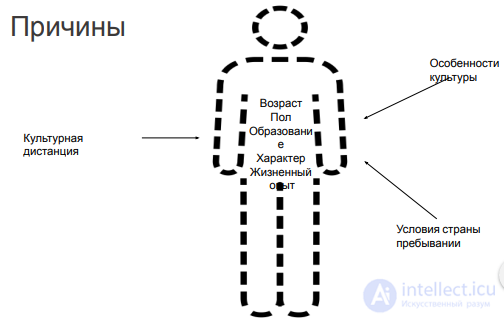
Fig. 1 Causes of culture shock
The essence of culture shock is a conflict between old and new cultural norms and orientations; the old ones, inherent to the individual as a representative of the society they left, and the new ones, which represent the society they have arrived in. Properly speaking, culture shock is a conflict of two cultures at the level of individual consciousness.
Culture shock is the feeling of discomfort and disorientation that arises upon encountering a new culture. Culture shock is a natural response to an entirely new setting. The degree to which culture shock affects a person varies. Rarely, but there are those who cannot live in a foreign country.
An important component of culture shock is linguistic shock. Linguistic shock can be defined as a state of surprise, laughter, or embarrassment that arises in someone who, while communicating with a native speaker of a foreign language, hears in that foreign language linguistic elements that sound strange, funny, or indecent in their native language.
Specialists studying the typical problems of foreign students are also familiar with a phenomenon known as reverse culture shock. This phenomenon is linked to the fact that a person needs to readapt to their home country, which has changed. The significance, depth, intensity, and often the painfulness of this phenomenon exceed the expectations of a person unfamiliar with it.
When returning home, we subconsciously expect to find everything at home just as it was, and to perceive the whole home environment through the same eyes. However, much has managed to change in the standard of living, the political climate, and relations between relatives and friends, and the person themselves has also managed to change during the time spent abroad, and many things are perceived in a new way.
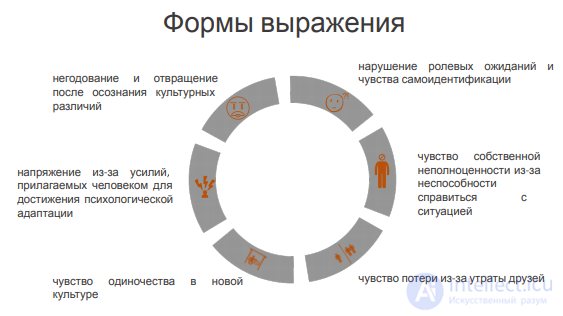
Fig. 2 Forms of expression
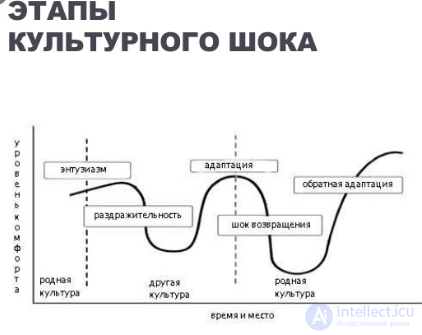
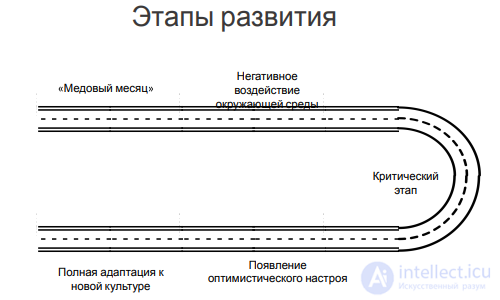
Fig. 3 a.b. Stages in the development of culture shock
The scholarly literature identifies five ways of resolving culture shock once it has already arisen.
The first method can conditionally be called ghettoization. It is realized in situations when a person arrives in another society but tries, or finds himself forced (through ignorance of the language, natural shyness, religion, or for some other reason), to avoid any contact with a foreign culture. In this case, he strives to create his own cultural environment - a milieu of fellow countrymen, by which he fences himself off from the influence of the foreign-cultural environment.
In practically any large Western city there exist more or less isolated and closed districts inhabited by representatives of other cultures. These are Chinese quarters or entire Chinatowns, these are the quarters or districts where immigrants from Muslim countries settle, Indian quarters, and so on.
The second method of resolving cultural conflict is assimilation, which in essence is the opposite of ghettoization. In the case of assimilation, the individual, on the contrary, fully renounces his own culture and strives to fully absorb the cultural baggage of the foreign culture necessary for life. Of course, this does not always succeed. The cause of the difficulties turns out to be either insufficient flexibility on the part of the personality of the one attempting to assimilate, or resistance from the cultural environment of which he intends to become a member. Naturally, for the children of such emigrants, who are included in the foreign-cultural environment from an early age, assimilation poses no problem.
The third way of resolving cultural conflict consists in cultural exchange and interaction. For the exchange to take place adequately, that is, to bring benefit and enrich both sides, goodwill and openness are needed on both sides, which in practice, unfortunately, is encountered very rarely, especially if the sides are unequal from the outset. However, there are examples of successful cultural interaction in history: these are the Huguenots, who fled to Germany from France from the horrors of St. Bartholomew's Night, settled there, and did much to bring French and German cultures closer together; these are the German philosophers and scholars who left Germany after the Nazis came to power and managed to make a significant contribution to the development of science and philosophy in English-speaking countries, substantially changing their intellectual climate and their influence on the development of social life in general.
The fourth way is partial assimilation, when an individual sacrifices his own culture in favour of the foreign-cultural environment only partially, that is, in just one particular sphere of life: for example, at work he is guided by the norms and requirements of the foreign-cultural environment, while in the family, leisure, and religious sphere he follows the norms of his own traditional culture.
The fifth way is colonization, the imposition of their culture by settlers on the indigenous inhabitants (as happened during the conquest of America).
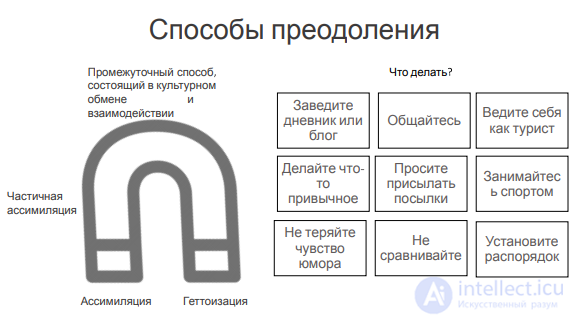
Fig. 4 Ways of overcoming culture shock
Thus, culture can be said to encompass the phenomena, properties, and elements of human life that qualitatively distinguish man from nature. Culture is studied by such disciplines as the philosophy of culture, cultural studies, ethnology, ethnography, cultural and social anthropology of culture, and the sociology of culture. The specificity of the sociology of culture lies in the fact that it examines the formation and functioning of culture in connection with other social institutions in a specific historical situation
Thus, culture can be defined as the phenomena, properties, and elements of human life that qualitatively distinguish humans from nature. Culture is studied by such sciences as the philosophy of culture, cultural studies, ethnology, ethnography, cultural and social anthropology of culture, and the sociology of culture. The specificity of the sociology of culture lies in the fact that it examines the formation and functioning of culture in connection with other social institutions, in relation to a specific historical situation. According to sociology, culture is a set of norms and values, as well as human activity aimed at creating, preserving, and transmitting them.
In society, culture performs a number of functions, the main ones being the functions of adaptation, socialization, integration, identification, social change, regulation, and communication. Any culture consists of signs, values, norms, techniques, and technologies. However, even within a single society, various types of culture can be distinguished. On the basis of its structure, material culture, spiritual culture, and artistic culture are distinguished. By the scale of its spread, culture is divided into dominant culture, subculture, and counterculture.
When a person finds themselves in another culture, they experience culture shock - discomfort and disorientation. After an extended period of living within a foreign culture, reverse culture shock may arise when the person returns to their own culture.

Comments