
Lecture
Deviant behaviour (also called social deviation, deviant conduct) (Lat. deviatio - deviation) is stable behaviour of an individual that departs from generally accepted, widespread and established social norms. Negative deviant behaviour leads society to apply certain formal and informal sanctions (isolation, treatment, correction or punishment of the violator) . Deviance as a social phenomenon, and society's reaction to it, is studied by sociology, while individual deviations are studied by psychology.
The problem of deviant behaviour has been at the centre of attention since the emergence of sociology. The French sociologist Émile Durkheim, who wrote the now-classic work "Suicide" (1897), is considered one of the founders of modern deviance studies. He introduced the concept of anomie - a state of confusion and disorientation in society during crises or radical social change. Durkheim illustrated this using the example of an increase in the number of suicides during unexpected economic downturns and upturns. Durkheim's follower, the American sociologist Robert King Merton, working within his theory of structural functionalism, created one of the first sociological classifications of human behavioural responses.
In most cases, members of society follow both officially established and de facto social norms, which to a considerable extent preserves it as a system. Depending on internal motives, two variants of normative behaviour can be distinguished:
Different scholarly disciplines give different definitions of deviant behaviour:
At the same time, society also sees rejection and non-observance of social norms. Such behaviour of individuals or social groups is defined as non-conformal, or non-normative. It may be positive in character, contributing to the establishment in society of more progressive norms of behaviour and activity (art, scientific-technical and social creativity), or it may have a pathological, negative, dysfunctional character that leads to the destruction of progressive tendencies. Such behaviour and activity of individuals and social groups is properly called deviant (that is, deviating) behaviour.
Deviant behaviour (French deviation, from Latin deviare - to stray from the path) is an act or activity of a subject that does not correspond to the officially established or actually prevailing norms, stereotypes and patterns in a given society.
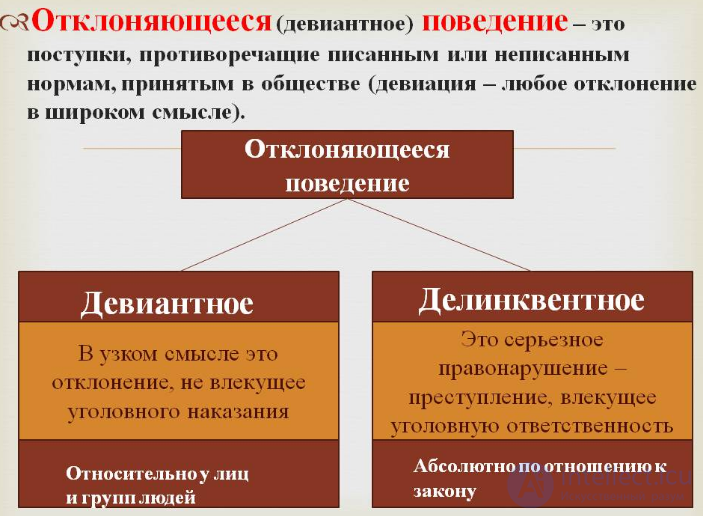
Fig. 1 deviant and delinquent behaviour
In a broad sense, the term "deviance" implies any deviation from the social norms accepted in society, ranging from the most insignificant, such as violation of the access regime in an institution, to the most serious, such as murder.
In a narrow sense, deviance denotes offences that are not approved of by public opinion but are not unlawful and do not fall under an article of the Criminal Code (for example, a wife earning a higher salary than those around her may seem an abnormal phenomenon, because from time immemorial a man has been considered the main source of family income). For more serious forms of violation, specialists use other terms, namely delinquency and criminality (criminal behaviour).
Delinquent behaviour is a set of acts that are not approved of by law but are not subject to punishment from the standpoint of the Criminal Code. Above all, these are administrative offences: petty hooliganism, minor theft of goods from a shop by a customer, jaywalking or smoking in an unauthorised place, etc.
Criminal behaviour is criminal conduct in the legal sense. For example, a fight involving grievous bodily harm, murder, etc.
A characteristic feature of deviant behaviour is cultural relativism. This means that a social norm, whether adopted by society or by legislation, is a purely relative phenomenon. The very same act may be considered normal in one society while being regarded as social pathology in another. For example, in early times cannibalism, the killing of the elderly and children, and incest were considered normal phenomena, caused by economic reasons (food shortages) or by social arrangements (permission of marriage between relatives), but in modern society this is considered deviant, and in some cases even criminal, behaviour.
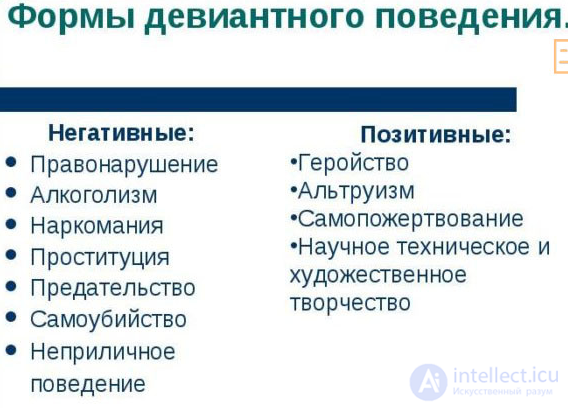
Fig. 2 forms of deviant behaviour
Main types of deviation (in the broad sense of the word).
1. By characteristics of the subject: individual and group deviation.
An adolescent who grew up in an intelligent family but becomes a drug addict thereby demonstrates individual deviation. Children who grew up in families of alcoholics and who subsequently become part of a group of homeless people, where substance abuse is an everyday occurrence, demonstrate group deviation. The use of toxic substances within this group of children is not a protest against subcultural norms, but a mechanism for finding status within the group. Thus, there are two pure types of deviants: 1) individual deviants reject the norms that surround them, 2) group deviants are conformists within the framework of deviant groups.
2. By the seriousness of the norms violated: primary and secondary deviance.
Primary deviance is when a person's behaviour on the whole conforms to the norms accepted in society, so minor deviations go unnoticed and the person is perceived as merely somewhat eccentric. Secondary deviance is when more important norms are violated, behaviour does not correspond to the role being performed, or when a person is labelled a "deviant" following public identification. Often a single deviant act (a homosexual act, drug use, theft, etc.) or even the suspicion of committing such an act is enough for a person to be given the "label" of a deviant. This process is called "stigmatisation".
3. In relation to society's interests: positive and negative deviance.
Positive deviance is a deviation from norms that is encouraged in a given society. A genius, a talented or gifted person, a hero, a spiritual leader - these are positive deviants. Although positive deviance occurs in every society, sociologists pay the most attention to negative deviance. Negative deviance is
behaviour that is condemned by society and entails punishment (crime, suicide, drug addiction, alcoholism, prostitution, fraud, corruption, prostitution, tax evasion, human trafficking, terrorism, etc.).
4. By type of norms violated: legal (offence or crime), moral (immoral act), etiquette (ill-mannered behaviour), religious (sinful act), aesthetic (ugly).
5. By purpose: acquisitive, aggressive, retreatist.
Acquisitive acts are committed for the purpose of personal or group enrichment, aggressive ones stem from a feeling of overwhelming hostility or hatred toward representatives of some group (ethnic, racial, gender, etc.), retreatist acts are committed with the aim of restoring a previously existing state of affairs or relationships (for instance, children run away from home hoping to prevent their parents' divorce).
By level of organisation: organised and unorganised.
By orientation: introversive and extroversive.
Introversive deviant acts are directed at the very subject who commits them - suicide, drunkenness, drug addiction. Extroversive deviant acts are directed against the interests of society and other people (murder, rape, theft).
Ukrainian sociologists Ye. Holovakha and N. Panina developed their own typology of social deviations in society, which includes: 1) psychopathology; 2) deviant behaviour; 3) sociopathy. This classification narrows the meaning of the term "deviant behaviour" to individual and conscious violations of established rules.
Psychopathology is a disruption of the psychological mechanisms of adaptation to social norms. Its bearers are severely ill people with mental and neurotic disorders who are unable to internalise norms or who react inadequately to their content. Psychopathologies can be both individual and mass. Examples of mass forms of psychopathology are panic, hysteria, and aggression, which often arise in a crowd during catastrophes and war, when physically healthy people lose their common sense and "forget" about norms.
Sociopathies arise under conditions of anomie, that is, value-normative chaos, when the absence of norms and social deviations themselves become the rule of existence. Sociopathy is a state of mass disorganisation. Physically healthy people lose their usual points of reference and cease to clearly perceive what is good and what is bad.

Comments