
Lecture
A processor, in computing, is an electronic component (digital circuit) that performs operations on an external data source, usually memory or some other data stream. The term is often used to refer to the central processing unit (CPU), the main processor in a system. However, it can also refer to other coprocessors, such as a graphics processing unit (GPU).
It now usually takes the form factor of a microprocessor, implemented on a single (or several closely integrated) chip (integrated circuit). In the past, processors were built using numerous separate vacuum tubes, numerous discrete transistors, or numerous small-scale-integration integrated circuits.
Types:
Quantum processors have also been created (see quantum processor, quantum computer); they use quantum superposition to represent bits (called qubits), rather than only binary on/off states.
Central processing units (CPUs) are the main processors in most computers. They are designed to handle a wide range of general-purpose computing tasks, rather than just a few domain-specific ones. If based on the von Neumann architecture, they contain at least a control unit (CU), an arithmetic logic unit (ALU) and processor registers. In practice, CPUs in personal computers are also usually connected, via the motherboard, to the main memory bank, a hard disk or other persistent storage, as well as to peripheral devices such as a keyboard and mouse.
Graphics processing units (GPUs) are present in many computers and are designed to efficiently perform operations on computer graphics, including linear algebra. They are highly parallel, whereas central processing units are generally better at tasks that require sequential processing. Although GPUs were originally intended for use in graphics, their range of application has since expanded, and they have become an important part of machine-learning hardware. [ 18 ]
Several kinds of processors are specialized for machine learning. They fall into the category of AI accelerators (also known as neural processing units, or NPUs) and include vision processing units (VPUs) and Google's tensor processing unit (TPU).
Sound chips and sound cards are used to generate and process audio. Digital signal processors (DSPs) are designed for processing digital signals. Image signal processors are DSPs that specialize specifically in image processing.
Deep-learning processors, such as neural processing units, are designed for efficient deep-learning computations.
Physics processing units (PPUs) are built to efficiently perform physics-related computations, especially in video games. [ 19 ]
Field-programmable gate arrays (FPGAs) are specialized circuits that can be reconfigured for various purposes, rather than being limited to a specific field of application at the time of manufacture.
The synergistic processing element or unit (SPE or SPU) is a component of the Cell microprocessor.
Processors based on various circuit technologies have been developed. One example is quantum processors, which use quantum physics to implement algorithms that are impossible on classical computers (using conventional circuitry). Another example is photonic processors, which use light to perform computations instead of semiconductor electronics. [ 20 ] Processing is carried out by photodetectors, which sense the light produced by lasers inside the processor.
The term processor is also used for a document-transformation language (see XSLT, Category:XSLT processors, Category:XQuery processors)
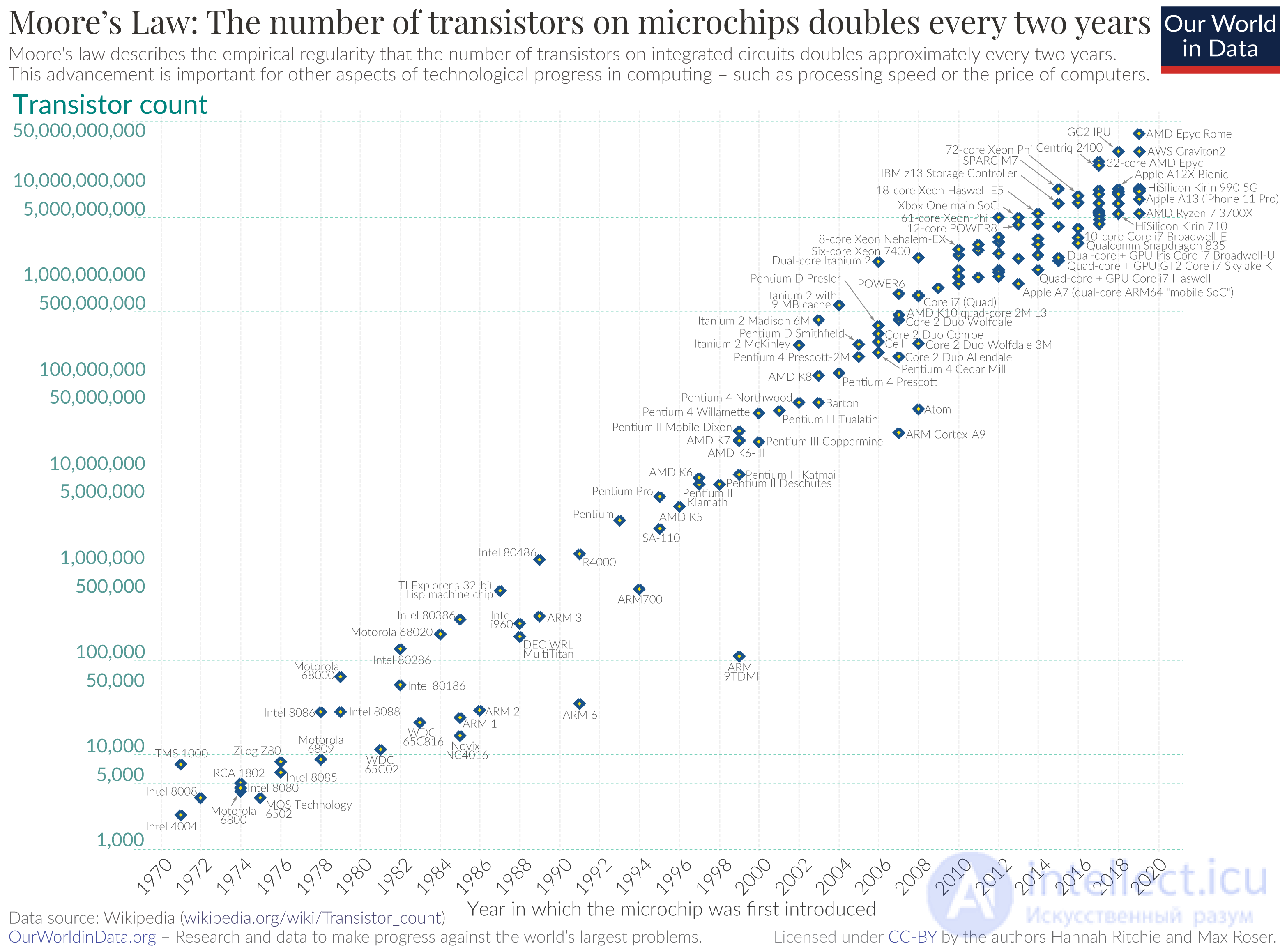
Transistor count over time, illustrating Moore's Law
Moore's law, named after Gordon Moore, is an observation and forecast based on a historical trend that the number of transistors in an integrated circuit, and hence in processors, doubles roughly every two years. The development of processors is closely tied to Moore's law.
How it works:
The CPU is a general-purpose processor capable of performing a wide range of computing tasks. It consists of several cores that process instructions sequentially or in parallel. Its architecture is optimized for executing sequential operations with a high degree of data-flow control.
Key features:
How it works:
The GPU is optimized for the parallel processing of large numbers of similar computations. It has thousands of cores that process data simultaneously, which makes it ideal for graphics rendering and computations that require parallelism.
Key features:
How it works:
The TPU is designed specifically to accelerate tensor operations, which are widely used in machine learning and deep neural networks. Its architecture is oriented toward performing matrix operations with high throughput.
Key features:
How it works:
The DPU is optimized for handling data streams, networking operations and data-storage tasks. It combines network-operation acceleration, server management and data-processing optimization.
Key features:
How it works:
The QPU operates on the principles of quantum mechanics, such as superposition and entanglement. Unlike classical processors, it processes information in quantum bits (qubits), which allows certain types of computation to be performed much faster.
Key features:
Each of these processors, in its own field, plays a key role in modern computing, providing high performance and efficiency for various applications.
The way a processor works consists of executing a sequence of instructions that specify how to process data. The processor, or central processing unit (CPU), is the computer's "brain," controlling the execution of programs. Its operation is based on the von Neumann architecture, which involves separating the functions of data storage and data processing.
Fetch: The processor retrieves an instruction from memory. To do this, it uses the program counter (PC), which points to the address of the current instruction. This instruction is loaded into the instruction register (IR).
Decode: The loaded instruction is analyzed. A special processor block, the instruction decoder, determines which operation needs to be performed (for example, addition, multiplication, writing data to memory). The decoder also determines which data or memory addresses will be involved in the operation.
Execute: After decoding, the processor executes the instruction. This uses:
Writeback: The resulting value is written either to a register or to random-access memory (RAM). This completes execution of the current instruction, after which the processor moves on to the next one.
Updating the program counter: The program counter is incremented to point to the next instruction, or is changed depending on the result of execution (for example, on a conditional branch).
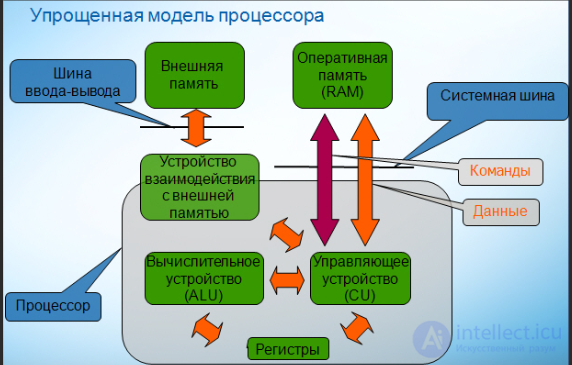
Arithmetic logic unit (ALU):
Register:
Controller:
Cache memory:
System bus:
Summary:
The way a processor works is based on the cyclical execution of instructions (fetch, decode, execute, writeback), which enables all programs on a computer to run. Modern processors aim to increase performance through parallel processing and high-speed data access.

Comments