
Lecture
A chemical computer , also called a reaction–diffusion computer , a Belousov–Zhabotinsky ( BZ ) computer , or a gooware computer , — is an unconventional computer based on a semi-solid chemical “soup” in which data are represented by the varying concentrations of chemical substances. The computation is carried out by natural chemical reactions .
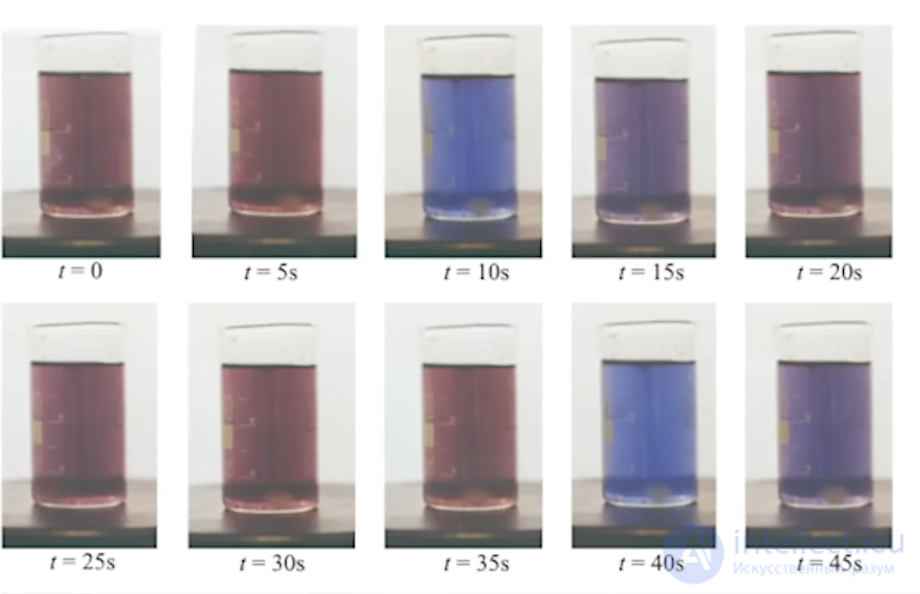
Color change (self-oscillation) of the reaction mixture in the Belousov–Zhabotinsky reaction with ferroin
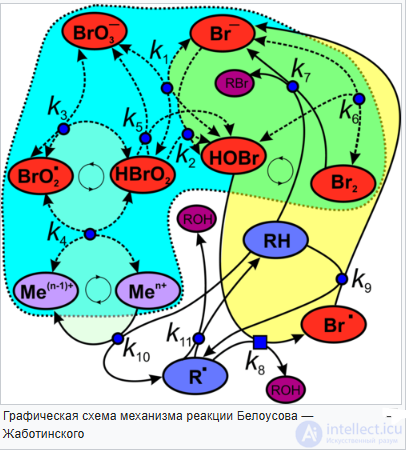
The Belousov–Zhabotinsky reaction is a class of chemical reactions that proceed in an oscillating regime, in which certain parameters of the reaction (color, component concentrations, temperature, etc.) change periodically, forming a complex spatiotemporal structure in the reaction medium.
The name is now used for an entire class of related chemical systems that are similar in mechanism but differ in the catalysts used (Ce3+, Mn2+, and complexes of Fe2+, Ru2+), the organic reductants (malonic acid, bromomalonic acid, citric acid, malic acid, etc.), and the oxidants (bromates, iodates, etc.).
Under certain conditions these systems can display very complex behavior, ranging from regular periodic to chaotic oscillations, and are an important object of study for the universal laws of nonlinear systems. In particular, it was in the Belousov–Zhabotinsky reaction that the first experimental strange attractor in chemical systems was observed, and its theoretically predicted properties were experimentally verified.
Chemical reactions were originally regarded as simply moving toward a stable equilibrium, which did not seem well suited to computation. This changed with a discovery by the Soviet scientist Boris Belousov in the 1950s. He created a chemical reaction between various salts and acids that oscillated between yellow and clear, as the concentrations of the various components cyclically rose and fell. At the time this was considered impossible, since it appeared to contradict the second law of thermodynamics , which states that in a closed system entropy only increases over time, forcing the components in a mixture to disperse until equilibrium is reached and ruling out any change in concentration. But modern theoretical analyses show that sufficiently complex reactions can indeed involve wave phenomena without violating the laws of nature. (A convincing, directly visible demonstration was achieved by Anatol Zhabotinsky using the Belousov–Zhabotinsky reaction , which showed spiral colored waves.)
The wave properties of the Belousov–Zhabotinsky reaction mean that it can carry information in the same way as any other wave. This, however, still leaves the need for the kind of computation performed by ordinary microchips, which transmit and change ones and zeros in binary code through a complex system of logic gates . To perform any conceivable computation it is enough to have NAND gates (a NAND gate has two input bits. Its output is 0 if both bits are 1, and 1 otherwise). In the chemical version of the computer, logic gates are implemented using concentration waves that block or reinforce one another in various ways.
In 1989 it was demonstrated how light-sensitive chemical reactions could perform image processing . This led to a surge of interest in chemical computing. Andrew Adamatzky of the University of the West of England demonstrated simple logic gates using reaction–diffusion processes. He also showed theoretically how a hypothetical “medium 2 + ”, modeled as a cellular automaton, could perform computation. Adamatzky was inspired by a theoretical paper on computing with balls on a billiard table, and applied this principle to BZ chemicals, replacing the billiard balls with waves: if two waves meet in the solution, they create a third wave, which is registered as a 1.
One problem with the current version of this technology is the speed at which the waves propagate; they travel at only a few millimeters per minute. According to Adamatzky, this problem could be solved by placing the gates very close together to allow rapid signal transmission. Another possibility would be new chemical reactions in which the waves propagate much faster.
In 2014, an international team led by the Swiss Federal Laboratories for Materials Science and Technology (EMPA) developed a chemical computing system. The chemical computer used surface-tension calculations derived from the Marangoni effect, with an acid gel, to find the most efficient route between points A and B, outperforming a conventional satellite navigation system that was trying to calculate the same route.
In 2015, graduate students at Stanford University built a computer using magnetic fields and droplets of water containing magnetic nanoparticles , which illustrated some of the basic operating principles of a chemical computer.
In 2015, students at the University of Washington created a programming language for chemical reactions (originally developed for DNA analysis ).
In 2017, researchers at Harvard University patented a chemical Turing machine that runs on the nonlinear dynamics of the Belousov–Zhabotinsky reaction . [ 12 ] The system they developed is able to recognize Chomsky type-1 languages using Gibbs free-energy considerations . This work was later published in 2019, adding systems for Chomsky type-2 and type-3 languages.
In 2020, researchers at the University of Glasgow built a chemical computer using 3D-printed parts and magnetic stirrers to control the oscillations of a Belousov–Zhabotinsky medium. With it, they were able to compute binary logic gates and perform pattern recognition.

Comments