
Lecture
In the economic system of society,
constantly renewed processes of production, dis-
tribution, exchange and consumption of material and spiritual goods
are continuously carried out.
Production is the process of interaction between people and nature aimed at creating
material goods and services necessary for
human existence and the development of society. Production has two interconnected aspects – the interaction of hu-
mans with nature (the material content of the labor process) and the relationships between people in the process of production (the social form of labor).
Production is impossible without the labor process of a person possessing the capacity to work. Labor is the conscious, purposeful activity of peo-
ple aimed at transforming objects of nature to satisfy their needs.
Human labor activity presupposes the existence, on the one hand,
of that to which labor is directed (objects of labor), and on the other hand, of that by means of which we carry out the labor process (means of labor). Objects of labor
and means of labor together constitute the means of production. The substance of nature upon
which a person acts in the course of labor is the object of labor.
That by means of which a person
acts upon the object of labor
is called the means of labor. In
a narrow sense, the means of labor include instruments of labor, whose mechan-
ical, physical and chemical
properties people use
in accordance with their purpose –
machine tools, equipment, instruments
and so on. In a broad sense, the means of labor include all materi-
al conditions of labor without which
it cannot be carried out (conditions
of labor). For example, to produce clothing, in addition to objects
of labor (fabric, trimmings, etc.), instruments of labor are required – a sewing machine,
needles, scissors and the like. But in fact all of this is not enough – it is impossible to organize
clothing production without land, buildings in which
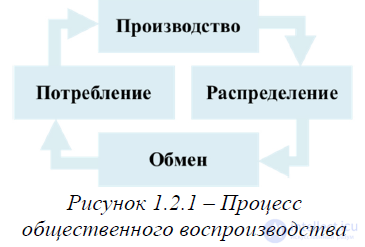
Figure 1.2.1 – The Process of Social Reproduction
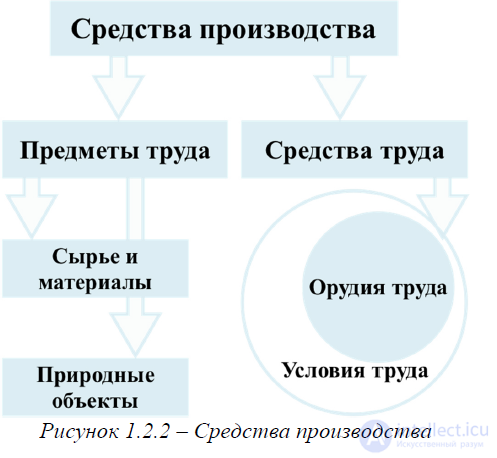
Figure 1.2.2 – Means of Production
production is located, transport, energy and other infrastructure, and so on. All of this pertains to conditions of labor, and hence to means of production. The result of the labor process is the products of labor.
In addition to relations of production, the economic system of society also contains relations of distribution. The mechanism of distribution depends on
which socio-economic interests predominate in society.
Another subsystem within the economic system of society is exchange relations. Exchange may be planned or spontaneous in character. It
may be carried out either in the form of direct distribution of products or through the commodity form. A commodity is a product of labor intended for exchange
through purchase and sale. If a product is created as a commodity, it is distributed
or redistributed in one form or another of commodity exchange.
The ultimate goal of production, distribution and exchange is the consumption of goods. Political economy views consumption as a link
in the process of social reproduction. Consumption may take the form of:
– part of the production process:
a) consumption of means of production (for example, the wear of machine tools in the course
of their operation);
b) consumption of objects of labor (for example, the use of fabric for sewing fashionable clothing);
– an element in the reproduction of the labor force (final consumption of goods
by people).
A commodity is a product of labor intended for exchange through purchase
and sale. However, over a long historical period, the bulk of material goods was produced by people for the purpose of direct
personal consumption. However, as society developed, the production and consumption of goods became increasingly diverse. Products were increasingly produced not for one's own consumption, but for exchange with other products. This form of exchange under conditions of a natural (subsistence) economy is called
barter and is the first precondition for the emergence of commodity-money relations. Exchange is a form of economic ties between producers.
For the emergence and development of commodity-money relations, what matters is not the mere fact
of the emergence of exchange itself, but the point at which it acquires a stable, systematic character.
The second precondition for the emergence of commodity-money relations, which also
contributed to the emergence of systematic product exchange,
was the social division of labor and the specialization of social production it caused. The social division of labor and the resulting
specialization is a historically established system of differentiation of labor activity, involving the separation and performance of its various
kinds.
The social division of labor and specialization led to increased
labor productivity. As a result, economies producing a particular
type of output could not fully consume it themselves and were forced to offer it for exchange.
The third precondition for the emergence of commodity-money relations was the gradual economic separation of producers. Economic separation
of producers implies the ability to independently choose what and
how to produce, as well as to dispose of the produced output relatively freely. The economic separation of producers arises simultaneously with
private property, which gives the owner the ability to choose what,
how and in what volume to produce. In addition, the owner determines the form of organization of production and labor, the forms and amount of remuneration, the structure of management
of the process of producing, exchanging and distributing goods and services.
A commodity is a product of labor produced for exchange through purchase and sale.
For a product to acquire the property of a commodity, it must be produced not for
personal consumption, but to satisfy the needs of other people, and its delivery to the consumer must be mediated by exchange.
Commodity production is a form of social economy in which products are produced not for one's own consumption, but to satisfy the needs of other people and reach them through purchase and sale on the market.
A commodity created in social market production possesses two
properties – use value and exchange value.
When a product is transformed into a commodity, its natural properties take on the form of use value. The use value of a commodity, its
usefulness, is the capacity of a good to satisfy some particular social
need. The presence of use value in a commodity is a necessary
condition for its production and sale.
However, the presence of use value in a product does not by itself make it a
commodity. Upon entering the market, a product must be exchanged for another commodity or
realized for money. The fact that commodities are capable of being exchanged indicates
that they contain something in common that makes them commensurable. This common element is the exchange value of a commodity – the ability of a commodity to be exchanged
for other commodities in a certain proportion or ratio.
The use value of a commodity depends on its useful properties, which allow it to satisfy people's needs. The labor theory of
value is based on the premise that the overwhelming majority of commodities have something
in common – they are all products of labor. At the same time, in the process of exchange
producers seek to economically recoup their costs of producing commodities. Thus, the basis for establishing the proportions of commodity exchange is the amount of social
labor expended on their production. For all the diversity of the use values of commodities, they are qualitatively homogeneous as embodiments of social labor. Of course, besides
labor, other resources are also used in the production of commodities – raw materials, supplies, instruments of labor. However, all of these are likewise products of labor (they
are called embodied or past labor).
Under commodity production, the exchange value of a commodity is determined not by
the labor actually expended (the amount of working time, as shown in the
example, can differ drastically), but by the socially necessary amount of labor.
The socially necessary amount of labor is the average, under given conditions (historical, technical-technological, socio-economic, etc.), working time spent on producing the sold goods of a given kind, corresponding to the needs of buyers. It is precisely this amount of labor, which determines the exchange value of a commodity, that constitutes the essence of the value of a commodity.
Value is the amount of socially necessary labor expended on producing a commodity.
The unity of use value and value determines the dual nature of the commodity.
The distinction between the two sides of a commodity (use value and value)
determines the distinction between the properties of the labor required to produce it. A distinction is drawn between concrete and abstract labor. Concrete labor is labor that
creates the use value of a commodity, i.e., that gives the product certain,
specific properties so that it is useful – capable of satisfying a need (for example, the labor of an engineer, a designer, a seamstress, etc.). Abstract
labor is labor whose magnitude sets the proportion of exchange, i.e., the exchange value of a commodity. This is socially necessary labor expenditure, not tied to
any particular concrete form of it. As a result, labor also has a dual nature, combining the unity of concrete and abstract labor.
In the system of commodity-money relations, a commodity has a price. Price is the monetary expression of the value of a commodity. It is therefore necessary to examine the
essence of money.
Money is a special commodity that plays the role of a universal equivalent.
Unlike other commodities, money possesses the capacity for universal exchangeability.
The essence of money is most clearly and comprehensively revealed in its functions:
1) Measure of value. The essence of this function is that the value
of all commodities in circulation is expressed uniformly in money.
Money acts as an intermediary in exchanging one commodity for other commodities. With the emergence of money, direct commodity exchange (C–C) is transformed into commodity-money exchange (C–M–C), where each commodity possesses its own use value, while money serves as the means of relating them to one another.
2) Means of payment. The social division of labor and the development of commodity circulation lead to a situation in which the realization of commodities over time ceases to
coincide with payment for their value. The seller (producer) cannot wait for payment for their goods, and continues to manufacture new batches of goods. The seller acts as creditor, and the buyer as debtor. Credit relations arise, and with them the function of money as a means of payment.
3) Medium of circulation. Unlike other commodities, which, once sold, leave the market and are consumed, money continues to be present
on the market and to perform its functions. With the emergence of the function of medium of circulation
the possibility arose of replacing real money – gold and silver – with paper
(or leather) money. The amount of money needed for the circulation of commodities does not
remain constant – the need for it either rises or falls.
4) Store of value (treasure). Money can leave circulation
and be transformed into savings. The accumulation of wealth takes the form of the accumulation of money. Besides accumulation as a way of preserving money, the function of money as a
store of value plays an important role in ensuring the stability of commodity-money circulation.
5) World money. With the inclusion of national economies in the international division of labor, money began to play the function of world money. Money
unites all commodity markets into an international market.
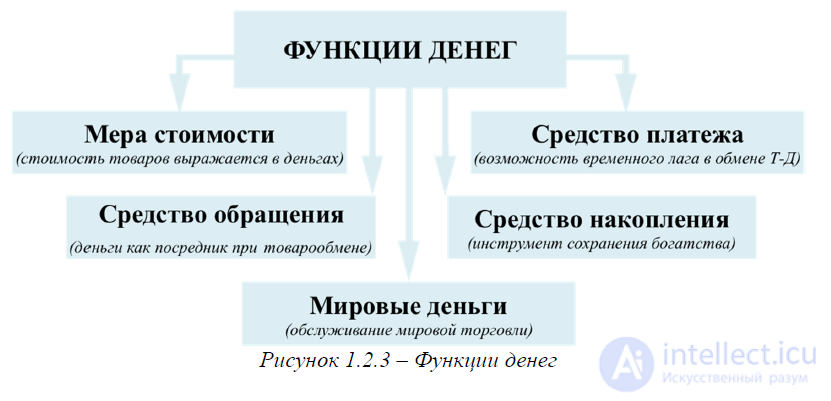
Figure 1.2.3 – Functions of Money
One of the most important concepts of political economy is capital. In the political-economic understanding, capital is self-expanding value.
Unlike money, capital tends toward constant growth. The owner of capital, among other resources, acquires labor power – a person's capacity for labor.
The owner of capital hires people (acquires labor power) and pays
for the labor received an amount equal to the necessary product created through
the use of that labor power. The necessary product is the product that ensures the reproduction of the labor force – that is, it compensates the worker's labor
expenditure and ensures the reproduction of workers (the physical
replacement of a worker once they pass working age). However, in addition to producing the necessary product, a worker can labor (and does labor) far more, creating a surplus product and thereby surplus value. The surplus product is the product produced beyond the production of the necessary product. Surplus value is the part of the value of commodities that a hired worker creates due to being compelled to labor
beyond the necessary working time.
In the labor market, what is bought and sold is not labor itself, but labor power, i.e.,
a person's specific capacities for labor, expended by a hired worker in the process of production over a given period of time. The price
in the labor market is none other than the wage.
Wages are the monetary expression of the value of a hired worker's labor power.
The value of labor power is determined by the value of the means of subsistence
necessary for the normal reproduction of the worker and their family. As we
have already established, during working time a hired worker creates both the necessary product and the surplus product. The creation of the necessary product is compensated to the hired worker, taking the form of wages. The surplus product, meanwhile, is appropriated by the owner of capital and serves as a source of profit for them. It is important to understand that profit and surplus product are
not the same thing, since part of the surplus value is redistributed and
in the process transformed into expenses of the capitalist (for example, interest on loans, rent, taxes, fines, wage bonuses, etc.).
Profit is the income of the owner of capital, the basis of which is the surplus
value created by the labor of hired workers.
The capitalist entrepreneur obtains profit as a result of selling the
produced commodity on the market at a certain price. The price of a commodity has a dual nature – on the one hand, the price of a commodity is the monetary expression
of value (as the amount of socially necessary labor expenditure), while on the other
hand, the price of a commodity depends on the scarcity of that commodity.
Price is determined by two factors – the value and the scarcity of the commodity.
The price of a commodity embodies the contribution of such factors of production as, firstly, capital (including embodied labor – raw materials and supplies fully consumed in the production process, as well as means of production consumed partially and recouped through depreciation) – the contribution of the capitalist entrepreneur, and secondly, labor power – the contribution of the hired worker.
The owner of capital perceives surplus value as the result of
all the production costs they have incurred. From this point of view, the surplus value
created by the hired worker is merely a product of capital as a whole – that is, profit. Accordingly, other things being equal, the
higher a worker's wage (compensation for the necessary product created), the lower the capitalist's profit.
As a result, a contradiction arises between the owner of capital
and the hired worker: the hired worker seeks to maximize wages, while the owner of capital seeks to maximize profit. Other things being equal, a change (a decrease or increase) in wages affects
only the rate of profit of the owner of capital, but does not affect the price of the produced commodity. When wages rise, the rate of profit falls; when
wages fall, the rate of profit rises. The distribution of income received between hired workers (in the form of wages) and owners of capital (in the form of profit) takes shape under the influence of the dynamics
of inter-class struggle and depends on the alignment of political-economic forces
within a historically specific economic system.
The transition from the feudal to the capitalist system of production was historically preceded by the process of primitive accumulation of capital, which
took place in Western Europe from the end of the 15th century to the 18th century, and in other countries – up to
the end of the 19th century. Primitive accumulation of capital is the process of formation of capitalist production relations, involving
the transformation of social wealth into capital, i.e., into self-expanding value.
At the basis of the process of primitive accumulation of capital lay the separation of direct producers from the means of produc-
tion belonging to them and the transition to the era of wage labor.
The deepening of the division of labor and the intensification of specialization led to the emergence of the manufactory type of production beginning in the 14th century. Manufactory pro-
duction was based on the manual labor of hired workers, among whom a division of labor into separate production operations took shape.
The cause of the emergence of manufactories was the expansion of markets for mass
commodity production.
The rapid growth of manufactory production contributed to
the formation of a mass need for hired labor. To ensure hired labor for manufactory production, it was necessary to organize the existence of a large mass of propertyless, but at the same time legally free, people. A widespread mechanism of forcible expropriation (deprivation, alienation) of means of production from the mass of small producers (peasants and artisans) was the already familiar process of enclosure, which took place
in Western Europe in the 15th–19th centuries. Because people were deprived of their means of production and subsistence, they were forced to work for the benefit of the owner
of the means of production essentially on any terms dictated to them. As a
result, in the countries of Western Europe enormous armies of hired
workers were created, who had to adapt to harsh working conditions and meager wages in order to ensure the physical survival of themselves and their
families. In this way, a once-free and economically independent rural population was transformed into declassed groups,
and then into hired workers.
The process of primitive accumulation of capital could not have been carried out
without the accumulation and concentration of wealth (land, money, means of production,
etc.) for the creation of capitalist enterprises. This process took place in
two directions – internal and external. Within the state, in the process of enclosure, there occurred the appropriation of peasants' personal plots and artisans' property,
the redivision of communal peasant property, the plundering
of church estates, and the fraudulent alienation of state lands. The external direction of the accumulation of wealth was linked to the plundering of the property
of other countries and territories as a result of the slave trade and colonial pillage.
Other conditions contributing to the primitive accumulation of capital were the specific system of state loans and the tax system, which contributed to the enrichment of representatives of large capital, as
well as the pursuit of protectionist policy. It should be said that not in all
countries was primitive accumulation of capital carried out by such cruel,
violent methods as in England. It is precisely the cruelty in the transformation of
property relations both within one's own country and in colonies around the world,
based on plunder and violence, that underlies the rapid processes of primitive accumulation of capital and the transition to the capitalist mode of produc-
tion, accompanied by the subsequent industrial revolution. As a result, a world industrial monopoly of England was formed, which by the
end of the 19th century was shared with other Western European countries and the USA.
Market mechanisms – above all, competition – led to the ruin of small producers both in the metropolitan centers and in the colonies. Small
enterprises simply could not compete with large-scale mass mechanized
production, and were therefore doomed. But whereas in Europe small business was replaced by national industrial capital, and ruined producers had a chance of becoming hired workers, in the colonial countries, which served as agrarian-raw-material appendages of the colonies, the ruin of local producers as a result of the flood of industrially manufactured goods from Europe
often led to the starvation deaths of millions of people and the complete
collapse of local production. All this became the cause of a significant economic gap between the European countries and the rest of the world,
which has not been overcome to this day.
Capital exists in various forms – monetary, financial, productive, commodity. The circuit of capital is a single completed act of
the reproduction of capital, encompassing the sphere of production and the sphere of circulation. Capital is not reproduced by itself, but through the change of its forms. The monetary form of capital is transformed into productive capital as a result of
investment in means of production and the hiring of labor power. Productive capital is transformed into commodity form as a result of the production
of a product for exchange – a commodity. It is precisely at this stage that surplus value is created. Commodity capital returns to its monetary form
as a result of the purchase and sale of the produced product on the market, and then a new circuit begins.
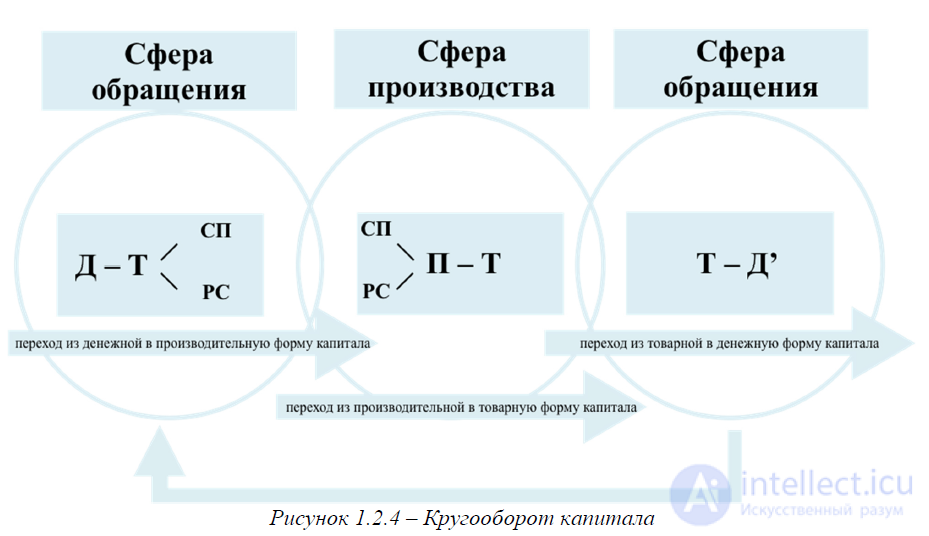
Figure 1.2.4 – The Circuit of Capital
The circuit of capital is possible only under the condition of the continuous recreation of the material conditions for the production of new value, as well as the free
transformation of forms from one into another. Since monetary, productive and commodity capital perform different functions in the movement of industrial capital, they may become separated into independent types of capital.
Monetary capital became separated into loan capital, and commodity capital into merchant (trading) capital.
Continuously connected processes of the circuit of capital form the process of the turnover of capital. The time during which advanced capital passes
through the stages of production and circulation and returns to its monetary form is called
the turnover time of capital, which consists of production time (the working
period, interruptions in the labor process, the time capital spends in production inventories) and circulation time (the time needed to purchase means of production and
labor power, the time needed to sell the commodity). All entrepreneurs are interested in
reducing the turnover time of capital, which allows them to maximize their profit.
Advanced capital is monetary funds or property assets
invested at the start of an activity for the purpose of obtaining profit.
From the point of view of participation in the circulation process, capital is divided into fixed and circulating. Fixed capital is capital that during a single
circuit is consumed only partially. Its complete renewal
(expressed in the recoupment of capital) occurs only after many cycles
of the circuit. Accordingly, fixed capital transfers its value to the
finished product in parts. The process of transferring the value of fixed capital in parts, as it undergoes physical or moral wear, onto the cost of the output produced is called
depreciation. Fixed capital includes buildings, structures, machinery, equipment.
Circulating capital is a type of capital that is consumed (and renewed) entirely within the course of a single circuit of capital. To renew circulating capital, consumed within a single circuit of capital, it is necessary to transfer its value to the finished product in full.
Circulating capital includes raw materials, supplies, and the value of labor power.
The circuit of capital is associated with the emergence of costs not only in
the sphere of production, but also in the sphere of circulation. These costs are borne by the enterprise
outside the process of direct production. Costs in the sphere of circulation of capital are divided into pure and additional. Pure costs of circulation are costs of circulation not associated with the creation of new value.
For example, when carrying out an economic transaction, an enterprise bears time costs associated with searching for a counterparty and concluding the deal, costs associated with checking the counterparty's reliability, and so on. These costs are not associated
with the creation of new value, since they do not give the commodity any additional useful properties. Modern neo-institutional theory
calls such costs transaction costs.
Unlike pure costs of circulation, which do not give the commodity new properties, there are costs of the circulation of a commodity that change its useful properties. These are additional costs of circulation, which include, for example, the costs of storage, transportation, packaging of a commodity, and so on.
The continuity of the existence of social needs predetermines the continuity of the process of production. The constant renewal of the process of production constitutes reproduction. A distinction is drawn between:
– individual reproduction – the continuously repeating process of the
productive combination of factors of production for the purpose of creating commodities and
earning income within relatively separate units of the economy;
– social reproduction – the totality of reproducing individual production units of the unified system of the national economy.
Both individual and social reproduction share a number of common features. This is because in the process of reproduction, at any level, the following most important elements of the production process are reproduced: material means (the material factor), labor power (the personal factor), and
the system of economic relations inherent in society. Any capital – private, monopolistic, state – is reproduced, above
all, in a natural-material form, in the form of means of production or
consumer goods, while whatever is not produced at a given enterprise is obtained from other enterprises through exchange.
There are three types of social reproduction – simple, expanded and contracted. Under simple reproduction, the volume of production from year to year
is renewed at an unchanged scale. Expanded reproduction is characterized by an increase in the scale of production in each successive year.
Contracted reproduction involves a decrease in the volume of production.
Political economy studies the laws of the economic development of society.
Economic laws are essential, stable, regularly recurring,
causally conditioned connections and interdependent socio-economic phenomena
within the economic system of society. In other words, economic laws are the
laws by which relations of production, distribution, exchange and
consumption develop. The most important difference between economic laws and the laws of nature lies in the fact that the laws of nature operate without human participation, while economic laws cannot operate outside society. In this connection a question arises that is one of the most important methodological questions of political economy.
Do economic laws depend on the will and consciousness of people, or are they exclusively objective in character?
Economic laws are objective in character, but they manifest themselves in the spontaneous
actions of people or as a result of consciously organized human activity, i.e.,
they always depend on the will and consciousness of people. By coming to know economic laws, people can
use them in their own interests.
The system of economic laws in a given society depends on the economic relations that have taken shape within it. Let us consider some economic laws.
The law of economizing social time consists in the fact that the total (aggregate) expenditure of working time on producing a given use value decreases. As a result, working time decreases and
free time increases.
The law of growth of labor productivity is a general economic law
governing the economizing of labor. According to this law, production costs
constantly fall, while labor constantly becomes more productive.
The law of value (the law of the value of commodities) describes the economic
exchange of products of human labor. According to the law of value, the exchange
value of commodities, usually expressed as prices, is proportional to the average amount of human labor currently necessary for their
production.
The law of supply and demand is an economic law combining
the law of demand and the law of supply. Other things being equal, a decrease in
the price of a commodity increases the quantity demanded and decreases the quantity supplied.
The law of the rise of needs expresses the quantitative and qualitative growth of society's needs, achieved as a result of the development of the productive forces and culture. In the course of society's development, people's needs grow
and change. Some of them disappear, others arise, so that the range of needs expands. At the same time, qualitative changes occur in the structure of needs – the share of intellectual and
social needs increases, and the form in which physical
needs are realized changes substantially as a result of the growing role of socio-cultural factors. The law of the rise of needs operates and manifests itself as objective only
in relation to the social system of needs, including the totality of the personal needs of all members of society, but not to any single individual.
The economic system of society is a unified, stable, organizationally formed, relatively independent, material-social complex, within which internally interconnected production, appropriation and socially significant consumption of material means and goods are carried out to ensure the physical life of society, as well as
to create the material base necessary for all other spheres of social life.
Within the economic system of society, the following categories of relations
are distinguished:
– labor relations, property relations, need-based relations, and relations of socio-economic management of the behavior of
subjects. Labor relations, property relations and need-based relations are responsible for realizing the function of the economic system of society
– the creation and use of material goods. Relations of socio-economic management of the behavior of subjects are a block (subsystem) responsible
for the normal functioning of the economic system of society.
Relations of socio-economic management of the behavior of subjects constitute a special set of relations concerning the
production of socially necessary behavior of subjects. These relations arise in connection with economic relations themselves, their organizational
forms and methods of organization. The functional purpose of relations of socio-economic management of the behavior of subjects is, through the formation and implementation of certain behavior of subjects,
to ensure the realization of the function of the economic system of society – the production, appropriation and use of material goods in the interests of the dominant social classes and groups, of society as a whole, and of other subjects.
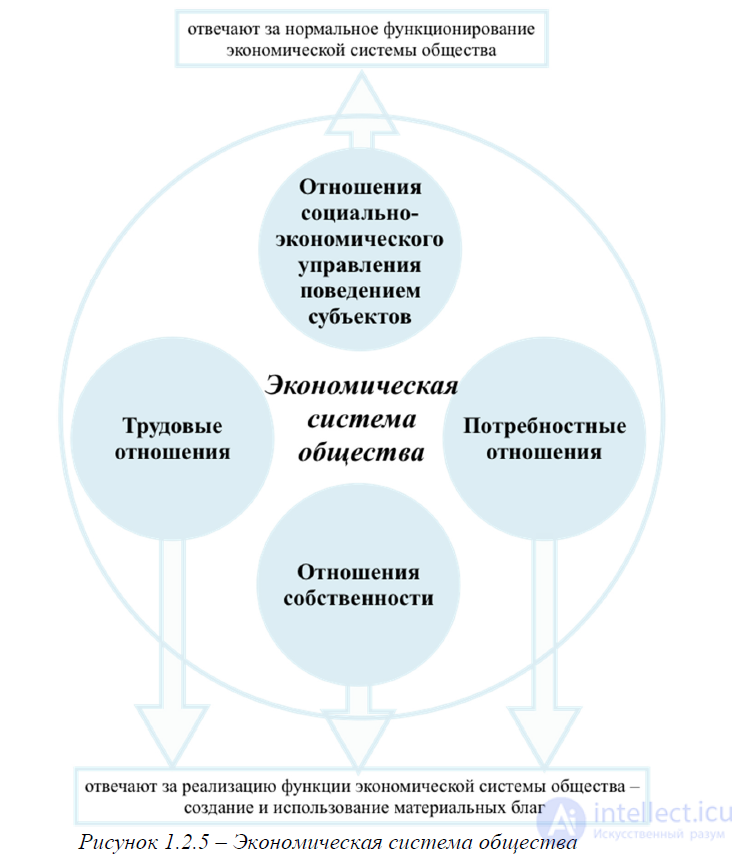
Figure 1.2.5 – The Economic System of Society
The category of "property" entered scholarly use long before the emergence of political economy and was originally an object of study in philosophy. Property is an economic category expressing the system of objective relations between people concerning the appropriation of the means and
results of production in the process of producing, distributing, exchanging and
consuming material goods.
Property relations are viewed both as subject-subject
(behavioral) relations and as subject-object (productive) relations. Viewing property relations as subject-subject relations focuses attention on the fact that the belonging of certain goods to a subject must be recognized by other subjects. Outside society, property relations do not exist. The subject-object characterization of property relations is based
on reflecting the real interaction of the owner with their property
(the disposal and use of the latter).
The objects of property relations comprise the entire set of economic goods: material means of production; the natural
environment; use values (results of production); the informational
and social conditions of production; the productive and social capacities of individuals, as well as the productive and socio-economic
functions themselves. Property relations attach these objects to specific
subjects and thereby subordinate people to one another.
The subjects of property relations are natural and legal
persons, between whom some kind of property relations arise in the course of interaction. These are individuals, collectives, society or the state.
Within property relations there is a differentiation by form.
Depending on the actual social subjects and the specific social
mechanisms by which they are combined, the following forms of property relations are distinguished: state, collective and private. Property relations in
any society are characterized by considerable diversity, the presence of numerous mixed forms and types, and various ways of their implementation.
The needs and interests of economic subjects are the object of constant attention at all levels of the organization of social production.
Only the interconnection and interaction of economic subjects (as a means
of the optimal realization of their economic interests) can ensure the self-regulation of the reproduction process. At the same time, within many economics
courses, the emphasis continues to be placed on studying subject-less economic models, based on the ancient myth of the magical "invisible
hand" of the market, which supposedly automatically adjusts any market economy on its own. In
fact, only the realization of economic interests is the driving
force behind the development of society.
Any economic actions, labor relations and property relations are ultimately directed toward satisfying one or another need of subjects, toward ensuring the material life of individuals, various social-class communities and society as a whole. A need is the source and the ultimate point of all economic activity.
There are two approaches to interpreting needs – the negativist and the positivist. In the negativist interpretation, a need is a "negative"
state of a subject (a state of absence or lack of something) that the subject
strives to overcome. In the positivist interpretation, a need is a positive relationship between the normal functioning of a subject and the conditions for that normal functioning. In this approach, the state of an unsatisfied need is seen as a deviation from the norm, and its satisfaction as a return to the state of the norm. Such an understanding reveals the
internal source of the activity of social subjects, in which ensuring one of the conditions of the subject's life (or changing its measure) causes a "chain" of changes in other conditions and in the very norm of the subject's existence. Such an interpretation makes it possible to represent the needs of social subjects as an integral
systemic formation, in which the satisfaction or non-satisfaction of any particular need triggers the activity of the entire set of social impulses.
A subject is a bearer of activity.
Labor is a form of a subject's activity.
A need is the source of a subject's activity.
An interest is the direction of a subject's activity.
Needs are closely interconnected with interests. From a psychological point of
view, an interest represents the concentration of attention on satisfying
a particular need. An economic interest is directed toward satisfying an economic material need.
Economic interests represent the social orientation of the vital
activity of subjects toward creating the most favorable social conditions necessary for satisfying their material needs and wants, and ensuring the maximum possible physical and social vitality.
In real life, the economic interests of various social groups
may coincide, coincide only partially, or be opposed to one another. Interests are the sole impulses that motivate people to act,
and consequently, their dynamics and balance determine the trajectory of development of the social system.
For the stability of society and the enhancement of its vitality, it is important to prevent its social atomization.
The existence of needs presupposes the availability of the means necessary to satisfy them. Means (things, services) suitable for satisfying needs are called goods. A large quantity of goods is created
by nature. These are so-called natural or free goods (air, sunlight, water, etc.). Goods obtained as a result of people's production activity are economic goods. A characteristic feature of these
goods is their scarcity. The scarcity of economic goods means that the quantity of these goods produced at a given point in time is insufficient
to satisfy the economic needs of people that exist at that moment. The scarcity of economic goods stems from the limited nature of the resources used to produce them.
Economic goods are quite diverse. Several criteria can be used
to classify them. Based on functional purpose,
goods are divided into consumer (final) goods, which go toward satisfying the needs of the population, and production (investment) goods, used in the production process. By their role in consumption, goods are divided into
necessities and luxury items. By duration of
use, goods are either durable or non-durable.
Depending on the number of consumers using the goods, they
are divided into private and public goods.
A private good, once consumed by one person, cannot simultaneously be consumed by another person. Most consumer and investment goods are private goods.
A public good can be consumed by many people at the same time without the consumption of one person reducing the consumption
of another. Distinctive features of public goods are non-rivalry and non-excludability from the consumption of individuals. Examples of public goods include radio and television broadcasting services, universal healthcare, education, etc.
Interchangeable (substitute) goods and complementary goods are also distinguished. Goods that can replace
one another in satisfying the same need (for example, personal
transport and public transport, etc.) are interchangeable goods, or substitutes. Goods that can satisfy a particular
need only when used together are complementary goods (for example, a car cannot move
without fuel, a mouse is useless without a computer, etc.).
Production, which ensures the fulfillment of needs, is limited in its
possibilities. It cannot expand and develop indefinitely because of the limited nature of resources.
Economic resources are all limited natural, human, and man-made resources used to produce goods and services.
Four groups of economic resources are distinguished:
1) natural resources – the potentially usable part of the natural
environment that is used or can be used in production
activity. Natural resources include land itself, forest and water
resources, mineral deposits, etc.;
2) material resources – means of production created by people: production
buildings, machinery and equipment, vehicles,
raw materials and supplies, etc.;
3) labor resources – the able-bodied part of the population;
4) financial resources – the monetary funds necessary for organizing and carrying out production activity.
Such forms of resources as administrative, social, and cultural resources can also be considered
resources (sometimes, by absolutizing the macroeconomic component, they are called capitals).
Economic resources are divided into those involved in the production process and those not involved, i.e., held in reserve. Resources actually involved in the production
process become factors of production. It is precisely on the quantitative and qualitative characteristics of the factors of production that
the volume and variety of economic goods produced depend.
The main factors of production are: labor, land, capital, and the entrepreneurial factor.
Labor as a factor of production is the totality of people's physical and mental abilities, their knowledge and experience, applied in production.
Land is a natural factor that includes all the free
gifts of nature used in production activity. This includes agricultural and non-agricultural land, mineral
deposits, forests, and water resources.
Capital as a factor of production represents the totality
of means of production created by people and used in the production
process. Let us note that in this context capital is considered as one
manifestation of capital as self-reproducing value.
The entrepreneurial factor is a special type of human resource
consisting in the ability to effectively coordinate, combine,
and use all the other factors of production, the ability to anticipate market conditions, manage risk, and minimize the probability of undesirable
consequences, and to make decisions in non-standard situations. The specificity of this resource lies in the fact that it brings together such resources as labor, land,
and capital into a single process of producing goods and services. It acts as the driving force of production and its mediator. The entrepreneur takes on
production risk, the task of making the main production decisions,
and ensures the motivation of labor and innovation in production.
Sometimes such factors of production as science and information are also distinguished.
The subject of a given social process or activity, including
economic activity, should be considered not merely a thinking and understanding entity,
but an acting agent — not so much potential as actual. A subject is always socially active.
A socio-economic subject is an individual (or group of individuals) personifying certain social and economic functions, possessing specific needs and activity in relation to other subjects.
Subjectness is precisely the ability to display activity, perform an action
and, accordingly, enter into relations.
The degree of "subjectness" of socio-economic subjects depends directly on the level of their aggregation — the greater the degree of aggregation,
the fewer the subjective attributes. Accordingly, it is the individual who possesses the largest set of subjective properties and variability of behavior.
Economic subjects can be differentiated by the types of economic relations they enter into (labor, property, etc.),
by the degree of aggregation or levels of subjectness (individuals, elementary and cumulative groups), and by the spheres or subsystems of the economic system of society (for example, market subjects such as the household, the enterprise, the state).
The most important category in political economy is "social
class."
A social class is a community of people occupying similar positions with respect to economic, political, and professional status.
Social stratification is the differentiation of the totality of people
(population) into classes in a hierarchical order. It finds expression in the existence of higher and lower strata. Its basis and essence lie in the uneven
distribution of rights and privileges, responsibilities and duties, and the presence or
absence of social values, power, and influence among the members of a given
community.
The social division of labor and the socio-economic inequality of individuals underlie social class stratification. It follows
that in order to determine the essence of socio-class relations, social
classes must be examined from two perspectives:
– first, from the point of view of their place and functional role in society;
– second, through the contradiction of socio-class interests.
Political economy is interested, above all, in the essence of the second aspect of socio-class relations. The contradiction of interests, primarily economic interests, of various social groups arises from the possibility of some
social groups appropriating the results of the labor of other social groups.
Since a social class is a solidary totality of individuals
similar in profession, property status, and scope of rights, representatives of the same social class have identical professional-property-social-legal interests.
As soon as stable professional, property, and rights-based groups form in society, interaction immediately begins
between
society, taken as a whole, and
individual social
groups, with each side influencing the nature of the other. Individuals united by all three bonds will have similar economic interests,
which serves as the material condition for their unification into social
classes for the more successful pursuit and defense of their interests.
In a broader interpretation, the category "social class" is understood as a cumulative, normal, semi-closed (though tending toward openness) group
bound by positive socio-class complementarity,
composed of the accumulation of three main groupings: professional,
property-based, and rights-based. Socio-class complementarity refers to a sense of subconscious mutual sympathy (or antipathy)
among members of social classes, leading to the formation of a shared ideology among them
and determining the division into "insiders" and "outsiders."
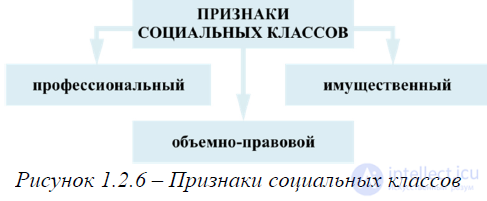
Figure 1.2.6 – Characteristics of Social Classes
In the socio-class structure of Belarusian society, the following
social classes are distinguished: the class of state administrators, the class of intelligentsia, the working class, the class of collective-farm peasantry, the class of law enforcement employees, the class of owners, the class of managers, the class of small producers, the class of non-specialist employees, and class-like groups: pensioners, children, students, and criminals.
The stages of market development are simple (small-scale commodity) and capitalist commodity production. Small-scale commodity production was based
on the private ownership by the producer himself of the means of production and on
the use of his personal labor. It was precisely small-scale commodity production that prepared the ground for capitalism. Commodity production under capitalism acquired special properties while retaining many features of simple commodity
production, since it grew out of and developed from it. What simple and
capitalist commodity production have in common is that both have
the same type of economic foundation in the form of private ownership of the means
of production; in both types of production, economic ties between producers, sellers, and buyers are carried out through purchase and
sale. The differences are that under simple commodity production the producer is the owner of the means of production, whereas under
capitalism the worker uses means of production belonging to the capitalist. Simple commodity production is based on the producer's personal labor, capitalist production — on hired labor. Simple commodity production
peacefully coexists with subsistence farming, while capitalist production undermines and
erodes the latter, expanding and deepening its internal market.
The development of commodity-money relations leads to the formation of the market and
a system of market relations; therefore the factors behind the transition to commodity production largely coincide with the factors behind the emergence of the market, among which are: division of labor, exchange of activity, the emergence of money as a universal equivalent, the limited nature of economic resources, the economic separateness
of commodity producers, economic freedom, and competition.
The exchange of activity, which acquired a systematic character, and
the emergence of money as a universal equivalent, shaped the market economy. The products of exchange took on the form of commodity values, and the perpetual
mediation of human relations became an objective property
of the market economy. The market is thereby formed as an instrument for simplifying
interaction between people.
Gradually, the exchange of the products of labor by means of money becomes the rule of the economic life of society. This form of relations, having become universal
and generally accepted, gradually spreads to all spheres of human
life.
Economic freedom, as a factor in the emergence of the market, is manifested in
the fact that the owner has at his disposal material and monetary
resources with which he can acquire resources and set up a production process. Legal freedom is expressed in the fact that the owner
gains the opportunity to engage in whatever legal activity interests him and brings income. However, not all resource owners use them
with equal efficiency. Between producers of goods and services, as well as owners of resources, there exists competition — rivalry for the most favorable conditions of their use. In seeking to maximize profit, entrepreneurs expand production, introduce new equipment and technology,
improve means of transport, intensify advertising, and fight to lobby for their interests in state government bodies, including
legislative ones, and unite into monopolistic alliances.
Speaking of the "free market" and the development of capitalist relations,
one must understand that so-called "free competition" inevitably leads to the situation where stronger economic subjects find themselves in a privileged position, since they can come to an agreement among themselves and form various kinds of monopolies, thereby creating favorable
conditions for the pursuit of their economic interests.
Competition, although it is a factor in the emergence of the market, gradually leads
to monopoly — the exclusive right to dictate one's terms in the market or in some
sphere of activity.
The more acute the problem of resource scarcity in the economy, the
higher the competition in all spheres of the economy and in all markets — for goods, capital, labor, resources, etc. The problem of resource scarcity concerns all types of resources. Labor expended in one sphere of activity limits the possibility of using it in another. Capital used in one production is "lost" for another. Land also has several alternative uses — for industrial or agricultural production, or the construction of infrastructure. Not all information can be available to all economic entities, both because of the time factor and because of the need to have the material capacity to obtain, recognize, and use it. Social resources are limited by the institutional environment.
The functions of the market are quite diverse. Among the most important of them is the function of regulating social production. Firms can
assess the market situation only by means of expert estimates (their own or with the involvement of professional agencies). A firm analyzes
market conditions and, on this basis, makes a forecast of its actions; however,
the final situation can only become clear once goods have entered
the market. The ratio of supply and demand established here predetermines what goods and in what volume are needed by the consumer. Thus,
production is adjusted relative to the needs and demands of buyers of material goods and services.
The price-forming function of the market is very important for the economy. The price level testifies to the volume and trends in the development of demand, to costs and
the level of profitability, to the income of the population, etc. The market establishes the level of
prices for the goods and services being sold.
Closely related to the price-forming function is the informational function of the market, which is one of the most important functions. Information supplies the subjects
of market relations with up-to-date data on the level of prices, the number of sales made, etc., allowing them to make tactically and strategically sound decisions.
The next function of the market is the competition-forming function. Competition compels producers toward business activity and the search for new opportunities
for economic growth.
However, competition also possesses a cleansing, destructive power, in
connection with which another function of the market is distinguished — the sanitizing function. As a result of
competitive struggle, not all market subjects can be efficient. Under conditions of market relations, unprofitable enterprises do not receive subsidies. Their
position is evidenced by the state of prices and the level of costs, and if the situation does not change, such enterprises go bankrupt. Through this sanitizing process, the economy is cleansed of economically weak, non-viable subjects.
A market economy does not require awareness of social goals; the subjects
of the market do not think about them — they set their own private, egoistic goals and try
to realize them with the help of the market.
The market is a specific form of organizing the economic life
of society; it is the unity of commodity and monetary circulation, through which it
exerts an influence on social production and the entire reproduction process, informing participants in economic relations about their desired (optimal)
economic behavior.
The market economy, as a developed system of commodity-exchange relations,
represents a system of individual interconnected markets with a developed infrastructure. Individual markets are connected with ensuring production, as well
as with the circulation of goods and money. The infrastructure includes a number of institutions that ensure the uninterrupted and rapid movement of goods and services.
Market infrastructure is a system of specialized institutions and establishments that serve the market and ensure the movement
of goods, capital, and labor. It includes a network of banking institutions, commodity and stock exchanges, labor exchanges, insurance companies, information and commercial centers, auctions, fairs, etc. The core of market infrastructure is the banking system, which represents a powerful
financial organization consisting of a number of subordinate units carrying out financial operations within the country.
The modern market economy is characterized by a multiplicity (including
mixed forms) of ownership, a declared freedom of enterprise, and mandatory state intervention in the economy. The modern market mechanism functions under conditions of establishing equilibrium and stability by means of economic tools of state regulation, related both to the specific features of the economy's functioning at
the macro level (cyclical fluctuations, economic growth, etc.) and to the imperfections of the market mechanism (discount policy, issuance of government obligations, etc.).
Describing demand, supply, and market equilibrium requires the use of a microeconomic approach. Therefore, to a certain extent one has to
abstract from a large number of factors (including
продолжение следует...
Часть 1 Basic Concepts of Political Economy, Economic Laws and Categories
Часть 2 - Basic Concepts of Political Economy, Economic Laws and Categories

Comments