
Lecture
Political economy is one of the social sciences whose subject of study is the relations between the market and the state, and between the individual and society. Besides purely economic methods, political economy uses a variety of methods borrowed from philosophy, political science, and sociology.
Political economy historically preceded economic theory. In the 20th century, the understanding of political economy was contradictory: some considered it a field of study (economics and politics in their interconnection), while others considered it a methodological approach, which was in turn divided into an economic approach (public choice theory) and a sociological approach
Nowadays the term political economy is often used for Marxist and heterodox approaches to economic, political, legal, and cultural phenomena. A relatively new direction is international political economy studies, devoted to the global distribution of income
Table 1. Difference between political economy and economics
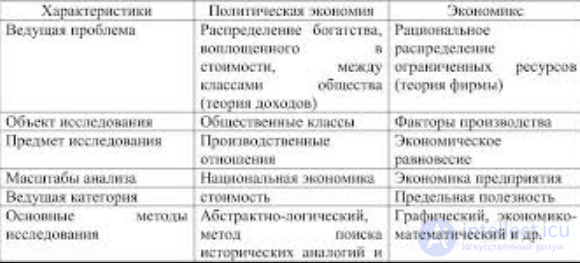
The phrase political economy was first used by the playwright and writer Antoine de Montchrétien in his economic treatise "Traité d'économie politique" ("Treatise on Political Economy," 1615). Montchrétien wrote no economic works either before or after this one. In 1911, assessing the degree of the treatise's originality, the Encyclopaedia Britannica concluded that it "is mainly based on the works of Jean Bodin" . The circumstances that prompted the playwright to write the treatise were purely political (the author dedicated it to the young King Louis XIII and the Queen Mother Marie de' Medici ). An excellent connoisseur of ancient languages and literature, Montchrétien constructed the term to designate the subject of Jean Bodin's study:
One can interpret the anagram "political economy" → "economic policy" as a movement from justification (theory) to implementation (practice). However, owing to its fundamental nature, political economy is unable to take into account every current specific, and its conclusions are perceived by politicians, at best, as recommendations.
Montchrétien was not destined to "put the new term into circulation" —that is, to confirm it in discussions with colleagues or even see it in the works of others—he died six years (1621) after the publication of his treatise.
The term "political economy" came into use during the Enlightenment in the late 18th century and, until the end of the 19th century, was used as the modern term "economic science" is used today. From the late 19th century, the term "economic science" (economics) has been used instead, and use of the term "political economy" ceased .
In the early 20th century, a number of economists attempted to return to defining the subject studied by economic theory; however, discussions on this matter continue to this day, and many consider the theory to be merely a tool of cognition.
J. M. Keynes noted in 1921, in the "Introduction" to the Cambridge Economics Handbooks series: "Economics is a method rather than a doctrine, an apparatus of the mind, a technique of thinking which helps its possessor to draw correct conclusions" . J. Robinson expressed this more concisely in 1933, characterizing economic science as a "box of tools" .
In the 1960s the term "political economy" was revived, but its content changed . Marxists, meanwhile, never abandoned the use of the term "political economy" in its original meaning .
By the 1960s the term "political economy" also began to be used by the right-wing libertarians of Chicago and the Center for Study of Public Choice. The central question studied within modern political economy is formulated as follows: "How can economic science contribute to understanding the causes of a particular social problem?"
Within institutionalism (G. Tullock), the tools of economic theory are used to study family relations, child-rearing, death, crime, sexual relations, and the behavior of politicians . This direction is often called economic imperialism.
According to the Russian economist G. S. Vechkanov, political economy studies the deep foundations of society's economic life
The category "political economy" is one of the elements of the category "economic theories"; accordingly, these terms are not equivalent and are not interchangeable.
Political economy is only one of many sciences that formulate economic theories. At the same time, within its bounds, as "within" any other science, several qualitatively different sets of particular theories may arise, coexist, and even compete.
Groups of interconnected, mutually consistent theories, developed within a single science, on the basis of the same subject, but by different groups of scholars applying different methods and approaches, form schools and currents of scientific thought. Over time, the divergences between them in terms of subject and method may reach a critical point, after which the emergence of new sciences is recognized, each now having its own, mutually consistent definitions of subject and method.
The subject of political economy: the object of study is society, social ties. But this object is also studied by psychologists, sociologists, political scientists, and so on. The subject of political economy, however, is the socio-economic phenomena that take shape in certain spheres which, at different periods of time, have been the focus of political economy's attention.
The method of a science is its research techniques. Among the methods that political economy shares in common with most other economic theories, it relies on:
The systems approach is not a separate method (as is sometimes mistakenly indicated, alongside analysis, synthesis, abstraction, deduction, and induction), but rather the entire set of methods listed above, which makes it possible to consider a particular phenomenon or process as a system consisting of a certain number of interconnected and interacting elements.
Methods specific to political economy, which may be absent or of secondary importance in other economic theories, include:
"The historical approach is an approach to the singular, the one-off, while the sociological approach is an approach to the recurring, that is, to the typical."[12]
However, political economy does not substitute itself for either history or sociology, borrowing from these sciences not their specific methods and subjects, but only their principles. Thus historicism is the principle of studying things and phenomena in their development and formation, in connection with the specific historical conditions that determine them.
Political economy studies the economy and the relations that take shape within it, insofar as its subject is concerned, which is thus defined by the category "relations of production." These are social relations that take shape in the process of reproduction, which includes:
Political economy identifies regularities and formulates economic laws governing the development of production relations at different historical stages of humanity's economic activity. To distinguish between them, various methodologies may be used here that make it possible to identify qualitatively different states of society's productive forces and production relations, in particular the special category of socio-economic formations.
Having formulated its subject and thereby drawn a dividing line with earlier stages in the development of economic thought, in the 19th century political economy, proceeding from adherence to this formula, carried out a further demarcation from other sciences and disciplines adjacent to it in terms of subject matter. In particular, from commodity science, the history of law (including economic law) and of the national economies of various countries and regions, economic statistics[en], and others. In interacting with them, and using materials studied professionally and thoroughly by specialist scholars in other fields, political economy itself became the basis for the emergence of new sciences: the history of economics, econometrics, and others.
Specific elements corresponding to the definition of the subject of political economy appear in the works of the "pioneers" of this science (W. Petty, P. de Boisguilbert, and others), receiving their final consolidation in the works of A. Smith, D. Ricardo, K. Marx, J.-B. Say, T. Malthus, Bastiat, and others, whose works are classified as classical political economy. Despite the similarity of certain conclusions and laws formulated by different "classes," different schools and currents of economic thought developed within political economy. Of these, the largest in terms of number of scholars, print runs of scholarly works, and duration of existence is Marxist political economy (within which various schools and currents are also distinguished).
From the 18th–20th centuries to this day, political economy has been a major, but not the only, source of socio-economic theories. The distinction between political economy and other related sciences and disciplines is drawn according to a number of criteria, including the socio-historical component, the coverage of the interests of all social groups that are subjects of production relations, and the forecasting of the results of a given economic policy. A number of other economic schools of the 19th–20th centuries generally meet these criteria, one of which has consequently been given the name "Neoclassical economic theory" (tracing back to classical political economy).
The historical predecessor of political economy is mercantilism, whose subject of study is the sphere of circulation. Later, as political economy developed as a science, the main emphasis shifted to the sphere of production.
A clear categorical apparatus, with unambiguous definitions preceding the authors' arguments, is an important requirement of the method of political economy. In this it differs from other works on economic subjects that are not tied to a strict categorical basis. A notable clash of definitions arises when considering mercantilism—the historical stage in the development of economic thought that chronologically preceded the emergence of political economy. There are two points of view on this matter.
According to one historical-economic tradition[13], Adam Smith is the founder of political economy, while the mercantilists (whom he criticizes in his principal work[14]) are its forerunners. Indeed, in terms of the form in which they were presented, the treatises of the mercantilists were pragmatic proposals (often addressed to the supreme authorities), whose authors included merchants, officials, and other practicing economists. Their main argument consisted of purely arithmetical calculations rather than scholarly-academic reasoning involving transitions from the concrete to the abstract and back. Finally, in terms of content, these were proposals for changing economic policy; in other words, they were doctrines. That is, the mercantilism that preceded political economy (its early stage is also called the monetary system) was not a science in the strict sense[15], but one of the stages in the genesis of economic thought — so to speak, the prehistory of political economy.
In some other sources mercantilism is attributed as one of the economic theories. Given that, in this case, the subject of economic theory is identified with the subject of political economy, the latter automatically loses its status as the historically first economic science. There, too, the mercantilist authors may be called economists (in the sense of scholars), although for some of them (merchants, officials) this term is applicable only in the broad collective sense of "practitioners in the economic sphere of finance and trade."
The subject of political economy, in Adam Smith's version, is formulated in the title of his principal work: "An Inquiry into the Nature and Causes of the Wealth of Nations." D. Ricardo also understood wealth (English wealth) as the subject of the science. Throughout the 19th century Smith's work played both an educational role and served as an object of criticism that gave rise to new concepts in the science. The second meaning of wealth is abundance (and, in Smith's time, also "prosperity"). But political economists returned to this meaning only in the 20th century.
The critics closest to Smith in time — Simonde de Sismondi (and later another representative of economic romanticism, P. J. Proudhon) — argued that it was not the objects of wealth themselves (things), but their distribution (and redistribution) that was the subject of political economy, and that its special purpose was to ensure the fairness of this process[16]. A number of researchers[17] single out a particular element of novelty that Sismondi introduced into the method, namely the introduction of a moral-ethical element into the set of principles of classical political economy[17]:
Political economy is "not a science of mere calculation, but a moral science"; it "leads into error when it operates with bare figures, and leads to its goal only when the feelings, needs, and passions of people are taken into account."
K. Marx considered Sismondi's position to be petty-bourgeois and populist. In seeking the fundamental, deep-lying basis of economic processes, he took the path of a philosophical-abstract understanding of their essence. Marx concentrated attention on the process of reproduction (production, distribution, exchange, consumption) as a single integrated whole. In order not to be distracted by particulars that constitute the subject of specialized sciences (branch economics, the economics of trade, marketing, etc.), Marx examined the production relations that arise between people engaged in these processes according to each person's place on the steps of society's social pyramid. These relations are not subjective-psychological (interpersonal, person-to-person relations), but socio-legal. With this in mind, the subject of political economy today is production relations, that is, relations concerning the production, distribution, exchange, and consumption of goods.
Marx acted not only as a critic of Smith. While noting flaws in his concept, he also found and creatively used the rational core in the great Scotsman's formula. Having broken down Smith's "wealth" into its constituents — goods — Marx demonstrated, through purely abstract logical reasoning, that it is precisely the commodity as a category that must serve as the starting point of political-economic research. The opening words of Chapter 1 of Volume I of "Capital," devoted to the commodity, pay tribute to the founder of the science, as if echoing the title of his work: "The Wealth of Nations…"
To mark a particular starting point, on the chronological axis of the history of economic doctrines, for the history of political economy, various criteria can be used, depending on the specifics of the task for which this is required.
The earliest boundary is determined formally, on terminological grounds. This is the moment of publication of a study or work bearing that title. For political economy this is 1615 — the year of publication of Montchrétien's "Treatise on Political Economy." However, the author did not continue his research (the subject was, in a sense, incidental for him), and none of his contemporaries used this work as a starting point for subsequent developments of the science under this name.
The latest boundary is determined by a strict academic criterion — the emergence of the first center for systematic collective research. In this formal sense, the emergence of political economy as an academic science is dated to 1805, when the first chair was opened and the first professor of political economy (Thomas Malthus) was appointed at Haileybury College. A body of previously written scholarly works, serving as the starting point for the chair's further research, is a necessary condition.
The classification of the subject and method is carried out, in general, by the same group of scholars who pave the academic path for a newly recognized science, and therefore the choice of a starting point for the immediate prehistory of the science is always, to some extent, the result of their subjective choice. New schools subsequently opened in other countries, using definitions of subject and method already given by others, may seek to prove a "right of primacy" for the research conducted in their own country, and so on. One way or another, the first claim to priority is often eventually contested, and this does not happen immediately, but by the time the science's life cycle is approaching its peak.
Later, in other European countries — Italy, Germany, Russia, and others — amid the general mid-19th-century European surge of interest in one's own history, many hitherto forgotten names were rediscovered. Using the same formal, subject-methodological approach, each country rediscovered its own scholars who had left works for posterity that turned out to be political-economic in nature. However, from the fact that I. T. Pososhkov published his "Book on Poverty and Wealth" in 1724, that is, more than half a century before Adam Smith's almost identically titled work (1776), it by no means follows that political economy began in Russia.
While paying tribute to the scholars of each country, modern historiography of economic doctrines tends toward the following formulations.
François Quesnay is considered the founder of the school of the physiocrats (who called themselves "economists"), as the historically first current of classical political economy and the first scientific school. Among the foundational works are Quesnay's "Tableau économique" (1758) and Turgot's "Reflections on the Formation and Distribution of Wealth" (1766). P. Boisguilbert (works of 1697–1707) is considered the founder of scholarly research in this direction.
Adam Smith, who met the physiocrats in 1764–1766 and wrote "An Inquiry into the Nature and Causes of the Wealth of Nations" ten years later, in 1776, is considered the founder of the school of classical English political economy. Its beginnings can be traced to a number of his closest predecessors, including W. Petty (works of 1662–1682). England is considered the birthplace of political economy as an academic science (the first chair was opened in 1805).
The elimination of social injustice and the means to achieve it, the building of a just society — this is the goal set forth in the treatises of many great thinkers since deep antiquity. Already in the ancient Egyptian "Admonitions of Ipuwer"
The land has turned over like a potter's wheel. The poor have become rich, and the propertied destitute… He who sought oxen for plowing has become the owner of a herd; he who had no grain now lends it out; he who never built himself a boat now owns ships; the former owner looks at them, but they are no longer his.
To ignore this problem is suicidal, for the alternative is social upheaval, revolution, and bloodshed
Dependent people have become masters of people… he who ran errands now sends another in his stead… Officials have been driven out across the whole land; the laws are thrown out and trampled underfoot, lowly people wander back and forth through the great courts of justice; the chamber has been broken into, the tax records seized; the royal storehouses and grain have become the property of anyone… A handful of lawbreakers has deprived the land of its kingship; what the pyramid concealed is empty; the king has been removed…
This is the oldest documentary evidence of the first known social revolution in human history. At the same time, this treatise is also the first attempt to point to the most dangerous type of injustice in terms of its consequences — namely, injustice in economic relations, in relations of property, and in the distribution of goods. Ancient philosophers, for whom economic problems were inseparable from problems of ethics and morality, studied the same questions. In modern times, the tasks of transforming society on socialist principles and of the necessity of a just restructuring of social relations (including economic ones) fall within the subject of a special current — the theories of utopian socialism. Although economic relations are one of their subjects, methodologically the works of the pre-Marxian utopian socialists stand outside political economy: alongside bourgeois political economy, utopian socialism is one of the three sources of Marxism that preceded it[20]. However, priority in introducing the task of eliminating social injustice among the most important objective functions of political economy belongs not to Karl Marx, but to his predecessor, S. Sismondi[21]:
"people united into a society… in order to secure happiness for themselves"
In the course of the transformation of bourgeois political economy into economics (or, in an alternative interpretation of the process, after the completion of its crisis, with the "death" of this science and its replacement by economics), part of the bourgeois political economists deliberately excluded the entire ethical-social component from their science. This position was expressed, among others, by Lionel Robbins in 1932:
Economics deals with ascertainable facts; ethics with valuations and obligations. These two fields of inquiry do not lie on the same plane[22].
J. M. Keynes expressed categorical disagreement with this position:
Contrary to Robbins, economics is essentially a moral science. It employs, so to speak, the method of introspection and passes judgments of value[23].
England. Sir Thomas Robert Malthus became the first professor of the chair of political economy.
Italy. To this day political economy continues to develop as a science and is taught as a subject (see Economia politica).
Pre-revolutionary Russia. It is interesting that, based on the interrogations of the Decembrists, it was concluded that in order to curb the spread of free-thinking it was necessary to remove political economy from school curricula (although this was never actually done)[24].
The Soviet Union.
Marxism-Leninism rested on a single, conceptually interconnected complex of three sciences: philosophy (dialectical and historical materialism), political economy, and scientific communism. Despite the powerful socio-political component in the way Marxist political economy framed its tasks, it was not political economy (as is sometimes mistakenly believed) but precisely scientific communism that took on the leading role of the socio-political theory of Marxism-Leninism within this triad. Cf.:
Section I. Scientific communism — a component part of Marxism-Leninism.
Chapter I. The subject and method of scientific communism.
§ 1. Scientific communism — the socio-political theory of Marxism-Leninism.[25]
In Soviet economic science, Marxist political economy was regarded as the basic principle for running the national economy; on its basis the planned nature of economic development was worked out, with the ultimate goal of abolishing commodity-money relations.
Political economy as a science has been, and remains, fundamental in character and serves as the methodological basis for other economic sciences. At the same time it is limited in its subject to the study of economic relations directly. For example, it studies value relations but does not deal with cost accounting; it examines the history and nature of money but does not deal with banking; it studies the nature and mechanism of the production of surplus value but does not consider the specific proportions of its distribution among the owners of the factors of production.
Political economy is a social science that studies the relations among social subjects included in a single, relatively
stable, organizationally structured material-social complex, within which internally interconnected production, appropriation, and socially significant consumption of material means
and goods take place, ensuring the physical life of society and creating the material basis for all spheres of social life.
Material production is human activity aimed at creating
material goods to satisfy diverse needs. It is precisely
material production that is fundamental to the development of all
other spheres of human life — spiritual, religious, cultural, political, and so on.
Production is always social in character. What accounts for this?
First, as a rule, more than one person takes part in the process of production.
Second, the process of production makes use of the results of other people's labor.
Third, the character of production is determined by the historical, civilizational,
and technical-technological conditions that have taken shape in a given society.
The main function of economic relations consists in providing
society with the material conditions,
means, and goods necessary for its existence. This functional purpose of economic relations is characteristic of all historical eras and societies. However, the mechanisms and
tools for realizing this function differ depending on specific civilizational, social, national, historical, and other
conditions. Political economy studies both the general and the particular in economic relations.
Political economy is a social science that studies the laws governing the development of economic systems across different historical periods and spatial dimensions.
Political economy studies historically specific economic systems — that
is, various types of economic systems in unity with the civilizational, political, social, and other factors of their development. Political economy
traditionally investigates economic laws that express internal, objectively necessary connections between economic phenomena and drive the development of
society, as well as the development of qualitatively distinct socio-economic
systems in different historical periods, through the lens of subject-based (inter-class) relations.
The principal content of political economy is the study of the social
structure and of relations among social classes as the basis for the development of society.
People, groups of individuals, classes, and so on — the subjects of political economy — have certain needs, which give rise to a large
number of divergent interests directed at the object of satisfying those needs. Economic interest underlies every action of a
subject. It is precisely people's social position that makes their
economic interests qualitatively different.
From a politico-economic point of view, what matters is which of
these interests predominate and which of them underlie the development of a given economic system.
The object of political economy is society's economic system.
The subject of political economy is the relations among socio-economic subjects. Political economy studies institutional (social) factors alongside material and financial ones.
Politico-economic research widely draws on the achievements of neighboring sciences — social philosophy, epistemology, universal history, psychology, sociology, and several others. Modern political
economy covers the area of interaction and interconnection between the economy and the social sphere, including the social, political, ecological, legal, and other spheres of human relations. Thus the subject of modern political economy inevitably includes processes occurring not
only in the narrowly economic sphere, but also in the social, sociocultural, and geopolitical spheres. It is simply impossible to fully separate these processes from one another.
Political economy is a fundamental science that serves as the basis for the specialized economic sciences. The differentiation of specialized economic
sciences, which occurs as a result of the intensifying division and cooperation of scholarly labor within economic science, is theoretically and practically justified. But
this differentiation remains legitimate and yields obvious benefit only as long
as the conclusions of the specialized economic sciences are not extended beyond their subject and object. Many specialized economic sciences are characterized by abstraction from a huge number of factors influencing the object being analyzed. This is largely a consequence of the widespread use of excessively formalized economic-mathematical models characteristic of neoclassical economic theory. In order to translate
the living economic process into the language of mathematics, one is forced to disregard
the bounded rationality of individuals' economic behavior, the uneven distribution of information among market participants, the existence of transaction costs, the variability of their subjective assessments, and so on.
The domain of modern political economy includes the search for answers to
such questions as: How is society's economic system structured? What objective laws govern the evolution of economic systems? What are the historical forms of economic systems, and what determines the choice of one
form or another? How is politico-economic power distributed in the world? Whose interests underlie the functioning of a given economic system?
What are the mechanisms for finding a balance of interests as a driving factor in the development
of society and the economy? How are the economy and other spheres of human life connected? What is the role of the human being in the economy? Finally, modern political economy provides answers to questions related to the direction of the evolution of society and the economic sphere. Whose interests predominate in the modern world economy, and what is the role of our country in today's global
politico-economic processes?
The methodology of modern political economy is based on a set of methods such as the civilizational, historical, systemic, and institutional approaches. The civilizational approach makes it possible to take into account, in economic analysis, the national characteristics of a given society or state. These national characteristics are reflected in economic mentality and, consequently, exert a great influence on the model of economic management
and the dynamics of economic processes; the population's perception of
particular economic policy measures also depends on them. Thanks to the historical approach,
political economy considers the development of economic systems in dynamic terms and investigates the factors influencing the evolution of the economy and society. The systemic approach makes it possible to study economic systems as integral,
complexly organized, self-organizing organisms, together with the whole set of elements, connections, and relations between them. The application of the institutional approach consists in the fact that political economy is not confined to analyzing economic categories and processes in their pure form, but also studies such
non-economic factors as institutions — historically established, stable forms of the organization of joint activity among individuals.
In addition, political economy uses the method of scientific abstraction, analysis and synthesis, mathematical and statistical research
methods, and the unity of the logical and historical methods.
Combining the socio-class approach with institutional modeling in political economy will contribute to the development of this science as a theoretical-methodological basis, helping to adapt all the economic and
social sciences to the objective demands of the structural deformations characteristic today of most of humanity.
The qualitative characteristics of modern society and the economy are described through the lens of such categories as "post-industrial society," "information society," "knowledge society," "technotronic society," "network society," "ecological post-industrialism," "risk economy," "post-market economy," "post-capitalist economy," "super-industrial society," "neo-industrial society," "digital economy," and others. These concepts are of different orders and, to varying degrees,
describe the evolution of modern society and the economy.
Modern society is characterized by:
– a change in the character of industrial production from mass manufacturing to flexible, specialized production in response to technological innovation;
– a significant increase in the importance of knowledge for economic development;
– growth in symbolic (status) consumption;
– the development of the service economy;
– changes in the structures of labor relations;
– the formation of fundamentally new global finance, which goes beyond
its traditional role in society's economic system and exists in a fairly
isolated way from the processes occurring in the real sector of the economy;
– the increasing role of socio-functional innovations, and so on.
Political economy, as a fundamental economic science, performs an ideological function. The choice of a model of economic management, of directions and methods of its transformation, and of the implementation of economic policy measures depends on the balance of politico-economic interests that has taken shape in society, on the alignment of forces among social classes and socio-class groupings, and on their degree of organization and cohesion. It should also be understood that in modern society the importance of ideology is constantly increasing, not only as an important factor in the competitiveness of the national economy, but also as a means of undermining the competitiveness of rival countries (through the "export" of
destructive ideological doctrines, concepts, clichés, stock phrases, and so on,
which serve as some of the most important forms of modern information warfare).
The development of economic thought has taken place over the course of centuries, and therefore, from a historical perspective, the process of the formation and development of economic theory
can be divided into stages.
The first stage is the period of the functioning of the natural (subsistence) economy
and the expansion of commodity-money relations, during which scholars attempted
to systematize economic views and outlooks and to define the boundaries
of economic science. The doctrines of the ancient world and the Middle Ages arise.
The second stage (mid-16th – mid-19th centuries) is a period when the intensive development of commodity-money relations begins and national
market economies take shape. Economic science becomes a self-contained
discipline. Scholars begin developing its categorial apparatus,
defining the function of economic science, whose subject becomes the system-forming element of the entire body of categories; the methodology for studying socio-economic phenomena is enriched; theoretical approaches to the main directions of foreign and domestic policy take shape.
The doctrines of mercantilism and physiocracy arise, as well as the classical school and Marxism. At this stage, scholars completed the discussion and theoretical generalization
of the problems involved in forming the conceptual apparatus of economic science.
The third stage (mid-19th – early 20th century) is a period of the flourishing of the market economy, during which the functional role of the economy is determined and scholars begin to study the problems of the development and functioning of the entire economic system and the mechanisms for regulating it. At the same time, the theoretical analysis of socio-economic phenomena is enriched through the study of
subjective, psychological, social, legal, technological, and ecological aspects in interpretations of economic categories. The subject of study of economic theory expands, microeconomics is singled out, functional and branch disciplines take shape, ideas of economic liberalism
predominate in economic policy, and ideas of social
control by society over the economy are introduced. New directions and schools arise:
the neoclassical direction (the Austrian, Cambridge, and mathematical
schools), the American, social, socio-historical, and legal schools,
and institutionalism.
The fourth stage (early 20th century to the present) is a period in which the mechanisms for the functioning of national market economies are modified and a world market system takes shape and develops. Scholars begin to address the problems of the governability of the economic system: models of its functioning and regulation; the search for options for an optimal combination of market and
state methods of regulating a mixed-type market economy, and they investigate problems of the world economy. During this time,
the leading directions of economic theory are developed — Keynesianism (including neo- and
post-Keynesianism), the neoclassical (neoconservative) direction, and the socio-institutional direction.

Comments