
Lecture
The collapse of the Soviet Union was not merely a grandiose geopolitical event but also a qualitative economic and political change for our country. As a result, a new socioeconomic system took shape, which we will hereafter call the economy of the Russian Federation, or the Russian socioeconomic system. It is not the task of this section to analyze the entire course of the so-called "market reforms" of the 1990s and the subsequent recovery process of the 2000s, nor the profound contradictions that characterized these qualitative changes: this analysis has already been given by the authors in previously published textbooks and scholarly works1. 1 See: Ekonomika perekhodnogo perioda: ucheb. posobie dlya vuzov po napravleniyu «Ekonomika» i spets. «Teoret. ekonomika» / Ed. by V. V. Radaev, A. V. Buzgalin. Moscow: Moscow State University Press, 1995; Buzgalin A. V., Kolganov A. I. Teoriya sotsialno-ekonomicheskikh transformatsiy. Proshloe, nastoyashchee i budushchee ekonomik «realnogo sotsializma» v globalnom postindustrialnom mire. Textbook for economics students. Moscow: TEIS, 2003; Transformatsionnaya ekonomika Rossii: ucheb. posobie / Ed. by A. V. Buzgalin. Moscow: Finansy i statistika, 2006; Buzgalin A., Kolganov A. Liberalizatsiya versus modernizatsiya (sravnitelny analiz perekhodnykh ekonomicheskikh sistem) // Voprosy ekonomiki. 1997. No. 8; Buzgalin A. V. Zakonomernosti perekhodnoy ekonomiki: teoriya i metodologiya // Voprosy ekonomiki. 1995. No. 2. Pp. 40-49.
Let us emphasize only that the post-Soviet socioeconomic transformations affected: (1) the productive forces, causing a substantial change in the structure of the economy, the main elements of which were, on the one hand, a sharp reduction of high-technology production and deindustrialization, and on the other hand, significant growth in such sectors as trade and commercial services; (2) the relations of production, where a predominantly planned system based on state-social appropriation was replaced by relations based predominantly on the market and private-capitalist alienation; (3) the institutional-legal and political spheres. As a result of these quarter-century-long qualitative changes (often inaccurately called "market reforms"), the Russian socioeconomic system has acquired a relatively stable form, which can generally be classified as a variety of late semi-peripheral capitalism, whose specific feature, however, is that it retains many traits of a Soviet-type economy. The post-Soviet economy is a variety of late semi-peripheral capitalism, whose distinguishing feature is the preservation of certain traits of the Soviet-type economy.
This section is devoted to the analysis of this system. The significant internal contradictions inherent in the Russian socioeconomic system also give rise to fundamental differences in the assessment of the outcomes of the transformation processes of recent decades. Two polar opinions, and a broad spectrum of assessments lying between these poles, are typical here. As one might easily guess, one of these poles is a fundamentally positive assessment, the essence of which is that, despite all the difficulties of the transition period, Russia has achieved a transition to an open market economy in which there is no shortage of goods and services, any solvent demand is satisfied, and private owners have opportunities for entrepreneurial activity and virtually unlimited growth of their wealth. It is true that, in the geopolitical conditions that have arisen since 2014, according to these authors—who typically hold neoliberal positions—these opportunities have become quite limited. The diametrically opposite position, typical of adherents of left-wing views (across a broad spectrum, from social-democratic to communist), holds that the post-Soviet transformations did not lead to a positive sublation (overcoming shortcomings while developing achievements), but rather to the destruction of the Soviet economic system and to a so-called "negative convergence"—a combination of the worst features of the Soviet and peripheral capitalist models. Let us examine in more detail the main objective indicators characterizing the Russian economy nearly a quarter of a century after the departure of the Soviet system. Let us begin with the positive results, which it is fundamentally important to take into account.
Among the main positive results is the elimination of shortages of goods and services. While the overall volume of consumption of basic goods and services in physical terms was largely maintained (or slightly reduced/increased), the introduction of free prices led to a balance between solvent demand and supply.
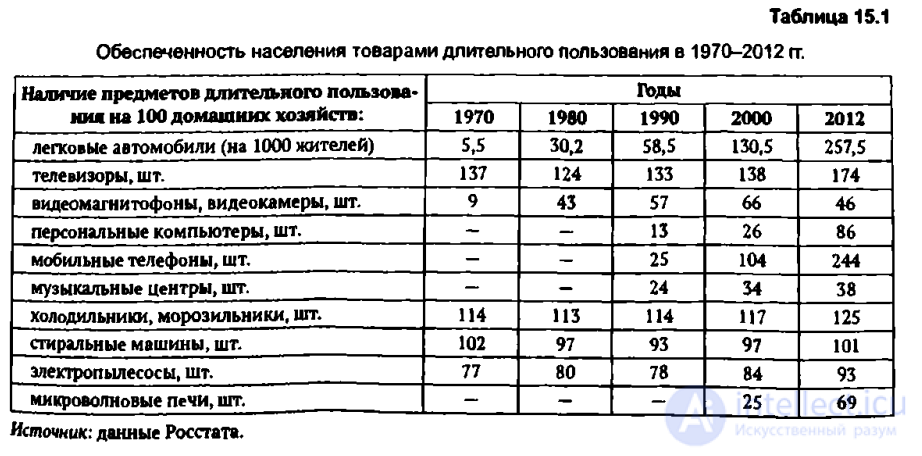
For this, at first glance, seemingly paradoxical situation, there are well-known explanations: the market creates an objective appearance of an abundance of goods and of conditions for satisfying the needs of every individual. Here, however, as elsewhere in our study, it is essential to distinguish between the content of economic phenomena and their distorted forms. It seems that needs are being satisfied on the market, but the actual content is the satisfaction of solvent demand alone. This "nuance" points to a mechanism inherent in the market economy that cuts off the poorest strata (in particular, up to half of Russians) from satisfying many vital needs (for example, in quality housing, medical care, education, and so on). A study by specialists at the Higher School of Economics says essentially the same thing, in its own way. Explaining the fact that 1990 was perceived as a year of shortages while 2000 was perceived as a year of abundance—even though sales volumes of many durable goods reached 1990 levels only by 2000-2003—they note that, on the one hand, market equilibrium prices limit demand, while on the other hand, the range of goods and brands offered has expanded, so that when purchasing the same quantity of goods, the consumer's choice has become much wider. A number of data illustrating these changes are presented in Table 15.1. To be sure, over these more than 20 years, consumption of a number of goods that were designed and appeared on the market precisely during this period (computers, mobile phones, and the like), as well as cars, cosmetics, and so on, grew many times over. But in the RSFSR too, the volumes of consumption of newly appearing goods (a consequence of structural changes in the consumer market that regularly occur due to scientific and technological progress), as well as of durable goods (refrigerators, televisions, cars), increased several-fold over a five-year period, and almost ten- to twentyfold over 20 years. Thus, the number of cars per 1,000 people increased more than tenfold over the 20 years from 1970 to 1990 (from 5.5 to 58.5 units), whereas over the following 20 years of "reforms" it increased only 4.4-fold (and this despite the fact that in the Soviet period, state regulation was aimed at restraining the growth of private passenger vehicles, which had its own rationale).
Table 15.1. Household Ownership of Durable Goods, 1970-2012
The second important positive achievement was the restoration of average income to the level of 20 years earlier (according to calculations by critics of the "reforms"), or even an increase of approximately 30% compared to 1991 (according to official statistics)1. This result is perhaps the most sensitive one for the citizens of our country. At the same time, however, as noted by experts at the Higher School of Economics working under the direction of Professor E. G. Yasin (who can hardly be suspected of great sympathy for the Soviet system, nor of antipathy toward the market "reforms"), as a result of the sharply increased social differentiation of the population, by 2009 only the top 20% of Russians had substantially (more than twofold) improved their position in terms of real monetary income. Another 20% of our citizens (the third quintile group) live, 20 years after the collapse of the RSFSR, the same way they did almost a quarter of a century ago (and they managed to reach the 1991 level only by 2007). Finally, the bottom 40% of Russians live worse than they did in our country in the late 1980s, and half of them live nearly twice as poorly as in the pre-reform period (real monetary incomes in 2009 amounted to 55% of the 1991 level). Authors who assess the results of the transformations more critically point out that for the majority of the population, actual quality-of-life indicators, and in particular consumption volumes, are substantially worse, and the degree of differentiation is even higher than on the eve of the reforms. In any case, we can conclude that the economic and social achievements of the reform period are, for the most part, nullified for the majority of Russians 1 Calculated for 2012 relative to 1991 based on: Socioeconomic Indicators of the Russian Federation, 1991-2012 (supplement to the statistical yearbook "Russian Statistical Yearbook. 2013").
as a result of the sharply increased level of property inequality2. The third achievement of the last twenty years is the recovery growth not only in raw-materials industries but also in some other sectors of the real economy. In particular, during the 2000s hundreds of industrial enterprises were created (most of which are essentially assembly, bottling, and similar facilities for the products of transnational corporations or suppliers of components to them), production was restored at a number of defense-industry enterprises, and the share of exports of primary processed raw materials is growing. Moreover, a non-linear upward trend in labor productivity was observed, not only for the economy as a whole (here output per employee in services, trade, and the like played a large role), but also in a number of manufacturing branches and in agriculture3. Finally, right-liberal economists consider the most important positive result of the "reforms" to be the formation in our country of the basic institutions of a market economy and private property. Here, however, a qualification is immediately required: from our point of view, the market and private property are not in themselves a "result"; in themselves they are merely one of the means for achieving the results that society sets for itself. If among such results we include substantial positive outcomes in improving human qualities (satisfaction of material and spiritual needs, life expectancy, level of education and culture, security, etc.), technological progress, the resolution of environmental problems, and so on, then the transformations of the last 20 years have led to positive shifts in only one area—the satisfaction of solvent demand through a wide range of predominantly foreign consumer goods and services.
1 See: Uroven i obraz zhizni naseleniya Rossii v 1989-2009 godakh: doklad k XII Mezhdunarodnoy nauchnoy konferentsii po problemam razvitiya ekonomiki i obshchestva, Moscow, April 5-7, 2011 / G. V. Andrushchak, A. Ya. Burdyak, V. E. Gimpelson et al.; headed by E. G. Yasin; National Research University "Higher School of Economics." Moscow, 2011. Pp. 69-70. 3 For more on this, see: Epshtein D. B. Rossiya 2013: protivorechiya ekonomicheskoy evolyutsii // Alternativy. 2014. No. 1
Here the results are plain to see: retail trade turnover over this period grew by nearly a factor of 3 (according to calculations based on the physical-volume index of retail trade turnover, the 2012 level is 2.93 times higher than the 1991 level)1, and the volume of paid services to the population grew by nearly a factor of 2 over this period. However, all the other social indicators, as we will show below, either deteriorated (the position of the poorest part of the population, the human development index) or improved only slightly (average incomes of the population). Compared to the growth rates of all these indicators even during the years of "stagnation" (to say nothing of the decade of the "thaw"), these results look more than modest. And this despite the fact that we are comparing them with the "inefficient" (in the view of the authors of the "reforms") planned economy of the RSFSR. It is therefore incorrect to cite as positive results (achievements) the mere creation of private property and free enterprise (to the extent it is free in the Russian Federation…), of a stock market and hundreds of banks, and so on: all of these are nothing more than means, which may or may not bring about progress toward social, humanitarian, technological, and other kinds of advancement. After these remarks, we should turn to a brief commentary on the principal, well-known macroeconomic indicators.
As is well known, official statistics show that during these years the country's gross domestic product first fell by nearly half, after which economic growth began. According to Rosstat data, the situation looked as follows (see Fig. 15.1).
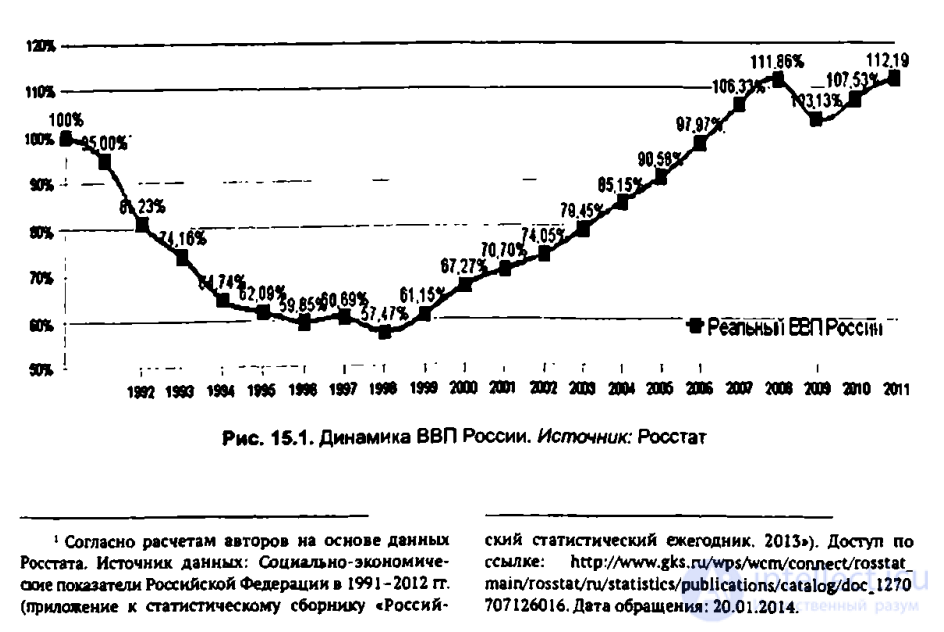
Calculations by other economists are far less optimistic and show only a marginal excess of GDP over the Soviet-era level. Thus, according to data from D. Kotz and F. Weir, based on IMF statistics and Rosstat data from the corresponding periods rather than present-day retrospective recalculations, the maximum decline in Russia's GDP amounted to 51.2%1, rather than 43% (World Bank data). Accordingly, the current ratio of Russia's 2013 GDP to its 1990 level looks substantially less optimistic. In any case, most economists acknowledge that the Russian economy grew in the early 2000s largely as a result of consistently high prices for energy resources and raw materials, which make up the absolutely dominant part of Russian exports.
Let us recall that for the postwar Soviet economy, the main source of growth in national income was the increase in labor productivity. Thus, owing to growth in labor productivity, 69% of the total growth in industrial output was obtained during the war years and the fourth five-year plan, 68% in the fifth five-year plan, 72% in the sixth five-year plan, 62% in the seventh five-year plan, and 73% in the eighth five-year plan.
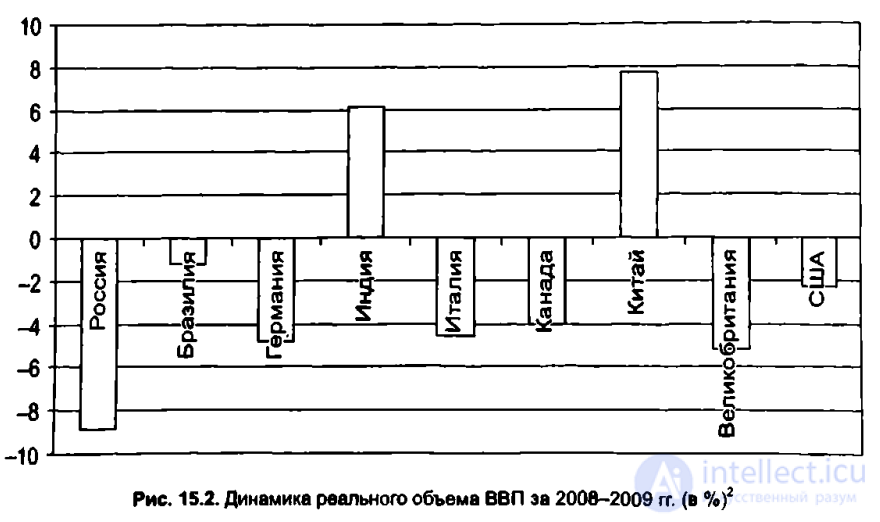
It is significant that, owing to the high degree of the Russian economy's dependence on the world economy, the crisis of 2008-2010 turned out to be one of the deepest in the world for Russia: a cumulative decline of about 9%, against 3-5% in the EU and US (see Fig. 15.2); for China, the crisis merely resulted in a slowdown in growth rates to 7% in 2009-2012.3 In recent years our country has been experiencing a period of slow growth threatening to turn into a downturn (GDP growth rates declined in 2010-2014 and turned negative in 2015). Thus, in the area of such an aggregate macroeconomic indicator as gross domestic product, after more than 25 years of "reforms," the Russian economy has only slightly exceeded the level of the "inefficient," "crisis-ridden" (in the assessment of the authors of the "reforms") economy of the RSFSR. Undoubtedly, one of the most important indicators of the outcomes of the economic system's evolution is the structure of the economy and, in particular, the dynamics of modern high-technology production. If we turn to a general assessment of the situation, it is here almost universally accepted that the high-technology sector in our country has been almost completely destroyed, that the defense industry is being restored only with great difficulty and predominantly on the basis of Soviet-era technologies and developments. The same applies to the space industry. Aircraft manufacturing, in terms of production volumes, is at a level more than half a century old. As for education, the quantitative results look positive here.
Thus, in terms of the number of students per capita in state and non-state institutions of higher and secondary vocational education, the Russian Federation exceeds the RSFSR of 20 years ago by a factor of 1.81, but the quality of university education leaves much to be desired, a view shared by almost all members of the educational community2, and the world rankings of leading domestic universities have fallen compared to the Soviet period. At the same time, the post-reform period was characterized (especially in the 2000s) by growth in such areas as trade and services. In recent years there have emerged positive shifts in some sub-sectors and types of production in the non-resource sector of the real economy. This applies primarily to assembly production, bottling, packaging, and similar goods, as well as (though to a lesser extent) some sub-sectors of manufacturing and agriculture. In the first case, this growth is a consequence of the active advance of transnational corporations, or their Russian subsidiaries, into Russian markets. In the second, it is the result of the development of medium-sized domestic business and of large state-affiliated enterprises (regional agro-industrial associations and the like). Overall, however, the non-resource sector of the real Russian economy retains not only a substantial lag behind developed countries, but also behind the level of development of key sectors of the real economy of the RSFSR in 1990.
This state of affairs in key sectors of the economy is almost universally recognized. The very fact that the Russian authorities have raised the problem of reindustrialization is symptomatic. Let us emphasize, however, that the reindustrialization tasks set by the leaders of the developed Western countries and by the Russian authorities are qualitatively different: there, it is a matter of bringing back industrial production previously outsourced to newly industrialized countries and of expanding high-technology material production adequate to the challenges of the 21st century, whereas here it is a matter of restoring a destroyed Soviet industry amid dangerous dependence on the import of modern technology from abroad.
In the financial sphere, one of the achievements is the creation of a substantial gold and foreign-currency reserve (whereas at the start of 1993 the gold and foreign-currency reserve amounted to $4.5 billion, by the start of 2014 it had reached $509.6 billion; the subsequent deterioration of the economic situation caused a gradual reduction of the reserves).
The growth of the gold and foreign-currency reserve is, however, an achievement of a rather dubious nature. First, the overwhelming part of this reserve consists of US and EU currency and securities, which, as is well known, are (a) low-yielding and (b) stable only insofar as the dominant economic and geopolitical position of these "proto-empires" is maintained. Second, these investments in the economies of the most developed Western countries prove unprofitable for the Russian producer, who is forced to take out loans at interest rates many times higher than those we receive from the West. Russian banks essentially lived off appropriating the difference between the rate charged by foreign credit sources and the rate at which they extended loans domestically. Instead of long-term, low-cost credit and direct investment ensuring the implementation of targeted development programs for high-technology sectors, education, science, and other spheres of the Russian economy, domestic producers took out loans from foreign financial institutions, which, moreover (and this is a reproach directed at Russian business itself), were used predominantly in the raw-materials and intermediary sectors (mainly for financial speculation). When the sanctions regime introduced by the West in 2014 significantly restricted access to Western credit, the policy of stashing away financial reserves further exposed its own unsoundness. As for inflation, it should not be forgotten that during the years of "reforms" prices in the country rose more than 100,000-fold, and for certain groups of goods even more (for example, fares on the Moscow Metro, and a wide range of services)—by a factor of 600,000... In the 2000s, price growth slowed to 6-10% per year, but the past has not been left behind: inflationary expectations remain high. And inflation of 6-10% would, for developed countries, be sufficient grounds for judging macroeconomic policy to be ineffective. In Russia, however, this is... a major achievement. And one more detail: according to numerous experts, the rise in prices for basic consumer goods, housing and utility services, and other goods that form the basis of the expenditures of most Russian citizens, is substantially higher than 10% per year. It is significant that for "ordinary" Russian citizens, what matters is the comparison between the stably maintained prices for basic goods at the end of the USSR's existence and today's prices, in relation to average wages.
A great deal of research has been done on this subject, and virtually all of it shows that for the majority of citizens, who at that time earned wages of 150-350 rubles a month (from a low-skilled worker to a highly skilled industrial worker, from an assistant lecturer to an associate professor at a university) and who now earn 15,000-35,000 rubles (that is, taking redenomination into account, 100,000 times more), the price/wage ratio turns out to be:
• negative for such areas as housing, education, culture, and transport (housing costs have risen 200,000-1,000,000-fold, theater and cinema tickets 300,000-500,000-fold, urban transport 300,000-500,000-fold, and so on);
• neutral or negative for most food products (average price growth of around 100,000-fold; for example, meat in the USSR cost 2 rubles in state stores, where it was in short supply, and 4-6 rubles in free trade at the market; now it costs 200-400 rubles; bread cost 18-26 kopecks per kilogram in the USSR and 20-100 rubles in Russia; milk cost 32 kopecks per liter and 40-60 rubles respectively; a meal in a factory or university cafeteria then cost 60-80 kopecks, and now costs 150-200 rubles);
• positive for such goods as clothing and durable goods (when these goods are valued in the USSR at black-market prices; for example, jeans from a black-market dealer then cost 150-200 rubles, and now cost 500-1,500 rubles) or neutral (when valued at state-store prices; for example, a men's wool suit then cost 100-150 rubles, and now costs 10,000-20,000 rubles).
If, however, we move from macroeconomic indicators, used predominantly in neoclassical theory, to development indicators, the statistics show a substantial deterioration compared to the Soviet period. Thus, the "green GDP," or "inclusive wealth index" (IWI), calculated by UN experts, was declining in our country even during the period of economic growth in the early 2000s: the country's natural resources were shrinking by 0.3% per year, and the per capita IWI index was shrinking at roughly the same average annual rate. In terms of the Human Development Index, our country ranks around 60th (66th in 2011, behind Argentina, Chile, Mexico, Romania...3), which is substantially lower than the figures of twenty years ago (when the USSR was among the top ten; for the RSFSR these figures are similar: in terms of per capita GDP, life expectancy, and education, Russia differed little from the average Soviet level).
For other social indicators, the situation likewise points either to deterioration or to an extremely marginal improvement compared to—let us recall—the crisis year (!) of 1991. Above we noted that, on average, consumption volume in comparable prices grew by about 1.3-fold over a quarter century, but the majority of the population either improved its position only slightly or came to live worse (this concerns the 60% of the population making up the three lowest quintile groups—20% each—two of which have not yet reached the 1991 level in terms of real per capita income, while the income of the third group is at the 1991 level; that is, altogether this concerns 60% of the population).
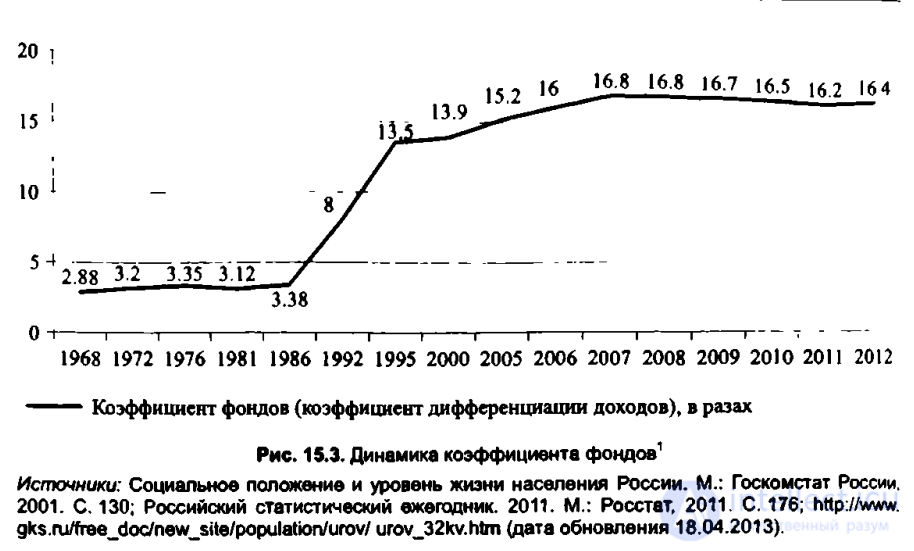
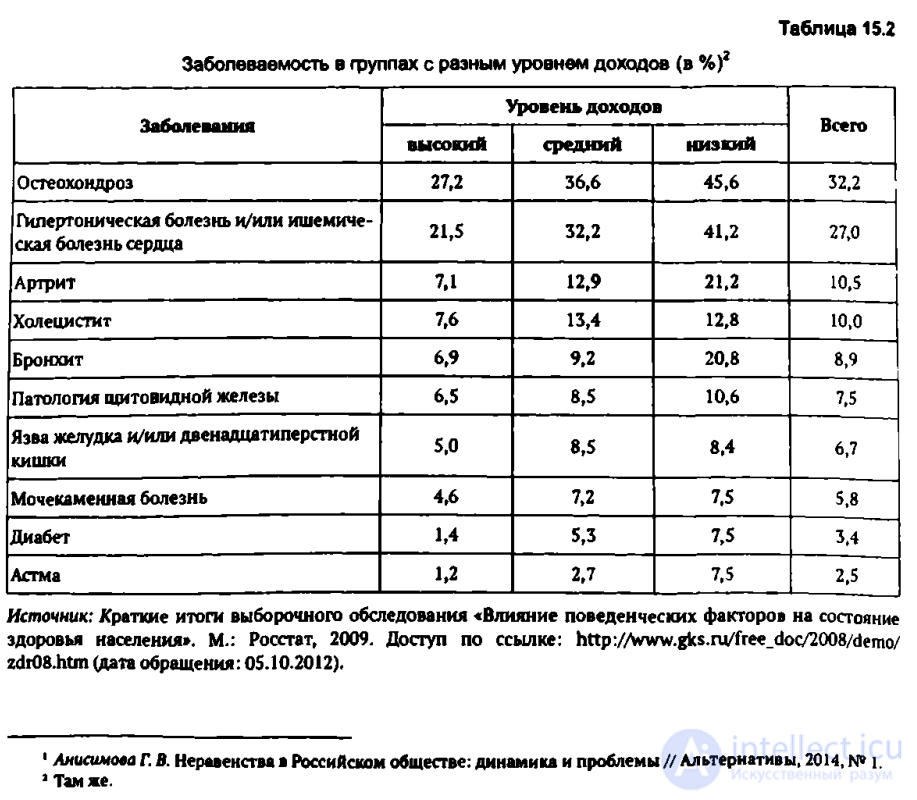
The number of workers whose income is below the subsistence minimum (which does not include, for example, apartment rent, complex medical services, and much else) has increased approximately fourfold over 20 years and, at the start of 2015, exceeded 20 million people. The number of adults and children who have become homeless and destitute exceeds one million. Even more significant is the growth in social differentiation. Official data show that it has increased many times over. Thus, the decile coefficient in present-day Russia is, according to official data, 16 (see Fig. 15.3), but experts' estimates are far more categorical: 25-30.4 It is significant that social differentiation has a meaningful effect on quality of life, which can be illustrated, if only by data on the incidence of illness among population groups with different income levels (see Table 15.2). The contradictions associated with the extremely high level of social differentiation are aggravated by the fact that this differentiation affects not only income but also wealth: according to the Global Wealth Report 2013, in Russia 110 people control 35% of national wealth!
Dynamics of Population Welfare in the RSFSR and in the Russian Federation: Let us note that above we have consistently compared the Russian Federation of 2012-2013 with the RSFSR of 1990-1991. If we suppose that the "reforms" had followed a genuinely effective trajectory, then over this time the country should have traveled the same distance that the USSR traveled, say, from the postwar years of 1946/50 to 1970. Let us recall how the volumes of citizens' consumption, the level of education, life expectancy, scientific and technological potential, labor productivity, and so on changed over those years (see Table 15.1). Back then they grew. And they grew quickly. Let us look only at those indicators for which positive shifts occurred in Russia over 1991-2012. Real incomes then grew by nearly a factor of 3 over 20 years; now they have grown by a factor of 1.3; retail trade turnover then increased fivefold, now threefold; consumption of durable goods grew 7-10-fold, and so on. And this was happening in a planned economy that was, by definition (the definition of such "authorities" as Hayek, Mises, and the like), "inefficient."
The brief overview above of the main results of post-Soviet development in the Russian Federation was not undertaken in order to once again offer criticism of the "reforms" carried out in Russia. The purpose of this overview was to pose a problem: why, in a country with (1) enormous natural resources, (2) a high level of human potential, and in particular one of the world's best systems of education, science, and culture, (3) one of the most powerful military-industrial complexes, concentrating within it strong high-technology industries, and also (4) generally satisfactory industrial production (at the level of moderately developed European countries and above the level of the Third World)—why, in a country with such potential, did the transition from a (seemingly) "inefficient" planned economy to a (supposedly) "efficient" market economy lead to a deep crisis that was overcome only with great difficulty, leaving the country, almost 25 years later, back at its starting level? The answer to this question is provided by an analysis of the specific character of the post-Soviet socioeconomic system.
POST-SOVIET ECONOMY: a variety of late semi-peripheral capitalism, whose distinguishing feature is the preservation of certain traits of the Soviet-type economy.

Comments