
Lecture
The constantly renewing acts of reproduction form the continuous process of the circulation of capital. One completed act of reproduction constitutes the circuit of capital. If money capital is the starting point of reproduction, then the formula for its circuit is as follows: Formula for the circuit of money capital:
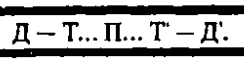
If commodity capital is the starting point of the circuit, then the formula for the circuit of commodity capital changes accordingly:
Formula for the circuit of commodity capital:
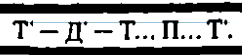
When examining the reproduction of productive capital, its circuit looks as follows:
Formula for the circuit of productive capital:
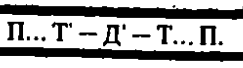
All three of these figures of the circuit, taken together, represent an expression of the unity of production and circulation in the circuit of capital. Every real capital is in the process of all three figures of the circuit simultaneously. The process of circulation, like the process of production, involves expenditures of labor. Does this labor expenditure create value that is added to the commodity in circulation? Not all of it does. Costs of circulation are divided into pure and additional costs. This division depends on whether the costs create a new use value or not.
Pure costs of circulation are those costs of circulation that do not add new value to a commodity.
The costs of carrying out a transaction, and the time spent on the process of buying and selling, do not create new value. On the contrary, expending capital for these purposes reduces the time it functions productively. The same applies to bookkeeping and all forms of economic accounting in general, as well as to the costs of running the monetary system. The fact that these costs are necessary for carrying out the circulation of capital does not make them a value-creating factor, since they add no additional useful properties to the commodities produced.
Parallels with neo-institutional theory (transaction costs):
From the standpoint of modern neo-institutional theory, all these costs could be classified as transaction costs (as opposed to transformation costs, which are associated with the physical transformation of the commodity itself).
Additional costs of circulation are costs that change the useful properties of a commodity and thereby enter into the process of value creation.
Additional costs of circulation include transportation costs and the costs of packaging and wrapping a commodity carried out outside the immediate process of production. Turnover of capital: continuous, interconnected circuits of capital form its turnover. From the standpoint of the circulation process—that is, according to the role that individual component parts play in the circulation process—capital is divided into fixed and circulating capital. Fixed capital is capital that, over the course of one circuit, is only partially consumed, and hence only partially enters the circulation process, although it is applied in its entirety. Accordingly, it transfers its value to the finished product in parts. Its complete renewal occurs only after many cycles of the circuit. Circulating capital is capital that enters the circulation process and is consumed in it entirely, and must be renewed in every cycle of the circuit. Elements of circulating capital transfer their entire value to the finished product in each circuit.
Fixed capital includes those elements of constant capital which, in each given cycle of commodity production, wear out only partially, and only part of their value is transferred to the finished product. This is the value of machinery, equipment, buildings, and structures.
Circulating capital includes all variable capital, since labor power is consumed in each circuit and its value is likewise transferred in full to the finished product and must be replaced in each circuit, as well as part of the elements of constant capital—the value of raw materials and supplies, since it is transferred in full to the product in each circuit and likewise requires replacement in each circuit. The division of capital into fixed and circulating, which objectively arises from circulation, at the same time obscures the fundamentally different roles that different elements of capital—constant and variable capital—play in the process of producing surplus value. This is why, outside of Marxism, the division into constant and variable capital is not used, and only the division into fixed and circulating is known—that is, the division that appears on the surface of the circulation process of capital.
The circuit and turnover of individual, separate capitals are in fact merely the circulation of separated parts of social capital. No individual capital can be productive—that is, it cannot exist at all outside of its linkage with the entire mass of individual capitals, a linkage created by the social division of labor. Thus, individual capital is conceivable at all only within the system of social capital. Social capital is the production relation of the aggregate capitalist to the aggregate labor power of society, manifesting itself as a multitude of individual relations, whose division—as well as their interconnection into social capital—is conditioned by the social division of labor.
The laws of reproduction of social capital therefore differ from the laws of reproduction of individual capitals. In the circulation process of an individual capital, it is sufficient for it to be replaced merely in terms of value, and although it must also be replaced in its natural (physical) form, this appears as a simple consequence of its replacement in value form, in the form of money capital. As for the reproduction and circulation of social capital, however, the proportions of the social division of labor take on fundamental importance for it. Only when certain proportions of the social division of labor are observed can the real process of production and reproduction proceed normally, and hence social capital can be replaced both in value and, moreover, in natural form.
To investigate the process of reproduction of social capital, Marx introduces the simplest two-sector model of social production. He divides social production into two departments—the production of means of production and the production of articles of consumption—not following the sectoral classifications previously accepted in statistics (for example, into industry and agriculture), and introducing for the first time his own approach to the division of social production. Why does Marx propose precisely this division? It is connected with the different roles that articles of consumption and means of production play in the process of social reproduction, not only from the standpoint of the production process in general, regardless of its social form, but also of the process of capital production. Means of production form the material basis of constant capital, while articles of consumption form that of variable capital. Therefore, Marx's proposed division of social production into two departments makes it possible to trace simultaneously the process of replacement of various elements of capital both in value and in natural form.
In order to ensure the replacement of elements of constant and variable capital both in value and in natural form, aggregate production in the second department (production of articles of consumption) must ensure the replacement of the variable capital and surplus value of both the first and second departments:

Aggregate production in the first department (production of means of production) must ensure the replacement of fixed capital both in the first,
and in the second department:

Transforming both the first and second equations yields one and the same equality:
The law of simple reproduction:
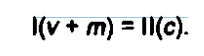
Thus, that part of the production of means of production in the first department which corresponds in value to the variable capital and surplus value of the first department must equal that part of the production of articles of consumption in the second department which corresponds in value to the constant capital of the second department.
The laws of expanded reproduction Marx limits himself to the formula:
The inequality for expanded reproduction proposed by K. Marx:
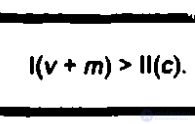
Such an inequality must indeed hold for expanded reproduction. However, it does not ensure the proportional replacement of all elements of social capital in both departments, and, moreover, it is not the only inequality that must hold. Using Marx's own notation, we can set out the precise initial conditions for expanded reproduction. Aggregate production in the second department must ensure the replacement of the variable capital of both the first and second departments, and that share of the surplus value in both departments which is directed toward the consumption of capitalists and the increase of variable capital (the hiring of additional labor power):

Aggregate production in the first department must ensure the replacement of the constant capital of both the first and second departments, and that share of the surplus value in both departments which is directed toward the increase of constant capital:

where: b — the share of surplus value advanced for the capitalist's own consumption and the increase of variable capital in the second department;
a — the share of surplus value advanced for the capitalist's own consumption and the increase of variable capital in the first department;
1−a — the share of surplus value advanced for the increase of constant capital in the first department;
1−b — the share of surplus value advanced for the increase of constant capital in the second department.
Transforming the first equation, we obtain:  , which corresponds to the inequality

Transforming the second equation, we obtain:  which corresponds to the inequality

.
Thus, we see that Marx's inequality is only one of the conditions for expanded reproduction, and one that is not too precisely defined quantitatively.
Further transformation yields the precise conditions for proportional expanded reproduction.
From both equations we obtain one and the same equality

Or, interpreted in words: production in the second department corresponding in value to the constant capital of the second department and to that part of the surplus value of the second department which is directed toward the increase of constant capital must equal the production in the first department corresponding in value to the variable capital of the first department and to that part of the surplus value of the first department which is directed toward the increase in the capitalists' personal consumption in the expansion of variable capital.
Why then does Marx limit himself to a single inequality, without showing the precise proportions required for expanded reproduction? Marx himself nowhere explains this directly. One can only put forward a conjecture: because the process of capitalist production never ensures strict proportionality in the replacement of all elements of capital, either in value or in natural form.
Social capital does not function as a single whole, but is made up of the chaotic interaction of individual capitals, which are opposed to one another and separated by the barriers of private property. As is generally the case under commodity production, the process of production and reproduction of capital proceeds on the basis of private labors and private entrepreneurial decisions independent of one another, oriented only toward the spontaneous fluctuations of commodity prices. This is why Marx considers it possible to show only the boundary conditions of expanded reproduction under which it can take place at all, regardless of how proportional it is.
On the law of the preferential growth of the first department (the preferential growth of the production of means of production): The laws of expanded reproduction of social capital investigated and formulated by Marx gave his followers (V. I. Lenin) grounds to conclude that capitalist expanded reproduction must be characterized by a predominance in the growth rate of the first department of social production over that of the second. This was called the law of the preferential growth of the first department, or the law of the preferential growth of the production of means of production. The logic of this conclusion was simple: if (as is characteristic of the industrial stage of capitalism) reproduction proceeds with a rising organic composition of capital, then, consequently, in each new cycle of reproduction the ratio of additional constant capital to additional variable capital shifts in favor of the former. It follows that the production of means of production must expand faster than the production of articles of consumption.
Stalinized "Marxism-Leninism" turned this assertion into an unquestionable dogma, one that no longer had any connection to the premises on the basis of which this conclusion was drawn, and within which it could be valid. Meanwhile, this law had limited applicability, determined by the historical framework of the period of extensive development of capitalist industrialization. Indeed, when, in one branch of industry after another, hand tools were massively replaced by machines, the value of the means of production employed rose considerably, and the branches producing machine technology developed at an accelerated pace.
However, even before the completion of mass industrialization, other laws of the reproduction of capital begin to operate. The transition to the mass production of machine technology and the growth of labor productivity in the corresponding branches make it possible to reduce the cost of producing machines and equipment. And although, in natural (physical) form, the production of machine technology may expand very substantially, in value terms this increase may be much less significant. Moreover, once the period of mass industrialization is complete, forced growth in the production of means of production is no longer required, and technical progress makes it possible to cheapen the elements of constant capital. At the same time, a tendency toward a rise in the value of labor power develops. Thus, a capital-saving path of expanded reproduction becomes possible, in which growth in the technical composition of capital is not accompanied by growth in its value composition. [1] The reasons for this dogmatization lay not only in the general tendency toward dogmatism characteristic of the Stalin period, but also in the entirely pragmatic defense of the interests of the economic bureaucracy in the heavy and defense industries, which held a dominant position and sought to secure it.
The material basis of cyclical crises under capitalism lies in the renewal of the material elements of constant capital in the process of capitalist reproduction. Since the establishment of a capitalist factory presupposes the simultaneous mass installation of machinery and equipment, the obsolescence of these elements of constant capital also occurs more or less simultaneously, which in turn requires their more or less simultaneous replacement. The mass replacement of machinery and equipment with new ones—if they are technically substantially superior—at one or several capitalist factories creates competitive advantages for their owners and pushes other capitalists to likewise carry out a mass replacement of machinery and equipment. Such a chain reaction is by no means triggered by any and every individual act of more or less mass replacement of machinery and equipment, but only by those that coincide with the achievement of substantial shifts in technical progress and, accordingly, in the productivity of the new machines.
Only in such a case does the level of competitive advantage gained make the replacement of machinery and equipment—even if not yet physically worn out—a compelling necessity for other capitalists, one without which survival in competition is impossible. This creates increased demand for the output of the branches of the first department, leading to growth in the production of means of production, and along with this—growth in wages and the hiring of additional workers, which in turn increases demand for articles of consumption. A general industrial upswing sets in, which, however, together with the exhaustion of the wave of mass equipment replacement, eventually leads to an industrial downturn and crisis: expanded production suddenly runs up against a narrowed demand for machinery and equipment. The economic mechanism of the cyclical nature of capitalist reproduction will be examined in more detail later.
For the capitalist, in the process of capitalist reproduction and circulation, surplus value appears to be the product not merely of variable capital, but of the entire capital advanced. There are objective grounds for this appearance—from the standpoint of an individual capital, the surplus value it receives is a consequence of the fact that it throws a certain sum of value into circulation, regardless of what that sum was spent on. From the standpoint of the circulation process, the distinction between the roles of constant and variable capital in the process of producing surplus value is erased, and obscured by the division into fixed and circulating capital, which differ only in their speed of turnover (as well as in the manner of transferring their value to the finished product—in the one case in parts, in the other, all at once). And indeed, from any standpoint, the expenditure of means of production is just as necessary a condition for the production of surplus value (and for the production of products of labor in general) as is the expenditure of living human labor beyond the necessary labor time. It is another matter that past (objectified) labor does not itself produce value and surplus value.
Thus, for the capitalist, surplus value appears as a consequence of the production costs he has incurred—that is, of the aggregate outlay of capital. In the category of production costs, constant and variable capital merge together, now appearing as a single, general outlay of capital.
Surplus value, as the product of capital as a whole, now appears in the form of capitalist profit. Profit appears as the transformed form of surplus value. In capitalist production, capitals of equal magnitude tend to produce roughly the same rate of profit on the capital invested, regardless of the amount of variable capital employed. Of course, individual differences in the rate of profit between different capitals are quite large, but they are determined by individual differences in aggregate production costs, not by differences in the amount of variable capital employed. There are also sectoral (branch) differences in the rate of profit (which have various causes), but these too do not correspond to differences in the share of variable capital. Despite all individual and sectoral differences, capitals tend toward earning an average rate of profit on the capital invested.
How can this be? After all, surplus value is the result of the functioning specifically of variable capital, of the labor power hired with its help, and, other things being equal, is proportional to the magnitude of that capital? Why, then, is profit formed in proportion to the outlay of capital as a whole?
Where do capitalists in branches with a high organic composition of capital get their additional surplus value, and where does the surplus value go missing in branches with a low organic composition of capital? The equalization of the rate of profit is carried out through the mechanism of competition among capitals. From branches with a high organic composition of capital, where less surplus value is produced relative to the total capital invested, and where the rate of profit produced is therefore relatively lower, capitals, in pursuit of a higher rate of profit, move into branches with a lower organic composition. As a result, a shortage of supply relative to demand arises in the first group of branches, while a surplus arises in the second.
Prices in the first group of branches rise above value, while in the second group they fall below value. Through this, a redistribution of the surplus value created takes place between branches, such that an equal amount of surplus value falls to capitals of equal size. This is how average profit is formed. Price of production is the price of commodities formed on the basis of the competition of capitals for an equal profit on equal capital, and quantitatively equal to the cost of production plus average profit.
On the contradiction between Volumes I and III of "Capital": This concept of Marx's gave rise to polemics around the so-called contradiction between Volumes I and III of "Capital." Marx's critics assert that the determination of commodity prices in Volume I of "Capital" on the basis of the labor theory of value contradicts the determination of commodity prices in Volume III of "Capital" on the basis of prices of production. In their view, this contradiction arose from Marx's attempt to reconcile an untenable labor theory of value, and the theory of surplus value derived from it, with the facts of capitalist reality. The contradiction between Volumes I and III of "Capital" does indeed exist. However, this contradiction does not arise from an internal inconsistency between Volumes I and III of "Capital," but from the objective contradictions of capitalist reality itself, which give rise to a discrepancy between the essence of capitalist relations and the surface forms in which they appear.
In analyzing capitalist relations of production, we have already encountered transformed forms—forms that negate their own content. One such form, for example, is wages, which appear as the transformed form of the price, and accordingly the value, of labor power. The form of wages creates the illusion that it is in reality payment to the worker for his labor, rather than the price paid by the capitalist to purchase his labor power. In just the same way, the form of profit denies the fact that surplus value is created by the living labor of wage workers, presenting the excess over production costs as the product of capital as a whole. Thus, while in essence surplus value is the product of variable capital, on the surface of phenomena profit appears as the product of capital as a whole. In Volume III of "Capital," Marx uncovers this contradiction, showing how, through the unfolding of the laws of capitalist production itself, surplus value takes on the form of profit.
In Volume III of "Capital," Marx examines the question of the tendency of the rate of profit to fall. In his view, under the influence of the growing organic composition of capital, the rate of capitalist profit must tend to fall, since, with the development of technical progress, the share of variable capital in total capital declines while the share of constant capital rises. However, as Marx himself emphasizes, this law does not operate with iron inevitability. It represents only a tendency, one seriously modified by the influence of counteracting factors. Of all the factors of this kind analyzed by Marx, the following are of the greatest importance.
First, there are factors that cheapen the elements of fixed capital, which hinder the growth of the value composition of capital. Among these factors, the most important role is played by the growth of labor productivity, which is itself an objective, internally conditioned (immanent) historical tendency of the development of the capitalist mode of production.
Second, there is the growth in the rate of exploitation, ensured by the production of relative surplus value through the cheapening of the material elements of variable capital. In this case, the relative share of living labor compared to objectified labor may decline (i.e., the organic composition of capital rises), yet the proportion in which this living labor divides into necessary and surplus labor also changes. Although the share of living labor as a whole falls, the rate of surplus value may rise, and along with it the rate of profit may rise (or at least not fall). It can be noted that the production of relative surplus value is likewise an immanent law of the capitalist mode of production.
Third, foreign trade with less developed countries has a restraining influence on the fall in the rate of profit. This factor retains its significance to this day. The gap in the level of economic development between the countries of the "core" of the capitalist world economy and its "periphery" may narrow, but it remains a fact of the world capitalist economy, one that preserves favorable conditions for capitalists of developed countries to extract additional profit from trade with less developed countries. There is one more factor that Marx did not analyze, since it did not fully manifest itself until the end of the nineteenth century.
Under the influence of the growing complexity of the means of production employed, as well as of the organized struggle of the working class in defense of its interests, the value and price of labor power rise, which likewise hinders the increase in the value composition of capital, and hence the fall in the rate of profit. Thus, we see that the factors counteracting the fall in the rate of profit are not some incidental circumstances, but arise from the laws of development of the capitalist mode of production itself. They are capable of preventing a significant fall in the rate of profit. This does not mean, however, that the tendency toward a falling rate of profit does not operate. It means that, under the threat of this tendency, capital is compelled to choose only those paths of technical progress and of the development of production in general that do not allow the rate of profit to fall noticeably.
Thus, capitalist relations, which create capital's drive toward the unlimited improvement of production, themselves set definite limits to this very drive. "The true barrier to capitalist production is capital itself: it is that capital and its self-expansion appear as the starting and the closing point, the motive and the purpose of production; that production is only production for capital, and not the reverse: the means of production are not mere means for a constant expansion of the living process of the society of producers. <...> The means—unrestricted development of the social productive forces—come continually into conflict with the limited purpose—the increase of the value of the existing capital. If, therefore, the capitalist mode of production is a historical means for developing the material powers of production and creating the world market corresponding to these, it is at the same time in continual conflict with this its historical task and the corresponding social relations of production peculiar to it."[1]
The forms that capital takes on in the process of circulation—money capital, commodity capital, and productive capital—become, in the historical development of capitalist production, separate functional forms in their own right. Individual capitalist entrepreneurs begin to specialize in performing the corresponding functions—in managing money, commodity, and industrial capital respectively. This does not mean that the industrial capitalist no longer engages in trading or monetary operations at all. However, a significant mass of commodity and money capital [1] Marx K. Capital // Marx K. and Engels F., Works, 2nd ed., vol. 25, part I, p. 274. begins to function separately. The specialization of capitalists in managing money and commodity capital makes it possible to significantly reduce the time of circulation and the costs of circulation, compared with a way of doing business in which every capitalist engages in production as well as trading and monetary operations all at once. Thus, the specialization of capitals increases the rate of profit of productive capital. The separate character of commodity capital manifests itself not only in the fact that the sale, the final realization of commodity capital, now becomes the function of a special entrepreneur—the merchant capitalist—but also in the fact that commodity capital now appears not merely as one of the functional forms that industrial capital assumes in the course of its metamorphosis, but as an independent capital carrying out an independent circulation of its own. The merchant capitalist independently advances money to purchase commodity capital, and this money capital he has advanced carries out a circuit according to the general formula of capital: 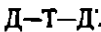
The general rate of profit is now calculated on the entire aggregate capital, that is, productive capital plus commercial capital. The price of production is formed accordingly. Industrial capital realizes profit because that profit, as surplus value, is already contained in the value of the commodity. Commodity capital realizes profit only because not all of the surplus value, or profit, was realized by the industrial capitalist in the price of the commodity. The merchant capitalist earns a profit not because he sells commodities above their value, but because the industrial capitalist sells commodities below their value. Since, in this case, the sale of the commodity by the industrial capitalist—when it is sold to a trading intermediary—is not the final sale, not the sale to the actual consumer, and since the capital has therefore not yet completed its circuit, and its completion falls to the merchant capitalist, industrial capital cannot lay claim to the entire surplus value produced. Commercial capital appropriates surplus value by forcing the industrial capitalist to cede to it part of the surplus value created by industrial workers. Therefore, the larger commercial capital is in comparison with industrial capital, the lower, correspondingly, is the rate of industrial profit (and vice versa).
Although commercial capital also exploits wage workers, just as industrial capital does (compelling them to labor beyond the necessary labor time), the wage workers who service the metamorphosis of commodity capital create neither value nor surplus value. Nevertheless, the unpaid (surplus) labor of workers in trade is, for commercial capital, a necessary condition for appropriating part of the surplus value created in industry. How does this happen? The labor of wage workers in the sphere of trade lowers the costs of circulation, creating savings on these costs for the industrial capitalist. Thus, although the participation of the merchant capitalist in profit reduces the profit of the industrial capitalist, thanks to the savings on circulation costs achieved through specialization, this reduction in profit occurs to a lesser degree than would be the case if the industrial capitalist independently carried out trading operations on his own.
Exactly the same considerations apply to the separated money capital as well—that is, to the capital of money capitalists servicing the monetary operations of industrial capital. It should be particularly emphasized that money capital, in this respect—that is, insofar as it merely services the metamorphosis of the commodity, mediating purchase and sale—is itself a variety of commercial capital, namely money-trading capital, just as commodity capital is commodity-trading capital. In general, independent commercial capital, in the form of commodity capital and money capital, is not something absolutely independent of industrial capital. These forms are merely relatively separated functional forms of the latter, performing the necessary circulation functions of industrial capital itself. And it is only to this extent that they participate in the equalization of the general rate of profit and can lay claim to a portion of the surplus value produced by the wage workers of the industrial capitalist. It was noted above that the wage workers of commodity-trading capital (as well as of money-trading capital) do not produce value or surplus value—insofar as we are speaking only of servicing the change of forms of capital in the process of circulation, abstracting from additional costs of circulation. They relatively reduce unproductive costs of circulation, but they create no use value whatsoever (and hence neither value nor surplus value).
This is precisely why, although their functions are necessary for ensuring the process of reproduction and circulation of social capital, they are unproductive workers. In general, for Marx, labor that is productive in a commodity economy is labor that creates both use value and value. Labor that is productive in the capitalist sense, however, is labor that is exchanged for capital (variable capital) rather than for revenue—that is, labor that yields surplus value. This is why trade workers (as well as employees of credit and financial institutions) are unproductive in the first sense of the word, but are productive for the capitalist. Matters would stand differently if we were considering a mode of production based on the joint participation of producers in labor and their joint ownership of the means of production. In that case, the functions of the circulation process—that is, for example, the movement of products of labor from producer to consumer and the keeping of social accounts—would appear directly as part of social reproduction, and the workers employed in it, as necessary elements of the aggregate worker of society, would appear as productive workers.
In that case, however, a whole series of functions connected with the commodity and capitalist form of production would disappear, including the carrying out of purchase-and-sale transactions, the servicing of the monetary economy, and so on. 10.4. Loan Capital and Interest. Interest and Entrepreneurial Profit. Fictitious Capital In the course of the development of the capitalist process of production, separated money capital is capable not only of servicing the circuit of capital, the transition from commodity form to money form and back. Within the system of capitalist relations of production, money itself is potentially capital, for it can be used to purchase labor power and means of production on the basis of capitalist relations, for the exploitation of that labor power and the production of surplus value.
This possibility is realized in the relationship between the money capitalist and the industrial capitalist, taking the form of a loan—a temporary cession of money capital to the industrial capitalist. In this relationship, money capital becomes loan capital. Here the money is provided to the industrial capitalist not as money, but precisely as capital, for productive use—for the production of surplus value. On this basis, money capital acquires an additional use value. Its use value as money consisted in the property of universal exchangeability. Its use value precisely as capital consists in its capacity to appropriate someone else's unpaid labor—the surplus labor of wage workers—and thereby to produce surplus value or profit. This specific use value of money as capital is paid by the industrial capitalist to the loan capitalist in the form of interest on the loan. The very existence of interest is determined by the fact that the capital lent is put to productive use, by its capacity to yield a profit. It is precisely this profit, arising from the use of borrowed money as capital, that is the source from which interest is paid. Without such use, the payment of interest (within the framework of relations of the capitalist mode of production[1]) would be impossible.
However, representing interest as the price of loan capital is a purely irrational notion, for it bears no relation whatsoever to the determination of the value, and accordingly the price, of a commodity by labor, nor even to the determination of the market price as the price of production (costs plus average profit). Nevertheless, interest as the price of loan capital constitutes an objective form of the capitalist mode of production. What, then, determines the magnitude of interest? The magnitude of interest depends on the proportion in which the capital of society divides into industrial and loan capital—that is, on the extent to which capital is diverted from productive use and takes the form of temporarily free money capital. This proportion determines the outcome of the competition between industrial and loan capitalists, on the basis of which it is decided what part of capitalist profit will be appropriated by the latter in the form of interest.
The lower limit of the rate of interest is some minimum magnitude at which lending capital out has economic sense for its owners (this magnitude tends toward zero, but, in general, cannot reach it). The upper limit is the magnitude of average profit. In periods of crisis, however, a situation may temporarily arise [1] Here we abstract from cases of non-capitalist use of borrowed money—for example, for consumer needs. In this case, the source from which interest is paid is not profit obtained from the capitalist use of the loan, but, for example, wages, or profit from the use of one's own capital. in which the rate of interest exceeds the rate of profit, owing to an acute need for money to make current payments. The general historical tendency consists in an increase in the relative share of money capital, and, correspondingly, in a fall in the rate of interest. In loan capital, the capitalist relation acquires its most fetishized, abstract expression—loan capital appears as the simple begetting of money by money, as value that of itself yields additional value. Interest appears as a property of loan capital itself, as its direct offspring.
By contrast, industrial profit then appears merely as a consequence of the application of loan capital. The actual relationship, as was shown above, is the reverse — interest can arise only because productive capital is functioning, ensuring the production of surplus value by wage workers. In loan capital, the source of interest comes to be seen in the very fact of ownership of capital. Possession of ownership of a certain sum of money comes to be seen as sufficient grounds for that money to bring in additional money. Even an industrial capitalist who does not use credit begins to divide his profit into interest and entrepreneurial income — that is, into the part of profit that, as he supposes, belongs to him as owner of capital, and the part that belongs to him as a functioning capitalist. Moreover, entrepreneurial profit itself comes to be regarded no longer as a product of capital, nor as the result of the exploitation of wage workers. Interest now appears as the product of capital, while entrepreneurial income is presented as payment for the capitalist's labor of exploiting wage workers, for the labor of supervision and management. In such a conception, the labor of management, which is indeed necessary in any combined process of production as a component part of the labor of the collective worker, is conflated with the specific functions arising from the class-antagonistic nature of the capitalist mode of production.
Such specific functions, engendered by the conflict of interests between exploiters and exploited, exist in any class-antagonistic mode of production — for example, the functions of an overseer of slaves. What the actual functions of the capitalist-entrepreneur in managing production are, independent of their capitalist form, and what the proper level of pay for these functions should be, is shown by workers' cooperative factories that exist under capitalism.
For example, the charter of the Mondragon Cooperative Corporation (Spain) stipulates that the highest salary of managers may not exceed the minimum wage of cooperative workers by more than 4.5 times (and even that only in exceptional cases). At the same time, the quality of the managerial staff's work at Mondragon cooperatives is unprecedentedly high. This situation differs strikingly from the situation in capitalist corporations, where the "salary" of managers, members of boards of directors, and the like, is usually merely a disguised form of appropriating entrepreneurial profit, and not infrequently a form of redistributing shareholders' income in their own favor. Such highly paid managers often drive their enterprises into bankruptcy.
The explanation of interest in neoclassical theory:
In modern neoclassical theory, the nature of interest is explained in a thoroughly absurd manner.
This theory represents a step backward even compared with the conceptions already worked out in the mid-eighteenth century. Interest is derived from the difference between subjective valuations of "present goods" and "future goods." Since it is natural to value future goods lower than present goods, the loan capitalist is entitled to demand compensation for forgoing immediate consumption. Thus, this is one variety of theories that derive capitalist profit from the capitalist's "abstinence." Whether the capitalist "deserves" reward for his "abstinence" or "does not deserve" it is a question that has nothing to do with economic science. Economic science, meanwhile, has so far failed to explain how anything at all could arise from the mere fact of "abstinence." The only rational element in this whole set of "explanations" is the reference to a real, existing quantitative difference between the price of present goods and future goods. Only this difference is, in this case, exactly the reverse of what is presented in neoclassical theory. "Present goods," once applied in the process of capitalist production, have the property of increasing their value in the future through the exploitation of wage labor. And it is precisely this process of producing surplus value that creates the possibility of appropriating part of the surplus value in the form of interest — it is no accident that the payment of interest occurs only after a certain period has elapsed, the period needed to produce surplus value by means of the borrowed money capital.
As the capitalist mode of production develops, loan capital, having become a distinct entity, increasingly ceases to be the property of individual private owners of capital alone, concentrating instead in banks, and later in other credit institutions as well. A bank concentrates within itself the monetary savings of capitalists, the small savings of other social strata, as well as the temporarily free funds of capitalist enterprises and the funds they need for conducting current settlements.
As a result, the banker acts as an intermediary between the actual creditors — the owners of money who deposit it in the bank — and the borrowers. For the borrower, the bank acts as the aggregate creditor, representing all the actual creditors, while for the creditors it acts as the aggregate borrower, concluding contracts with creditors on uniform terms. A bank's capital is divided into its own capital and borrowed capital — that is, funds attracted from depositors, with the latter usually many times exceeding the former. Bank profit is formed as the difference between the loan interest rate and the deposit interest rate — that is, between the interest the bank charges borrowers and the interest it pays to holders of money deposited in the bank, minus the costs of banking operations. The development of loan capital leads to the extensive development of credit money. Even the functioning of money as a means of payment (when payment is made some time after the act of purchase and sale and the transfer of the commodity into the buyer's hands) gave rise to payment obligations, the most widely used of which is the bill of exchange.
These payment obligations themselves (bills of exchange) came to be used for settlements in place of money, performing the function of a means of circulation. If a need for actual money arose, one could discount the bill of exchange — that is, sell it at some discount, granting its purchaser the right to demand payment on it. With the development of the credit system, the practice of banks discounting bills of exchange develops. Banks themselves also begin to issue bills of exchange.
A banknote is a bill of exchange drawn on a banker.
Banknotes, being more reliable payment obligations than those issued by private individuals, came to be readily used as a means of circulation. Over time, the right to issue banknotes was transferred solely to state banks or banks specially authorized by the state, and the payment power of banknotes came to be backed by state guarantees. In this way, money was transformed into credit money.
Another consequence of the development of credit was the widespread spread of fictitious capital. Fictitious capital is a form of existence of capital in which the title certifying ownership rights to real capital undergoes an independent circulation, separated from the movement of the real capital, although fictitious and real capital retain channels of mutual influence.
The already-mentioned bills of exchange, warehouse or dock receipts, became among the first forms of fictitious capital. A purchase of goods could be paid for with a bill of exchange (rather than actual money), a new bill of exchange could be issued against those goods, and so on. A colossal impetus to the development of fictitious capital was given by the formation of joint-stock companies.
Shares, too, have a credit basis. The purchaser of a share essentially extends credit to the joint-stock company — though not at a strictly stipulated rate of interest, but in the expectation of future dividends on the shares or of a rise in the market price of the share itself. Shares begin to undergo independent circulation on the stock market. The buying and selling of shares becomes both a means of attracting money capital by accumulating relatively small, temporarily free monetary funds, and an object of purely speculative operations, as is the case with operations involving all forms of fictitious capital in general.
How the price of securities is formed:
The price of securities (shares, bonds, certificates, etc.) is formed as the capitalization of interest. It equals the sum of money that would need to be placed at interest in order to yield the same income as that produced by the given security. For example, if the annual dividends on some share amounted to $10, then, if the interest rate is 5% per annum, one would need to lend out $200 at interest to obtain the same income. This is what the price of that share would be. However, actual market quotations may deviate from the calculated price many times over. This is because, at present, the principal form of obtaining income from securities is not the appropriation of dividends but the buying and selling of shares (bonds, etc.) on the stock market in anticipation of a favorable change in the price of these securities. As a result, share prices can fluctuate considerably under the influence of a variety of market factors, including deliberate speculative pressure on share prices. At times, the prices of shares even of loss-making enterprises can soar to astronomical heights, while the shares of profitable enterprises may be quoted substantially lower.
The development of the joint-stock form of enterprise modifies the capitalist mode of production, transforming private individual enterprises into collective enterprises of capitalists, and their private capital into social capital. This, in Marx's words, is the abolition of capitalist production within the framework of the capitalist mode of production itself. "It is private production without the control of private property."
1. Marx, K. Capital // Marx K. and Engels F., Works, 2nd ed., vol. 25, part 1, p. 482.
At the same time, the joint-stock form gives a handful of capitalists the ability to control concentrated capital of enormous scale, engendering an entire system of fraud and deception connected with the issuance of shares and trading in them. With the development of the modern stock market, the uncontrolled processes of speculative capital movement have acquired an altogether unprecedented scale. The joint-stock form of capital, by ensuring its accelerated concentration and specialization, creates the preconditions for the formation of capitalist enterprises of such enormous size that a few such capitals can divide entire branches of industry among themselves, and sometimes even combine to seize 100% control of some branch. A tendency toward the formation of capitalist monopolies arises. Marx also noted that the development of credit makes possible the appearance, on a noticeable scale, of workers' cooperative factories (which, without it, could hardly count on any external sources of capital). These cooperative factories themselves, although they remain within the framework of the capitalist mode of production, signify the positive abolition of private property, the elimination of relations between wage labor and capital — though only within the narrow confines of such cooperative associations.
The formation of rent on natural resources (including here land, mining, forest, water, and other kinds of rent — for brevity we shall hereafter use the single term "land rent") must be explained from the standpoint of the laws of the capitalist mode of production. The obvious basis for the formation of land rent is the difference in fertility among different plots of land (or in the productivity of deposits, etc.). But how does a difference in fertility give rise to rent? Capitalist farming on the land is based on a separation of the economic figures of the landowner and the operating capitalist — the tenant of the land plot. For plots of land differing in fertility, the owners of these plots receive different rental payments from the capitalist farmers who use them. Rental payment includes compensation for the depletion of soil fertility, payment for the use of various structures and buildings on the land (depreciation charges), interest on the capital invested in the leased land, and rent proper. The capitalist farmer himself receives the average profit — but now on his own capital, invested in the exploitation of wage workers on the leased land. The figures of the landowner and the operating capitalist-farmer may also coincide. But even in this case (as in the case, discussed above, of a capitalist charging interest while using his own rather than borrowed capital) the capitalist divides the income he receives into land rent and average profit (entrepreneurial income).
The magnitude of the rent is higher, the higher the natural fertility of the leased plot. But where does the rent come from? How can the farmer pay the landowner, in addition to interest on the capital invested in the land and inseparable from it, a rent as well? The source of rent becomes clear if one takes into account the peculiar mechanism by which the price of agricultural products is formed. Recall that the value of commodities is determined by the average normal labor expenditures required for their current reproduction. However, production on the land (agriculture, fishing, forestry, extractive industry...) differs from other kinds of production in that here production is based on the use of strictly limited natural resources. For example, there is a certain finite area of land suitable for agricultural use, and different plots possess different degrees of fertility, and therefore require different costs to produce the same quantity of agricultural products. In that case, for one and the same capital invested, even under average normal conditions of production (equal equipment with machinery, equal technologies, an equal level of labor organization and wage level, etc.), these plots will yield different profits owing to differences in the natural fertility of the soil.
It follows that equal capitals in agriculture cannot claim the average profit if they are applied on plots with a level of natural fertility worse than average. In that case, these capitals will flee agriculture for other branches of production in pursuit of the normal average profit. The amount of cultivated land and the quantity of products produced will decrease, demand in the market will exceed supply, the price of agricultural produce will rise, and this process will continue until the capital invested in agriculture, even on relatively worse plots, is assured the average profit. Thus, the price of production in agriculture (as, indeed, in branches based on the direct appropriation of natural resources generally) is regulated not by average but by the worst conditions of production, or, more precisely, by the average conditions of production on relatively worse-fertility plots of land. Owing to this, capitalists farming relatively better-fertility plots of land receive, in addition to the average profit, an extra profit as well, the magnitude of which is differentiated depending on the level of fertility of the plots cultivated. Differential extra profit is the profit obtained by capitalists farming relatively better-fertility plots of land in excess of the average profit, as a result of the fact that the price of production in agriculture is regulated by the average-normal conditions of production on relatively worse-fertility plots of land.
Of course, this in no way means that demand for agricultural produce always exceeds supply. The spontaneous character of commodity production and the spontaneous character of competition among private capitals periodically (as a rule, during cyclical crises) leads to the formation of a relative excess of applied capital in agriculture and to overproduction.
However, agriculture is characterized by a situation of relative underproduction compared with industrial branches. This differential extra profit has as its source the redistribution of surplus value (profit) created in industrial branches, in favor of capitalists engaged in agriculture. The basis for such redistribution is the limited extent of cultivable land, which, under capitalist relations, takes the form of a monopoly on land as an object of enterprise. Plots with different natural fertility do not here constitute a general condition of production available to all capitalists (as, for example, the use of steam engines or electric motors is); on the contrary, the natural fertility of these plots is the exclusive possession only of those capitalists who have leased these plots. And it is precisely the differential extra profit obtained under such conditions that is the source of rent — differential rent — paid by the farmer to the landowner (even if the landowner is the farmer himself).
Differential rent is that part of the rental payment to the owner of a land plot whose source is differential extra profit.
However, differential rent does not exhaust the full magnitude of the rent received by the landowner. Under the conditions considered, plots with the very worst fertility can yield only the average profit, and no extra income beyond that. But the landowner will not lease out even the worst-fertility plots without payment of at least some rent. So the capitalist tenant
продолжение следует...
Часть 1 Chapter 10. Circulation and Transformed Forms of Capital: Wages, Profit, Interest, and Rent. Reproduction and
Часть 2 The price of land and soil fertility: - Chapter 10.

Comments