
Lecture
Every economic system represents a historically determined and
subordinated system of relations of production, corresponding to the
level of the productive forces on which
it rests. The dialectical unity
of historically determined productive forces and relations of production constitutes a mode of production.
It is precisely the various modes of production,
the corresponding systems of relations of production (that is, the social
conditions of production), and the laws of production and exchange that reflect them, that constitute
the subject matter of political economy1.
Above, a definition of political economy in the broad sense of the word was given.
At one time an understanding of
the subject matter of political economy was widespread that relied on
a restrictive interpretation of Marx's words from the
Preface to Volume I of "Capital":
"The subject of my inquiry in this work," he wrote, "is the capitalist mode of production and the relations of production
and exchange corresponding to it"2. If one ignores Marx's
qualification — "in this work" — one can
turn this definition of the subject matter of political economy in the narrow sense of the word
(using Engels's formulation from "Anti-Dühring") into the "only correct" interpretation of the entire subject matter of political economy, and claim that the political economy of Marxism studies only
the capitalist mode of production.
Such an approach began to be criticized
as early as the 1920s, and later lost its popularity altogether.
Another question, which sparked no less debate, is whether
political economy retains its subject matter with
the passing of the capitalist mode of production into history? Starting from the words
of the classics of Marxism to the effect that in a socialist 1 For more detail, see: Engels F. Anti-Dühring. Part
II. Political Economy. Chapter 1. Subject and Method //
Marx K., Engels F. Works. Vol. 20. Moscow: Politizdat, 1961.
Pp. 150-155.
* Marx K. Capital. Volume 1. Preface to the First Edition // Marx K., Engels F. Works. Vol. 23. Moscow: Politizdat, 1960. P. 6.
society the relations of production would become clear and transparent, it was argued that a special science would then no longer be needed to study them. We shall not
put a final point to this dispute here, leaving
it to the reader to judge for himself whether a science is needed to
study those relations of a post-capitalist society which have already manifested themselves in historical reality.
In this chapter we shall examine in detail all those fundamental concepts
of political economy that were
mentioned above.
It has already been said above that in the process of
producing the material conditions of their own
existence, people enter into specific social relations — relations of production.
Relations of
production —
social relations among people that arise in the process of, and in connection with, the production of their own material life. The content of relations of production is objective (it does not depend on the will and consciousness of people), since it is determined by the given,
existing level of development of the material
conditions of production, that is, by the level of development of the productive forces of human society;__________________________________
Consequently, whatever the character of production, whatever the level of productive
forces at which this production is carried out at a given historical stage
of its development, such also are the relations of production that
people enter into with one another. One should never
lose sight of the fact that the fundamental element of
the productive forces is people themselves, and therefore, in a certain sense, one can even say that the productive forces enter among themselves into relations of production. But even people, as an element
of the productive forces, cannot choose their level of development at their
own will, being themselves at every point determined by the material conditions of production present at a given historical stage.
Thus, people do not choose relations of production at their own will.
These relations depend on the level of development of
the productive forces of society. The character
of the means of production acquired by society, and the sum total of people's labor skills and
abilities, ultimately determine which relations of production will be established between people.
Hunting and gathering give us the primitive community, the iron-tipped plow and
the hand spinning wheel give us the ancient or feudal
society, and if we add to them a network of irrigation canals, Asiatic despotism.
Machine technology everywhere gives rise to capitalist relations of production.
However, relations of production
are not simply a cast of the productive forces of society. Relations of
production are capable of exerting an active
reverse influence on the development of the productive forces.
The dependence of relations of production on the existing productive forces
determines the objective, material character of relations of production. This
dependence can even be formulated as
a law of correspondence between the character of relations of production and the level and character of the productive forces. But this approach is one-sided, whereas the connection between
the productive forces and the relations of production cannot be reduced to such a
one-sided and unambiguous dependence.
The relations of production themselves,
forming the necessary socio-economic form of movement of the productive forces
(without which the productive forces cannot function and ensure the process of social production), actively
influence their development, being able
(within certain limits that have not yet been studied precisely enough) to outpace the level of
development of the productive forces, or, conversely, to lag behind it, to accelerate, or,
on the contrary, to slow down the economic progress of society.
In fourteenth-century Italy, on the basis of hand
tools, capitalist relations could take root, while in the United States in the mid-
nineteenth century, in the era of the industrial revolution, slavery could persist. The example of
contemporary Russia shows that with
the same level of development of the productive forces (that is, with the same set
of worker qualities and the same technology),
different systems of relations of production can take shape.
Nevertheless, a certain stable connection between the productive forces and the relations of production,
though not absolutely rigid, does exist. By virtue of this connection, the productive forces of society, at a
certain level of development and functioning within the framework of the relations of production corresponding to them,
form a mode of production.
Mode of production —
a stage of development of social production, at the basis of which lies the contradictory
interaction of productive forces of a historically determined level and character, and of
the corresponding system of relations of production.
The contradictory interaction of the productive forces and the relations of production constitutes the main source of
the development of social production.
The productive forces, developing and passing to a qualitatively new stage, burst the shell of outdated relations of production.
New relations of production, established as a result of a qualitative leap having the character of a social revolution, give impetus to the further progress of the productive forces.
Historical development is based on
a periodic transition from evolutionary stages of development to a revolutionary
change of modes of production, which acts
as a form of resolving the contradictions between
the productive forces and the relations of production. Thus, the transition
from one mode of production to another
takes the form of a social revolution.
Social revolution —
a qualitative leap in the entire system of social relations during the transition from one
mode of production to another. When the old
relations of production become an obstacle to the development of new productive forces, a social revolution occurs as a non-economic intervention in the economic order of society, leading to the destruction of outdated relations of production and their replacement by new relations of production
that create the possibility for the
rapid growth of the productive forces of society. On this basis a revolutionary
transformation of the social superstructure also takes place.
The preconditions of a social revolution
are: growth of the productive forces
that comes into contradiction with the former
relations of production, which exhaust their progressive possibilities; a part of the productive
forces of society reaching a qualitatively new historical level of development, the formation of new relations of production adequate to this level, and thereby the development of
the rudiments of a new mode of production within the womb of the old, and the formation on
this basis of new social groups and
classes with new interests. The active
role in a social revolution is played
precisely by those social groups and classes which, by their objective position,
are linked by economic interests to
the development of the new mode of production.
During the transition from one mode of production to another, elements of the old and new systems
of relations of production coexist for a historically prolonged time. In the process of their emergence, new relations of production do not appear at once in a complete, ready-made form,
existing for some time as transitional
relations of production, burdened with certain elements of the relations of production of the former mode of production. Gradually, in the process of the new system of relations of
production acquiring its integrity, together with
the development of productive forces adequate to it, the elements of the old relations of production are transformed, serving as a kind of "building material" for
the new system, and disappear.
Production as a Social Process
Production in human society
always acquires a definite social form and is impossible outside of this form, outside of definite social ties
between people. This socio-economic
form itself (relations of production), as
already stated, depends on the material
conditions of production (the level of development
of the productive forces). Therefore social production appears not only
as the production of products of labor, but also as
the production of the social ties of people themselves, of human society itself (both from the
point of view of its material conditions of life and from the point of
view of its social conditions) or of
socially determined man. It is precisely the character of production that determines what
material conditions of life a person will receive, and what
social ties he will enter into.
Production as a social process:
social production appears simultaneously as the production of products
of labor, and as the production of the social ties of people themselves, of human society itself (both from the point of view of its material conditions and from the
point of view of its social conditions of life),
or of socially determined man.
Thus, the constant renewal of the production process ensures both the very existence of man
and the constant renewal and development of people's social ties. Production constantly creates human
society itself.
Since political economy studies various, historically determined modes of production, understanding its subject matter also presupposes understanding
of those socio-economic stages through which
the historical development of humanity passes.
From a socio-economic point of
view, the historical development of humanity is divided into three great social
formations — the archaic, the economic, and the
communist. These social formations differ from one another in the dominant type of social tie among people,
which is determined by the dominant relations of production, and the latter,
in turn, depend above all on the state of social production.
The archaic formation is characterized by
a high degree of human dependence on
the natural environment, and by the predominance of processes of
adaptation to the external environment, even
of subordination to it, over processes of actively adapting nature to one's own ends. This corresponds to a low level of productivity of social labor, barely sufficient to sustain the existence of naturally formed small human collectives (communities). The social tie among people
here grows out of their natural (blood-kinship) tie, and rests on the personal dependence of people on one another in their joint struggle for survival. Self-reproduction (the maintenance of life) of communal collectives is the main goal of production in this period.
The economic social formation is characterized by an increased level of labor productivity, making it possible to ensure the production of a surplus product.
This fundamental fact leads to the emergence of the exploitation of man by man.
Although the self-reproduction of communal collectives continues to play an important role for a long time, alongside it develops
the accumulation of material wealth, which gradually becomes the main goal and criterion
of efficiency. At first the main form of
social tie here remains personal
dependence, but, unlike in the archaic
formation, it is directed above all toward
the compulsion of some people by others to surplus labor.
The striving for the accumulation of wealth
determines the nature of this social formation as economic, that is,
aimed at increasing the material results of production with the smallest possible
economic outlays. Thereby,
starting from a certain stage of development of the economic social formation, relations of production come to be determined no longer by personal but by material dependence of people on one another, that is, by a dependence determined by their role and place in
the production of things. The main form of this
dependence becomes the market. This character of the relations of production leads, at a late stage of the economic
social formation, to an unbridled
development of the productive forces in the pursuit
of the accumulation of material wealth.
Material dependence:
a dependence determined by the role and place
of a person in the production of things. The main
form of this dependence is the relations of commodity production and the market, as their
surface expression. People's material dependence creates conditions for the rapid
development of the productive forces in the pursuit of
the accumulation of material wealth.
The significant growth of human productive forces within the framework of the economic social formation makes possible
a substantial reduction in the time
spent on the production of the means
of subsistence, and, at the same time, a significant expansion of the time and resources that can be directed toward the development
of the human being himself, toward the all-round
improvement of his abilities. Whereas previously
significant progress in the development of the human personality could not be ensured
without the exploitation of some people by others,
in order to concentrate in the hands of
a part of humanity the material means
necessary for such development, now this condition falls away. This opens
the path to the next, communist social formation, where man, no longer
bound by the necessity of spending most of his
time obtaining the means of subsistence and ensuring the accumulation
of material wealth in the hands of other people,
will be free to develop his own individuality. A free union of people,
appearing as independent individuals
(a free and equal association), becomes here the basic form of their social tie.
This last thesis apparently contradicts the materialist
understanding of history. How can a person
be free in his social ties if they are determined by the mode of production of the material conditions of life and
by the character of the relations of production based upon it?
The point is precisely that the development of production at this stage frees man from the struggle for the means of subsistence
(of course, the production of the means of subsistence is preserved, but the main task
now is to minimize the time
spent on this purpose). Therefore man
acquires extensive free time,
used as a space for the development of the human personality. And it is precisely this character of social production,
where the development of the human personality is
the main goal, occupying the main share of
active activity time, that determines the free character of the social ties formed by people. It is precisely the freedom and equality
of people in this sphere that best
ensure the solution of the task of
the free development of each person's individuality.
Previously, the subordination of man to the task of
increasing the production of material wealth led to the formation of various forms of
compulsion of man to labor, and set against him his own social ties formed on this basis,
as something alien.
Social
alienation —
the estrangement of people from one another, from the social ties they form, and from social
processes and phenomena. It is expressed in setting people's social ties against them,
as something alien, hostile, imposed on them. The most general cause of alienation lies in
the contradictions of economic interests, especially those connected with the exploitation of labor. This
leads not only to the estrangement of people from one another, but also to the fact that labor activity itself, its results, and the social relations that arise on
the basis of this activity, appear as imposed on man
from without, alien to him. Such alienation of social relations is overcome together with the liberation of man from the compulsory necessity of spending his main energies on
the production of material wealth — both for
himself and for others. Since man
is no longer subordinate (at least for the main part of his time) to this necessity, he is free to choose his social ties, which ensures him
the best conditions for the development of his
abilities. And therefore now man's social ties no longer confront him
as something alien. The alienation of man from
his social relations, from labor,
of man from man, together with the development of
free human activity, becomes a thing of the past.
Insofar as the task of producing sufficient means of subsistence for all people is solved, there will fall away
the necessity of subordinating the entire system
of relations of production to the task of the most efficient accumulation of material
wealth. The new, communist social formation thereby ceases
to be an economic formation. Although the task
of economizing social labor is not removed, and even acquires greater importance, it is no longer directed at increasing the production of things, but at expanding the scope
of free time.
The historical development of various
peoples is characterized by such phenomena as:
the presence of backward movements (involutions),
the loss of an already-attained level of productive forces, and the insufficiency of internal
preconditions for the transition to the next
stage of social evolution. Since different societies develop unevenly, an enormous role in historical development is played by the interaction of societies at different
stages of development, which can, for some of them,
interrupt the course of evolution determined by
internal causes. Not infrequently, on the contrary, the transition to the next stages occurs under the influence not of internal sources of development, but of external influences,
which leaves a specific imprint
on the further course of historical development.
This complex character of real history gives grounds for attempts to place first among the factors of the historical development of peoples the so-called
civilizational features, shaped mainly not in the sphere of social production, but in the sphere of everyday and moral traditions specific to a given ethnic group, spiritual make-up, religion,
peculiarities of the state and legal regime, and so on. This concept is opposed to the materialist interpretation
of history, reducing the latter to combinations
of traits of the "national spirit," conditioned by
causes that are random or altogether incomprehensible
to the human mind. Thereby
history turns into an arbitrary set of "civilizations," in the emergence and demise of which there are no general
regularities, but only, each time, particular
circumstances. History thus
ceases to be a science.
Undoubtedly, what is customarily called civilizational features
plays a significant role in the historical
development of countries and peoples, leaving a significant imprint on the distinctive
forms of manifestation and paths of development of modes of production. However, in order to
remain on the ground of a scientific interpretation of human history, we must
turn to the search for regularities of historical development lying beneath the motley surface of phenomena that seem random.
Civilizational features can receive, within the framework of the materialist
interpretation of history, a fully rational
explanation. These are specific traits
of historical development that are caused
by prolonged prior historical experience, and are rooted in the peculiarities
of the geographical environment, the existing economic resources, and the resulting features
of economic life (sectoral
structure, technologies, structure of consumption, etc.), the economic system, traditions of economic behavior, the political and legal structure, social
psychology, family and household traditions,
ethnic features of culture, and much
else besides. These features are by no means always
leveled out by the character of a given mode of
production, but can become entrenched (mainly in the sphere of the spiritual life of society — in economic and social
psychology, traditions, beliefs, cultural stereotypes, etc.) over the course of
long historical epochs, exerting a reverse modifying influence on
the specific form that a given mode of
production takes in that particular society.
Within classical Marxism
the following modes of production were traditionally distinguished: primitive, ancient,
Asiatic, feudal, and capitalist.
The question of whether one can speak of a socialist or communist mode of production is a subject of
discussion. In any case, classical Marxism does not contain such concepts
The Principles of the Historical Periodization of the Development of Human Society
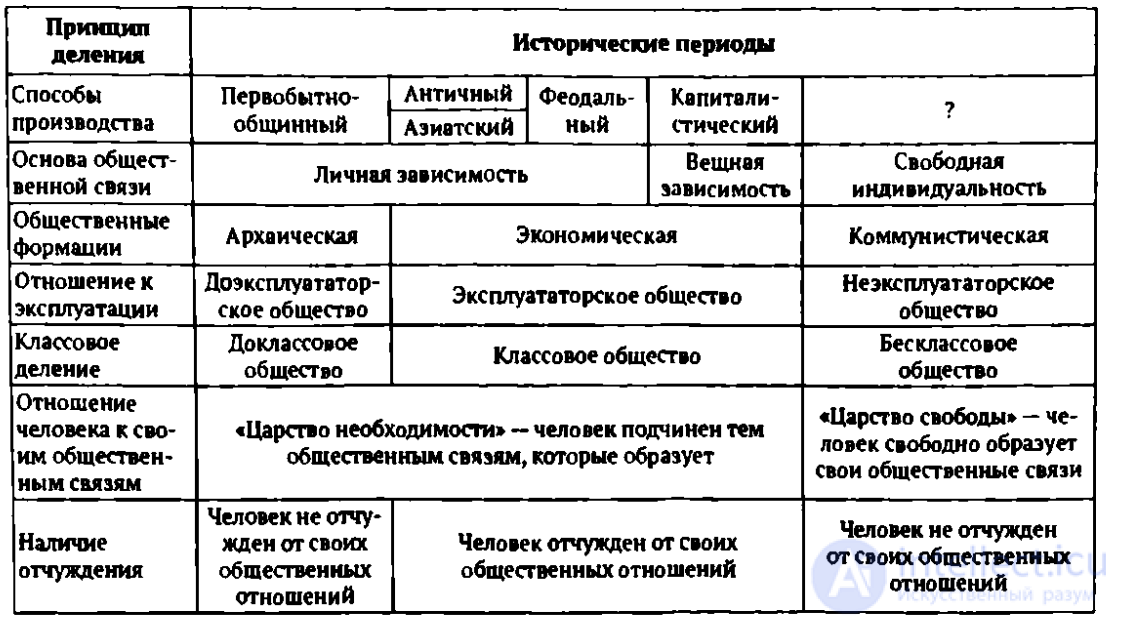
as the socialist (or communist) mode of production, which were widely used in Soviet "Marxism-Leninism." Lenin, incidentally, also
did not use these terms.
This is probably connected with the fact that the terms "socialism" and "communism" were introduced in Marxism not to characterize
modes of production, but to characterize, on the whole, the historical movement leading beyond the bounds of humanity's prehistory. As for the mode of production
that forms as a result of
the resolution of the contradictions of the capitalist mode of production, formulations such as "the comradely mode of production," "a free union of people working according to a common plan," and others were used to characterize it.
Many questions connected with the Asiatic mode
of production, and the boundary between the Asiatic
and feudal modes of production, are also debatable. Some researchers have put forward
suggestions that K. Marx, toward the end of
his life, abandoned the concept of the Asiatic
mode of production; however, although there are some grounds for such a claim,
this hypothesis does not yet have sufficiently convincing confirmation. Other researchers propose their own solution
to the question of the character of the mode of production in
a number of early exploitative societies (the bondage/servile mode of production, etc.).
On the attitude of Stalinist "Marxism-Leninism" toward Marx's concept of the Asiatic mode of production:
In the ideological doctrine of "Marxism-Leninism" that took shape in the USSR
under Stalin, there prevailed the assertion of a rigid mechanical sequence of modes of production in time — the so-called "five-stage scheme." According to the "five-stage scheme," history saw the successive replacement of five modes of production — primitive-communal, slaveholding, feudal, capitalist, and
socialist.
This approach crudely diverged both from classical Marxism and from historical facts. Apart from the fact that Marx never spoke of a "socialist"
or "slaveholding" mode of production, for him, I repeat once again, there also
existed no rigid sequence of modes of production that every society must
necessarily pass through in its historical development. It is precisely for this reason that
"Marxism-Leninism" denied, for example, the existence of the Asiatic mode of production, despite a mass of historical facts and Marx's own statements on this
matter. For this mechanistic, straight-line doctrine, it was impossible to admit the parallel existence of two different modes of production (the ancient and the
Asiatic), neither of which historically followed the other.
Such a mechanistic doctrine sought to bypass "inconvenient" facts, which demonstrated the possibility of a distinctive character in the course of
historical sequences of modes of production in many societies, and,
for all its "Eurocentrism," ignored many problems of the historical
development not only of non-European but also of a number of European societies.
One of the reasons for the sharply negative attitude of Stalinist "Marxism-Leninism" toward Marx's concept of the Asiatic mode of production was the desire to present the historical development of Russia as an almost typical case of transition
from feudalism to capitalism, and from it to socialism. After all, doubts about the classically
feudal (or, even more so, generally feudal) character of pre-capitalist
society in Russia cast doubt on assertions of the maturity of Russian capitalism, and thereby also on the concept of "building socialism in one, single
country" in its Russian variant.
For K. Marx it was obvious that there
does not exist a strictly defined sequence of modes of production that every society must pass through
from beginning to end. He stated quite
definitely that he had not created a "theory of a general path along which all peoples are fatefully
doomed to travel, whatever the
historical circumstances in which they
find themselves"1. Precisely because, in general, the dependence of social relations on the character of the relations of production and the level of development of the productive forces concerns any community of people,
historical development proceeds according to more complex regularities than a linear
progressive movement, occurring
in the same way for all societies,
despite the differences in the historical preconditions of their development.
In his letter to the editors of "Otechestvennye Zapiski"
and in his letter to Vera Zasulich, K. Marx
explained that his theoretical analysis
of the development of capitalism was relevant
1 Marx K. Letter to the Editors of "Otechestvennye
Zapiski" // Marx K., Engels F. Works, 2nd ed. Vol. 19. Moscow:
Gospolitizdat, 1961, p. 120.
only to the countries of Western Europe2 — or
to any other country which "has a tendency to become a capitalist nation on
the model of the nations of Western Europe," and that "once it finds itself within the bosom of the capitalist system,
it will be subject to its inexorable laws, like other profane nations"3.
Marx repeatedly emphasized that with
the development of capitalism, history fully
becomes world history, and
therefore it would be correct to consider
the development of modes of production not simply
as abstract economic systems, and not
as national economic systems, but
from a world-historical point of view. Framing the question this way brings us to the necessity, when analyzing the regularities of the historical development of modes of production,
not to confine ourselves to studying national
economic systems, but to study the totality of those international historical conditions under which such development takes place.
A certain step forward in this understanding of historical development was made by the school of the "world-systems" approach (Immanuel Wallerstein, Samir Amin, Giovanni Arrighi, Andre Gunder Frank, and others)1, while an attempt at a synthesis of the Marxist stadial conception of development with the world-systems approach
was undertaken by Yu. I. Semyonov2.
On K. Marx's forecast with respect to countries that had not yet embarked on the path of capitalist development (Russia, at the end of the 19th century, belonged to this group of countries):
But what if a nation has not yet embarked on the path of capitalist development? Is
this path then obligatory for it? K. Marx tried to find an answer to this question as well,
posing it and attempting to resolve it primarily with reference to Russia in the last third of the 19th century. In general, this answer amounted to the following: if the development of private property and the market did not have time to dissolve the archaic communal structures, then, should a revolution interrupt Russia's movement toward capitalism, Russian
society would be able to assimilate the achievements of the capitalist era by taking the commune as the starting point for the formation of a system of collective production, without having to traverse
the entire historical path of development of the capitalist mode of production3.
We see here, at the very least, two preconditions for the realization of such
a distinctive variant of development. The first is the existence of the possibility of carrying out a revolution oriented toward socialism; the second is the existence of the possibility of assimilating the achievements of capitalism. However, a question arose: did Russia in the 19th century (or any other country in a similar position) have sufficient internal
grounds for achieving these two preconditions? The answer would be categorical: no.
Both of these preconditions could only be borrowed from external, international conditions of historical development.
Consequently, for such a course of events to occur, there must exist, above all,
a readiness of the developed capitalist countries for a world socialist revolution.
Here it does not matter what exactly serves as the historical starting point of such a revolution — it could even be a revolution in a country with archaic communal structures. What matters is that, within a foreseeable historical perspective, the course of events should lead,
ultimately, to the development of a world socialist revolution.
In the reality of the late 19th century, such conditions did not exist (although K. Marx hoped for their presence). And when the Russian revolution did later break out, it did not
become the signal for a world revolution. Therefore Marx's position, as a concrete historical forecast, did not find confirmation. However, the question remains open: might this forecast not yet be realized under other conditions, when those
preconditions on which Marx pinned his hopes should indeed come to pass?
RELATIONS OF PRODUCTION - social relations among people that arise in the process of, and in connection with, the production of their own material life. The content of relations of production is objective (it does not depend on the will and consciousness of people), since it is determined by the given, existing level of development of the material conditions of production, that is, by the level of development of the productive forces of human society.
MODE OF PRODUCTION - a stage of development of social production, at the basis of which lies the contradictory interaction of productive forces of a historically determined level and character, and of the corresponding system of relations of production.
SOCIAL REVOLUTION - a qualitative leap in the entire system of social relations during the transition from one mode of production to another. When the old relations of production become an obstacle to the development of new productive forces, a social revolution occurs as a non-economic intervention in the economic order of society, leading to the destruction of outdated relations of production and their replacement by new relations of production that create the possibility for the rapid growth of the productive forces of society. On this basis a revolutionary transformation of the social superstructure also takes place.
PRODUCTION AS A SOCIAL PROCESS: social production appears simultaneously as the production of products of labor, and as the production of the social ties of people themselves, of human society itself (both from the point of view of its material conditions and from the point of view of its social conditions of life), or of socially determined man.
MATERIAL DEPENDENCE — a dependence determined by the role and place of a person in the production of things. The main form of this dependence is the relations of commodity production and the market as their surface expression. People's material dependence creates conditions for the rapid development of the productive forces in the pursuit of the accumulation of material wealth.
SOCIAL ALIENATION - the estrangement of people from one another, from the social ties they form, and from social processes and phenomena. It is expressed in setting people's social ties against them, as something alien, hostile, imposed on them. The most general cause of alienation lies in the contradictions of economic interests, especially those connected with the exploitation of labor. This leads not only to the estrangement of people from one another, but also to the fact that labor activity itself, its results, and the social relations that arise on the basis of this activity, appear as imposed on man from without,
alien to him
3.1. How is the subject matter of political economy defined in the narrow and in the broad sense of the word?
3.2. What is the objective character of relations of production, and how do they depend on the development of the productive forces?
3.3. What is a mode of production?
3.4. What are the results of the process of social production?
3.5. On what basis are the historical stages of the development of human society and the transitions from one stage to another formed?
3.6. What is a social revolution?
3.7. What is the relationship between formations and modes of production?
3.8. What are the shortcomings of a unidirectional-linear model of periodizing the historical process?
3.9. What is the fundamental difference between the Marxist formational and civilizational approaches to periodizing human history? Do they have any points of intersection?

Comments